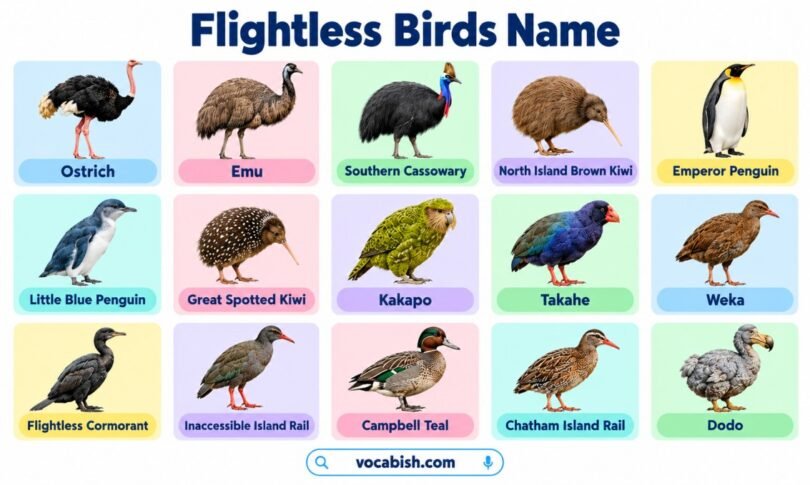

Flightless birds names in English include ostrich, penguin, emu, kiwi, cassowary, and rhea. These birds cannot fly, but they have special features that help them survive. Ostriches run fast on land, while penguins swim efficiently underwater. Emus and rheas are known for their strong legs and running ability. Kiwis are small birds with long beaks and limited eyesight. Learning the names of flightless birds helps children and English learners recognise different bird species, improve their vocabulary, and explore interesting facts about their habitats, physical features, and behaviour.
Here’s a complete guide on 200+ birds name and their types with pictures.
Common Flightless Birds Names with Their Pictures
The following list includes well-known flightless birds, their pictures, and short facts. These birds have different body shapes, habitats, diets, and ways of moving.

1. Ostrich
- The ostrich is the world’s largest living bird.
- It runs fast using its long, powerful legs.
- It lives mainly in African grasslands and open areas.

2. Penguin
- Penguins cannot fly but swim very well.
- Their wings work like flippers underwater.
- Most species live in the Southern Hemisphere.

3. Emu
- The emu is Australia’s tallest native bird.
- It has long legs and shaggy feathers.
- It can run quickly across open land.

4. Cassowary
- The cassowary is a large, powerful flightless bird.
- It has a helmet-like structure on its head.
- It lives in tropical forests around New Guinea and Australia.

5. Kiwi
- The kiwi is a small bird from New Zealand.
- It has tiny wings and a long beak.
- It usually searches for food at night.

6. Rhea
- The rhea is a large bird from South America.
- It has long legs and loose feathers.
- It runs across grasslands instead of flying.

7. Takahe
- The takahe is a large New Zealand rail.
- It has blue-green feathers and a red beak.
- It lives mainly in mountain grasslands.

8. Weka
- The weka is a brown bird from New Zealand.
- It has strong legs and a short beak.
- It searches for insects, seeds, and small animals.

9. Kakapo
- The kakapo is a large, flightless parrot.
- It has green feathers and a rounded body.
- It is active mainly at night.

10. Little Spotted Kiwi
- The little spotted kiwi is a small New Zealand bird.
- Its feathers look soft and hair-like.
- It feeds mainly on small invertebrates.

11. Inaccessible Island Rail
- This tiny rail lives on Inaccessible Island.
- It cannot fly despite having wings.
- It searches for insects and other small food.

12. Flightless Steamer Duck
- This duck lives along southern South American coasts.
- Its wings are too small for flight.
- It swims and feeds in coastal waters.
Types of Flightless Birds with Their Names
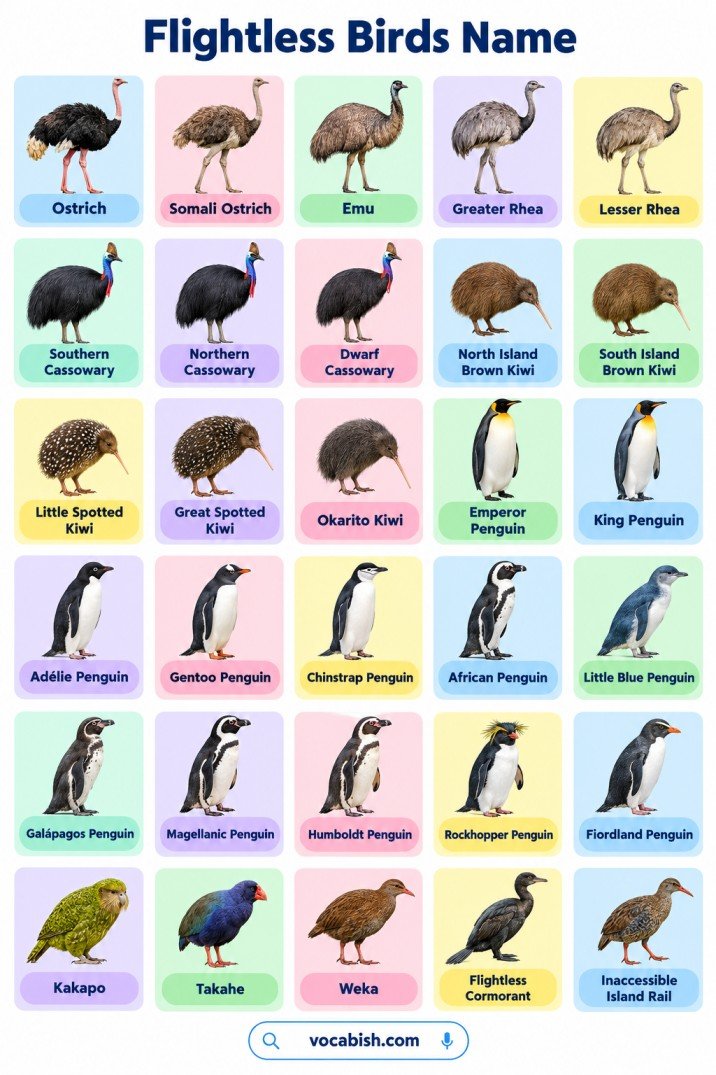
Flightless birds belong to several bird families. Some are large running birds, while others are small island birds or powerful swimmers.
Ratites
Ratites are a group of mostly large, flightless birds with reduced flight ability. Their classification and evolutionary relationships are more complex than the traditional group name suggests.
- Ostrich
- Emu
- Southern Cassowary
- Northern Cassowary
- Dwarf Cassowary
- Greater Rhea
- Lesser Rhea
- Darwin’s Rhea
- Brown Kiwi
- Great Spotted Kiwi
- Little Spotted Kiwi
- Okarito Kiwi
Penguins
Penguins are flightless seabirds with wings adapted for swimming underwater.
- Emperor Penguin
- King Penguin
- Adélie Penguin
- Chinstrap Penguin
- Gentoo Penguin
- African Penguin
- Humboldt Penguin
- Magellanic Penguin
- Galápagos Penguin
- Little Penguin
- Fiordland Penguin
- Snares Penguin
- Erect-crested Penguin
- Royal Penguin
- Macaroni Penguin
- Rockhopper Penguin
- Yellow-eyed Penguin
Flightless Rails and Other Island Birds
Several rails and other island birds have lost the ability to fly through evolution. Not all members of these groups are flightless.
- Takahe
- Weka
- Inaccessible Island Rail
- Guam Rail
- Lord Howe Woodhen
- Calayan Rail
- Samoan Moorhen
- Laysan Rail (extinct)
- Wake Island Rail (extinct)
- Hawaiian Rail (extinct)
- Chatham Rail (extinct)
- Okinawa Rail
- Kagu
- Flightless Coot
- Giant Coot
Flightless Parrots
– Kakapo
Flightless Ducks
– Flightless Steamer Duck
Flightless Birds by Habitat
Flightless birds live in different environments, from cold polar regions to tropical forests and open grasslands.
Grassland Birds
- Ostrich
- Emu
- Greater Rhea
- Lesser Rhea
- Darwin’s Rhea
- Takahe
Forest Birds
- Cassowary
- Kiwi
- Kakapo
- Weka
- Kagu
- Lord Howe Woodhen
Polar and Cold-Region Birds
- Emperor Penguin
- King Penguin
- Adélie Penguin
- Chinstrap Penguin
- Gentoo Penguin
- Macaroni Penguin
- Rockhopper Penguin
Island Birds
- Inaccessible Island Rail
- Guam Rail
- Takahe
- Kakapo
- Kiwi
- Flightless Steamer Duck
Extinct Flightless Birds
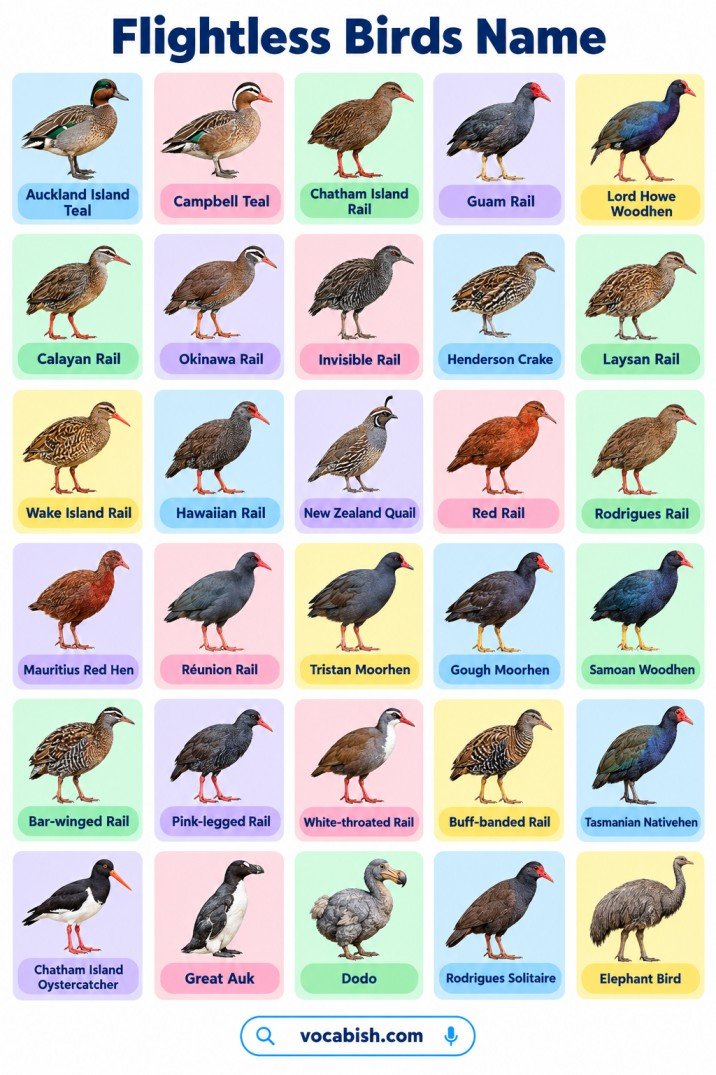
Many flightless birds once lived on islands and continents but disappeared because of habitat changes, hunting, introduced predators, or other environmental pressures.
- Dodo
- Rodrigues Solitaire
- Great Auk
- Elephant Bird
- Moa
- Haast’s Eagle’s prey included moa, but Haast’s eagle itself could fly
- Laysan Rail
- Wake Island Rail
- Hawaiian Rail
- Chatham Rail
- Broad-billed Parrot
- St. Helena Rail
- Ascension Crake
- New Zealand Quail
Important distinction: The dodo, great auk, elephant birds, and moa are well-known examples of extinct flightless birds. Haast’s eagle is not flightless and is included above only to clarify a common association with moa.
Why Can Some Birds Not Fly?
Flightless birds have evolved physical features that suit their environments and lifestyles.
- Small or reduced wings: Their wings cannot produce enough lift for flight.
- Strong legs: Many species use their legs for running, walking, or defence.
- Dense or waterproof feathers: Penguins use their feathers and body shape for swimming.
- Large bodies: Some species have bodies that make powered flight difficult.
- Island evolution: Some birds evolved without flight when flying was less necessary and ground-based living was advantageous.
Flightless Birds vs Flying Birds
Flightless birds and flying birds differ in body structure, movement, and the ways they find food.
Feature | Flightless Birds | Flying Birds |
|---|---|---|
Main movement | Walking, running, or swimming | Flying and walking |
Wings | Often reduced or adapted | Usually adapted for flight |
Legs | Often strong in running species | Vary by species |
Examples | Ostrich, kiwi, penguin | Eagle, sparrow, pigeon |
Habitat | Land, forests, islands, oceans | Many habitats worldwide |
Common Mistakes About Flightless Birds
- Penguins are not fish. They are birds that swim underwater.
- Not every island bird is flightless. Many island species can fly.
- Chickens are not fully flightless in every situation. Many can fly short distances.
- The great auk is extinct. It should not be confused with modern penguins.
- Not all birds with small wings are flightless. Flight ability depends on several physical features.
Flightless Birds Quiz
Test your knowledge of birds that cannot fly. Choose an answer, check your knowledge, and learn something new with every question.
Which bird is the largest living bird in the world?
Select one answer from the options below.
Review Your Answers
FAQs
Flightless birds are birds that cannot fly naturally. They may use their wings for swimming, balance, courtship, or other activities.
Common examples include the ostrich, penguin, emu, cassowary, kiwi, rhea, takahe, weka, and kakapo.
The ostrich is the largest living bird. It cannot fly but can run at high speeds across open ground.
The little blue penguin, also called the little penguin, is among the smallest living flightless birds.
No. Penguins cannot fly through the air, but their strong, flipper-like wings help them swim quickly underwater.
Chickens are not completely flightless in the strict sense. Many domestic chickens can fly short distances, although they rarely sustain flight.
Famous extinct flightless birds include the dodo, great auk, moa, elephant birds, Rodrigues solitaire, and several extinct island rails.
Some birds evolved flightlessness because flying became less necessary in their environments. Natural selection favoured other abilities, such as running or swimming.
Conclusion
Learning flightless birds name in English helps you recognise different bird species and expand your vocabulary. The ostrich, penguin, emu, cassowary, kiwi, rhea, and kakapo are well-known examples. Some flightless birds run across grasslands, others swim through the sea, and many live on islands. Their different adaptations show how birds survive in a wide range of environments.