
Have you ever seen birds disappear in one season and return months later? Migratory Birds Names help us identify these travellers and learn about bird migration, seasonal journeys, and the places birds visit to find food, warmer weather, and safe breeding grounds.
Migratory birds move from one region to another during particular seasons. Some travel thousands of kilometres, while others make shorter journeys. Swallows, Arctic terns, geese, cranes, and storks are well-known examples of migratory birds.
Here’s a complete guide to explore the 200+ types of birds with their names and pictures.
Common Migratory Birds Names with Their Pictures
Many familiar birds migrate when seasons change. Their journeys help them reach suitable feeding areas, breeding grounds, and warmer regions.
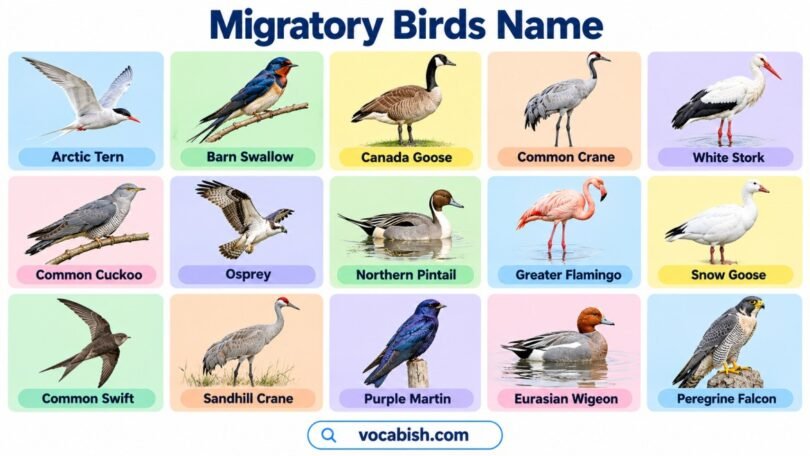
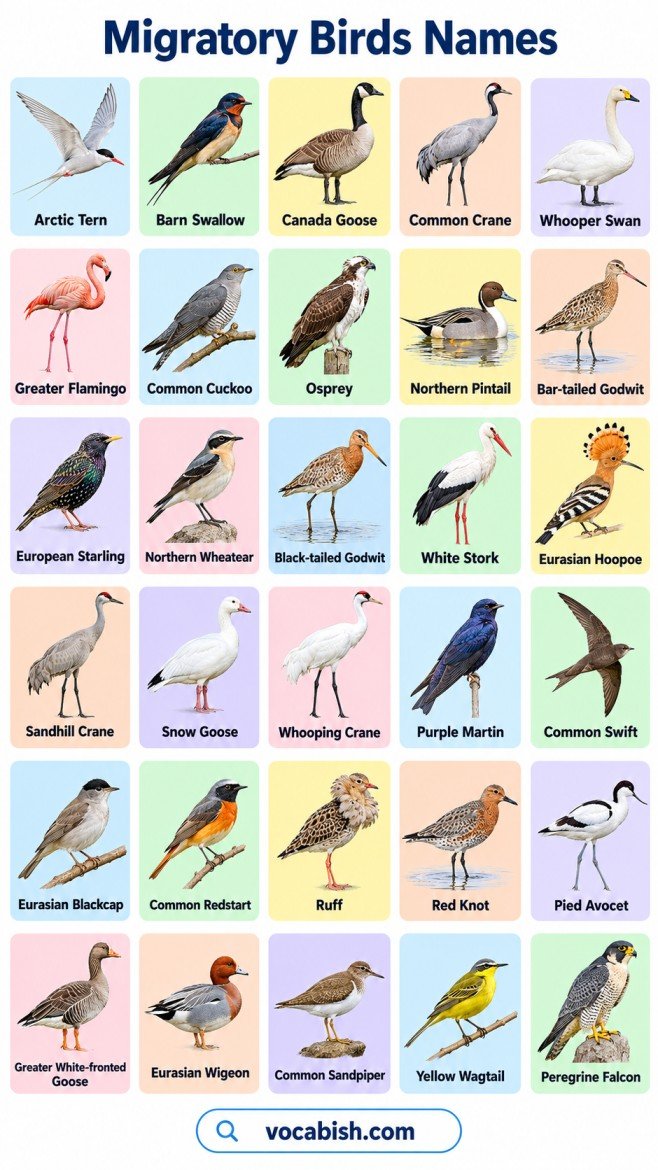
Here are common migratory birds names in English, with short facts and pictures to help you identify them.
- Arctic Tern: Arctic terns travel between polar regions each year.
- Barn Swallow: Barn swallows catch insects while flying over open land.
- Canada Goose: Canada geese migrate in noisy, V-shaped flocks.
- Common Crane: Common cranes travel between breeding and wintering grounds.
- Whooper Swan: Whooper swans migrate between northern and milder regions.
- Greater Flamingo: Greater flamingos move between wetlands as conditions change.
- Common Cuckoo: Common cuckoos migrate to warmer African wintering grounds.
- Osprey: Ospreys travel between breeding sites and fish-rich wintering areas.
- Northern Pintail: Northern pintails move between northern breeding and southern wetlands.
- Bar-tailed Godwit: Bar-tailed godwits make exceptionally long ocean-crossing migrations.
- European Starling: European starlings move south when northern winters become harsh.
- Northern Wheatear: Northern wheatears travel between Arctic breeding and African wintering grounds.
- Black-tailed Godwit: Black-tailed godwits migrate between wetlands across several continents.
- White Stork: White storks often travel to Africa for winter.
- Eurasian Hoopoe: Eurasian hoopoes migrate from colder regions to warmer areas.
- Sandhill Crane: Sandhill cranes gather in large flocks during migration.
- Snow Goose: Snow geese migrate south to find winter feeding grounds.
- Whooping Crane: Whooping cranes migrate between northern breeding and southern wintering areas.
- Purple Martin: Purple martins travel to South America during winter.
- Common Swift: Common swifts migrate between European summers and African winters.
- Blackcap: Blackcaps migrate to warmer regions when food becomes scarce.
- Common Redstart: Common redstarts breed in temperate regions and winter in Africa.
- Ruff: Ruffs migrate between northern breeding areas and southern wetlands.
- Red Knot: Red knots depend on coastal feeding sites during long journeys.
- Pied Avocet: Pied avocets move between wetlands as water conditions change.
- Greater White-fronted Goose: These geese travel between Arctic breeding and wintering grounds.
- Eurasian Wigeon: Eurasian wigeons migrate between northern lakes and southern wetlands.
- Common Sandpiper: Common sandpipers visit freshwater habitats during seasonal journeys.
- Yellow Wagtail: Yellow wagtails migrate between European breeding and African wintering areas.
- Peregrine Falcon: Some peregrine falcons travel thousands of kilometres seasonally.
Note: Migration varies by species and population. Some birds migrate long distances, while others remain in the same region throughout the year.
Types of Migratory Birds
Bird migration can be classified by the distance birds travel, the direction they move, and the seasonal patterns they follow.
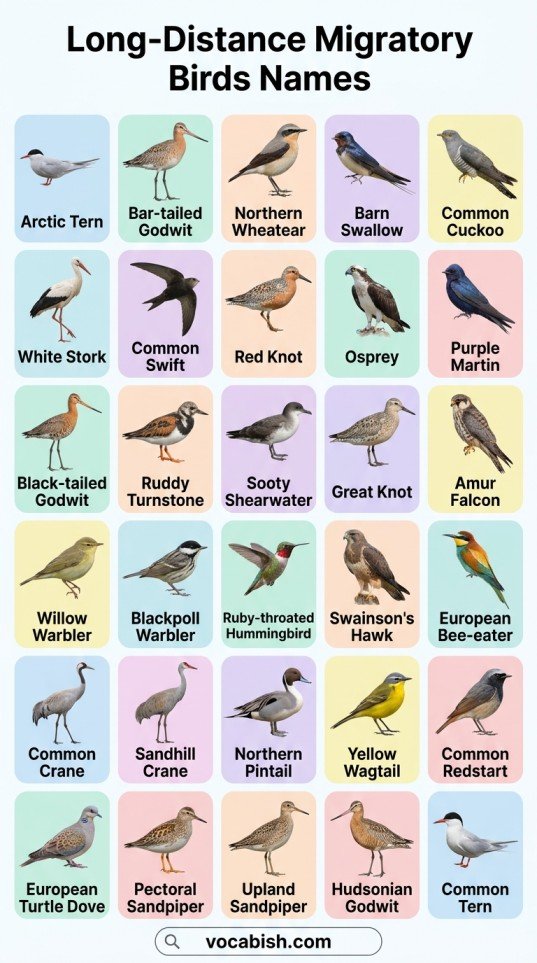
1. Long-Distance Migratory Birds
These birds travel between distant breeding and wintering regions, sometimes crossing continents or oceans.
- Arctic Tern
- Bar-tailed Godwit
- Northern Wheatear
- Barn Swallow
- Common Cuckoo
- White Stork
- Common Swift
- Red Knot
- Osprey
- Purple Martin
- Black-tailed Godwit
- Ruddy Turnstone
- Sooty Shearwater
- Great Knot
- Amur Falcon
2. Short-Distance Migratory Birds
These birds move shorter distances to find food, suitable temperatures, or better habitats.
- European Robin
- Eurasian Blackbird
- Common Starling
- Eurasian Wren
- Common Chaffinch
- Eurasian Skylark
- Great Tit
- Blue Tit
- Common Snipe
- Eurasian Jay
3. Partial Migrants
Some members of these species migrate, while others remain in their usual territories.
- European Robin
- Common Blackbird
- Eurasian Blackcap
- Song Thrush
- Common Chaffinch
- House Sparrow
- Eurasian Blue Tit
- Great Tit
- American Robin
- Northern Cardinal
4. Complete Migrants
These populations generally leave their breeding regions seasonally and return when conditions become suitable.
- Barn Swallow
- Common Cuckoo
- Common Swift
- Northern Wheatear
- Arctic Tern
- Purple Martin
- Yellow Wagtail
- Willow Warbler
- Blackpoll Warbler
- Ruby-throated Hummingbird
5. Altitudinal Migrants
These birds move between higher and lower elevations, often following seasonal changes in weather and food availability.
- Himalayan Monal
- White-capped Redstart
- Wallcreeper
- Alpine Chough
- Himalayan Griffon
- Snow Partridge
- Himalayan Snowcock
- Brown Dipper
- Alpine Accentor
- Yellow-billed Chough
Migratory Birds Names by Habitat
Migratory birds use different habitats for feeding, resting, breeding, and surviving the winter. Many species depend on several habitats during one journey.
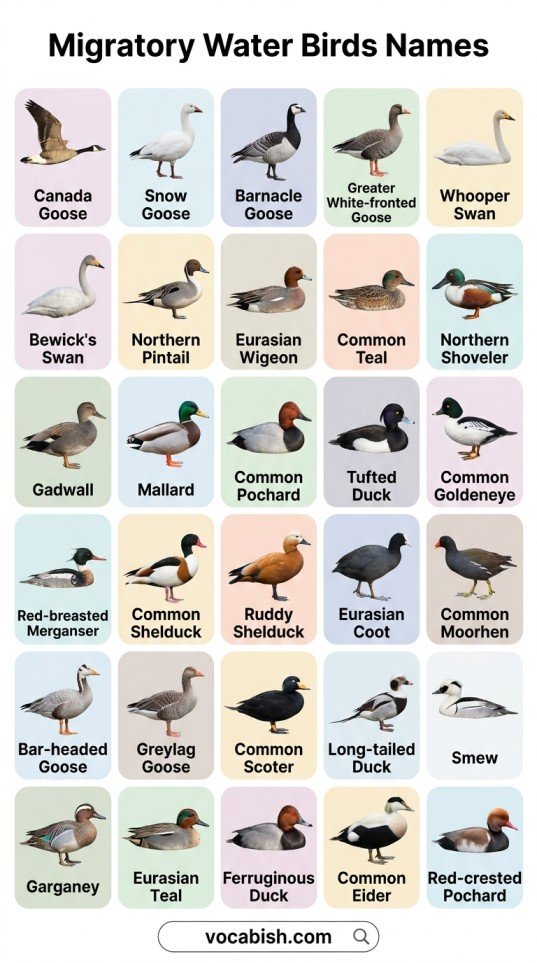
1. Migratory Water Birds
- Canada Goose
- Snow Goose
- Barnacle Goose
- Greater White-fronted Goose
- Whooper Swan
- Bewick’s Swan
- Northern Pintail
- Eurasian Wigeon
- Common Teal
- Northern Shoveler
- Gadwall
- Mallard
- Common Pochard
- Tufted Duck
- Common Goldeneye
- Red-breasted Merganser
- Common Shelduck
- Ruddy Shelduck
- Eurasian Coot
- Common Moorhen
2. Migratory Shorebirds
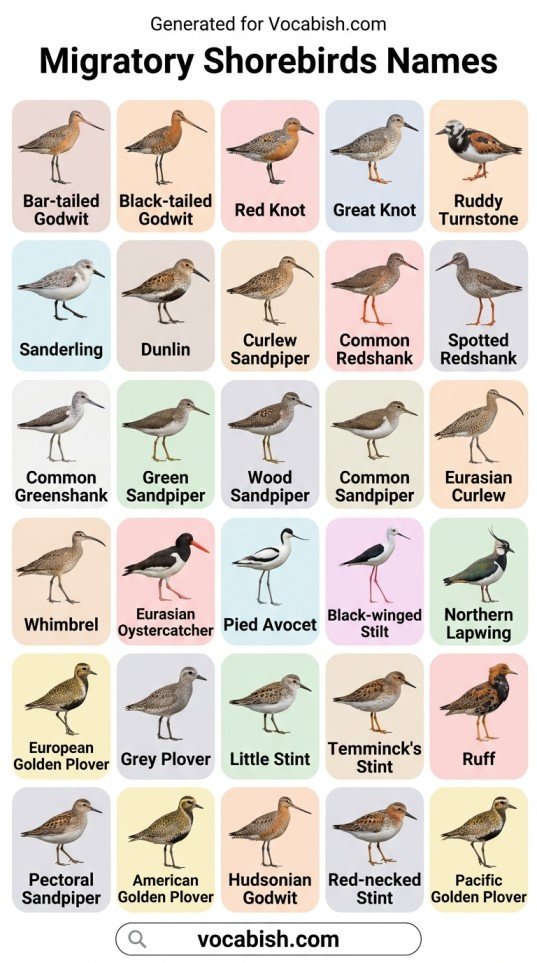
Shorebirds often feed along coastlines, mudflats, riverbanks, and shallow wetlands. Many undertake long seasonal journeys between breeding and feeding grounds.
- Bar-tailed Godwit
- Black-tailed Godwit
- Red Knot
- Great Knot
- Ruddy Turnstone
- Sanderling
- Dunlin
- Curlew Sandpiper
- Common Redshank
- Spotted Redshank
- Common Greenshank
- Green Sandpiper
- Wood Sandpiper
- Common Sandpiper
- Eurasian Curlew
- Whimbrel
- Eurasian Oystercatcher
- Pied Avocet
- Black-winged Stilt
- Northern Lapwing
- Golden Plover
- Grey Plover
- Little Stint
- Temminck’s Stint
- Ruff
3. Migratory Songbirds
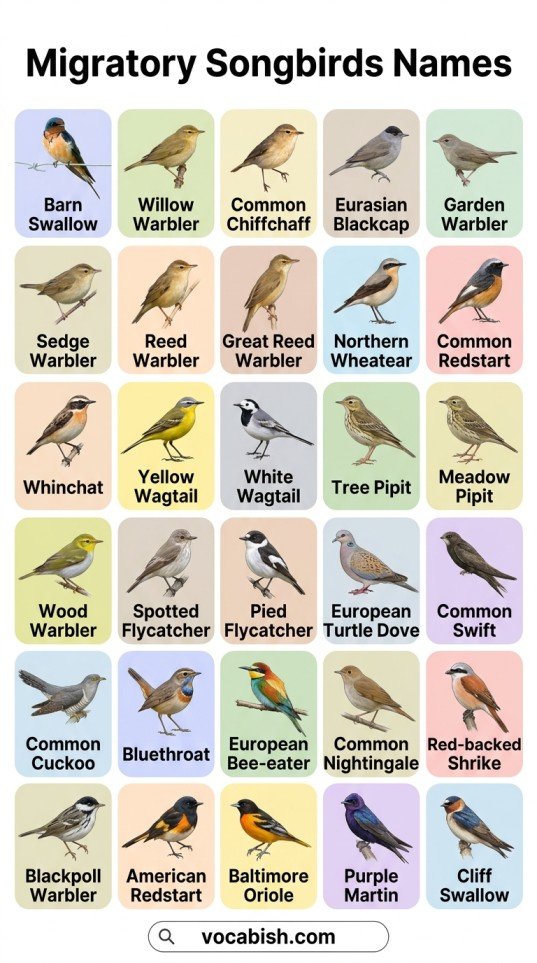
- Barn Swallow
- Common Swift
- Willow Warbler
- Common Chiffchaff
- Eurasian Blackcap
- Garden Warbler
- Sedge Warbler
- Reed Warbler
- Great Reed Warbler
- Northern Wheatear
- Common Redstart
- Whinchat
- Yellow Wagtail
- White Wagtail
- Tree Pipit
- Meadow Pipit
- Wood Warbler
- Spotted Flycatcher
- Pied Flycatcher
- European Turtle Dove
4. Migratory Birds of Prey
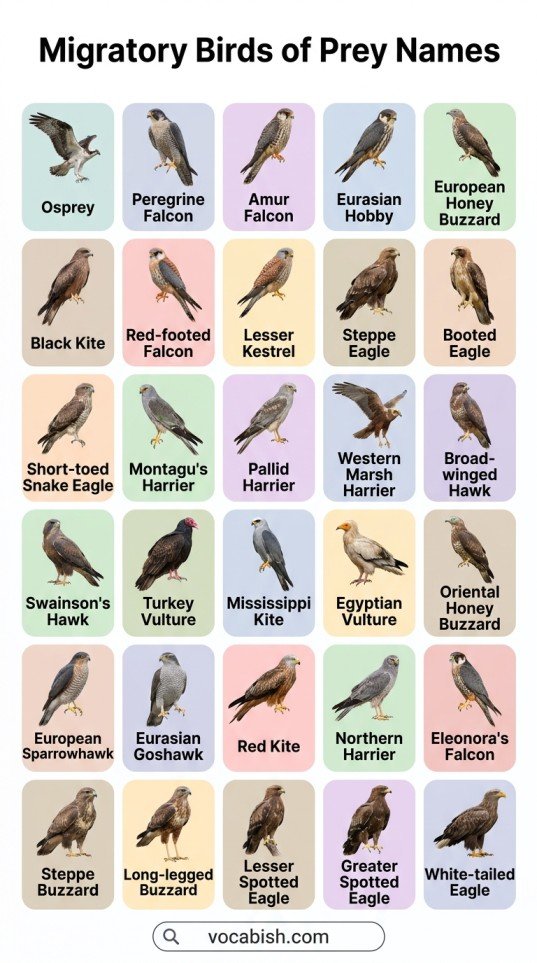
- Osprey
- Peregrine Falcon
- Amur Falcon
- Eurasian Hobby
- European Honey Buzzard
- Black Kite
- Red-footed Falcon
- Lesser Kestrel
- Steppe Eagle
- Booted Eagle
- Short-toed Snake Eagle
- Montagu’s Harrier
- Pallid Harrier
- Western Marsh Harrier
- Broad-winged Hawk
- Swainson’s Hawk
- Turkey Vulture
- Mississippi Kite
- Egyptian Vulture
- Oriental Honey Buzzard
5. Migratory Seabirds
- Arctic Tern
- Sooty Shearwater
- Manx Shearwater
- Cory’s Shearwater
- Great Shearwater
- Wilson’s Storm Petrel
- Northern Gannet
- Brown Skua
- Pomarine Jaeger
- Parasitic Jaeger
- Long-tailed Jaeger
- Sabine’s Gull
- Black-legged Kittiwake
- Franklin’s Gull
- Heermann’s Gull
- Sandwich Tern
- Roseate Tern
- Common Tern
- Black Tern
- Red-necked Phalarope
6. Migratory Wading Birds
- White Stork
- Black Stork
- Common Crane
- Sandhill Crane
- Demoiselle Crane
- Eurasian Spoonbill
- Black-faced Spoonbill
- Great Egret
- Little Egret
- Cattle Egret
- Grey Heron
- Purple Heron
- Glossy Ibis
- Eurasian Bittern
- Black-crowned Night Heron
- American White Pelican
- Great White Pelican
- Painted Stork
- Asian Openbill
- Wood Stork
Migratory Birds Names by Migration Distance
Not all migratory birds travel the same distance. Some move between nearby regions, while others cross oceans and continents.
Migration category | Examples |
|---|---|
Short-distance | European Robin, Common Blackbird, Common Chaffinch |
Medium-distance | Common Crane, Eurasian Wigeon, Northern Lapwing |
Long-distance | Barn Swallow, Common Cuckoo, Northern Wheatear |
Extreme long-distance | Arctic Tern, Bar-tailed Godwit, Sooty Shearwater |
These categories are approximate. Actual distances depend on the bird population, its starting location, and its destination.
Migratory Birds Names by Season
Birds often migrate in response to changing temperatures, food availability, daylight, and breeding needs. The timing varies across hemispheres and regions.
1. Birds That Migrate in Spring
- Barn Swallow
- Common Swift
- Common Cuckoo
- Willow Warbler
- Northern Wheatear
- Yellow Wagtail
- Common Redstart
- European Turtle Dove
- Osprey
- Common Tern
2. Birds That Migrate in Autumn
- Arctic Tern
- Barn Swallow
- Common Swift
- White Stork
- Common Cuckoo
- Northern Wheatear
- Yellow Wagtail
- Eurasian Wigeon
- Northern Pintail
- Common Crane
3. Birds That Migrate in Winter
These species may move into warmer regions or lower latitudes when their northern habitats become cold or food becomes harder to find.
- Snow Goose
- Canada Goose
- Whooper Swan
- Northern Pintail
- Eurasian Wigeon
- Common Redshank
- Eurasian Curlew
- Blackcap
- Common Chiffchaff
- Osprey
4. Birds That Migrate in Summer
Some birds travel to cooler northern regions during summer to breed and raise their young.
- Arctic Tern
- Barn Swallow
- Common Swift
- Common Cuckoo
- Northern Wheatear
- Yellow Wagtail
- Willow Warbler
- Common Crane
- White Stork
- Purple Martin
Migratory Birds Found Around the World
Migration occurs on every continent. The species seen in a region depend on its climate, location, wetlands, forests, and position along migration routes.
1. Migratory Birds in Asia
- Siberian Crane
- Demoiselle Crane
- Bar-headed Goose
- Amur Falcon
- Black-tailed Godwit
- Northern Pintail
- Common Cuckoo
- Oriental Honey Buzzard
- Rosy Starling
- Indian Pitta
- Bluethroat
- Ruddy Shelduck
- Greater Flamingo
- Eurasian Wigeon
- White Wagtail
2. Migratory Birds in Europe
- Barn Swallow
- Common Swift
- Common Cuckoo
- White Stork
- Common Crane
- Northern Wheatear
- Common Redstart
- Willow Warbler
- Eurasian Wigeon
- Northern Lapwing
- European Turtle Dove
- Osprey
- Common Tern
- Yellow Wagtail
- Eurasian Blackcap
3. Migratory Birds in Africa
- European Bee-eater
- Barn Swallow
- Common Cuckoo
- Northern Wheatear
- White Stork
- Osprey
- Willow Warbler
- Common Swift
- Yellow Wagtail
- Eurasian Hobby
- Amur Falcon
- Lesser Kestrel
- European Roller
- Steppe Eagle
- Sedge Warbler
4. Migratory Birds in North America
- Canada Goose
- Snow Goose
- Sandhill Crane
- Whooping Crane
- Ruby-throated Hummingbird
- Broad-winged Hawk
- Swainson’s Hawk
- American Robin
- Barn Swallow
- Purple Martin
- Blackpoll Warbler
- Red Knot
- Pectoral Sandpiper
- Northern Pintail
- American Golden Plover
5. Migratory Birds in South America
- Swainson’s Hawk
- Upland Sandpiper
- Hudsonian Godwit
- White-rumped Sandpiper
- Buff-breasted Sandpiper
- Pectoral Sandpiper
- American Golden Plover
- Barn Swallow
- Osprey
- Common Tern
- Arctic Tern
- Fork-tailed Flycatcher
- Cliff Swallow
- Yellow-billed Cuckoo
- Bobolink
6. Migratory Birds in Australia
- Sharp-tailed Sandpiper
- Red-necked Stint
- Eastern Curlew
- Bar-tailed Godwit
- Ruddy Turnstone
- Curlew Sandpiper
- Common Greenshank
- Pacific Golden Plover
- Latham’s Snipe
- Oriental Plover
- White-throated Needletail
- Fork-tailed Swift
- Eastern Osprey
- Little Tern
- Arctic Jaeger
7. Migratory Birds in Pakistan
Pakistan lies along important bird migration routes, particularly those used by waterbirds and birds travelling between Central Asia and the Indian subcontinent.
- Common Crane
- Demoiselle Crane
- Bar-headed Goose
- Greylag Goose
- Ruddy Shelduck
- Northern Pintail
- Eurasian Wigeon
- Common Teal
- Gadwall
- Common Pochard
- Greater Flamingo
- Black-tailed Godwit
- Eurasian Curlew
- Common Redshank
- Common Greenshank
- Osprey
- Steppe Eagle
- Western Marsh Harrier
- White Wagtail
- Barn Swallow
Seasonal occurrence differs between regions and years. Some birds are common winter visitors, while others appear mainly during passage migration.
Why Do Birds Migrate?
Birds migrate because conditions change throughout the year. Their journeys help them find suitable places to feed, reproduce, and survive.
The main reasons for bird migration include:
- Food availability: Birds move to places with more insects, fish, seeds, or other food.
- Breeding: Many birds travel to areas where nesting sites and food for chicks are available.
- Weather: Some birds leave regions where cold temperatures make survival harder.
- Daylight: Seasonal changes in daylight help trigger migration in many species.
- Habitat conditions: Drought, freezing wetlands, and changing water levels can encourage movement.
- Competition: Birds may travel to areas with more available food and nesting space.
Not every bird migrates because of cold weather. Some tropical birds move when rainfall changes or food becomes scarce.
How Do Migratory Birds Find Their Way?
Migratory birds use several natural signals to travel between breeding grounds and wintering areas. Different species rely on different combinations of these abilities.
- Sun compass: Some birds use the Sun’s position to help maintain direction.
- Star compass: Certain night migrants use patterns of stars for orientation.
- Earth’s magnetic field: Many birds can sense magnetic information that helps guide their journeys.
- Landmarks: Rivers, coastlines, mountains, and other visible features provide useful clues.
- Smell: Some seabirds use odours to help locate familiar places.
- Inherited routes: Young birds of some species follow migration directions partly guided by inherited behaviour.
- Experience: Older birds may learn routes and stopover sites through previous journeys.
Interesting Facts About Migratory Birds
Bird migration includes remarkable journeys, specialised behaviours, and impressive endurance.
- Arctic Terns: They travel between Arctic breeding areas and Antarctic waters.
- Bar-tailed Godwits: Some populations fly thousands of kilometres without stopping.
- Swallows: Many migrate between northern breeding regions and warmer southern areas.
- Cranes: Some cranes travel in large flocks and use soaring air currents.
- Geese: Many geese fly in V-shaped formations that can help reduce flight effort.
- Hummingbirds: Some Ruby-throated Hummingbirds cross the Gulf of Mexico.
- Sooty Shearwaters: They undertake extensive journeys across the world’s oceans.
- Storks: Many White Storks use rising warm air to soar efficiently.
- Shorebirds: Some depend on coastal mudflats to refuel during migration.
- Young birds: Some species can navigate their first migration without following experienced adults.
Common Confusions About Migratory Birds
- Migration versus local movement: Migration is usually a seasonal journey, not just daily movement.
- All birds migrate: Many bird species remain in the same region year-round.
- Every individual migrates: Some species have resident and migratory populations.
- Migration always means flying south: Birds may travel north, south, east, west, or between elevations.
- Migration distances are fixed: Routes and distances can differ between individuals and populations.
FAQs About Migratory Birds
Migratory birds are birds that travel from one region to another at particular times of the year to find food, breed, or survive changing conditions.
Common examples include Barn Swallow, Arctic Tern, Canada Goose, Common Crane, White Stork, Common Cuckoo, and Northern Pintail.
The Arctic Tern has one of the longest annual migrations, travelling between Arctic breeding areas and Antarctic waters.
Birds cross borders to reach suitable breeding grounds, find seasonal food supplies, avoid harsh weather, and access habitats that support survival.
Pakistan receives seasonal visitors such as Demoiselle Cranes, Common Cranes, Bar-headed Geese, Northern Pintails, and several species of shorebirds.
No. Some species migrate in large flocks, while others travel alone or in small groups, depending on their species and migration behaviour.
Birds respond to signals such as changing daylight, temperature, food availability, and internal biological rhythms that influence seasonal migration.
Resident birds usually stay in the same region throughout the year, while migratory birds travel seasonally between different areas.
Conclusion
Learning Migratory Birds Names helps you recognise birds from different habitats and understand their seasonal journeys. From the Arctic Tern and Bar-tailed Godwit to the Barn Swallow and Common Crane, each species follows its own migration pattern. Their movements reveal how birds respond to changing weather, food supplies, and breeding needs around the world.