
Baby animal names are special words used for the young of different animals. A baby dog is a puppy, a baby cat is a kitten, and a baby horse is a foal. Other common names include calf, lamb, cub, chick, fawn, joey, and pup. These words are useful for building English vocabulary and talking about pets, farm animals, birds, wildlife, and sea animals. This list of baby animal names includes common animals, wild species, birds, mammals, reptiles, amphibians, and water animals with their young names.
Common Baby Animal Names with Their Pictures
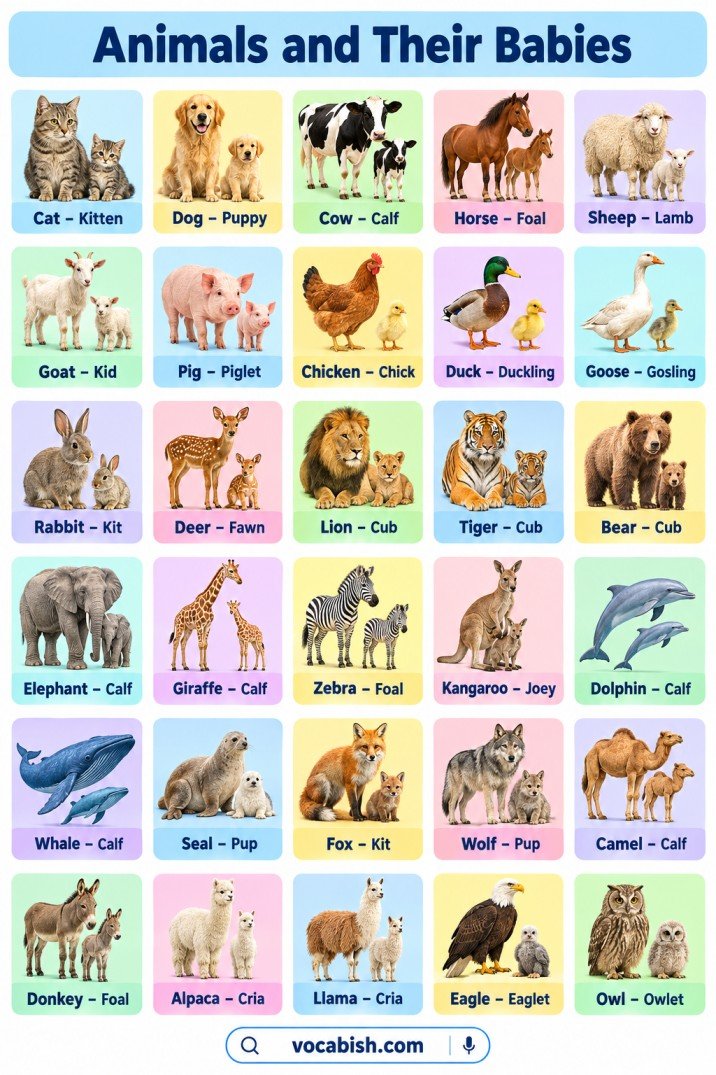
Here are some of the most common baby animal names with pictures to help you recognize each young animal and remember its English name.
1. Cat — Kitten
A baby cat is called a kitten. Kittens are born very small and depend on their mother for warmth, milk, and protection. They gradually develop stronger legs, sharper senses, and the ability to explore. The word kitten is one of the most common young-animal words in English.
2. Dog — Puppy
A baby dog is called a puppy. Puppies are born with their eyes and ears closed and rely heavily on their mother during their first weeks. They grow quickly and begin walking, playing, and exploring as they develop. The word puppy is used for young dogs of many breeds.
3. Cow — Calf
A baby cow is called a calf. A calf drinks its mother’s milk and gradually begins eating grass and other food. Calves can stand and walk soon after birth. Calf is also used for the young of several other large mammals.
4. Horse — Foal
A baby horse is called a foal. A foal can stand and walk not long after birth. A male foal may later be called a colt, while a female foal may be called a filly. The general word foal applies to young horses regardless of sex.
5. Sheep — Lamb
A baby sheep is called a lamb. Lambs usually stay close to their mothers for food and protection. They are covered with soft wool that becomes thicker as they grow. Lamb is also commonly used when talking about the meat of a young sheep.
6. Goat — Kid
A baby goat is called a kid. This word can be confusing because kid also means a child in informal English. A newborn goat can stand and move soon after birth. Kids usually remain close to their mothers while they develop.
7. Pig — Piglet
A baby pig is called a piglet. Piglets are usually born in groups called litters. They nurse from their mother and grow rapidly during their early weeks. Their striped or spotted patterns in some breeds can help make them easy to recognize.
8. Chicken — Chick
A baby chicken is called a chick. Chicks hatch from eggs and are covered with soft down rather than adult feathers. They stay near the mother hen for warmth and protection. Chick is also used more broadly for the young of many birds.
9. Duck — Duckling
A baby duck is called a duckling. Ducklings hatch from eggs and are usually covered with soft down. They can often walk and swim soon after hatching. They commonly follow their mother closely when moving through water or on land.
10. Goose — Gosling
A baby goose is called a gosling. Goslings hatch from eggs and are covered with soft down. They usually stay close to their parents while growing. The word gosling is specifically associated with young geese.
11. Rabbit — Kit
A baby rabbit is commonly called a kit or kitten. Newborn rabbits are very small and are born with little or no fur, depending on their development stage. They remain in a nest and depend on their mother for care. Kit is the more specific animal term.
12. Deer — Fawn
A baby deer is called a fawn. Young fawns are often born with spots that help them blend into their surroundings. They spend much of their early life resting quietly while their mother searches for food. The word fawn is widely used for young deer.
13. Lion — Cub
A baby lion is called a cub. Lion cubs are born with soft fur and often have spots that fade as they mature. They stay with their mothers and gradually learn how to move and interact with the pride. Cub is also used for the young of several other large mammals.
14. Tiger — Cub
A baby tiger is called a cub. Tiger cubs are born with their characteristic striped coats. They depend on their mother for food and protection during their early months. As they grow, they develop the hunting skills needed for independent life.
15. Bear — Cub
A baby bear is called a cub. Bear cubs are generally born very small compared with their adult mothers. They remain dependent on the mother while developing strength and coordination. Different bear species have cubs with different sizes and appearances.
16. Elephant — Calf
A baby elephant is called a calf. Elephant calves are born after a very long pregnancy and can usually stand shortly after birth. They remain close to their mothers and other members of the herd. Young elephants learn many behaviors by watching older elephants.
17. Giraffe — Calf
A baby giraffe is called a calf. A newborn giraffe is already large and can stand and walk soon after birth. Its long legs and neck develop as it grows. The mother keeps the calf close while it becomes stronger and more independent.
18. Zebra — Foal
A baby zebra is called a foal. Like young horses, zebra foals can stand and walk shortly after birth. Their striped coats help them blend visually with other zebras in a herd. A foal remains close to its mother during its early development.
19. Kangaroo — Joey
A baby kangaroo is called a joey. Joeys are born at a very early stage of development and continue growing inside their mother’s pouch. They gradually become stronger before spending more time outside the pouch. Joey is also used for the young of several other marsupials.
20. Monkey — Infant
A young monkey can be called an infant. Some species may also have species-specific or informal terms, but infant is widely understood. Young monkeys usually remain close to their mothers and learn important behaviors through observation and play. Their development varies greatly between species.
21. Dolphin — Calf
A baby dolphin is called a calf. Dolphin calves are born in water and must quickly learn to swim beside their mothers. The mother helps the calf reach the surface for breathing. Young dolphins remain dependent on their mothers while developing hunting and social skills.
22. Whale — Calf
A baby whale is called a calf. Whale calves are born in the water and must swim soon after birth. They receive milk from their mothers and grow rapidly. Depending on the species, a calf may remain with its mother for months or years.
23. Seal — Pup
A baby seal is called a pup. Seal pups are born on land or ice, depending on the species. They receive rich milk from their mothers while they develop their swimming abilities. Their thick coats provide protection from cold conditions in many species.
24. Fox — Kit
A baby fox is commonly called a kit, kitten, or cub. Fox kits are born in a den and depend on their parents for food and protection. Their eyes remain closed for a period after birth. As they grow, they begin exploring outside the den.
25. Wolf — Pup
A baby wolf is called a pup. Wolf pups are born in dens and depend on adult wolves for food and protection. They begin exploring their surroundings as they become stronger. Young wolves also learn social behavior by interacting with members of their pack.
26. Camel — Calf
A baby camel is called a calf. Camel calves can stand and walk relatively soon after birth. They stay close to their mothers while developing strength and learning to move through their environment. Both one-humped and two-humped camels have calves.
27. Donkey — Foal
A baby donkey is called a foal. A male young donkey may be called a colt, while a female may be called a filly. Foals stay close to their mothers during early development. The general term foal is used for young donkeys as well as young horses.
28. Alpaca — Cria
A baby alpaca is called a cria. Crias are born with a soft coat and can usually stand and walk soon after birth. They remain close to their mothers as they grow. The same term is also commonly used for young llamas.
29. Llama — Cria
A baby llama is called a cria. Crias develop quickly and are able to stand and walk soon after birth. They stay near adult llamas for protection and social learning. The term is also used for young alpacas.
30. Owl — Owlet
A baby owl is called an owlet. Owlets hatch from eggs and initially depend on their parents for food and warmth. They develop feathers and gradually become capable of flying. Young owls remain under parental care until they are ready to live more independently.
You may also like 100+ Animal Sounds in English with Sounds
Baby Animal Names by Farm Animals
Here’s a list of young animal names commonly associated with animals raised on farms.
- Cow — Calf
- Horse — Foal
- Donkey — Foal
- Mule — Foal
- Sheep — Lamb
- Goat — Kid
- Pig — Piglet
- Chicken — Chick
- Duck — Duckling
- Goose — Gosling
- Turkey — Poult
- Pigeon — Squab
- Rabbit — Kit
- Guinea pig — Pup
- Alpaca — Cria
- Llama — Cria
- Buffalo — Calf
- Yak — Calf
- Reindeer — Calf
Read more: Farm Animals Name with Pictures
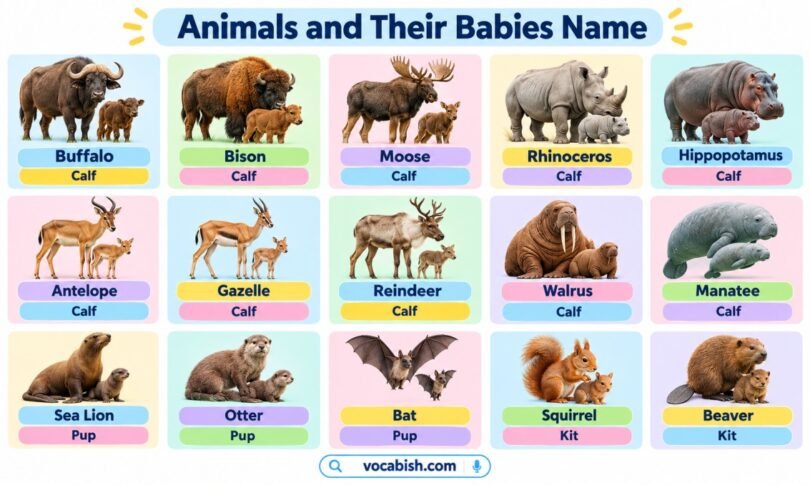
Baby Animal Names by Wild Animals
The following section covers names used for the young of wild animals found in different habitats.
- Lion — Cub
- Tiger — Cub
- Leopard — Cub
- Jaguar — Cub
- Cheetah — Cub
- Bear — Cub
- Wolf — Pup
- Fox — Kit
- Hyena — Cub
- Otter — Pup
- Seal — Pup
- Walrus — Calf
- Elephant — Calf
- Giraffe — Calf
- Rhinoceros — Calf
- Hippopotamus — Calf
- Zebra — Foal
- Deer — Fawn
- Moose — Calf
- Elk — Calf
- Antelope — Calf
- Gazelle — Calf
- Bison — Calf
- Kangaroo — Joey
- Koala — Joey
- Wombat — Joey
- Opossum — Joey
- Panda — Cub
- Sloth — Pup
- Squirrel — Kit
- Hedgehog — Hoglet
- Porcupine — Porcupette
- Mole — Pup
- Bat — Pup
- Chimpanzee — Infant
- Gorilla — Infant
- Orangutan — Infant
Baby Animal Names by Birds
This list includes the special terms used for young birds and newly hatched birds.
- Eagle — Eaglet
- Owl — Owlet
- Swan — Cygnet
- Goose — Gosling
- Duck — Duckling
- Chicken — Chick
- Turkey — Poult
- Peacock — Peachick
- Pigeon — Squab
- Dove — Squab
- Pheasant — Chick
- Quail — Chick
- Partridge — Chick
- Penguin — Chick
- Flamingo — Chick
- Ostrich — Chick
- Emu — Chick
- Parrot — Chick
- Sparrow — Chick
- Robin — Chick
- Crow — Chick
- Raven — Chick
- Hawk — Eyas
- Falcon — Eyas
- Heron — Chick
- Pelican — Chick
- Seagull — Chick
- Woodpecker — Chick
- Hummingbird — Chick
- Canary — Chick
Baby Animal Names by Mammals
Young mammal names are grouped here according to the terms commonly used for their offspring.
- Aardvark — Cub
- Antelope — Calf
- Badger — Cub
- Beaver — Kit
- Bison — Calf
- Camel — Calf
- Capybara — Pup
- Chimpanzee — Infant
- Cougar — Cub
- Deer — Fawn
- Elephant — Calf
- Giraffe — Calf
- Gorilla — Infant
- Hamster — Pup
- Hare — Leveret
- Hedgehog — Hoglet
- Hippopotamus — Calf
- Jaguar — Cub
- Kangaroo — Joey
- Koala — Joey
- Leopard — Cub
- Lion — Cub
- Mole — Pup
- Monkey — Infant
- Moose — Calf
- Panda — Cub
- Polar bear — Cub
- Rabbit — Kit
- Rat — Pup
- Rhinoceros — Calf
- Skunk — Kit
- Squirrel — Kit
- Tiger — Cub
- Walrus — Calf
- Weasel — Kit
- Whale — Calf
- Wolf — Pup
- Zebra — Foal
Baby Animal Names by Reptiles and Amphibians
Below are the names used for the young and early life stages of reptiles and amphibians.
- Alligator — Hatchling
- Crocodile — Hatchling
- Turtle — Hatchling
- Tortoise — Hatchling
- Lizard — Hatchling
- Snake — Hatchling
- Cobra — Hatchling
- Python — Hatchling
- Iguana — Hatchling
- Gecko — Hatchling
- Chameleon — Hatchling
- Frog — Tadpole
- Toad — Tadpole
- Salamander — Larva
- Newt — Larva
- Komodo dragon — Hatchling
- Sea turtle — Hatchling
- Caiman — Hatchling
Baby Animal Names by Sea and Water Animals
This section brings together the terms used for young animals that live in oceans, rivers, lakes, and other aquatic environments.
- Dolphin — Calf
- Whale — Calf
- Seal — Pup
- Walrus — Calf
- Sea lion — Pup
- Manatee — Calf
- Dugong — Calf
- Otter — Pup
- Shark — Pup
- Ray — Pup
- Eel — Elver
- Salmon — Fry
- Trout — Fry
- Fish — Fry
- Seahorse — Fry
- Jellyfish — Ephyra
- Crab — Zoea
- Lobster — Larva
- Shrimp — Larva
- Oyster — Spat
- Mussel — Larva
- Octopus — Larva
- Squid — Paralarva
- Clam — Larva
Baby Animal Names by Insects and Small Creatures
Here you’ll find the names used for young insects, spiders, and other small creatures.
- Butterfly — Caterpillar
- Moth — Caterpillar
- Bee — Larva
- Ant — Larva
- Beetle — Grub
- Fly — Maggot
- Mosquito — Larva
- Dragonfly — Nymph
- Grasshopper — Nymph
- Cricket — Nymph
- Cockroach — Nymph
- Termite — Nymph
- Aphid — Nymph
- Ladybug — Larva
- Flea — Larva
- Wasp — Larva
- Spider — Spiderling
- Scorpion — Scorpling
- Tick — Larva
- Mite — Larva
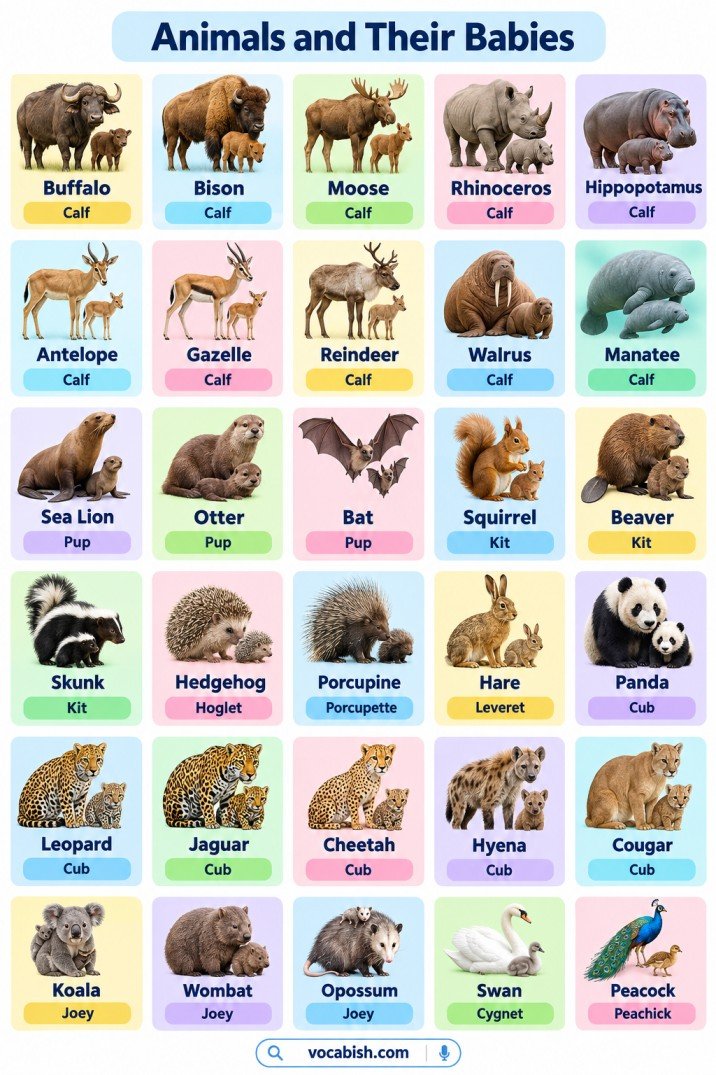
Baby Animal Names: Quick Reference Table
Adult Animal | Baby Animal Name |
|---|---|
Cat | Kitten |
Dog | Puppy |
Cow | Calf |
Horse | Foal |
Sheep | Lamb |
Goat | Kid |
Pig | Piglet |
Chicken | Chick |
Duck | Duckling |
Goose | Gosling |
Rabbit | Kit |
Deer | Fawn |
Lion | Cub |
Tiger | Cub |
Bear | Cub |
Elephant | Calf |
Giraffe | Calf |
Zebra | Foal |
Kangaroo | Joey |
Dolphin | Calf |
Whale | Calf |
Seal | Pup |
Fox | Kit |
Wolf | Pup |
Camel | Calf |
Donkey | Foal |
Alpaca | Cria |
Llama | Cria |
Eagle | Eaglet |
Swan | Cygnet |
Baby Animal Names: Common Confusions
- Kid means a young goat, but it can also mean a child in everyday English.
- Calf is used for young cows and also for several large mammals, including elephants, whales, giraffes, and dolphins.
- Foal means a young horse, donkey, or zebra; colt and filly specify a young male or female horse or related equine.
- Cub is used for the young of many mammals, including lions, tigers, bears, foxes, and pandas.
- Chick commonly means a young bird, while some birds have more specific names such as eaglet, owlet, and gosling.
How to Use Baby Animal Names in Sentences
You can use these words in short English sentences:
- The kitten is sleeping.
- The puppy is playing in the garden.
- The calf is drinking milk.
- The foal is walking beside its mother.
- The lamb is standing near the sheep.
- The duckling is swimming in the pond.
- The lion cub is resting with its mother.
- The kangaroo joey is inside its mother’s pouch.
- The eaglet is waiting for food.
- The fawn is hiding in the grass.
Baby Animal Names Practice
Choose the correct name for each baby animal and test your animal vocabulary.
What is a baby dog called?
Practice Complete!
Answer Review
FAQs
A baby animal is usually called a young animal, but many species have special names such as kitten, puppy, calf, cub, foal, and chick.
A baby dog is called a puppy. Puppies depend on their mother during their early development and gradually learn to walk, play, and explore.
A baby cat is called a kitten. The word kitten is used for young cats before they reach adulthood.
A baby horse is called a foal. A young male is called a colt, while a young female is called a filly.
A baby cow is called a calf. The word calf is also used for the young of several other large mammals.
A baby lion is called a cub. Lion cubs stay with their mothers and gradually develop the skills needed to live with the pride.
A baby kangaroo is called a joey. It develops inside its mother’s pouch after being born at a very early stage.
A baby deer is called a fawn. Many fawns have spotted coats that provide camouflage during their early months.
Conclusion
Baby animal names add many useful words to English vocabulary. Common examples include kitten, puppy, calf, foal, lamb, kid, piglet, chick, duckling, cub, fawn, joey, pup, and eaglet.
Knowing these names makes it easier to describe animals, read children’s stories, talk about wildlife, and write accurate English sentences. Learning the special name for each young animal also makes animal vocabulary more precise and interesting.