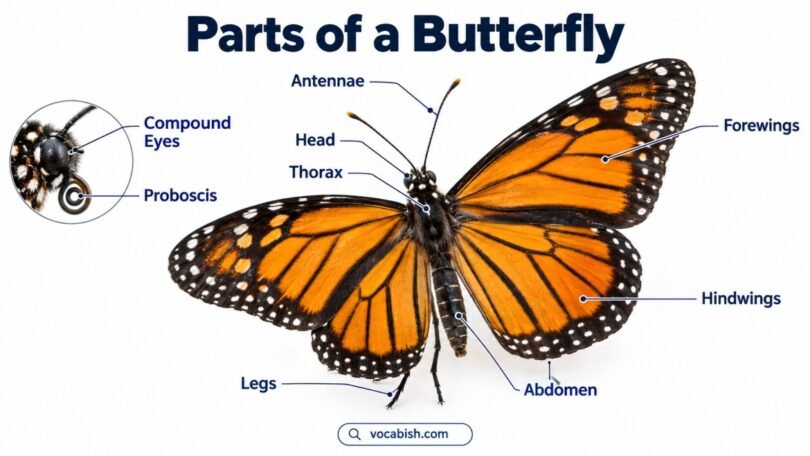

Parts of a butterfly include three main body regions: the head, thorax, and abdomen. A butterfly also has two antennae, two compound eyes, six legs, four wings, and a proboscis for drinking nectar. Each body part has a different function that helps the butterfly move, feed, sense its surroundings, or survive.
Learning butterfly anatomy helps students identify these structures and use their correct English names. The labeled butterfly diagram shows where the main parts are located, while the explanations describe their meanings and functions. You will also learn the differences between forewings and hindwings, how butterflies breathe, and how to use these vocabulary words in sentences.
Parts of a Butterfly with Names and Meanings
A butterfly has several external body parts that work together. Some help it fly, while others help it find food, detect movement, and breathe. Here are the main butterfly body parts with their meanings.
- Head: Front body region containing eyes and feeding structures.
- Thorax: Middle body region where wings and legs attach.
- Abdomen: Rear body region containing several important internal organs.
- Antennae: Two sensory structures that detect scents and signals.
- Compound Eyes: Large eyes that detect light, colours, and movement.
- Proboscis: Long, flexible feeding tube used to drink liquids.
- Forewings: Front pair of wings that help with flight.
- Hindwings: Rear pair of wings that support controlled flight.
- Legs: Six jointed appendages used for walking and gripping.
- Spiracles: Small breathing openings found along the butterfly’s body.
These names describe the main external structures of an adult butterfly. Some are large and easy to see, while others require a closer look.
Parts of a Butterfly Diagram
A labeled butterfly diagram helps you identify the location of each body part. The head is at the front, the thorax is in the middle, and the abdomen extends behind it. The wings and legs connect to the thorax.
Main butterfly anatomy diagram — identify the head, thorax, abdomen, antennae, compound eyes, proboscis, forewings, hindwings, and legs.
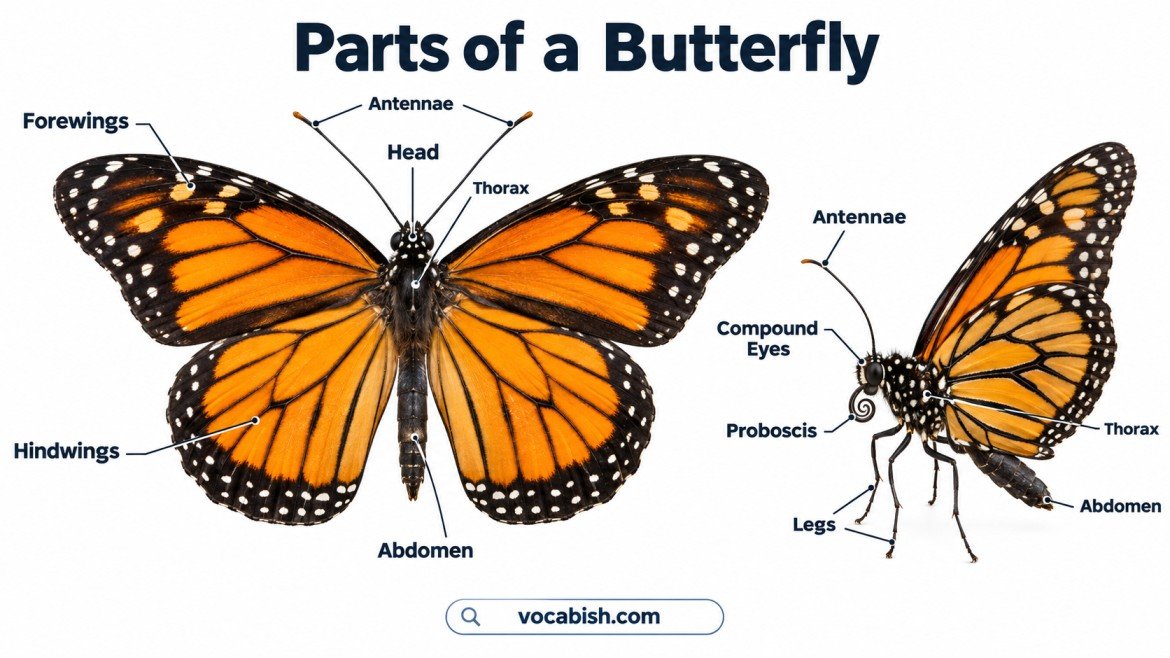
When studying the diagram, first locate the three body regions. Then identify the smaller structures attached to them. The forewings are closer to the head, while the hindwings are positioned behind them.
Three Main Body Parts of a Butterfly
Like other insects, a butterfly has three main body regions. Each region contains structures that perform particular functions.
Body Part | Location | Main Function |
|---|---|---|
Head | Front | Sensing surroundings and feeding |
Thorax | Middle | Supporting wings and legs |
Abdomen | Rear | Housing digestive and reproductive organs |
Head
The head is the front part of a butterfly’s body. It contains two compound eyes, two antennae, and the mouthparts that form the proboscis.
The head helps the butterfly detect food, recognise movement, and respond to its surroundings. Its sensory organs are particularly important when the butterfly searches for flowers.
Thorax
The thorax is the middle section between the head and abdomen. It has three segments and supports all six legs and four wings.
Strong flight muscles inside the thorax move the wings. These muscles allow the butterfly to take off, remain airborne, and change direction.
Abdomen
The abdomen is the long rear section of a butterfly’s body. It contains much of the digestive system, reproductive organs, and other internal structures.
The abdomen also contains breathing openings called spiracles. Its flexible segments allow movement while protecting the organs inside.
Parts of a Butterfly’s Head
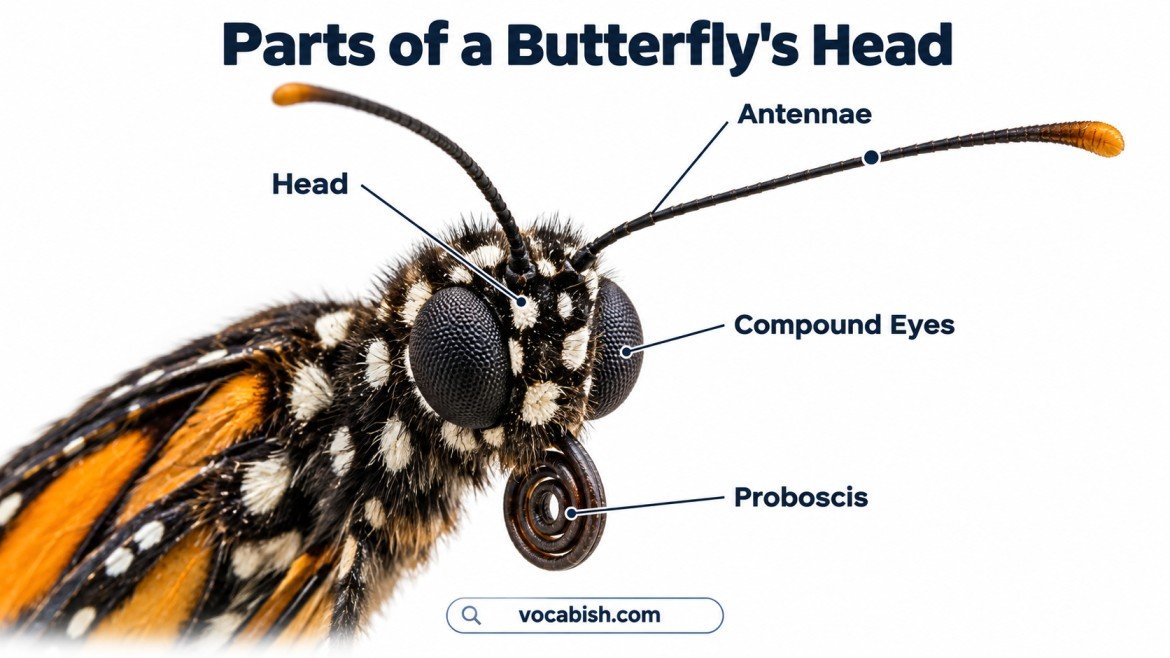
The butterfly’s head contains important sensory and feeding structures. These parts help it detect scents, see its surroundings, and drink liquids from flowers.
Antennae
Antennae are two slender sensory structures that extend from the butterfly’s head. Many butterflies have antennae with slightly enlarged or club-shaped tips.
They contain sensory receptors that help detect chemical signals, including scents associated with food and potential mates.
Butterflies also use their antennae to sense other environmental information.
The singular form is antenna, while the plural form is antennae.
Compound Eyes
Compound eyes are the two large eyes on the sides of a butterfly’s head. Each eye contains many tiny visual units called ommatidia.
These units work together to detect light, colours, and movement. Compound eyes help butterflies navigate, locate flowers, and notice approaching animals.
Many butterflies can also detect ultraviolet light, which humans cannot see.
Proboscis
The proboscis is a long, flexible feeding tube that extends from the butterfly’s head. It works like a drinking straw, allowing the butterfly to take in nectar and other liquids.
When a butterfly is not feeding, its proboscis usually curls into a spiral beneath its head.
During feeding, the butterfly uncoils the proboscis and places its tip into a flower to take up nectar.
Parts of a Butterfly’s Wings
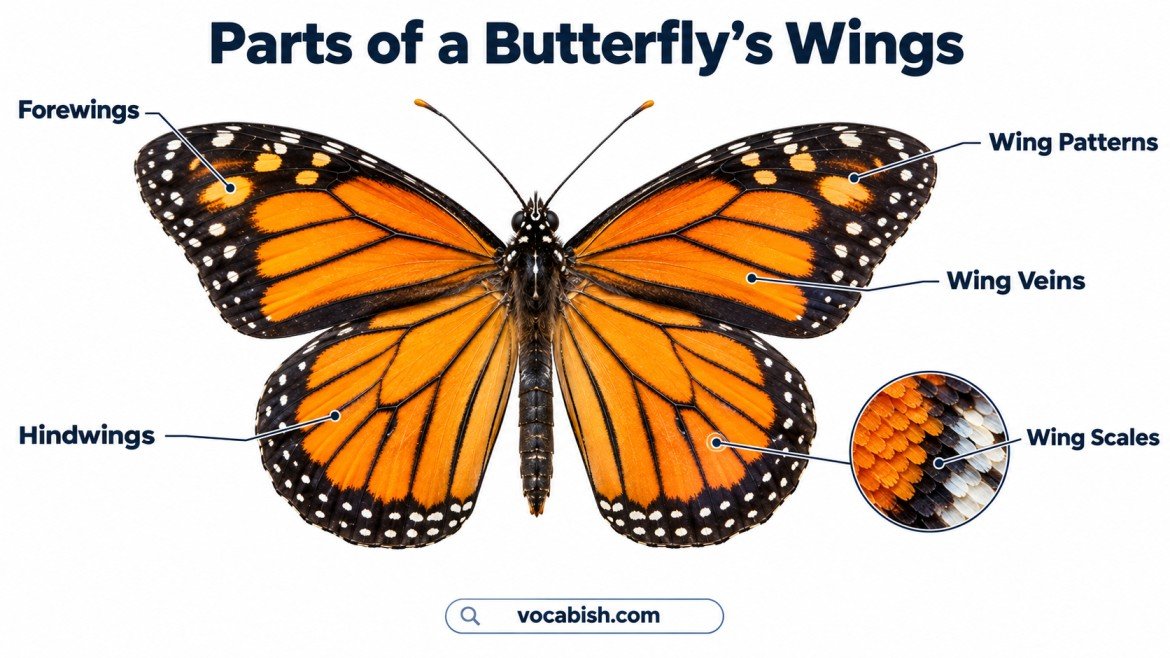
A butterfly has four wings attached to its thorax. These wings form two pairs: the forewings and hindwings. They work together to produce lift, control movement, and support flight.
Forewings and Hindwings
The forewings and hindwings differ mainly in their positions.
Wing Part | Location | Function |
|---|---|---|
Forewings | Front pair, closer to the head | Help produce lift and control flight |
Hindwings | Rear pair, behind the forewings | Support lift, stability, and manoeuvring |
Forewings are the front pair of wings. They are often larger than the hindwings and play an important role in flight.
Hindwings are the rear pair. They move together with the forewings and help the butterfly control its movement through the air.
Wing shapes vary among butterfly species, so the two pairs do not always look alike.
Wing Veins, Scales, and Patterns
Butterfly wings contain several structures that support flight and create their appearance.
- Wing Veins: Provide support and carry nerves and other tissues.
- Wing Scales: Tiny overlapping structures covering much of the wings.
- Wing Patterns: Coloured markings that may help with protection or communication.
Butterfly wings are covered with thousands of tiny scales. These scales produce many of the colours and patterns visible on the wings.
Some patterns help butterflies blend into their surroundings, while others may warn predators or help butterflies recognise members of their own species.
Parts of a Butterfly’s Legs
Butterflies have six legs arranged in three pairs. All three pairs attach to the thorax, although some butterflies have reduced front legs that are not used for ordinary walking.
Forelegs, Middle Legs, and Hind Legs
The three pairs of legs are named according to their positions on the thorax.
Leg Part | Location | Main Function |
|---|---|---|
Forelegs | Front pair | Walking or sensory functions, depending on species |
Middle Legs | Middle pair | Walking and gripping surfaces |
Hind Legs | Rear pair | Supporting movement and gripping surfaces |
Each typical insect leg contains several connected segments that allow it to bend and move.
Butterflies use their legs to stand on flowers, grip leaves, and move across surfaces. Many species also have taste receptors on their feet that help them detect chemicals on plants.
In some butterfly families, particularly brush-footed butterflies, the front legs are reduced. These butterflies may appear to have only four walking legs, although they still possess six legs.
Butterfly Abdomen and Breathing Parts
The abdomen is the rear section of a butterfly’s body. It contains important internal organs and forms part of the insect’s breathing system.
Unlike humans, butterflies do not have lungs. Instead, air enters through small openings called spiracles and travels through branching air tubes.
The main structures associated with the abdomen include:
- Abdominal Segments: Connected sections that allow the abdomen to bend.
- Spiracles: Small openings through which air enters and leaves.
- Digestive Organs: Internal structures that process food and absorb nutrients.
- Reproductive Organs: Internal structures involved in producing offspring.
- Exoskeleton: Protective outer covering that supports the body.
Spiracles occur on the thorax as well as the abdomen. They connect to air tubes called tracheae, which carry gases through the body.
The exoskeleton covers the butterfly’s entire body, not just its abdomen.
Functions of Butterfly Body Parts
Each butterfly body part performs a particular job. The following table provides a quick reference to the names and main functions of these structures.
Body Part | Main Function |
|---|---|
Head | Holds sensory organs and feeding structures |
Thorax | Supports movement through wings and legs |
Abdomen | Contains digestive and reproductive organs |
Antennae | Detect scents and other sensory signals |
Compound Eyes | Detect light, colours, and movement |
Proboscis | Takes in nectar and other liquids |
Forewings | Help produce lift and control flight |
Hindwings | Support flight and manoeuvring |
Legs | Help with walking and gripping |
Spiracles | Allow air to enter and leave the breathing system |
Wing Veins | Support the structure of the wings |
Wing Scales | Contribute to wing colours and patterns |
Butterfly Body Parts and Their English Sentences
Learning the names of butterfly body parts is easier when you use them in sentences. These examples show how anatomical words appear in natural English.
- The butterfly has two long antennae on its head.
- Its colourful wings move as it flies.
- A butterfly uses its proboscis to drink nectar.
- The thorax connects the wings and legs.
- The butterfly’s abdomen is behind its thorax.
- Its compound eyes help it detect movement.
- The butterfly rests its legs on a flower.
- Each forewing is positioned in front of a hindwing.
- Tiny scales cover much of the butterfly’s wings.
- Small spiracles allow air to enter the breathing system.
Notice how singular and plural words change in English. We say one wing but two wings, and one antenna but two antennae.
Common Butterfly Anatomy Words That Learners Confuse
Some butterfly anatomy terms sound similar or describe structures close to each other. These distinctions can help you identify them correctly.
- Head vs. Thorax: The head contains the eyes and mouthparts, while the thorax supports the wings and legs.
- Forewing vs. Hindwing: A forewing belongs to the front pair, while a hindwing belongs to the rear pair.
- Antenna vs. Proboscis: An antenna detects sensory information, while the proboscis takes in liquids.
- Antenna vs. Antennae: Antenna is singular; antennae is plural.
- Wings vs. Wing Scales: Wings are flight structures, while scales are tiny structures covering their surfaces.
FAQs About Butterfly Body Parts
The seven taxonomic ranks are kingdom, phylum, class, order, family, genus, and species. Butterflies belong to Animalia, Arthropoda, Insecta, and Lepidoptera.
The middle part of a butterfly is called the thorax. It connects the head and abdomen and supports the wings and legs.
Butterflies have three body regions, six legs, four wings, two antennae, compound eyes, a proboscis, wing scales, an exoskeleton, complete metamorphosis, and a tracheal breathing system.
The tube on a butterfly’s head is called the proboscis. It is a long, flexible feeding structure used to drink nectar and other liquids.
A butterfly has four wings arranged in two pairs. The front pair is called the forewings, and the rear pair is called the hindwings.
Butterflies have six legs attached to their thorax. In some species, the front legs are reduced, making only four walking legs easily visible.
Butterflies use their antennae to detect scents and other environmental signals. These sensory structures help them locate food and potential mates.
Conclusion
The main parts of a butterfly are the head, thorax, and abdomen. Other important structures include antennae, compound eyes, a proboscis, four wings, six legs, and spiracles. Each part helps the butterfly sense its surroundings, feed, move, or breathe.
By studying the labeled diagram and practising these English names, you can identify butterfly body parts and explain their functions using accurate vocabulary.