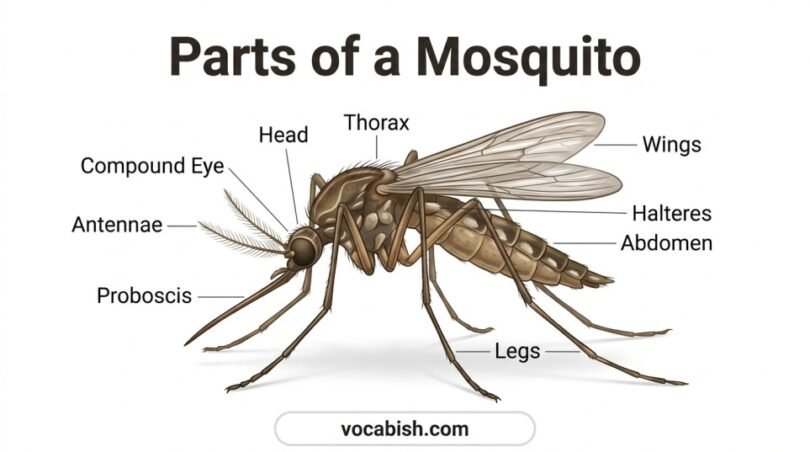

The parts of a mosquito include the head, thorax, abdomen, antennae, proboscis, wings, and six legs. Each part performs a specific function that helps the mosquito sense its surroundings, feed, move, and reproduce. The head contains sensory organs and mouthparts, the thorax supports the wings and legs, and the abdomen houses many digestive and reproductive organs. Understanding mosquito parts and their functions helps you identify the insect’s body structure and learn useful biology vocabulary. This article explains the names of the main body parts, their functions, the differences between male and female mosquitoes, and how to identify these structures in a labelled mosquito diagram.
Main Body Parts of a Mosquito
A mosquito has a slender body divided into three main sections. These sections contain the structures it needs to sense its environment, feed, fly, and reproduce.
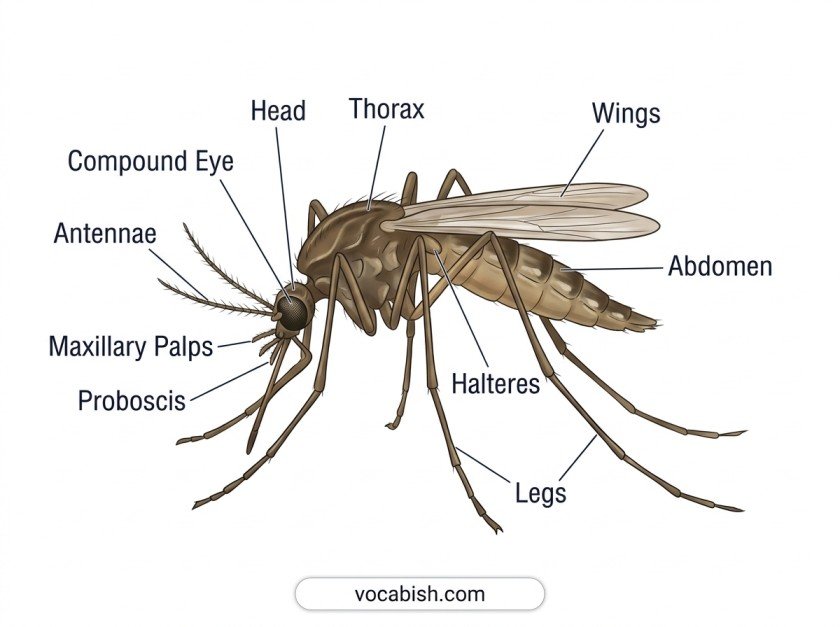
The three main body sections are:
- Head: Contains the eyes, antennae, palps, and mouthparts.
- Thorax: Supports the wings and three pairs of legs.
- Abdomen: Contains much of the digestive and reproductive systems.
These sections are connected to form the mosquito’s body. Although they work together, each section has a different role.
Parts of a Mosquito and Their Functions
The following table lists the main mosquito parts, their locations, and their functions. It includes the external structures most useful for identifying a mosquito and understanding how it lives.
Mosquito Part | Location | Function |
|---|---|---|
Head | Front of the body | Holds the eyes, antennae, and mouthparts. |
Thorax | Middle of the body | Supports the wings and legs. |
Abdomen | Rear of the body | Contains digestive and reproductive organs. |
Compound eyes | Head | Detect movement and visual information. |
Antennae | Head | Detect smells, air movement, and other environmental signals. |
Palps | Near the mouth | Help detect chemical signals and assess feeding cues. |
Proboscis | Front of the head | Acts as an elongated feeding structure. |
Labrum | Within the proboscis | Helps form the food canal used during feeding. |
Mandibles | Within the female mosquito’s mouthparts | Help penetrate skin during blood feeding. |
Maxillae | Within the proboscis | Help support penetration during blood feeding. |
Hypopharynx | Within the proboscis | Delivers saliva into the feeding site. |
Labium | Outer covering of the proboscis | Supports and protects the piercing mouthparts. |
Thoracic muscles | Thorax | Power wing movements during flight. |
Wings | Thorax | Enable flight and help the mosquito move between locations. |
Halteres | Behind the wings | Help maintain balance during flight. |
Legs | Attached to the thorax | Support walking, landing, and resting. |
Tarsi | Ends of the legs | Provide contact with surfaces during landing and walking. |
Spiracles | Along the body | Allow air to enter and leave the respiratory system. |
Tracheae | Inside the body | Carry air directly to body tissues. |
Digestive tract | Mainly within the abdomen | Processes food and absorbs nutrients. |
Malpighian tubules | Near the digestive tract | Remove waste and help regulate water and salts. |
Ovaries | Female abdomen | Produce eggs. |
Testes | Male abdomen | Produce sperm. |
Cerci | Rear end of the female abdomen | Help with sensory functions around egg laying. |
Not every mosquito part is visible from the outside. Structures such as the mandibles, ovaries, and tracheae are internal or partly hidden.
Parts of a Mosquito Head
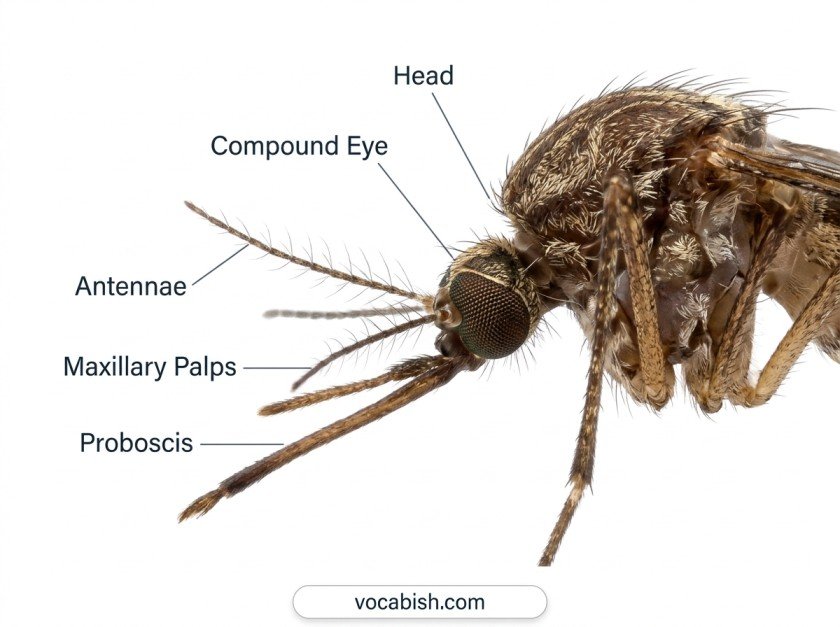
The mosquito’s head contains the sensory organs and mouthparts it uses to find food and interact with its environment. Several structures are visible under magnification, while others lie inside the proboscis.
1. Compound Eyes
Mosquitoes have two large compound eyes made up of many small visual units. These eyes help them detect movement and respond to visual signals in their surroundings.
2. Antennae
A mosquito has two antennae on its head. These sensory structures help detect smells and other signals. Male mosquitoes usually have much bushier antennae than females, helping them detect the sound of female wingbeats.
3. Maxillary Palps
Maxillary palps are paired sensory appendages located near the proboscis. Their length and appearance vary among mosquito species and sexes. They help detect chemical cues associated with potential food sources.
4. Proboscis
The proboscis is the long, narrow mouthpart extending from the head. Female mosquitoes of blood-feeding species use it to obtain blood, while both males and females can feed on plant sugars.
The proboscis is not a single hollow needle. It contains several specialized structures that work together during feeding.
5. Labium
The labium forms the outer sheath around the piercing mouthparts. During blood feeding, it bends back as the other structures enter the skin.
6. Labrum
The labrum is part of the internal mouthpart arrangement. It helps form the food canal through which blood is drawn during feeding.
7. Mandibles and Maxillae
These slender structures are part of the female mosquito’s piercing mouthparts. They help penetrate the skin and stabilize the feeding process.
8. Hypopharynx
The hypopharynx contains the salivary canal. It allows saliva to pass into the feeding site, where substances in the saliva help the mosquito feed.
Wings and Legs of a Mosquito
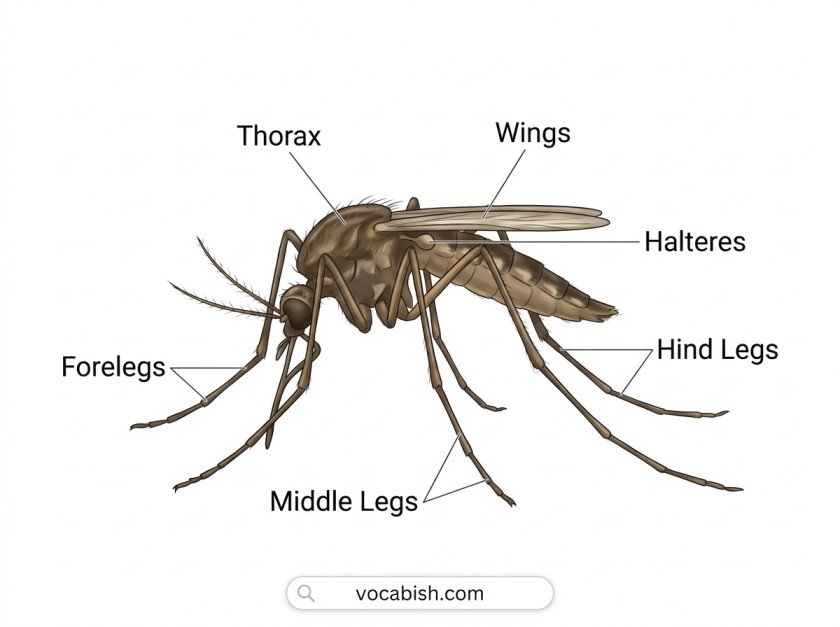
A mosquito’s thorax supports its wings and six legs. These structures allow the insect to fly, land, walk, and rest on surfaces.
Wings
Adult mosquitoes have one pair of functional wings. Their wings are narrow, delicate, and covered with small scales in many species.
Mosquitoes beat their wings rapidly to generate lift and move through the air. Wing movements also produce the familiar buzzing sound.
Halteres
Halteres are small, knob-shaped balancing organs located behind the wings. They help mosquitoes sense body rotation and maintain control during flight.
Six Legs
Mosquitoes have three pairs of legs attached to the thorax. Their long, slender legs help them land on skin, rest on walls, and move across surfaces.
Each leg has several sections, including the femur, tibia, and tarsus.
Leg Part | Description | Function |
|---|---|---|
Coxa | First section near the body | Connects the leg to the thorax. |
Trochanter | Small section after the coxa | Connects the coxa and femur. |
Femur | Long section of the leg | Provides structural support and leverage. |
Tibia | Section between the femur and tarsus | Supports leg movement. |
Tarsus | Foot-like end section | Helps the mosquito contact surfaces. |
Parts of a Mosquito Diagram
A labelled mosquito diagram makes it easier to identify the insect’s body sections and external structures. A side-view illustration is especially useful because it shows how the head, thorax, abdomen, wings, and legs connect.
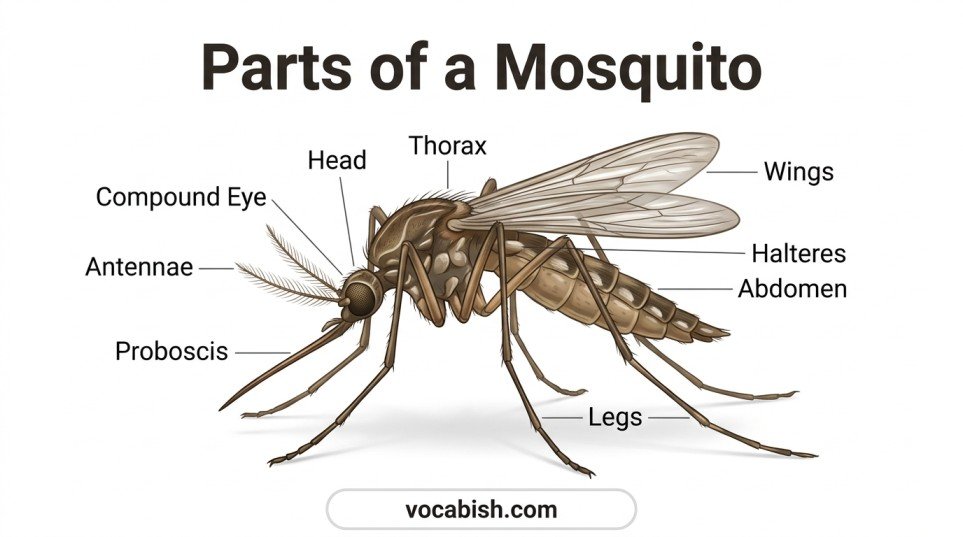
When studying a Parts of an Mosquito Diagram, look for these major labels:
- Head: The front section containing the eyes and mouthparts.
- Thorax: The middle section supporting the legs and wings.
- Abdomen: The segmented rear section.
- Antennae: The paired sensory structures on the head.
- Proboscis: The elongated mouthpart used for feeding.
- Wings: The structures used for flight.
- Legs: The six appendages used for movement and landing.
- Spiracles: Small openings involved in breathing.
Male and Female Mosquito Parts
Male and female mosquitoes share the same basic body plan, but certain structures differ in appearance and function. These differences can help identify the sex of an adult mosquito.
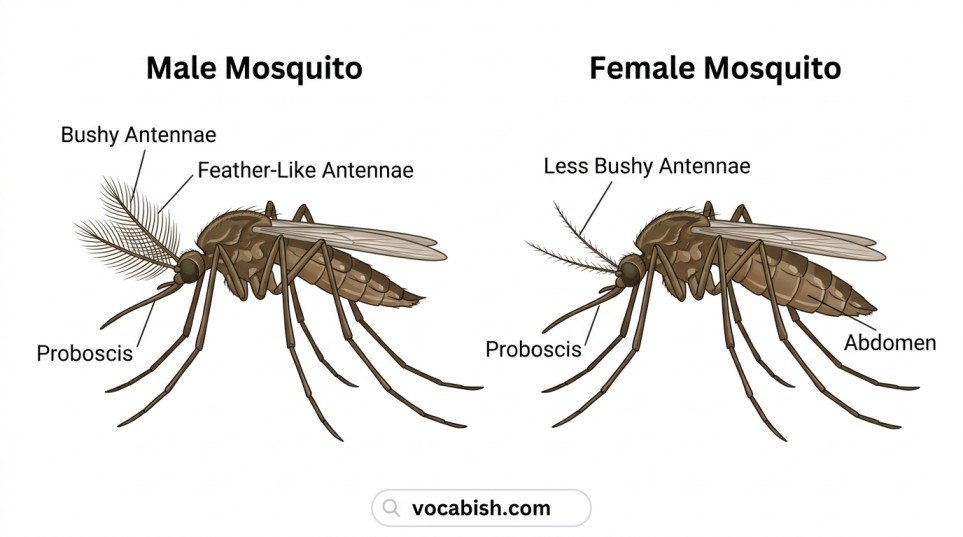
Feature | Male Mosquito | Female Mosquito |
|---|---|---|
Antennae | Usually bushy and feathery | Usually less bushy |
Proboscis | Used mainly for plant sugars | Used for plant sugars and blood in blood-feeding species |
Palps | Often long in many species | Length varies by species |
Reproductive organs | Contains testes | Contains ovaries |
Main reproductive role | Produces sperm | Produces eggs |
Blood feeding | Does not take blood meals | Many species take blood meals to support egg development |
Important: Not all female mosquitoes bite people. Blood-feeding habits vary by species, and some mosquitoes feed on other animals. Both males and females commonly obtain energy from nectar and other plant sugars.
Different Types of Mosquitoes
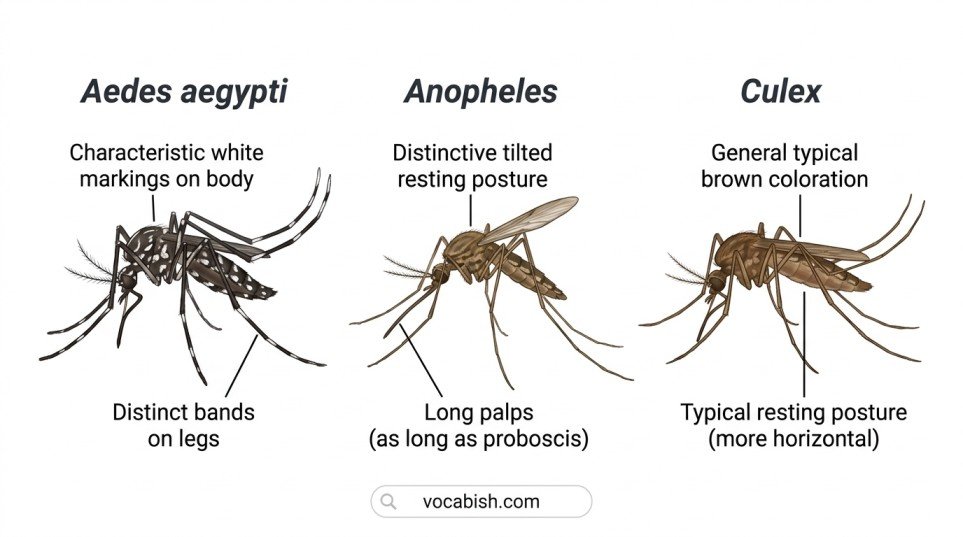
There are thousands of mosquito species, but a few well-known groups are particularly important because of their habitats, feeding habits, and role in spreading diseases.
Mosquito Type | Identifying Feature | Main Significance |
|---|---|---|
Aedes | Many species have black-and-white markings | Some species spread dengue, Zika, chikungunya, and yellow fever. |
Anopheles | Adults often rest with the body angled upward | Certain species transmit malaria parasites. |
Culex | Many species have a brown or grey appearance | Some species transmit West Nile virus and other pathogens. |
These groups do not have completely different sets of body parts. They share the basic mosquito body plan, but their markings, mouthpart features, resting positions, and other characteristics can differ.
How Mosquito Types Differ
- Aedes: Some species bite during the day and breed in small containers of standing water.
- Anopheles: Some species transmit malaria and have distinctive adult resting positions.
- Culex: Many species are active around dusk or at night, depending on the species and environment.
The word species refers to a particular kind of organism, while genus refers to a broader classification that contains related species.
Common Mosquito Anatomy Mistakes
Some mosquito terms are easy to confuse, especially when studying a labelled diagram.
- Proboscis vs. labium: The proboscis is the complete elongated feeding structure; the labium forms its outer sheath.
- Antennae vs. palps: Antennae are paired sensory structures on the head, while maxillary palps sit beside the proboscis.
- Wings vs. halteres: Wings provide flight, while halteres help maintain balance.
- Thorax vs. abdomen: The thorax supports the legs and wings, while the abdomen contains much of the digestive and reproductive systems.
- Male vs. female mosquitoes: Both feed on plant sugars, but females of blood-feeding species also take blood meals.
Frequently Asked Questions
The three main parts of a mosquito are the head, thorax, and abdomen. Each section contains structures that support sensing, movement, feeding, and reproduction.
The proboscis is an elongated mouthpart used for feeding. Females of blood-feeding species use it to take blood, while mosquitoes also feed on plant sugars.
An adult mosquito has six legs arranged in three pairs. All six legs attach to the thorax and help the insect walk, land, and rest.
Male mosquitoes do not take blood meals. They mainly feed on nectar and other plant sugars, while females of blood-feeding species obtain blood for egg development.
Mosquito antennae detect environmental signals, including smells and air movement. Male antennae are often bushier and help detect the sounds of female wingbeats.
Mosquitoes have one pair of functional wings that generate lift and allow flight. Their rapid wingbeats also produce the familiar buzzing sound.
The abdomen contains much of the mosquito’s digestive and reproductive systems. It also has spiracles and internal structures involved in breathing and waste removal.
Mosquitoes share the same basic body plan, but species differ in markings, proportions, mouthpart features, feeding habits, and other anatomical characteristics.
Conclusion
The parts of a mosquito include the head, thorax, abdomen, antennae, eyes, proboscis, wings, legs, and several internal organs. Each structure has a specific role in feeding, sensing, movement, breathing, or reproduction. Learning these names and functions helps students read mosquito diagrams, build biology vocabulary, and distinguish between different mosquito groups.