
Should you say someone is liable to make a mistake or likely to make a mistake? The words sound similar, and both can describe possibility, but they do not always communicate the same meaning.
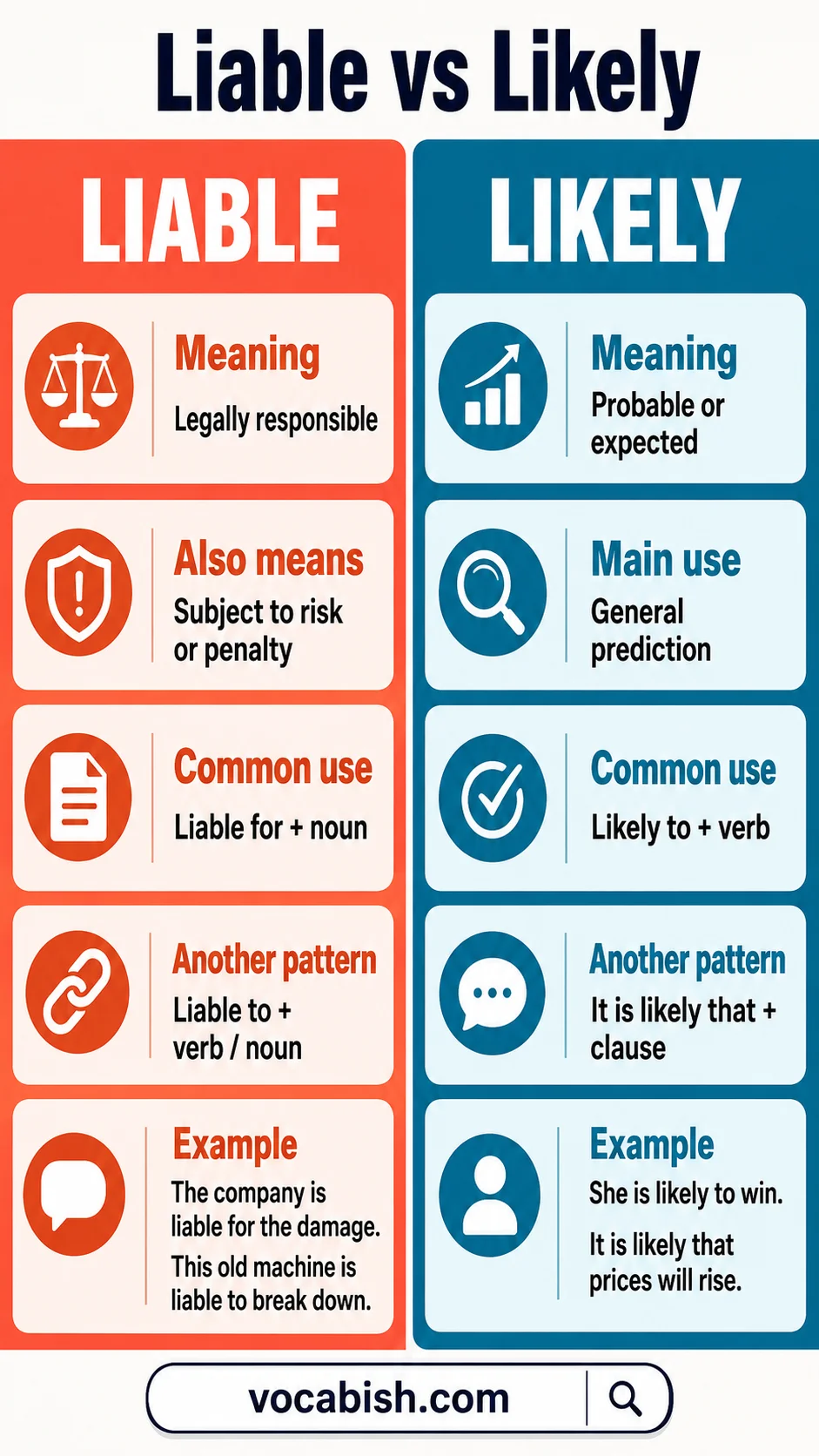
The main difference in liable vs likely is that likely expresses a general probability, while liable often describes legal responsibility, exposure to a penalty, or a tendency toward something undesirable.
Understanding these meanings will help you choose the right word in conversations, schoolwork, professional writing, and legal contexts.
Liable vs Likely: The Quick Difference
Both words can describe something that may happen. However, likely is the normal choice for neutral probability, while liable often suggests responsibility, risk, or an unwanted result.
Word | Main meaning | Common pattern | Example |
|---|---|---|---|
Likely | Probable or expected to happen | likely to + verb | It is likely to rain. |
Liable | Legally responsible | liable for + noun | The company is liable for the damage. |
Liable | Required or subject to something | liable to + noun/verb | Drivers are liable to a fine. |
Liable | Prone to an unwanted action or result | liable to + verb | This old machine is liable to break down. |
Quick answer
Use likely when you mean:
- probable
- expected
- having a good chance of happening
Use liable when you mean:
- legally responsible
- required to pay or face a penalty
- at risk of something
- prone to doing something, usually negative
Compare:
- She is likely to arrive late.
There is a good chance that she will arrive late. - She is liable to arrive late.
She has a habit or tendency to arrive late, often unexpectedly.
What Does Likely Mean?
Likely means that something is probable or has a good chance of happening. It can describe future events, expected results, or people and things that seem suitable for a particular outcome.
Likely as an adjective
As an adjective, likely commonly appears after a form of the verb be.
Pattern:
subject + be + likely + to + base verb
Examples:
- The train is likely to arrive at noon.
- Maya is likely to win the competition.
- Prices are likely to increase next month.
- The children are likely to feel tired after the trip.
- We are likely to need more chairs.
It can also appear before a noun:
- She is the likely winner.
- Heavy traffic is the likely cause of the delay.
- They discussed several likely outcomes.
- He is a likely candidate for the position.
In these examples, likely means expected, probable, or suitable.
Likely with a that-clause
Another common structure is:
It is likely that + subject + verb
Examples:
- It is likely that the meeting will finish early.
- It is likely that they already know the answer.
- It is likely that the road will remain closed.
- It is likely that sales will improve this year.
The following sentences have almost the same meaning:
- Emma is likely to pass the examination.
- It is likely that Emma will pass the examination.
Likely as an adverb
In many varieties of English, especially American English, likely can also modify a verb.
Examples:
- The package will likely arrive tomorrow.
- They will likely choose the cheaper option.
- He will likely remain at home.
- The event will likely attract a large crowd.
In British English, speakers may prefer probably in this position:
- The package will probably arrive tomorrow.
Both versions are understandable and grammatically accepted.
What Does Liable Mean?
Liable has several connected meanings. It most commonly refers to legal responsibility, an obligation, exposure to punishment, or a tendency toward an unwanted event.
The word usually appears after a linking verb such as be, become, or remain.
Liable meaning legally responsible
When someone is liable for something, that person or organisation is legally responsible for it.
Examples:
- The driver was liable for the damage.
- Employers may be liable for workplace accidents.
- The landlord is liable for certain repairs.
- The business could be liable for the customer’s losses.
- Who is liable for the unpaid bill?
Here, liable does not mean probable. It means legally or financially responsible.
Liable meaning required to pay
Liable can also mean legally required to pay money, tax, compensation, or another charge.
Examples:
- Residents may be liable to pay local taxes.
- The customer is liable for any additional fees.
- You may be liable to pay compensation.
- Importers are liable for customs duties.
The exact responsibility depends on the law, agreement, or situation being discussed.
Liable meaning subject to punishment
A person may be liable to a fine, punishment, arrest, or legal action.
Examples:
- Anyone who breaks the rule is liable to a fine.
- The offender may be liable to prosecution.
- Drivers without insurance are liable to penalties.
- A person who enters the area illegally may be liable to arrest.
In this structure, liable to means exposed or legally subject to something.
Liable meaning prone to something
In less formal English, liable to can mean likely or prone to experience something. This meaning often describes an unwanted, inconvenient, or unpredictable result.
Examples:
- This road is liable to flood during heavy rain.
- He is liable to forget appointments.
- Old pipes are liable to burst in freezing weather.
- The computer is liable to crash when too many programs are open.
- She is liable to become impatient when people arrive late.
This use is close to likely, but it often carries a more negative tone.
When Liable and Likely Have Similar Meanings
The meanings overlap when both words describe the possibility of an event. Even then, the speaker’s attitude and the type of event can change which word sounds more natural.
Consider these examples:
- The bus is likely to be late.
- The bus is liable to be late.
The first sentence makes a neutral prediction. The second suggests that the bus has a tendency to be late, perhaps because it is unreliable.
Another comparison:
- He is likely to lose his keys.
There is a good chance that he will lose them. - He is liable to lose his keys.
He often loses them or behaves carelessly.
Likely expresses probability
Use likely when you are estimating the chance of something happening.
- The team is likely to win.
- Our guests are likely to arrive soon.
- The weather is likely to improve.
- She is likely to accept the offer.
These predictions may be positive, negative, or neutral.
Liable expresses tendency or risk
Use liable when someone or something is prone to a particular problem or unwanted behaviour.
- The engine is liable to overheat.
- He is liable to say the wrong thing.
- These documents are liable to get lost.
- The path is liable to become slippery.
The focus is not only on probability. It is also on weakness, risk, repeated behaviour, or unpredictability.
Grammar Patterns for Liable and Likely
The two words follow some similar sentence patterns, but they cannot replace each other in every structure. Learning the most common combinations makes word choice much easier.
Be likely to + verb
Use this structure to express probability:
subject + be + likely to + base verb
- She is likely to call.
- They are likely to agree.
- The shop is likely to close early.
- We are likely to finish on time.
Do not use an -ing form directly after to:
- Incorrect: She is likely to calling.
- Correct: She is likely to call.
It is likely that + clause
Use this structure when you want to introduce a complete statement:
It is likely that + subject + verb
- It is likely that the flight will be delayed.
- It is likely that he misunderstood the question.
- It is likely that more people will attend this year.
Do not use liable in this pattern:
- Incorrect: It is liable that the flight will be delayed.
- Correct: It is likely that the flight will be delayed.
Be liable to + verb
This structure can describe tendency, risk, or legal obligation:
subject + be + liable to + base verb
- The glass is liable to crack.
- She is liable to change her mind.
- Customers may be liable to pay an extra charge.
- Anyone who ignores the warning is liable to face penalties.
The surrounding words tell you whether liable refers to probability or responsibility.
Be liable for + noun
Use liable for to identify responsibility:
subject + be + liable for + noun
- The tenant is liable for the repair costs.
- The company was liable for the accident.
- Parents may be liable for damage caused by their children.
- You are liable for any loss resulting from misuse.
Likely for cannot replace liable for in these sentences.
Liable for vs Liable to
The preposition after liable changes the sentence structure and often changes the meaning. Liable for usually introduces responsibility, while liable to introduces an action, consequence, or risk.
Structure | Meaning | Example |
|---|---|---|
liable for + noun | Responsible for something | He is liable for the damage. |
liable to + verb | Prone, expected, or required to act | He is liable to make mistakes. |
liable to + noun | Subject to a consequence | He is liable to a fine. |
Compare:
- The company is liable for the loss.
The company is responsible for the loss. - The company is liable to pay compensation.
The company may be legally required to pay. - The company is liable to further penalties.
The company may be subject to additional penalties.
Is someone liable to or liable for a fine?
Both structures can appear, but they communicate different relationships:
- Liable to a fine means subject to receiving a fine.
- Liable for a fine may mean responsible for paying that fine.
Example:
- Anyone parking here is liable to a fine.
- The vehicle owner may be liable for the fine.
Neutral and Negative Meanings
A useful way to separate liable and likely is to consider whether the sentence is neutral or carries a sense of risk. Likely works broadly, while liable commonly appears with problems and consequences.
Likely can describe positive events
- She is likely to succeed.
- He is likely to receive a promotion.
- The treatment is likely to help.
- The new café is likely to become popular.
- Our team is likely to win.
Using liable in these positive sentences would sound unusual:
- Unnatural: She is liable to succeed.
- Natural: She is likely to succeed.
Liable often describes unwanted events
- The roof is liable to leak.
- The child is liable to wander away.
- The machine is liable to stop without warning.
- He is liable to become angry.
- The roads are liable to freeze overnight.
In each case, the result is unwanted, risky, inconvenient, or difficult to predict.
Is liable always negative?
No. Its legal meaning is not necessarily negative in tone, although it often relates to debts, damages, penalties, or obligations.
For example:
- The insurer is liable for the repair costs.
This sentence simply identifies who must pay. It does not express probability or personal criticism.
Common Mistakes with Liable and Likely
Most errors happen when learners confuse probability with responsibility. Check whether you are describing a chance, a tendency, or a legal obligation before choosing the word.
1: Using liable for a positive prediction
- Incorrect: She is liable to win the scholarship.
- Correct: She is likely to win the scholarship.
Winning a scholarship is a positive predicted result, so likely is more natural.
2: Using likely for legal responsibility
- Incorrect: The company is likely for the damage.
- Correct: The company is liable for the damage.
Use liable for when identifying legal or financial responsibility.
3: Saying “liable that”
- Incorrect: It is liable that prices will rise.
- Correct: It is likely that prices will rise.
Only likely normally introduces a that-clause in this pattern.
4: Confusing liable to with liable for
- Incorrect: The driver is liable to the repair costs.
- Correct: The driver is liable for the repair costs.
Use for before the thing for which someone is responsible.
5: Using likely when describing a repeated weakness
- Less precise: This old lock is likely to jam.
- More expressive: This old lock is liable to jam.
Both sentences are possible. Liable places more emphasis on the lock’s weakness or tendency to cause trouble.
6: Using liable as an adverb
- Incorrect: They will liable arrive late.
- Correct: They will likely arrive late.
- Correct: They are liable to arrive late.
Liable is an adjective, so it normally needs a linking verb such as be.
Liable and Likely in Everyday Contexts
Seeing the words in different situations helps reveal how their meanings change. Notice whether each sentence focuses on probability, tendency, responsibility, or punishment.
Weather
- Rain is likely this evening.
- It is likely to rain this evening.
- Low-lying roads are liable to flood after heavy rain.
The first two sentences predict rain. The third describes a known risk.
School
- Daniel is likely to pass the test.
- Students who submit copied work are liable to disciplinary action.
- Mia is liable to forget her books unless someone reminds her.
These examples show probability, punishment, and personal tendency.
Work
- The manager is likely to approve the request.
- The employer may be liable for the employee’s injury.
- This software is liable to freeze during large updates.
Travel
- The flight is likely to leave on time.
- Roads near the coast are liable to become slippery.
- Passengers may be liable to additional charges for oversized bags.
Business and money
- Interest rates are likely to change.
- A careless seller may be liable for a customer’s losses.
- Late payments are liable to incur extra fees.
Behaviour
- She is likely to ask several questions.
- He is liable to interrupt when he becomes excited.
- Young children are liable to become restless during long journeys.
How to Choose the Correct Word
A short decision process can prevent most mistakes. Ask what the sentence is really communicating before selecting liable or likely.
Choose likely when asking about probability
Ask:
How probable is this event?
Examples:
- Is it likely to happen?
- Who is the likely winner?
- Is she likely to agree?
- What is the most likely explanation?
Choose liable when asking about responsibility
Ask:
Who is legally or financially responsible?
Examples:
- Who is liable for the damage?
- Is the owner liable for the debt?
- Could the employer be liable?
- Are customers liable for extra fees?
Choose liable when describing exposure
Ask:
Is someone subject to a penalty, payment, or consequence?
Examples:
- Offenders are liable to prosecution.
- Drivers are liable to a fine.
- The buyer may be liable to pay tax.
- Members are liable to additional charges.
Choose liable for an unwanted tendency
Ask:
Is this person or thing prone to a problem?
Examples:
- The pipe is liable to leak.
- He is liable to forget.
- The device is liable to overheat.
- The path is liable to become muddy.
Pronunciation of Liable and Likely
The two words begin with a similar sound, which may explain why some learners confuse them. However, they have different syllable patterns.
Word | Pronunciation | Syllables |
|---|---|---|
liable | /ˈlaɪ.ə.bəl/ | 3 |
likely | /ˈlaɪk.li/ | 2 |
Liable sounds like:
LIE-uh-buhl
Likely sounds like:
LIKE-lee
Notice that likely keeps the complete k sound from like, while liable does not contain that sound.
Related Words and Word Forms
Knowing the related nouns and adjectives can improve both vocabulary and sentence variety. These words belong to the same meaning groups as liable and likely.
Word | Part of speech | Meaning | Example |
|---|---|---|---|
likelihood | noun | The chance that something will happen | There is little likelihood of rain. |
unlikely | adjective | Not expected to happen | He is unlikely to refuse. |
probable | adjective | Expected or likely | Rain is probable tonight. |
probably | adverb | Most likely | They will probably arrive soon. |
liability | noun | Legal responsibility, debt, or disadvantage | The accident created a legal liability. |
liable | adjective | Responsible, subject, or prone | The owner may be liable. |
responsible | adjective | Having a duty or obligation | Who is responsible for the repairs? |
prone | adjective | Having a tendency toward something | This area is prone to flooding. |
Likelihood
Likelihood is the noun form connected with likely.
Examples:
- There is a strong likelihood of rain.
- We discussed the likelihood of success.
- The change reduced the likelihood of mistakes.
Liability
Liability is the noun form of liable. It can refer to legal responsibility, money owed, or something that causes difficulty.
Examples:
- The company accepted liability for the accident.
- The loan appears as a liability in the accounts.
- His lack of experience became a liability.
Quick Practice: Liable or Likely?
Choose the correct word for each sentence.
- The match is ______ to be cancelled because of heavy rain.
- The shop owner may be ______ for the customer’s injury.
- This old battery is ______ to fail in cold weather.
- Sara is the most ______ candidate for the position.
- Anyone entering without permission is ______ to prosecution.
- The package will ______ arrive on Friday.
- The landlord is ______ for maintaining the heating system.
- Children are ______ to become tired after the long walk.
Answers
- likely
- liable
- liable
- likely
- liable
- likely
- liable
- likely or liable, depending on meaning
In sentence eight, likely gives a neutral prediction. Liable suggests that tiredness is a common or troublesome tendency in that situation.
FAQs About Liable and Likely
Likely expresses probability, while liable usually means legally responsible, subject to a consequence, or prone to an unwanted action or event.
They overlap when discussing possibility, but liable often suggests an undesirable tendency. Likely is more neutral and works with positive outcomes.
Use likely to happen for a neutral prediction. Use liable to happen when the event is unwanted, unpredictable, or caused by a weakness.
Liable for means legally or financially responsible for something, such as damage, repair costs, unpaid fees, an accident, or another person’s loss.
Liable to a fine means legally subject to receiving a fine because of an action, offence, rule violation, or failure to comply.
Yes. Likely can appear before nouns in phrases such as likely winner, likely cause, likely outcome, and likely candidate.
No. Liable can also describe a tendency toward an unwanted event, as in “The machine is liable to overheat.”
Use likely that, as in “It is likely that she will attend.” The structure liable that is not standard English.
Conclusion
The difference in liable vs likely depends on whether you are discussing probability, responsibility, risk, or tendency. Use likely for neutral predictions and expected outcomes.
Use liable for legal or financial responsibility, exposure to a penalty, or a tendency toward something troublesome. When choosing between liable and likely, ask whether you mean “probable,” “responsible,” or “prone to a problem.” That quick check will usually lead you to the correct word.
You May Also Like
