
Have you ever described someone as a humane person when you meant a human person? The words look and sound similar, but they express different ideas.
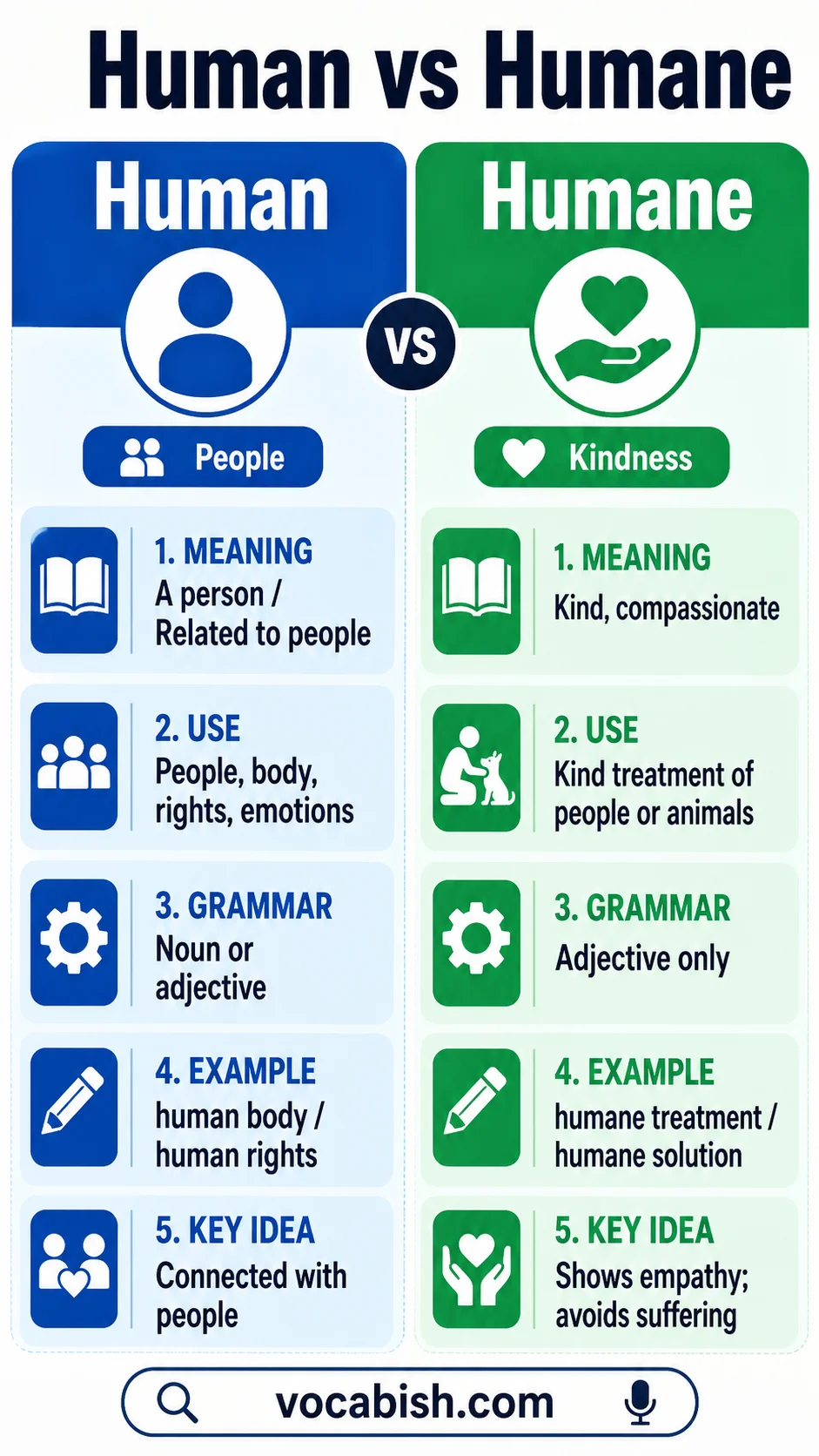
The main difference in human vs humane is straightforward: human relates to people, while humane describes kind and compassionate treatment. Understanding their meanings, pronunciation, and grammatical roles will help you choose the right word in everyday English.
Human vs Humane at a Glance
Although human and humane come from related language roots, they are not interchangeable. One identifies or describes people, while the other describes kindness.
Word | Main meaning | Part of speech | Example |
|---|---|---|---|
Human | A person or something related to people | Noun or adjective | Humans need clean water. |
Humane | Kind, compassionate, and unwilling to cause unnecessary suffering | Adjective | The shelter uses humane methods. |
Quick answer: Use human for people and qualities connected with people. Use humane for kind or compassionate behaviour, especially toward people or animals.
What Does Human Mean?
The word human refers to a person or to something connected with people. It can function as both a noun and an adjective.
Human as a noun
As a noun, human means a person or a member of the human species.
- Every human needs food and water.
- The story is about a human who travels to another planet.
- Humans communicate through language, signs, and expressions.
The plural form is humans.
Human as an adjective
As an adjective, human describes something belonging to, produced by, experienced by, or connected with people.
- The human body contains many complex systems.
- Making mistakes is a normal human experience.
- The machine can recognise the human voice.
- Fear is a natural human emotion.
In these examples, human does not mean “kind.” It simply shows a connection with people.
Pronunciation of human
Human is pronounced:
/ˈhjuː.mən/
It sounds like HYOO-muhn.
The stress falls on the first syllable: HU-man.
What Does Humane Mean?
The adjective humane means kind, compassionate, and concerned about the pain or suffering of others.
It is often used when discussing the treatment of animals, prisoners, patients, workers, or vulnerable people.
- The animals were kept in humane conditions.
- The organisation supports the humane treatment of farm animals.
- They searched for a more humane solution.
- A humane leader considers how decisions affect others.
Humane behaviour avoids cruelty and unnecessary suffering.
Pronunciation of humane
Humane is pronounced:
/hjuːˈmeɪn/
It sounds like hyoo-MAYN.
Unlike human, the stress falls on the second syllable: hu-MANE.
Human vs Humane: What Is the Main Difference?
The difference between human and humane depends on whether you are talking about people or kindness.
- Human means a person or something related to people.
- Humane means kind, caring, or compassionate.
Compare these sentences:
- The human body needs sleep.
- The hospital treated its patients in a humane way.
The first sentence refers to the body of a person. The second describes kind and respectful treatment.
Here are more direct comparisons:
Human | Humane |
|---|---|
connected with people | showing kindness |
can be a noun or adjective | always an adjective |
human life | humane treatment |
human behaviour | humane behaviour |
human rights | humane conditions |
human error | humane decision |
Notice that human behaviour means behaviour shown by people. Humane behaviour means behaviour that is kind and compassionate.
How to Use Human in a Sentence
Use human when referring to people, their bodies, abilities, feelings, societies, limitations, or activities.
Talking about people
- Humans have lived in communities for thousands of years.
- No human can survive without water.
- The rescue team searched for human survivors.
Describing the body and mind
- The human brain processes a large amount of information.
- The human eye can recognise many colours.
- Memory is an important human ability.
When describing feelings and experiences
- Sadness is a human emotion.
- Everyone needs human connection.
- Her fear was a natural human reaction.
Describing actions or mistakes
- The accident happened because of human error.
- Human activity can affect the environment.
- The final decision still requires human judgement.
Referring to society and rights
- Every person deserves basic human rights.
- Human history includes periods of progress and conflict.
- The charity provides humanitarian aid during emergencies.
How to Use Humane in a Sentence
Use humane when something shows mercy, kindness, respect, or concern for wellbeing.
Treatment of animals
- The shelter follows humane animal-care practices.
- They used a humane method to move the injured bird.
- The campaign promotes humane treatment of working animals.
Treatment of people
- Prisoners must be held in safe and humane conditions.
- The workers asked for more humane working hours.
- The doctor spoke to the frightened patient in a humane manner.
Decisions and policies
- The council is seeking a humane solution to homelessness.
- The new policy offers a more humane approach.
- A humane society protects vulnerable people from abuse.
The word often appears in serious discussions about welfare, justice, care, ethics, and cruelty.
Human Being, Human Nature, and Humane Treatment
Some common expressions make the distinction easier to see. Learning these word combinations can help you use both terms naturally.
Human being
A human being is a person.
- Every human being deserves dignity.
- The robot looked almost like a human being.
In everyday conversation, people often use person instead of human being.
Human nature
Human nature refers to the common feelings, qualities, and behaviour associated with people.
- Curiosity is part of human nature.
- People sometimes resist change because of human nature.
Positive and negative qualities included in the human nature. It does not always mean kindness.
Human touch
The human touch means personal warmth, care, or direct involvement from a person.
- Online services are useful, but customers still value the human touch.
- Her personal message added a human touch to the event.
Humane treatment
The phrase humane treatment means treating a person or animal with kindness and avoiding unnecessary pain.
- The law requires humane treatment of animals.
- Aid groups called for humane treatment of the prisoners.
Humane society
A humane society is usually an organisation that protects animals and promotes their welfare. The term may also describe a compassionate community.
- The local humane society cares for abandoned pets.
- A truly humane society protects its weakest members.
Common Mistakes with Human and Humane
These words are often confused because of their similar spelling. Most errors happen when learners use human to mean kind or use humane to mean related to people.
1: Using human instead of humane
Incorrect:
- The animals need more human treatment.
Correct:
- The animals need more humane treatment.
The treatment should be kind, so humane is the correct choice.
2: Using humane instead of human
Incorrect:
- The humane body needs regular sleep.
Correct:
- The human body needs regular sleep.
The body belongs to a person, so use human.
3: Thinking all human actions are humane
An action can be human without being humane.
- War is a human activity, but it is not necessarily humane.
- Cruelty is part of human behaviour, but cruelty itself is not humane.
The word human describes who performs the action. The word humane judges whether the action is compassionate.
4: Calling someone “a humane”
Humane is not normally used as a noun.
Incorrect:
- She is a caring humane.
Correct:
- She is a caring human.
- She is a humane person.
Use human as the noun. Place humane before a noun such as person, leader, or doctor.
5: Confusing humane with humanitarian
These words are connected but have different uses.
- Humane means kind and compassionate.
- Humanitarian relates to helping people whose lives are affected by war, disaster, poverty, or suffering.
Examples:
- The judge made a humane decision.
- The organisation provides humanitarian assistance after floods.
A humanitarian can also be a person who works to improve other people’s lives.
Word Forms and Related Vocabulary
Looking at the word families can make the meanings clearer.
Word | Part of speech | Meaning | Example |
|---|---|---|---|
Human | Noun/adjective | A person; related to people | Human life must be protected. |
Humans | Plural noun | People | Humans are social beings. |
Humanity | Noun | All people; kindness toward others | The disaster affected all humanity. |
Humanly | Adverb | In a way possible for a person | We did everything humanly possible. |
Humane | Adjective | Kind and compassionate | They found a humane solution. |
Humanely | Adverb | In a kind way | The animal was handled humanely. |
Humaneness | Noun | The quality of being humane | Her humaneness earned their respect. |
Humanitarian | Noun/adjective | Connected with helping people in need | Humanitarian workers delivered food. |
Inhuman | Adjective | Extremely cruel or lacking human qualities | The prisoners faced inhuman conditions. |
Inhumane | Adjective | Cruel and causing unnecessary suffering | The animals lived in inhumane cages. |
Inhuman vs inhumane
Both words can describe cruelty, but they are used slightly differently.
Inhuman often describes something so cruel that it seems unworthy of a human being.
- The victims suffered inhuman treatment.
- They were forced to work in inhuman conditions.
Inhumane is the direct opposite of humane. It means cruel or lacking compassion.
- Keeping animals without water is inhumane.
- The organisation criticised the inhumane policy.
In many contexts, the two words overlap. However, inhumane connects more directly with cruelty and suffering.
An Easy Way to Remember the Difference
Look at the ending of humane:
Human + e = extra empathy
The final e can remind you of empathy, the ability to understand and care about another person’s or animal’s feelings.
- Human = a person or related to people
- Humane = human kindness and empathy
You can also ask yourself one question:
Am I describing a person, or am I describing kindness?
Use human for a person or something connected with people. Use humane when kindness is the main idea.
Choosing the Right Word in Context
Complete each sentence with human or humane.
- Every ______ being needs social connection.
- The shelter provides ______ care for abandoned animals.
- Forgetting a name is a common ______ mistake.
- The group requested more ______ living conditions.
- The ______ brain continues to develop during childhood.
- They wanted to solve the problem in a ______ way.
- Language is an important part of ______ culture.
- The law aims to prevent cruel and ______ treatment.
Answers
- human
- humane
- human
- humane
- human
- humane
- human
- inhumane
More Examples of Human and Humane
Reading paired examples can help you recognise the difference quickly.
- The human population is growing.
The policy offers a humane response to poverty. - The dog enjoys human company.
The dog must receive humane care. - Fear is a human feeling.
Comforting a frightened child is a humane action. - Technology cannot replace every human worker.
Employers should provide humane working conditions. - Scientists study human behaviour.
Ethical researchers follow humane practices. - The mistake was caused by human error.
The manager responded in a humane and understanding way.
FAQs About Human and Humane
Human refers to people or things connected with people. Humane describes behaviour or treatment that is kind, compassionate, and considerate.
No. Human describes a person or a connection with people, while humane describes kindness and the avoidance of unnecessary suffering.
Humane is an adjective. It usually appears before a noun, as in “humane treatment,” or after a linking verb.
Yes. Every person is human, but a person’s actions may be cruel, selfish, or unkind rather than humane.
The direct opposite of humane is inhumane, meaning cruel, unkind, or causing unnecessary pain, suffering, or poor treatment.
Use humane treatment when you mean kind treatment. Use human treatment only when contrasting treatment by people with another type.
To act humanely means to behave with kindness, mercy, and concern for the comfort, dignity, or suffering of others.
Yes. Humanity can mean all human beings, but it can also refer to compassion, kindness, and concern for other people.
Conclusion
The difference in human vs humane becomes clear when you focus on the central idea of each word. Human refers to a person or something connected with people, such as the human body, human nature, or human rights. Humane describes kindness, mercy, and compassionate treatment.
Remember the final e in humane as empathy. That small spelling clue can help you choose correctly whenever you use human and humane in English.
You May Also Like
