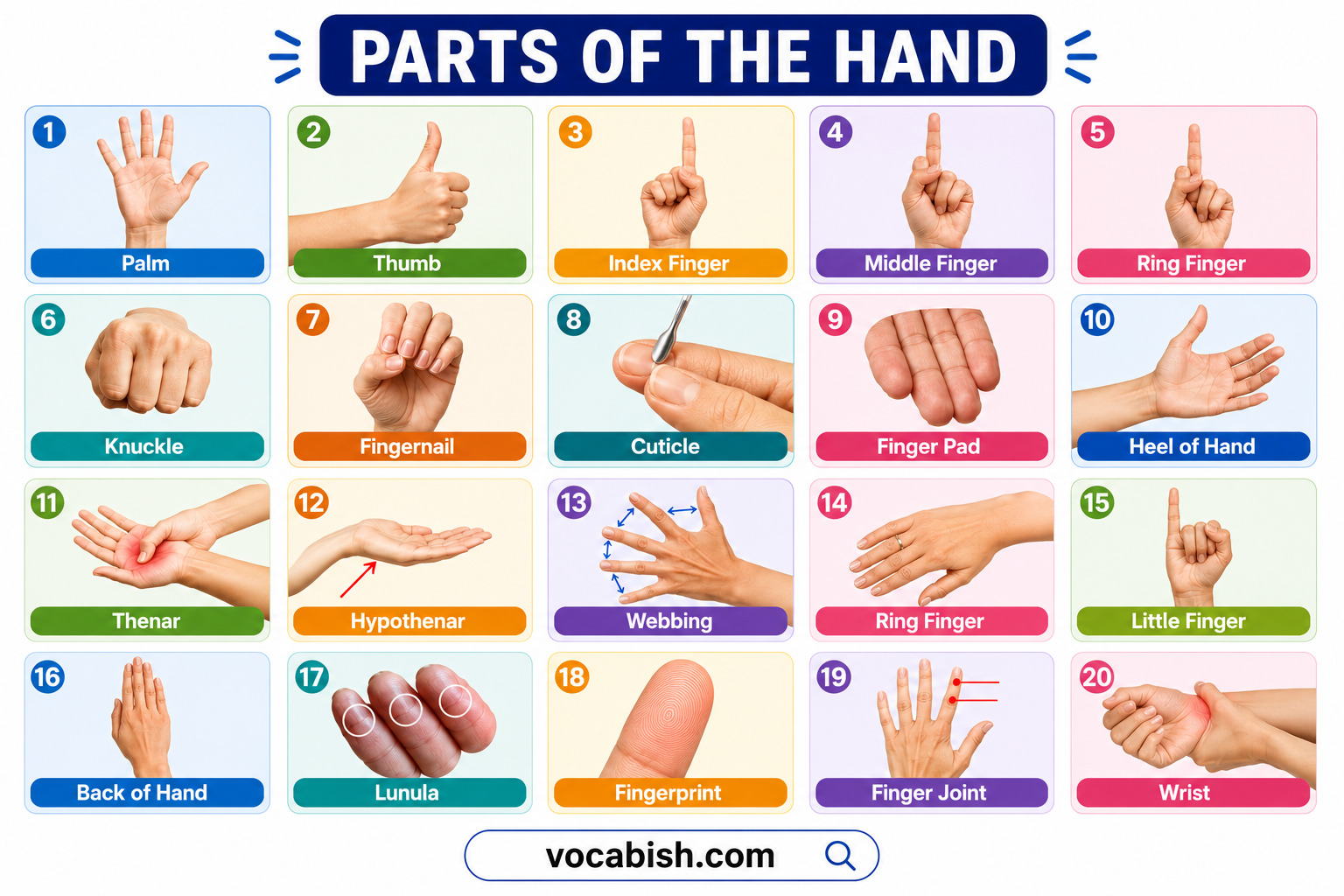

The hand is an important part of the human body that helps people hold, touch, write, lift, and perform many daily activities. In this blog post, you will learn the parts of the hand with their names, functions, and a labeled diagram to understand the structure of the human hand in detail. From the fingers and thumb to the palm and wrist, each part of the hand has a specific role in movement, grip, and flexibility. Learning the names of hand parts helps you understand English vocabulary related to human anatomy, body structure, health, and physical activities commonly used in schools, books, and educational studies.
What Is the Hand?
The hand is the body part at the end of the arm. It helps people touch, hold, lift, write, and move objects.
Each hand has:
- Five fingers
- A palm
- A thumb
- A wrist
- Nails
- Joints and muscles
The hand works together with the arm and fingers to perform many actions.
List of Major Parts of the Hand
1. Thumb
The thumb is the short and thick finger on the side of the hand.
Function:
- Helps grip and hold objects
- Makes writing and picking easier
Example:
- He gave a thumbs-up.
2. Index Finger
The index finger is next to the thumb.
Function:
- Used for pointing
- Helps press buttons and touch screens
Example:
- Point at the picture with your index finger.
3. Middle Finger
The middle finger is the longest finger.
Function:
- Helps hold objects firmly
- Supports balance while gripping
Example:
- She wore a bandage on her middle finger.
4. Ring Finger
The ring finger is beside the little finger.
Function:
- Helps with grip
- Commonly used for rings
Example:
- He wears a wedding ring on his ring finger.
5. Little Finger
The little finger is the smallest finger.
Function:
- Helps balance the hand
- Supports gripping actions
Example:
- Her little finger was injured.
6. Palm
The palm is the inner part of the hand.
Function:
- Holds and supports objects
- Helps create a strong grip
Example:
- She placed the coin in my palm.
7. Fingernail
A fingernail covers the top of each fingertip.
Function:
- Protects finger ends
- Helps pick up small objects
Example:
- Keep your fingernails clean.
8. Knuckle
Knuckles are the finger joints.
Function:
- Help fingers bend and move
Example:
- His knuckles turned red in the cold.
9. Wrist
The wrist connects the hand to the arm.
Function:
- Allows hand movement
- Helps turn and rotate the hand
Example:
- She wore a watch on her wrist.
10. Fingertip
The fingertip is the end of a finger.
Function:
- Helps feel texture and temperature
- Used for touching and typing
Example:
- My fingertips feel cold.
Parts of the Hand Diagram
Fingers and Finger Parts
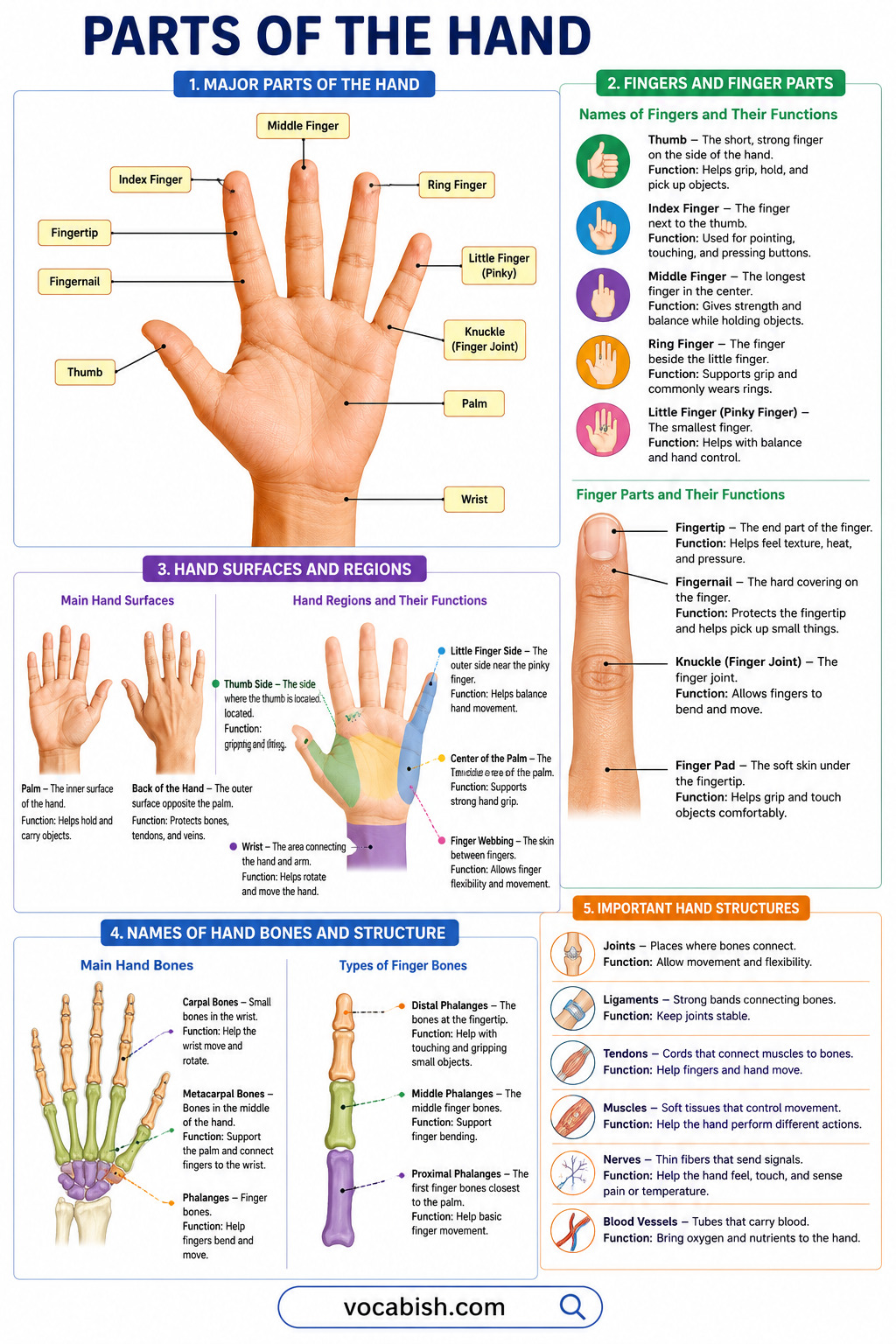
The fingers help us hold, touch, write, point, and move objects. Each finger has different parts that work together.
- Thumb — The short, strong finger on the side of the hand.
Function: Helps grip, hold, and pick up objects. - Index Finger — The finger next to the thumb.
Function: Used for pointing, touching, and pressing buttons. - Middle Finger — The longest finger in the center.
Function: Gives strength and balance while holding objects. - Ring Finger — The finger beside the little finger.
Function: Supports grip and commonly wears rings. - Little Finger (Pinky Finger) — The smallest finger.
Function: Helps with balance and hand control. - Fingertip — The end part of the finger.
Function: Helps feel texture, heat, and pressure. - Fingernail — The hard covering on the finger.
Function: Protects the fingertip and helps pick up small things. - Knuckle — The finger joint.
Function: Allows fingers to bend and move. - Finger Joint — The connection between finger bones.
Function: Helps fingers fold and stretch. - Finger Pad — The soft skin under the fingertip.
Function: Helps grip and touch objects comfortably.
Hand Surfaces and Regions
The hand has different surfaces and areas. Each area has a special purpose.
- Palm — The inner surface of the hand.
Function: Helps hold, lift, carry, and touch objects easily. - Back of Hand — The outer side of the hand opposite the palm.
Function: Protects bones and tendons while allowing smooth finger movement. - Heel of Hand — The bottom part of the palm near the wrist.
Function: Supports the hand during pressing, pushing, and lifting actions. - Thenar — The soft raised area below the thumb.
Function: Helps move the thumb and hold small objects firmly. - Hypothenar — The raised area near the little finger side of the palm.
Function: Supports finger control and improves hand grip strength. - Webbing — The soft skin between the fingers.
Function: Allows smooth finger movement and prevents overstretching. - Palmar Crease — The natural lines found on the palm.
Function: Helps the hand fold, bend, and stretch comfortably. - Wrist — The joint connecting the hand to the forearm.
Function: Helps rotate, turn, and move the hand in different directions.
Names of Hand Bones and Structure
The hand contains many small bones that give shape and movement.
- Carpal Bones — Small bones in the wrist.
Function: Help the wrist move and rotate. - Metacarpal Bones — Bones in the middle of the hand.
Function: Support the palm and connect fingers to the wrist. - Phalanges — Finger bones.
Function: Help fingers bend and move. - Proximal Phalanges — The first finger bones closest to the palm.
Function: Help basic finger movement. - Middle Phalanges — The middle finger bones.
Function: Support finger bending. - Distal Phalanges — The bones at the fingertip.
Function: Help with touching and gripping small objects. - Joints — Places where bones connect.
Function: Allow movement and flexibility. - Ligaments — Strong bands connecting bones.
Function: Keep joints stable. - Cartilage — Smooth tissue between bones.
Function: Reduces friction during movement.
Tendons and Soft Tissue
Soft tissues help the hand move smoothly and stay flexible.
- Flexor Tendons — Tendons on the palm side.
Function: Help fingers bend. - Extensor Tendons — Tendons on the back of the hand.
Function: Help fingers straighten. - Thumb Tendons — Tendons connected to the thumb.
Function: Help thumb movement and gripping. - Muscles — Soft tissues that create movement.
Function: Help fingers and the wrist move. - Skin — The outer covering of the hand.
Function: Protects the hand from injury and germs. - Fat Pads — Soft cushioning tissue under the skin.
Function: Absorb pressure and protect bones. - Nerves — Thin structures carrying messages from the brain.
Function: Help the hand feel pain, touch, heat, and cold. - Blood Vessels — Tubes carrying blood through the hand.
Function: Supply oxygen and nutrients.
Learning the parts of the hand with names and functions helps English learners improve vocabulary and daily communication skills. Hand vocabulary is useful in school, conversations, health topics, and everyday life.
Parts of the Hand Labeled Diagram for Kids
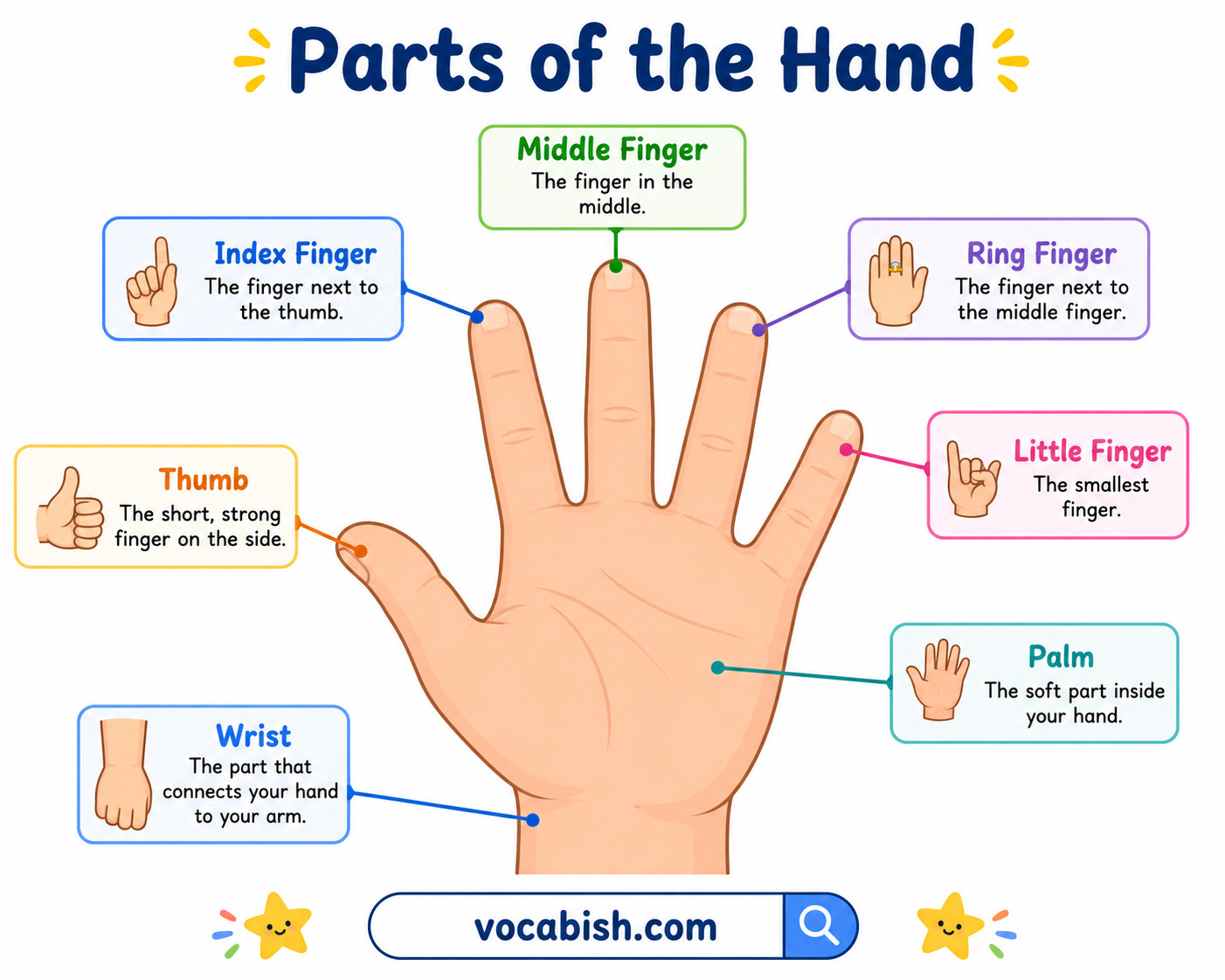
The hand has many important parts that help us hold, touch, write, eat, and play. Learning the names of hand parts helps kids improve English vocabulary and understand how hands work.
- Thumb
The short finger that helps hold things. - Index Finger
The finger used for pointing. - Middle Finger
The longest finger in the center. - Ring Finger
The finger where rings are usually worn. - Little Finger
The smallest finger on the hand. - Palm
The soft inside part of the hand. - Wrist
The part that connects the hand to the arm. - Fingernail
The hard cover on the top of each finger. - Knuckle
The finger joint that helps fingers bend. - Fingertip
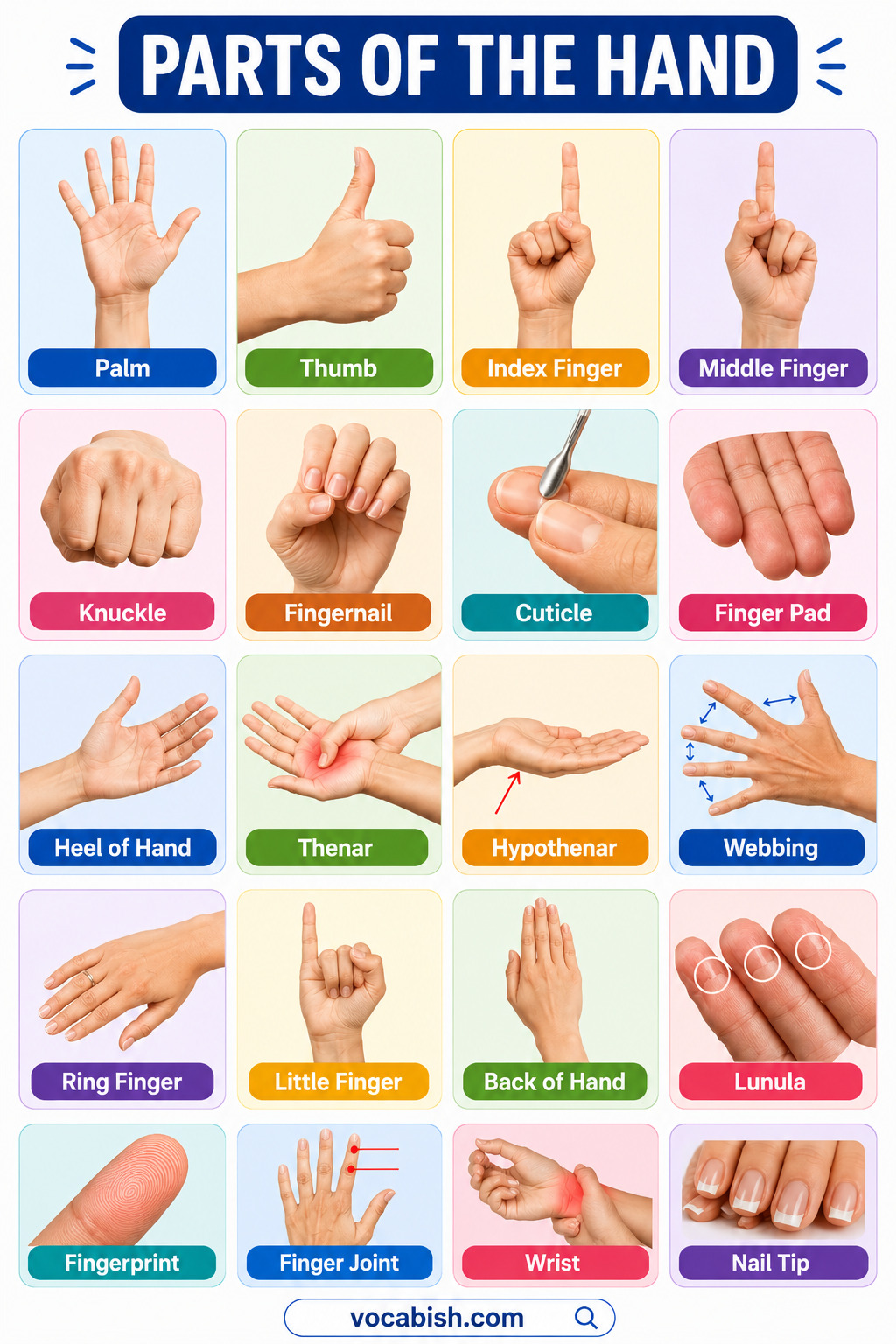
The end part of the finger used for touching. - Back of Hand
The outer side opposite the palm. - Webbing
The skin between the fingers. - Heel of Hand
The lower palm area near the wrist. - Thenar
The soft area below the thumb. - Hypothenar
The soft area below the little finger.
Why Learning Hand Vocabulary Is Important
Learning hand vocabulary helps English learners.
- Describe body parts correctly
- Understand health or science lessons
- Speak naturally in daily conversations
- Improve reading and writing skills
- Learn common English expressions
For example:
- “My thumb hurts.”
- “Wash your hands before eating.”
- “She wears a ring on her finger.”
FAQs about Hand Parts
The main parts of the hand are the palm, thumb, fingers, wrist, nails, knuckles, tendons, and hand bones. Each part helps the hand move and hold objects.
Hand bones are called carpals, metacarpals, and phalanges. These bones support hand shape, finger movement, and flexibility.
Yes, the wrist is part of the hand region. It connects the hand to the forearm and helps the hand move, rotate, and bend easily.
The parts of a hand are called the palm, fingers, thumb, wrist, nails, knuckles, tendons, joints, and hand bones.
The outside part of the hand is called the back of the hand. It is the outer surface opposite the palm.
Yes, fingers are part of the hand. They help people hold, touch, point, write, and perform many daily activities.
The five main parts of the hand are the thumb, fingers, palm, back of the hand, and wrist. These parts help with movement and gripping.
The fatty part of the hand is called the fat pad or padded area. It cushions the hand and protects bones during pressure and movement.
Related Articles: