
If you are learning Spanish, one of the first expressions you will need is Sorry in Spanish. People use apologies every day when they make a mistake, interrupt someone, arrive late, or accidentally cause a problem.
Understanding how to say sorry in Spanish helps you sound more natural and polite in conversations. Spanish offers several ways to apologize, and each expression fits a different situation.
In this article, you will learn common Spanish apology phrases with English translations, when to use them, and plenty of sentence examples that show how they work in everyday communication.
How to Say Sorry in Spanish
Spanish offers several ways to say sorry, and the right expression depends on the situation. Some phrases are used when you feel genuine regret, while others are used for small mistakes, interruptions, or polite conversations.
If you are learning how to say sorry in Spanish, the most common expressions are lo siento, perdón, disculpa, and disculpe. Each phrase has a slightly different meaning and usage.
Here’s a comprehensive guide on: How to Say and Reply to Thank You in Spanish.
Common Spanish Apology Words
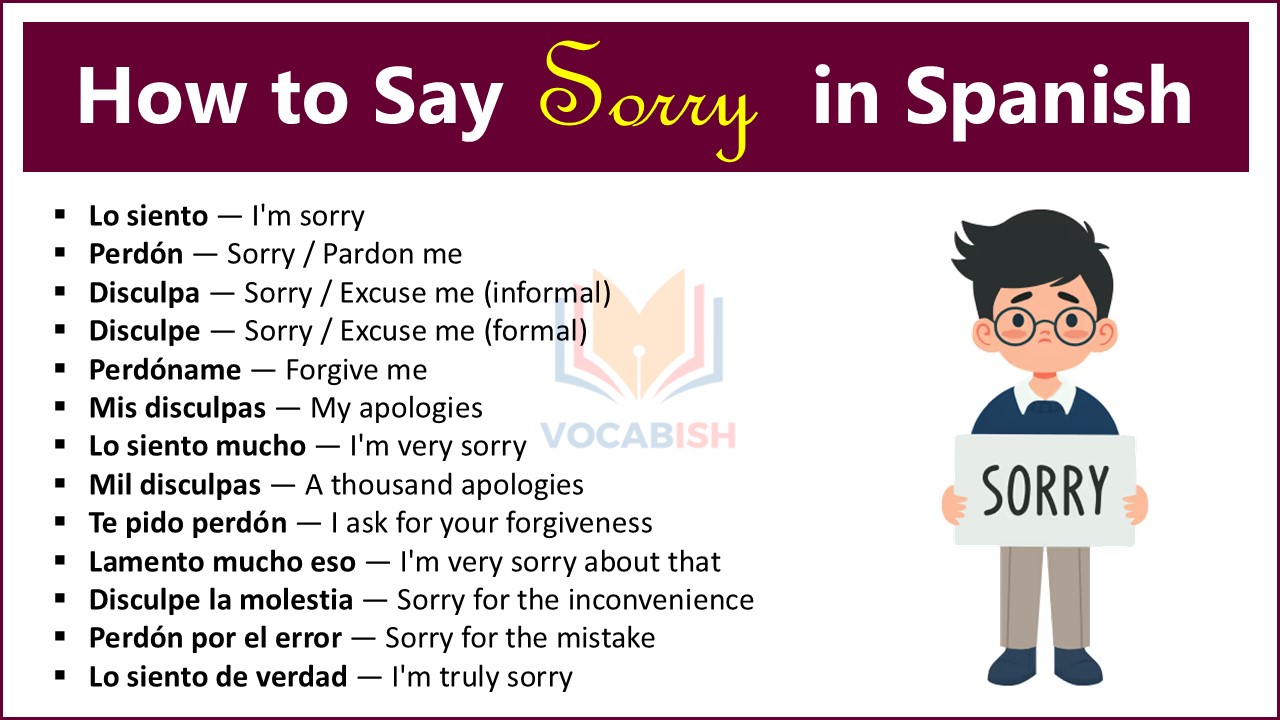
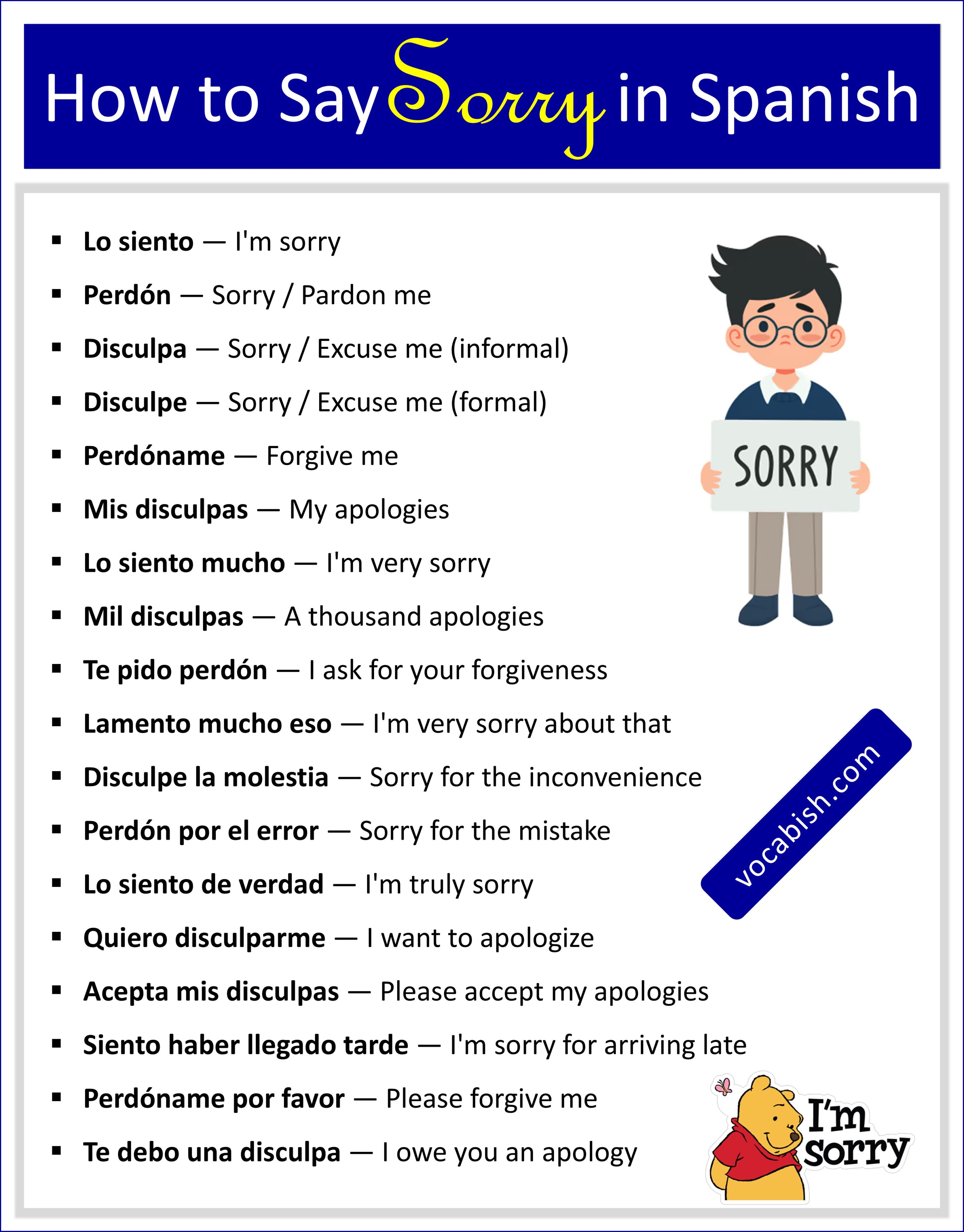
- Lo siento — I’m sorry
- Perdón — Sorry / Pardon me
- Disculpa — Sorry / Excuse me (informal)
- Disculpe — Sorry / Excuse me (formal)
- Perdóname — Forgive me
- Mis disculpas — My apologies
- Lo siento mucho — I’m very sorry
- Mil disculpas — A thousand apologies
- Te pido perdón — I ask for your forgiveness
- Lamento mucho eso — I’m very sorry about that
- Disculpe la molestia — Sorry for the inconvenience
- Perdón por el error — Sorry for the mistake
- Lo siento de verdad — I’m truly sorry
- Quiero disculparme — I want to apologize
- Acepta mis disculpas — Please accept my apologies
- Siento haber llegado tarde — I’m sorry for arriving late
- Perdóname por favor — Please forgive me
- Te debo una disculpa — I owe you an apology
- Lamento lo ocurrido — I’m sorry about what happened
- Lo siento por la confusión — Sorry for the confusion
Lo Siento (I’m Sorry)
Lo siento is one of the most common ways to say Sorry in Spanish. It is usually used when you feel regret, sympathy, or genuine sadness about a situation.
This phrase often sounds more sincere than other short apology expressions.
Usage of Lo Siento with English Translation
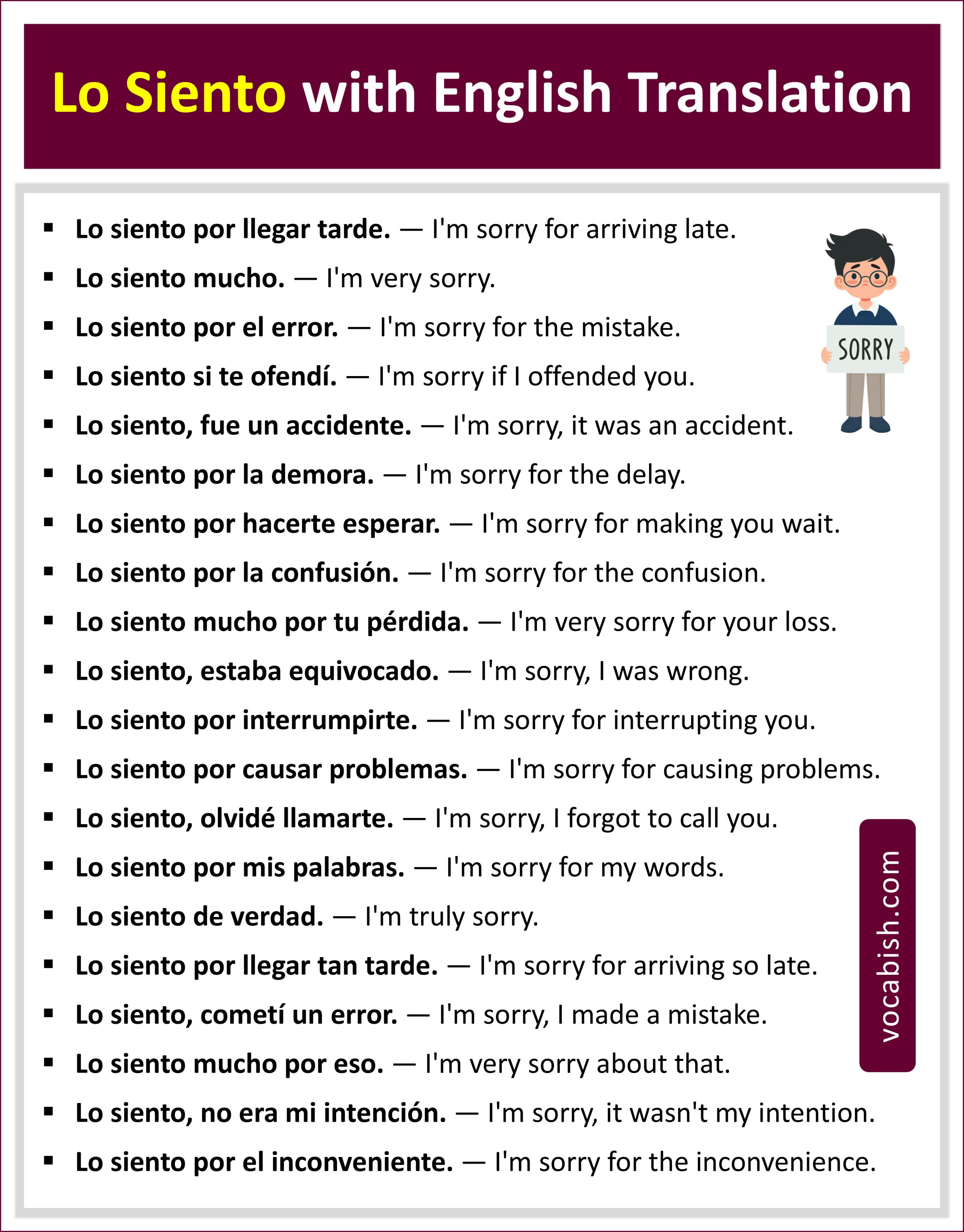
- Lo siento por llegar tarde. — I’m sorry for arriving late.
- Lo siento mucho. — I’m very sorry.
- Lo siento, olvidé tu cumpleaños. — I’m sorry, I forgot your birthday.
- Lo siento por el error. — I’m sorry for the mistake.
- Lo siento si te ofendí. — I’m sorry if I offended you.
- Lo siento, fue un accidente. — I’m sorry, it was an accident.
- Lo siento por la demora. — I’m sorry for the delay.
- Lo siento por hacerte esperar. — I’m sorry for making you wait.
- Lo siento, no escuché tu pregunta. — I’m sorry, I didn’t hear your question.
- Lo siento por la confusión. — I’m sorry for the confusion.
- Lo siento mucho por tu pérdida. — I’m very sorry for your loss.
- Lo siento, estaba equivocado. — I’m sorry, I was wrong.
- Lo siento por interrumpirte. — I’m sorry for interrupting you.
- Lo siento, tomé tu libro por error. — I’m sorry, I took your book by mistake.
- Lo siento por no responder antes. — I’m sorry for not replying earlier.
- Lo siento, no pude ayudarte ayer. — I’m sorry, I couldn’t help you yesterday.
- Lo siento por causar problemas. — I’m sorry for causing problems.
- Lo siento, olvidé llamarte. — I’m sorry, I forgot to call you.
- Lo siento por mis palabras. — I’m sorry for my words.
- Lo siento de verdad. — I’m truly sorry.
- Lo siento por llegar tan tarde. — I’m sorry for arriving so late.
- Lo siento, cometí un error. — I’m sorry, I made a mistake.
- Lo siento mucho por eso. — I’m very sorry about that.
- Lo siento, no era mi intención. — I’m sorry, it wasn’t my intention.
- Lo siento por el inconveniente. — I’m sorry for the inconvenience.
Perdón (Pardon Me / Sorry)
Perdón is often used for small mistakes, interruptions, or situations where you need someone’s attention. It is common in everyday conversations.
Many Spanish speakers use it the same way English speakers use “sorry” or “pardon me.”
Perdón Examples with English Translation
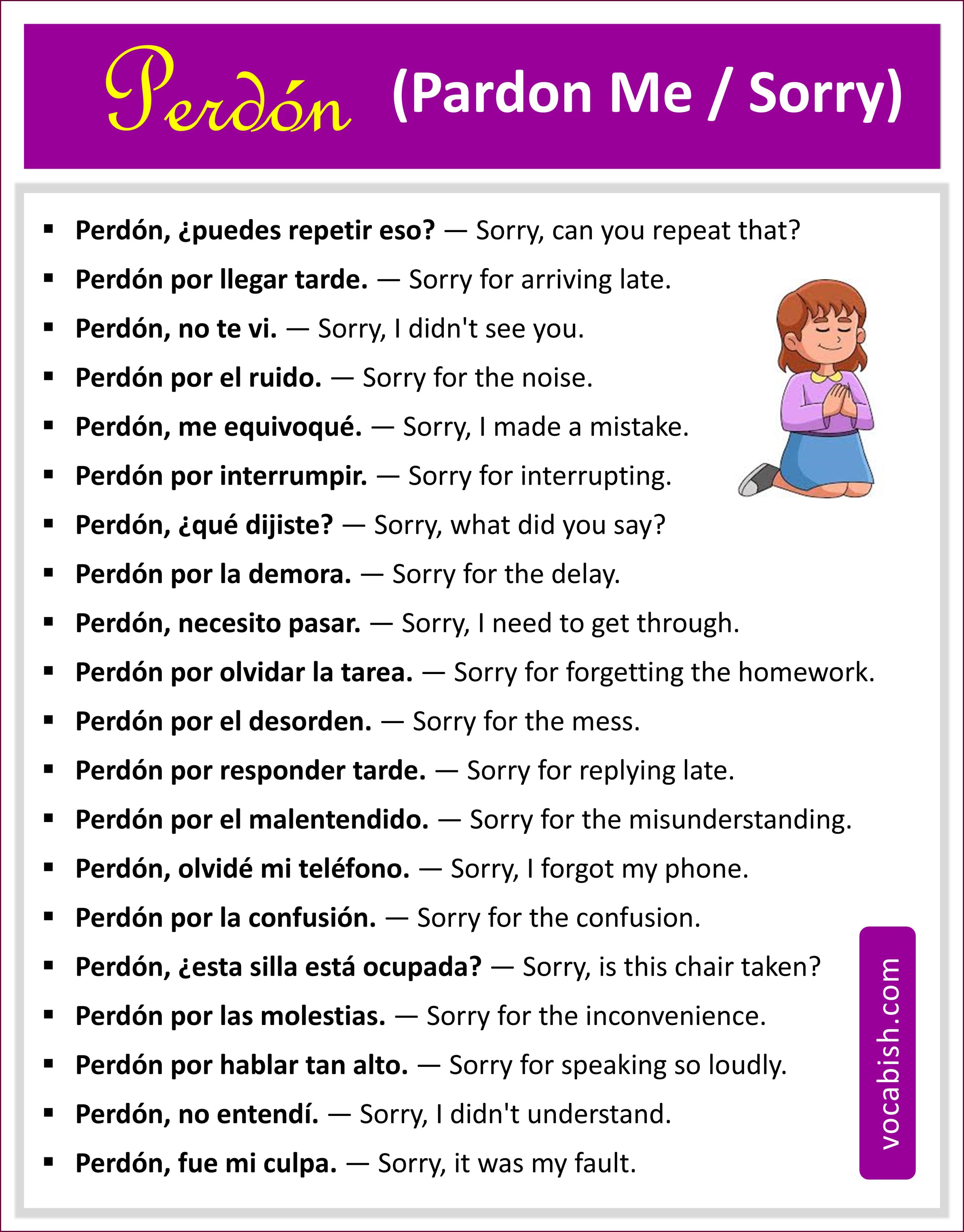
- Perdón, ¿puedes repetir eso? — Sorry, can you repeat that?
- Perdón por llegar tarde. — Sorry for arriving late.
- Perdón, no te vi. — Sorry, I didn’t see you.
- Perdón por el ruido. — Sorry for the noise.
- Perdón, me equivoqué. — Sorry, I made a mistake.
- Perdón por interrumpir. — Sorry for interrupting.
- Perdón, ¿qué dijiste? — Sorry, what did you say?
- Perdón por la demora. — Sorry for the delay.
- Perdón, necesito pasar. — Sorry, I need to get through.
- Perdón por olvidar la tarea. — Sorry for forgetting the homework.
- Perdón, pensé que eras otra persona. — Sorry, I thought you were someone else.
- Perdón por el desorden. — Sorry for the mess.
- Perdón, cerré la puerta muy fuerte. — Sorry, I closed the door too hard.
- Perdón por responder tarde. — Sorry for replying late.
- Perdón, estoy aprendiendo español. — Sorry, I’m learning Spanish.
- Perdón por el malentendido. — Sorry for the misunderstanding.
- Perdón, olvidé mi teléfono. — Sorry, I forgot my phone.
- Perdón por la confusión. — Sorry for the confusion.
- Perdón, ¿esta silla está ocupada? — Sorry, is this chair taken?
- Perdón por las molestias. — Sorry for the inconvenience.
- Perdón, llegué demasiado temprano. — Sorry, I arrived too early.
- Perdón por hablar tan alto. — Sorry for speaking so loudly.
- Perdón, no entendí. — Sorry, I didn’t understand.
- Perdón por entrar sin llamar. — Sorry for entering without knocking.
- Perdón, fue mi culpa. — Sorry, it was my fault.
Disculpa and Disculpe (Excuse Me / Sorry)
Disculpa is informal and often used with friends, classmates, or people of a similar age. Disculpe is more polite and commonly used with strangers, customers, teachers, or older people.
Both expressions are very useful in daily communication.
Examples of Disculpa with English Translation
- Disculpa, ¿puedo hacer una pregunta? — Excuse me, can I ask a question?
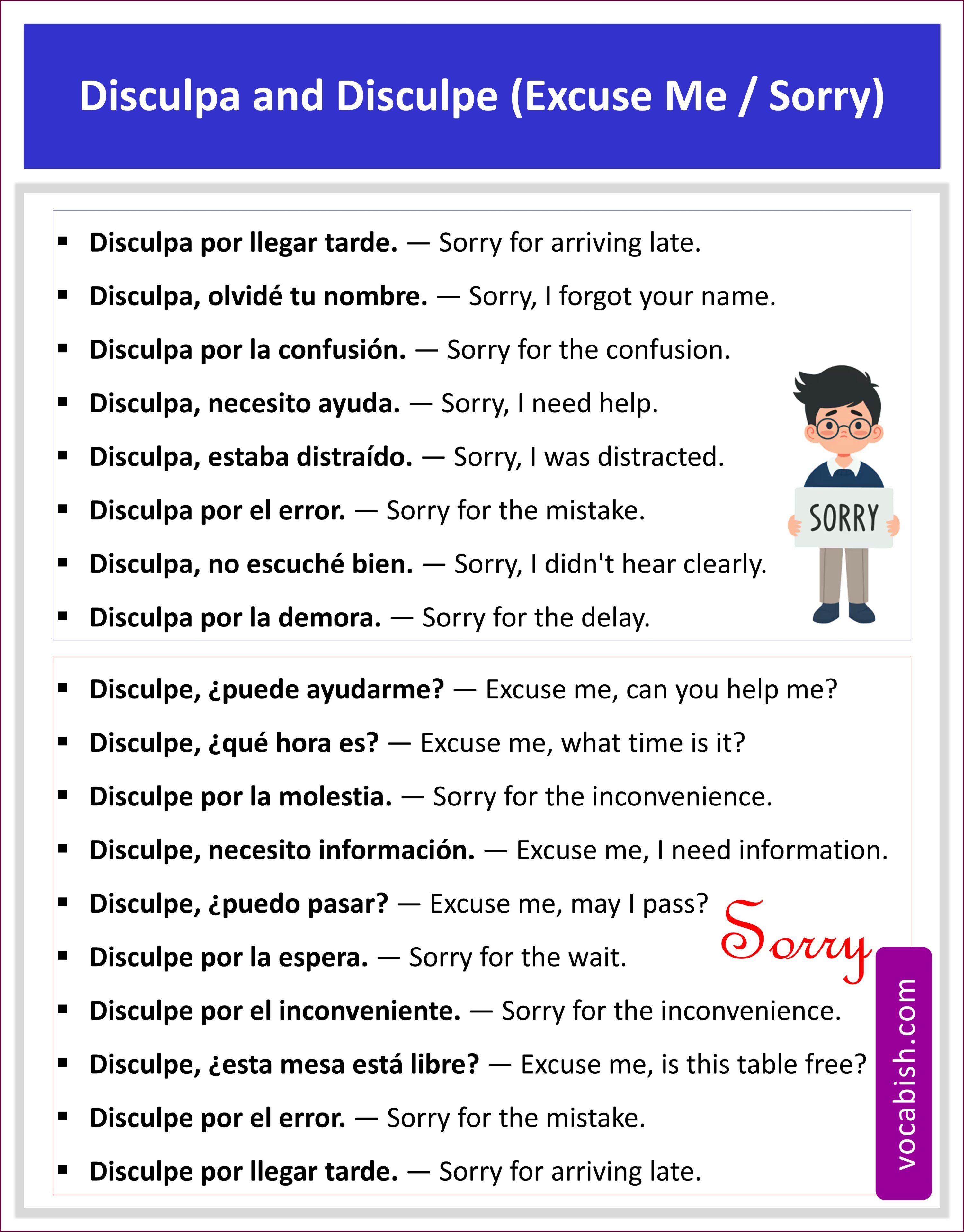
- Disculpa por llegar tarde. — Sorry for arriving late.
- Disculpa, olvidé tu nombre. — Sorry, I forgot your name.
- Disculpa por la confusión. — Sorry for the confusion.
- Disculpa, necesito ayuda. — Sorry, I need help.
- Disculpa por interrumpir la conversación. — Sorry for interrupting the conversation.
- Disculpa, estaba distraído. — Sorry, I was distracted.
- Disculpa por el error. — Sorry for the mistake.
- Disculpa, no escuché bien. — Sorry, I didn’t hear clearly.
- Disculpa por la demora. — Sorry for the delay.
Disculpe Examples with English Translation
- Disculpe, ¿puede ayudarme? — Excuse me, can you help me?
- Disculpe, ¿qué hora es? — Excuse me, what time is it?
- Disculpe por la molestia. — Sorry for the inconvenience.
- Disculpe, necesito información. — Excuse me, I need information.
- Disculpe, ¿puedo pasar? — Excuse me, may I pass?
- Disculpe por la espera. — Sorry for the wait.
- Disculpe, creo que dejó su bolso aquí. — Excuse me, I think you left your bag here.
- Disculpe por el inconveniente. — Sorry for the inconvenience.
- Disculpe, busco esta dirección. — Excuse me, I’m looking for this address.
- Disculpe, no hablo mucho español. — Excuse me, I don’t speak much Spanish.
- Disculpe, ¿esta mesa está libre? — Excuse me, is this table free?
- Disculpe por el error. — Sorry for the mistake.
- Disculpe, necesito hacer una llamada. — Excuse me, I need to make a call.
- Disculpe, ¿dónde está la estación? — Excuse me, where is the station?
- Disculpe por llegar tarde. — Sorry for arriving late.
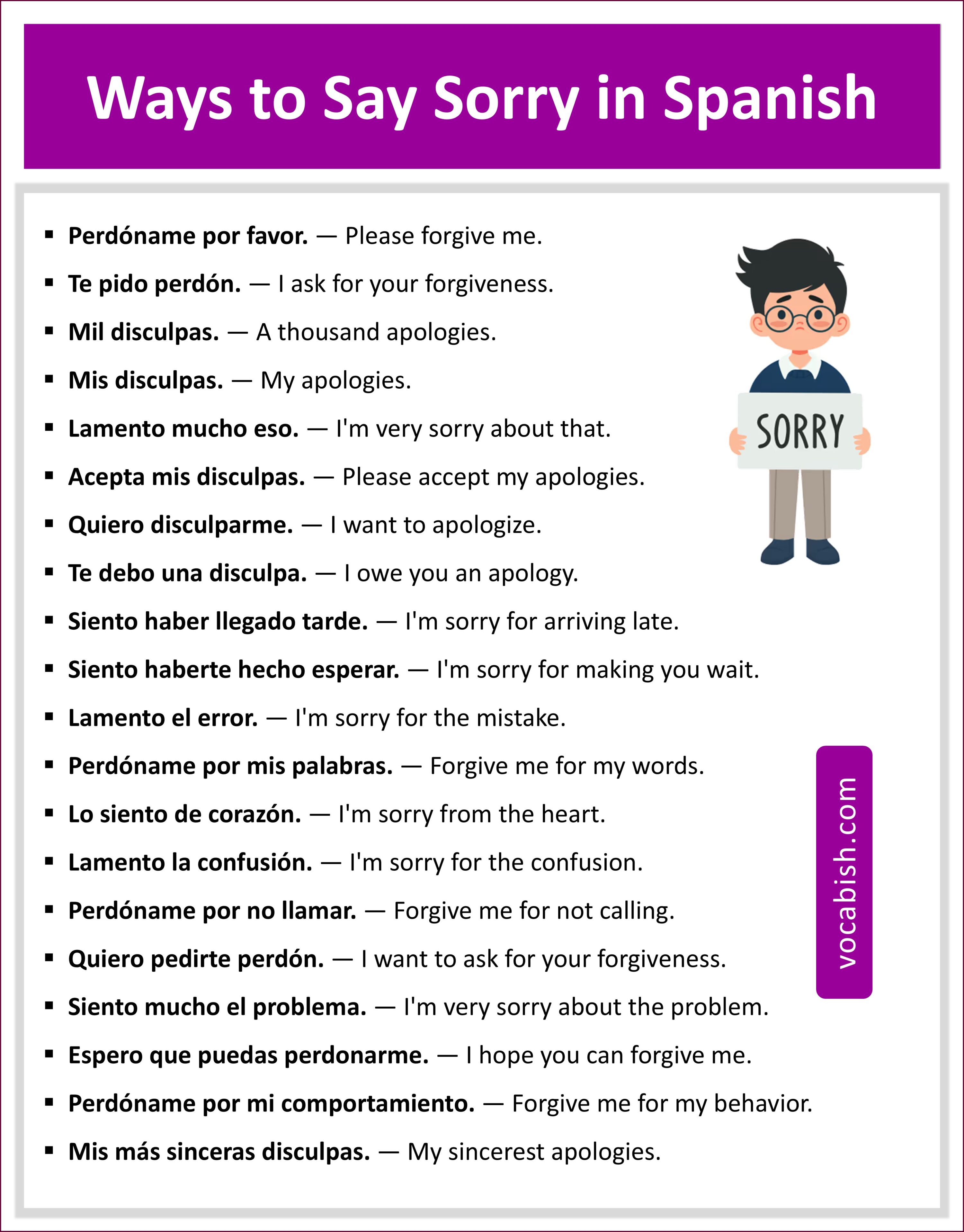
Other Ways to Say Sorry in Spanish
Spanish has several longer apology expressions that sound more sincere or formal. These phrases are useful when you want to show greater responsibility for a mistake.
They are common in personal conversations, school settings, and workplaces.
- Perdóname por favor. — Please forgive me.
- Te pido perdón. — I ask for your forgiveness.
- Mil disculpas. — A thousand apologies.
- Mis disculpas. — My apologies.
- Lo siento mucho por lo ocurrido. — I’m very sorry about what happened.
- Lamento mucho eso. — I’m very sorry about that.
- Acepta mis disculpas. — Please accept my apologies.
- Quiero disculparme. — I want to apologize.
- Te debo una disculpa. — I owe you an apology.
- Siento haber llegado tarde. — I’m sorry for arriving late.
- Siento haberte hecho esperar. — I’m sorry for making you wait.
- Lamento el error. — I’m sorry for the mistake.
- Perdóname por mis palabras. — Forgive me for my words.
- Lo siento de corazón. — I’m sorry from the heart.
- Lamento la confusión. — I’m sorry for the confusion.
- Perdóname por no llamar. — Forgive me for not calling.
- Quiero pedirte perdón. — I want to ask for your forgiveness.
- Siento mucho el problema. — I’m very sorry about the problem.
- Lamento profundamente lo sucedido. — I’m deeply sorry for what happened.
- Espero que puedas perdonarme. — I hope you can forgive me.
- Perdóname por mi comportamiento. — Forgive me for my behavior.
- Lo siento y asumiré la responsabilidad. — I’m sorry and I will take responsibility.
- Mis más sinceras disculpas. — My sincerest apologies.
- Siento no haber estado allí. — I’m sorry I wasn’t there.
- Lo siento por todo. — I’m sorry for everything.
Pronunciation Tips for Sorry in Spanish
Spanish apology phrases are usually spoken clearly and smoothly. Try listening to native speakers and repeat the phrases aloud to get comfortable with the sounds and rhythm.
Common Pronunciations:
- Lo siento → loh see-EN-toh
- Example: Lo siento por llegar tarde. (I’m sorry for arriving late.)
- Perdón → pehr-DON
- Example: Perdón, no te vi. (Sorry, I didn’t see you.)
- Disculpa → dees-KOOL-pah
- Example: Disculpa, ¿puedo hacer una pregunta? (Excuse me, can I ask a question?)
- Disculpe → dees-KOOL-peh
- Example: Disculpe, ¿puede ayudarme? (Excuse me, can you help me?)
- Perdóname → pehr-DOH-nah-meh
- Example: Perdóname por el error. (Forgive me for the mistake.)
Easy Speaking Tip:
In Spanish, the stressed syllable is important. For example:
- lo SIEN to
- per DÓN
- dis CUL pa
- dis CUL pe
Download PDF of Sorry in Spanish
You May Also Like:
- Spanish Words with English Meanings and PDF
- Condolence Phrases in Spanish with English
- 30 Most Common Spanish Phrases Used Daily
Tips for How to Say Sorry in Spanish
Using the right apology phrase can make your Spanish sound more natural. Choose your words based on the situation and how serious the mistake is.
- Use lo siento for sincere apologies.
- Example: Lo siento por llegar tarde. (I’m sorry for arriving late.)
- Use perdón for small mistakes or interruptions.
- Example: Perdón, ¿puedes repetir eso? (Sorry, can you repeat that?)
- Use disculpa with friends or people you know well.
- Example: Disculpa por la demora. (Sorry for the delay.)
- Use disculpe in formal situations.
- Example: Disculpe, ¿puede ayudarme? (Excuse me, can you help me?)
- Add mucho to make your apology stronger.
- Example: Lo siento mucho. (I’m very sorry.)
- Match your tone to the situation.
- A sincere and polite tone often matters as much as the words you use.
- Practice common apology phrases regularly.
- The more you use them, the more natural they will feel in conversation.
FAQs
Lo siento is the most common and widely understood expression for “I’m sorry.”
Lo siento usually expresses genuine regret, while perdón is often used for small mistakes or interruptions.
Disculpa is generally informal and is often used with friends or people you know well.
Use disculpe in formal situations or when speaking to strangers, customers, teachers, or older people.
Perdóname means “forgive me” and often sounds stronger than a standard apology.
Yes. Spanish speakers often say lo siento when expressing sympathy after hearing bad news.
Expressions such as mis disculpas, acepta mis disculpas, and le pido disculpas are common formal apologies.
Most learners start with lo siento, perdón, and disculpe because they are used frequently in daily conversations.
Conclusion
Learning Sorry in Spanish helps you communicate politely and naturally in many situations. Whether you use lo siento, perdón, disculpa, or a more formal apology, each expression has its own purpose.
As you practice how to say sorry in Spanish, try reading the examples aloud and comparing the Spanish sentences with their English translations. This approach helps build vocabulary, improve understanding, and increase confidence in everyday conversations.