Every sentence you write tells a story, and the way you arrange your words decides who the star of that story is. This is where active and passive voice come in.
Knowing how to switch between active and passive voice is a core skill for mastering English sentence transformation. It helps you sound more natural in conversations, write better essays, and pass grammar exams.
Let’s break down exactly what active and passive voice are, the rules for transforming them, and when to use each.
What is Active Voice?
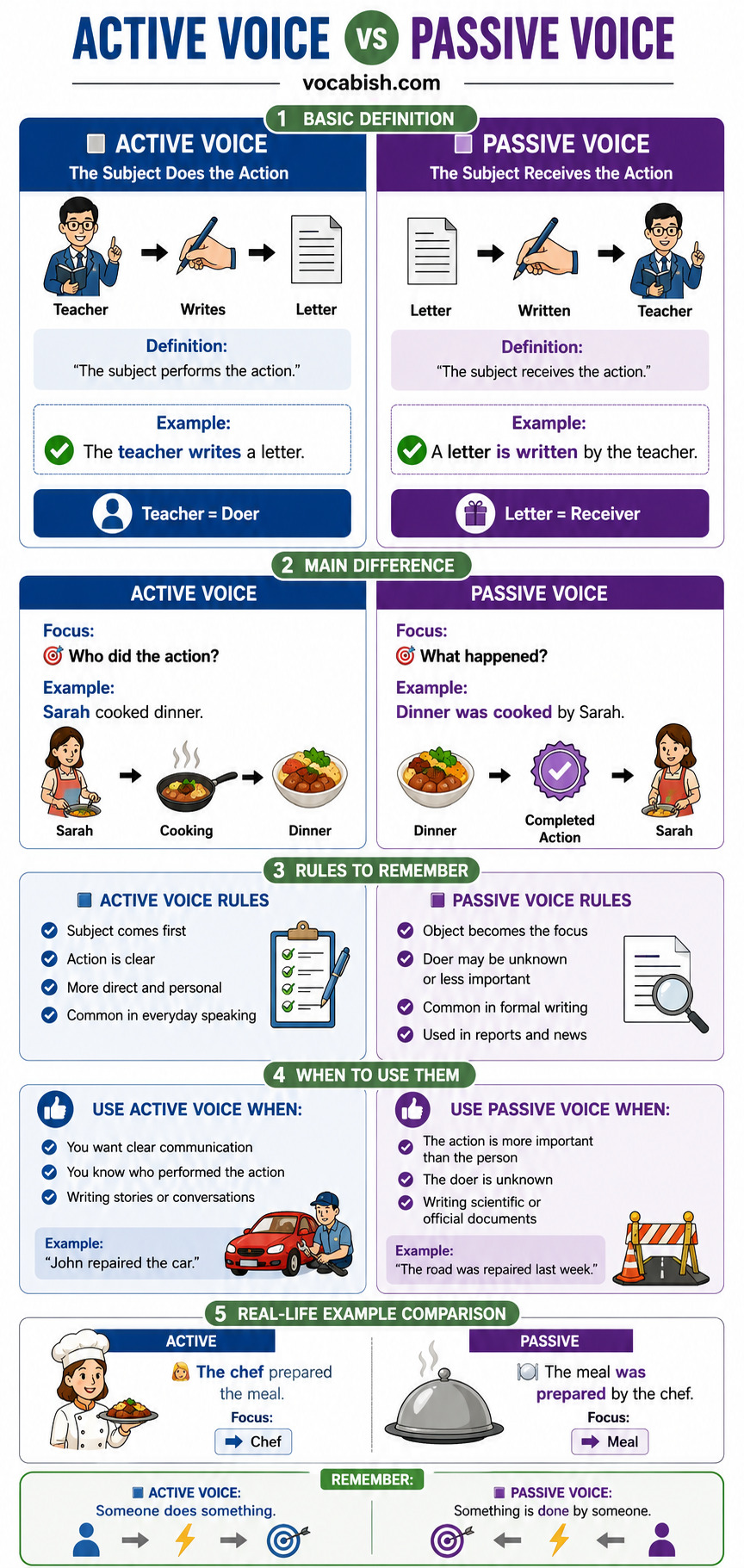
Active voice is when the subject of the sentence performs the action. It is direct, energetic, and tells the reader exactly who is doing what. In most everyday conversations and clear writing, you will use the active voice.
Structure of Active Voice
Subject + Verb + Object
Example in Sentence: “I finished the report.” (You clearly state that you did the work).
Quick Tip: If you want your writing to sound confident and easy to read, stick to the active voice.
What is Passive Voice?
Passive voice flips the sentence around. Instead of focusing on who did the action, the passive voice focuses on the person or thing receiving the action. We use it when the doer is unknown or unimportant or when we want to sound more formal and polite.
Structure of Passive Voice
Object + to be verb + Past Participle (V3) + [by Subject]
Example in Sentence: “The report was finished.” (The focus is entirely on the report. It doesn’t matter who finished it).
Active and Passive Voice Rules
Transforming a sentence from active to passive voice follows a strict pattern. If you miss a step, the grammar breaks. Here is exactly how to form passive voice:
1. Identify the parts:
Find the Subject, Verb, and Object in your active sentence.
2. Move the Object:
Take the Object from the active sentence and move it to the front. It is now the subject of your new sentence.
3. Add the ‘to be’ verb:
Look at the tense of the original verb. Add the matching form of the verb “to be” (am, is, are, was, were, be, being, been).
4. Change to Past Participle:
Take the main action verb and change it to its past participle form (also known as V3, like eaten, broken, played).
5. Add ‘by’ (Optional): Only if the doer is important.
If you need to mention who did the action, add the word “by” at the end, followed by the original subject. Remember to change pronouns (e.g., “I” becomes “me”, “she” becomes “her”).
6. Ensure that pronouns and tense are adjusted accordingly.
Active Voice (Subject) | Passive Voice (Object) |
I | me |
You | you |
He/She/It | him/her/it |
We | us |
They | them |
Difference Between Active And Passive Voice
Feature | Active Voice | Passive Voice |
Action Focus | The person doing the action | The thing receiving the action |
Tone | Direct, clear, and personal | Formal, objective, or detached |
Pacing | Fast and easy to read | Slower and more complex |
Best Used For | Everyday speech and storytelling | Science reports, news, and formal rules |
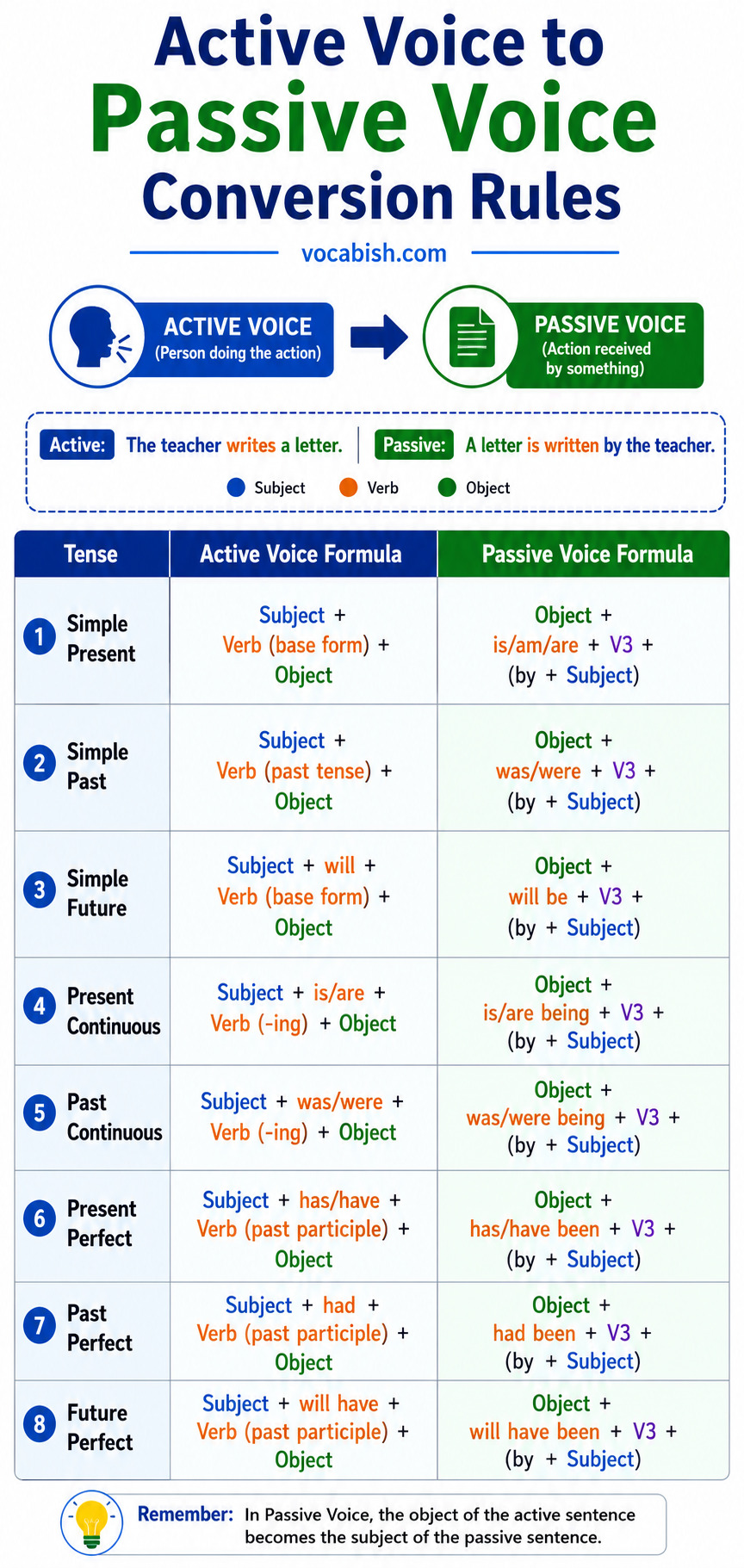
Formation of Active and Passive Voice in Different Tenses
The biggest challenge in sentence transformation is matching the tenses correctly. The “to be” verb does all the heavy lifting here.
Tense | Active Voice | Passive Voice |
Simple Present | Subject + Verb (base form) + Object | Object + is/am/are + V3 + (by + Subject) |
Simple Past | Subject + Verb (past tense) + Object | Object + was/were + V3 + (by + Subject) |
Simple Future | Subject + will + Verb (base form) + Object | Object + will be + V3 + (by + Subject) |
Present Continuous | Subject + is/are + Verb (-ing) + Object | Object + is/are being + V3 + (by + Subject) |
Past Continuous | Subject + was/were + Verb (-ing) + Object | Object + was/were being + V3 + (by + Subject) |
Present Perfect | Subject + has/have + Verb (past participle) + Object | Object + has/have been + V3 + (by + Subject) |
Past Perfect | Subject + had + Verb (past participle) + Object | Object + had been + V3 + (by + Subject) |
Future Perfect | Subject + will have + Verb (past participle) + Object | Object + will have been + V3 + (by + Subject) |
Simple Present Active And Passive Voice Examples Sentences
These show actions happening regularly or facts. The passive uses am/is/are + Past Participle (V3).
Active Voice | Passive Voice |
She feeds the dog. | The dog is fed by her. |
He takes the photos. | The photos are taken by him. |
We bake the cakes. | The cakes are baked by us. |
They wash the dishes. | The dishes are washed by them. |
I answer the phone. | The phone is answered by me. |
Present Continuous Examples Sentences
These show actions happening right now. The passive uses am/is/are + being + Past Participle (V3).
Active Voice | Passive Voice |
She is writing an email. | An email is being written by her. |
They are building a wall. | A wall is being built by them. |
He is fixing the TV. | The TV is being fixed by him. |
We are painting the house. | The house is being painted by us. |
The cat is catching the mouse. | The mouse is being caught by the cat. |
Present Perfect Examples Sentences
These show recently completed actions. The passive uses has/have + been + Past Participle (V3).
Active Voice | Passive Voice |
I have finished the report. | The report has been finished by me. |
She has lost the keys. | The keys have been lost by her. |
They have won the match. | The match has been won by them. |
He has cooked dinner. | Dinner has been cooked by him. |
We have planted the tree. | The tree has been planted by us. |
Simple Past Examples Sentences
These show actions finished in the past. The passive uses was/were + Past Participle (V3).
Active Voice | Passive Voice |
He locked the door. | The door was locked by him. |
She sang a song. | A song was sung by her. |
They broke the window. | The window was broken by them. |
I bought a new car. | A new car was bought by me. |
The dog bit the boy. | The boy was bitten by the dog. |
Past Continuous Examples Sentences
These show actions that were ongoing in the past. The passive uses was/were + being + Past Participle (V3).
Active Voice | Passive Voice |
She was reading a novel. | A novel was being read by her. |
They were watching a movie. | A movie was being watched by them. |
He was repairing the bike. | The bike was being repaired by him. |
We were singing songs. | Songs were being sung by us. |
I was eating an apple. | An apple was being eaten by me. |
Past Perfect Examples Sentences
These show actions completed before another past action. The passive uses had + been + Past Participle (V3).
Active Voice | Passive Voice |
She had solved the puzzle. | The puzzle had been solved by her. |
They had finished the work. | The work had been finished by them. |
He had returned the book. | The book had been returned by him. |
I had paid the bill. | The bill had been paid by me. |
We had packed the bags. | The bags had been packed by us. |
Simple Future Examples Sentences
These show actions that will happen later. The passive uses will be + Past Participle (V3).
Active Voice | Passive Voice |
She will buy the tickets. | The tickets will be bought by her. |
He will send the message. | The message will be sent by him. |
They will clean the yard. | The yard will be cleaned by them. |
I will read the report. | The report will be read by me. |
We will win the game. | The game will be won by us. |
Future Perfect Examples Sentences
These show actions that will be completed by a certain time in the future. The passive uses will have been + Past Participle (V3).
Active Voice | Passive Voice |
She will have painted the room. | The room will have been painted by her. |
They will have sold the house. | The house will have been sold by them. |
He will have paid the rent. | The rent will have been paid by him. |
I will have typed the letter. | The letter will have been typed by me. |
We will have prepared the food. | The food will have been prepared by us. |
Active and Passive Voice Quiz
Test your understanding. Decide if the following sentences are Active (A) or Passive (P).
- The window was broken yesterday.
- My sister paints beautiful portraits.
- The new software is being installed right now.
- We will announce the winner at 8 PM.
- The cookies were eaten by the children.
Answers: 1. Passive, 2. Active, 3. Passive, 4. Active, 5. Passive.
Active and Passive Voice Worksheet
Grab a pen or open a text document. Transform these active sentences into the passive voice. Pay close attention to the verb tenses!
- The teacher explains the grammar rules clearly.
- The company is launching a new phone next week.
- A famous director directed that movie.
- The storm had destroyed the old bridge.
- They will deliver the package tomorrow morning.
Answers:
- The grammar rules are explained clearly by the teacher.
- A new phone is being launched by the company next week.
- That movie was directed by a famous director.
- The old bridge had been destroyed by the storm.
- The package will be delivered tomorrow morning.
FAQs About Active and Passive Voice
Active voice is a sentence structure where the subject performs the action directly, making your writing clear, energetic, and easy to understand.
Passive voice is a sentence structure where the object receives the action, shifting focus away from the doer to the result.
Move the object to the front, add the correct tense of the verb “to be,” and use the main verb’s past participle.
Use passive voice when the person doing the action is unknown, unimportant, or when writing formal, scientific, and academic papers.
No, only sentences with transitive verbs—verbs that take a direct object—can be successfully transformed into the passive voice structure.
Active: The barista makes my coffee every morning.
Passive: My coffee is made by the barista every morning.
Active: Someone stole my bicycle yesterday.
Passive: My bicycle was stolen yesterday. (Notice we drop “by someone” because we don’t know who did it).
Active: The crew is fixing the road outside.
Passive: The road outside is being fixed by the crew.
Conclusion
Mastering active and passive voice is really about taking control of your writing. Once you know how to shift the focus from the person doing the action to the action itself, you get to decide exactly how your sentences sound.
As a general rule, stick to the active voice for your everyday conversations, emails, and essays to keep your English clear and energetic. Save the passive voice for those specific moments when you need to sound formal, objective, or when the doer just doesn’t matter.
Keep practicing with the tense formulas we covered. Take it one sentence at a time, and soon, transforming these structures will feel completely natural.
You May Also Like: