

A semicolon (;) connects ideas that are more closely related than two separate sentences but too complete to be joined by a comma alone.
Compare:
- The rain stopped. We continued our journey.
- The rain stopped; we continued our journey.
Both versions are correct. The semicolon makes the relationship between the two ideas feel stronger.
Think of a semicolon as a pause that is:
- Stronger than a comma
- Weaker than a full stop
- Used mainly between closely connected complete ideas
Understanding the main semicolon rules will help you avoid comma splices, organise complicated lists, and show relationships between sentences more clearly.
Joining Related Independent Clauses
A semicolon can join two independent clauses without a coordinating conjunction.
An independent clause:
- Contains a subject and a verb
- Expresses a complete thought
- Can stand alone as a sentence
Pattern:
Independent clause + ; + independent clause
Examples:
- The shop closes at nine; we still have plenty of time.
- Sara enjoys historical novels; her brother prefers science fiction.
- The road was covered with ice; driving conditions were dangerous.
- I have finished the report; you can review it now.
- The children were unusually quiet; they were planning a surprise.
Each part could be written as a separate sentence:
- The shop closes at nine. We still have plenty of time.
The semicolon is useful because the two statements are directly connected.
When the connection is not clear
Do not join unrelated ideas with a semicolon.
Incorrect:
- The meeting begins at ten; my neighbour owns a bakery.
Better:
- The meeting begins at ten. My neighbour owns a bakery.
Use a semicolon only when readers can easily understand the relationship between the two clauses.
Do not add a coordinating conjunction
Coordinating conjunctions include:
- And
- But
- Or
- So
- Yet
- For
- Nor
Incorrect:
- The bus was late; so we took a taxi.
Correct:
- The bus was late, so we took a taxi.
- The bus was late; we took a taxi.
A comma normally comes before a coordinating conjunction that joins two independent clauses.
Semicolons with Linking Adverbs
A semicolon is commonly used before a linking adverb when the adverb connects two independent clauses.
Common linking adverbs include:
- However
- Therefore
- Nevertheless
- Consequently
- Meanwhile
- Otherwise
- Instead
- Furthermore
- Similarly
- Thus
Pattern:
Independent clause + ; + linking adverb + , + independent clause
Examples:
- The hotel looked expensive; however, the rooms were reasonably priced.
- Amir had studied carefully; therefore, he felt confident about the test.
- We could leave immediately; otherwise, we might miss the train.
- The weather forecast predicted rain; nevertheless, they continued with the picnic.
- The roads were blocked; consequently, the delivery arrived late.
- Maria did not complain; instead, she quietly solved the problem.
The semicolon separates the two complete clauses. The comma separates the linking adverb from the second clause.
Linking phrases
Some linking phrases follow the same punctuation pattern:
- For example
- In addition
- In fact
- On the other hand
- As a result
- In other words
Examples:
- Some animals remain active at night; for example, owls hunt after sunset.
- The apartment is close to my office; in addition, it has excellent security.
- He had not forgotten the appointment; in fact, he arrived thirty minutes early.
- The task looks simple; on the other hand, it requires careful planning.
When the linking word appears inside one clause
Do not automatically place a semicolon before every linking adverb.
- The journey, however, took longer than expected.
- We therefore decided to stay overnight.
- She was nevertheless pleased with the final result.
A semicolon is needed only when the linking word connects two independent clauses.
Semicolons in Complex Lists
Commas usually separate items in a list:
- We bought apples, oranges, bananas, and grapes.
When the individual items already contain commas, semicolons make the divisions clearer.
Pattern:
Item with commas; item with commas; and item with commas
Examples:
- The conference welcomed speakers from Karachi, Pakistan; Dubai, United Arab Emirates; London, England; and Toronto, Canada.
- The committee included Nadia Khan, the chairperson; Bilal Ahmed, the treasurer; and Sarah Ali, the secretary.
- We visited Lahore, known for its historical buildings; Islamabad, famous for its green spaces; and Multan, recognised for its shrines.
- The package contained a blue shirt, size medium; a black jacket, size large; and two pairs of white socks.
- The winners were Hamza, first place; Sameer, second place; and Adeel, third place.
Without semicolons, the list may become confusing:
- The guests came from Paris, France, Rome, Italy, Madrid, Spain, and Lisbon, Portugal.
Clearer:
- The guests came from Paris, France; Rome, Italy; Madrid, Spain; and Lisbon, Portugal.
Semicolons show exactly where one list item ends and the next begins.
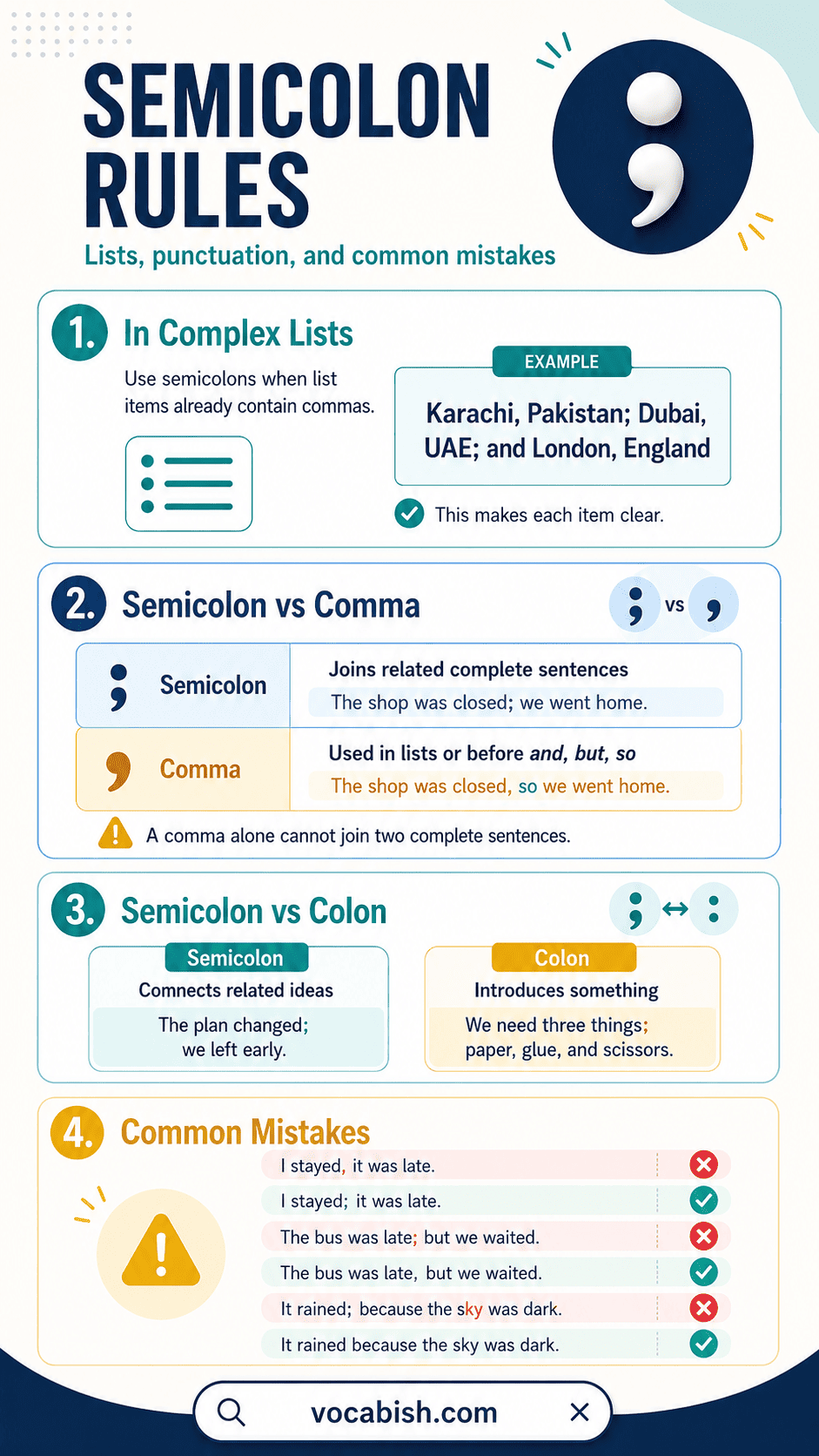
Semicolon vs Comma
A comma cannot usually join two independent clauses by itself. Doing so creates a comma splice.
Situation | Correct punctuation | Example |
|---|---|---|
Two closely related independent clauses | Semicolon | The lights went out; the room became silent. |
Independent clauses joined by a coordinating conjunction | Comma | The lights went out, so the room became silent. |
One independent clause followed by a dependent clause | Comma when required | The room became silent when the lights went out. |
Simple list items | Commas | We bought bread, milk, eggs, and cheese. |
Complicated list items containing commas | Semicolons | We visited York, England; Cork, Ireland; and Perth, Scotland. |
Avoid comma splices
Incorrect:
- I called the office, nobody answered.
Correct:
- I called the office; nobody answered.
- I called the office, but nobody answered.
- I called the office. Nobody answered.
A semicolon cannot replace every comma
Incorrect:
- After the lesson; the students asked questions.
Correct:
- After the lesson, the students asked questions.
The words after the lesson do not form an independent clause, so a semicolon is unsuitable.