
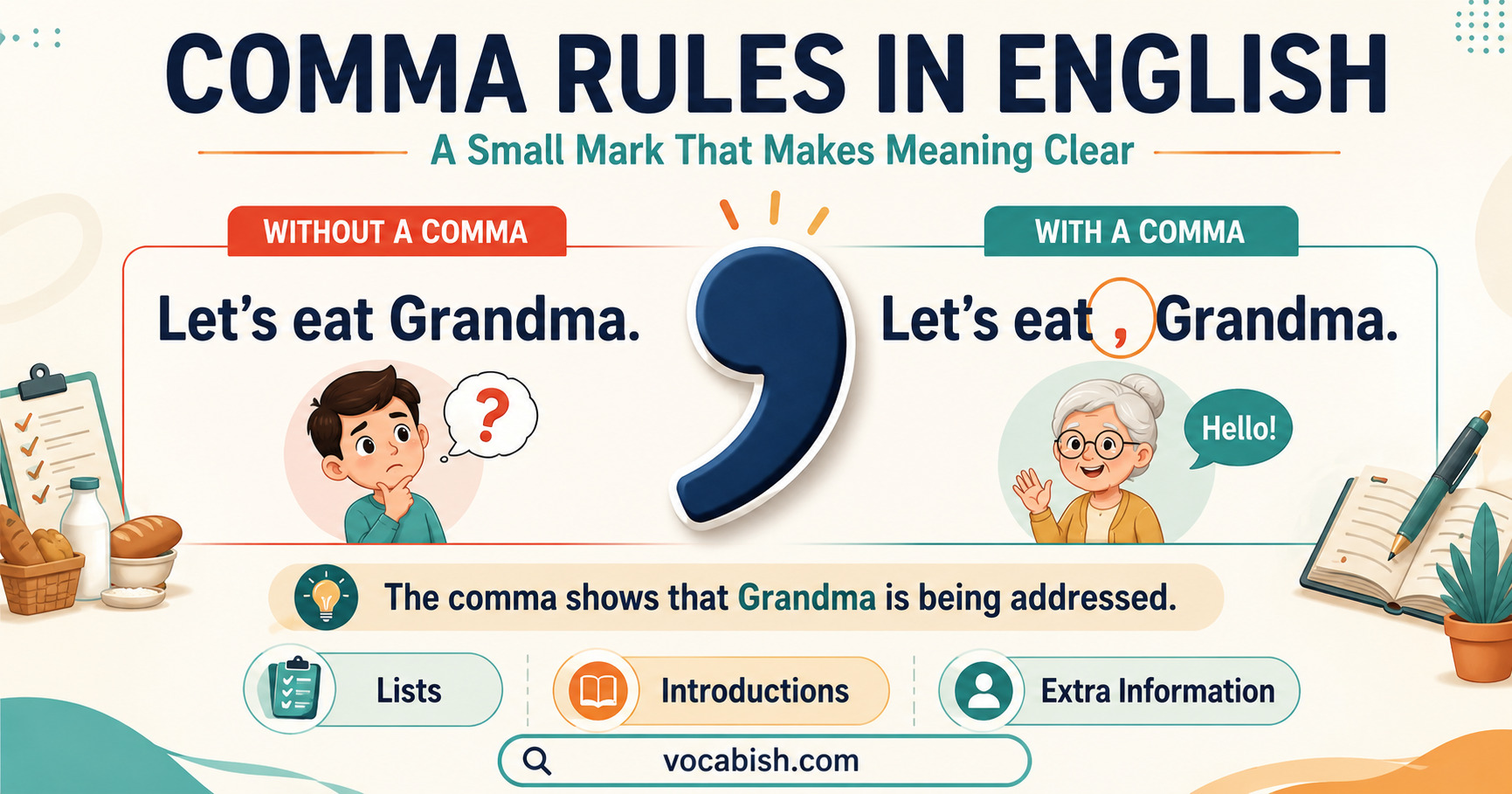

A comma (,) is a small punctuation mark, but it can make a noticeable difference to a sentence. It separates ideas, organizes information, and helps readers understand where one part of a sentence ends and another begins.
Learning comma rules is not simply about adding pauses. A comma should reflect the grammatical structure and meaning of a sentence. Some spoken pauses need commas, while others do not.
What Does a Comma Do?
A comma can:
- separate items in a list
- separate an introductory element from the main sentence
- connect two complete clauses with a coordinating conjunction
- mark extra or nonessential information
- show that someone is being addressed directly
- prevent confusion or an unintended meaning
Compare these sentences:
Without a Comma | With a Comma | Difference |
|---|---|---|
Let’s eat Grandma. | Let’s eat, Grandma. | The comma shows that Grandma is being addressed. |
After eating the children played. | After eating, the children played. | The comma separates the introductory phrase. |
I like cooking my family and my pets. | I like cooking, my family, and my pets. | The commas separate three different interests. |
A comma does not always represent a long pause. Its main job is to show how the words and ideas in a sentence are connected.
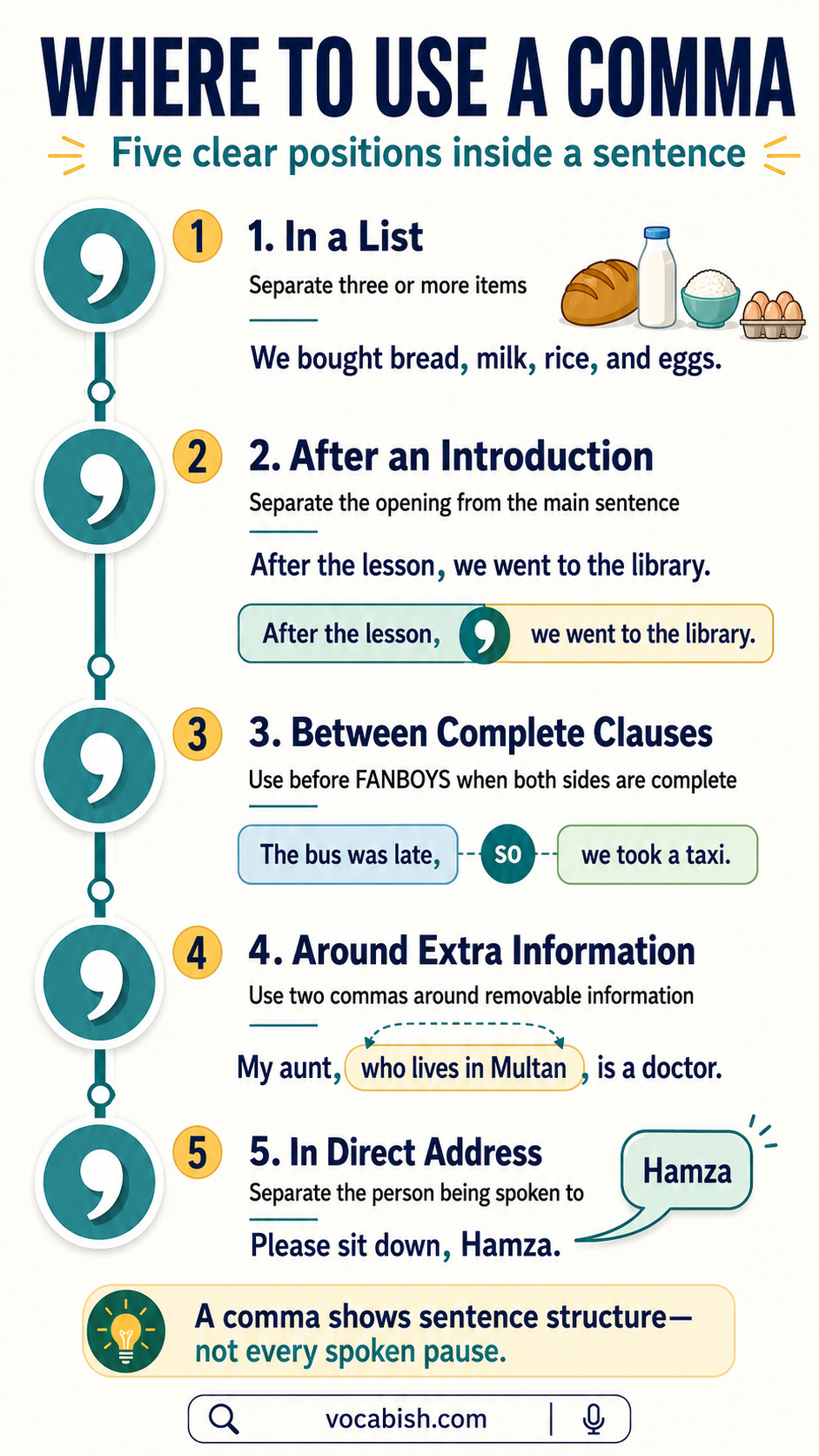
Commas in Lists
Use commas to separate three or more words, phrases, or clauses in a series.
Lists of Words
- We bought bread, milk, rice, and eggs.
- Her dress was simple, elegant, and comfortable.
- The flag is green, white, and gold.
Do not normally use a comma when a list contains only two items:
- We bought bread and milk.
- He is polite and patient.
Lists of Phrases
Commas can separate longer items:
- The job involves answering emails, preparing reports, attending meetings, and helping customers.
- On holiday, we plan to visit the museum, walk through the old town, and eat at local restaurants.
Lists of Clauses
A series can also contain complete clauses:
- The lights went out, the children became quiet, and someone opened the door.
- She checked the figures, she corrected the mistakes, and she sent the report.
The Oxford Comma
The comma before the final “and” or “or” is called the Oxford comma or serial comma.
- Without an Oxford comma: We invited the teachers, Sara and Ali.
- With an Oxford comma: We invited the teachers, Sara, and Ali.
The Oxford comma is optional in many writing styles, but it is useful when it prevents confusion.
Style | Example |
|---|---|
Without an Oxford comma | I ordered soup, bread and tea. |
With an Oxford comma | I ordered soup, bread, and tea. |
Needed for clarity | The prize went to my parents, Sana, and Ahmed. |
Be consistent. If your school, company, or publisher follows a particular style guide, use its preferred list punctuation.
Commas after Introductory Words
An introductory element appears before the main part of a sentence. A comma helps separate it from the complete idea that follows.
After Introductory Words
Common introductory words include yes, no, however, well, unfortunately, first, finally, meanwhile, and therefore.
- Yes, I understand the instructions.
- Unfortunately, the shop was closed.
- However, we found another solution.
- Finally, the rain stopped.
- Well, that was unexpected.
A short word such as today or sometimes may not need a comma when the sentence remains clear:
- Today we are studying punctuation.
- Sometimes people change their minds.
A comma may be added when the writer wants to give the word more emphasis:
- Today, we are studying punctuation.
After Introductory Phrases
Use a comma after an introductory phrase, especially when it is long or could be misunderstood.
- Before the meeting, I reviewed my notes.
- On the other side of the road, a small café was still open.
- After several unsuccessful attempts, the team solved the problem.
- To improve her pronunciation, Maria practised every evening.
Compare:
- Before eating, the children washed their hands.
- Before eating the children, the monster washed its hands.
The first comma prevents the reader from briefly misunderstanding the sentence.
After Introductory Dependent Clauses
A dependent clause cannot stand alone as a complete sentence. When it comes before the main clause, place a comma after it.
- When the lesson ended, the students packed their bags.
- Because the road was flooded, we stayed at home.
- Although he was nervous, he answered every question.
- If you need assistance, call the reception desk.
Commas with Clauses
A clause contains a subject and a verb. Comma use depends on the type of clause and its position.
Two Independent Clauses
An independent clause expresses a complete idea. Use a comma before a coordinating conjunction when it connects two independent clauses.
The main coordinating conjunctions can be remembered as FANBOYS:
- for
- and
- nor
- but
- or
- yet
- so
Examples:
- I wanted to leave, but the meeting was not finished.
- The weather was cold, so we stayed indoors.
- You can take the bus, or you can walk with us.
- Nadia prepared the slides, and Hassan checked the figures.
Both sides must be complete sentences:
- I wanted to leave.
- The meeting was not finished.
Because both clauses are complete, the comma is correct.
Do not usually place a comma before a conjunction joining only words or phrases:
- Correct: Hamza bought a notebook and two pens.
- Incorrect: Hamza bought a notebook, and two pens.
Dependent Clause before the Main Clause
Use a comma when the dependent clause appears first:
- If the printer stops working, contact the office manager.
- While I was waiting, I read the instructions.
- Since nobody objected, the proposal was accepted.
Dependent Clause after the Main Clause
A comma is usually unnecessary when the dependent clause follows the main clause:
- Contact the office manager if the printer stops working.
- I read the instructions while I was waiting.
- The proposal was accepted since nobody objected.
However, a comma may be needed when the final clause expresses contrast or unexpected information:
- I completed the work, although I was feeling unwell.
- She agreed to attend, even though she disliked large gatherings.
Sentence Pattern | Comma Rule | Example |
|---|---|---|
Dependent clause + main clause | Use a comma | When the bell rang, everyone left. |
Main clause + necessary dependent clause | Usually no comma | Everyone left when the bell rang. |
Main clause + contrasting clause | A comma may be used | Everyone stayed, although it was late. |
Complete clause + FANBOYS + complete clause | Use a comma | It was late, but everyone stayed. |
Commas around Extra Information
Use commas around information that adds detail but is not needed to identify the person or thing being discussed.
This information is sometimes called:
- nonessential information
- nonrestrictive information
- a parenthetical element
Extra Information in the Middle
Place one comma before the extra information and another after it.
- My brother, who lives in Lahore, is visiting us.
- The building, which was completed last year, has twenty offices.
- Mrs Khan, our new manager, will lead the meeting.
- The laptop, despite its age, still works well.
Test the sentence by removing the information:
- My brother is visiting us.
- The building has twenty offices.
- Mrs Khan will lead the meeting.
- The laptop still works well.
The remaining sentences are grammatically complete and keep their basic meaning.
Extra Information at the End
Use one comma before extra information placed at the end:
- We stayed at the Riverside Hotel, which overlooks the lake.
- Ayesha won the competition, an impressive achievement for a first-time participant.
- The delivery arrived on Friday, two days earlier than expected.
Essential Information
Do not use commas around information needed to identify the noun.
- The student who received the highest score won a scholarship.
- People who work from home often need a quiet space.
- The book that you lent me was fascinating.
The highlighted information identifies which student, people, or book the speaker means.
Compare the meanings:
Sentence | Meaning |
|---|---|
My cousins who live in Karachi are visiting. | Only the cousins living in Karachi are visiting. |
My cousins, who live in Karachi, are visiting. | All my cousins live in Karachi, and they are visiting. |
The cars that were damaged were removed. | Only the damaged cars were removed. |
The cars, which were damaged, were removed. | All the cars were damaged and removed. |
Do not add commas simply because a clause begins with who, which, or that. First decide whether the information is essential.