
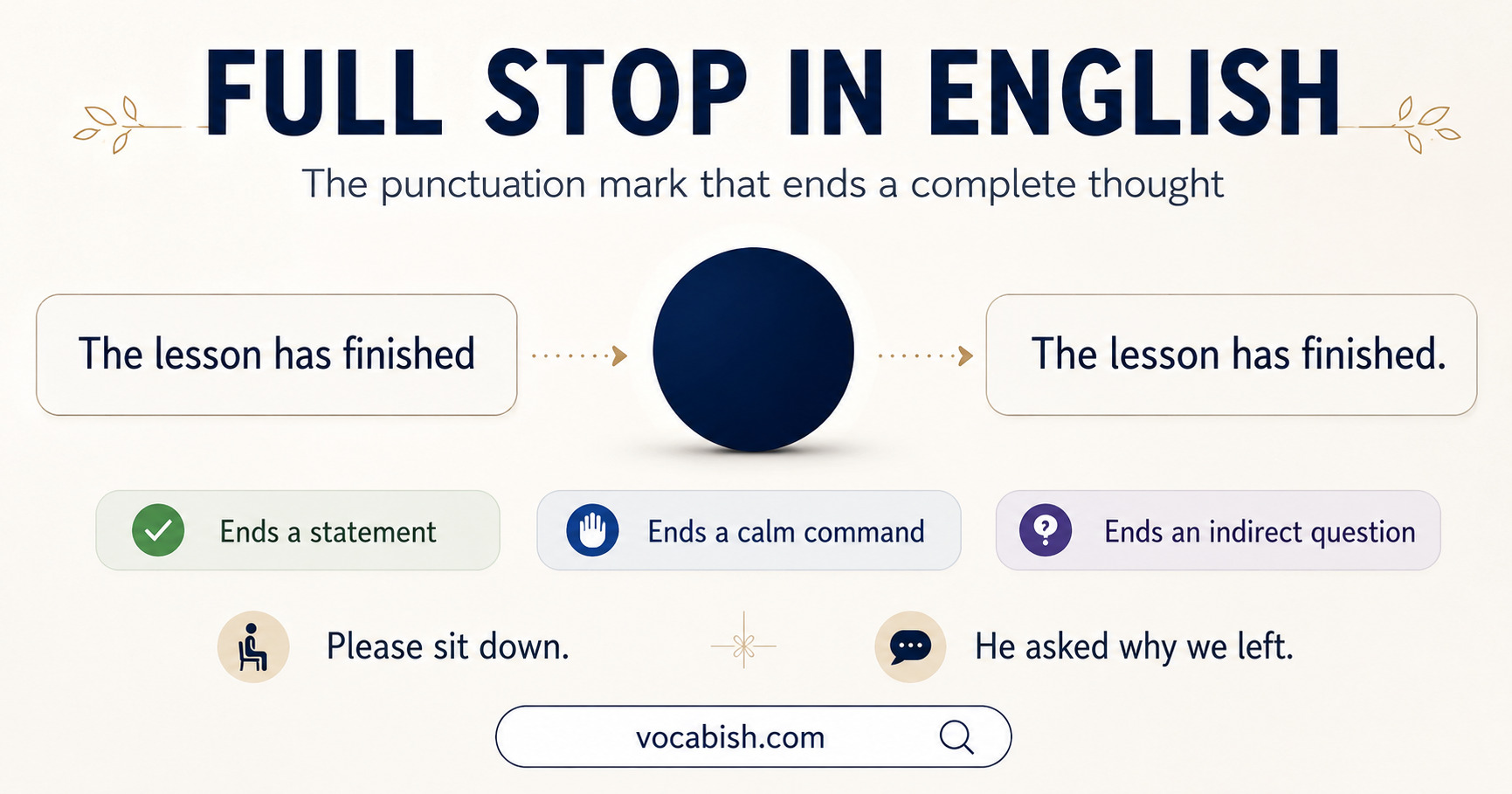

The full stop punctuation mark (.) shows that a complete sentence or idea has ended. It helps readers pause, separate one statement from another, and follow written information clearly.
In American English, a full stop is usually called a period. Although it is one of the simplest punctuation marks, learners often misuse it with questions, abbreviations, initials, and decimal numbers.
What Is a Full Stop?
A full stop (.) is an end punctuation mark placed after a complete statement.
It tells the reader:
- The sentence is complete.
- The writer has finished one idea.
- A new sentence may begin next.
- The sentence is not a direct question or strong exclamation.
Example:
Our English class begins at nine.
The full stop after nine shows that the statement has ended.
A full stop is known by two common names:
Variety of English | Common Name |
|---|---|
British English | Full stop |
American English | Period |
The mark and its basic function remain the same in both varieties.
Where and How to Use a Full Stop (.)
A full stop (.) is used at the end of a complete statement or sentence. It shows that the thought is finished and helps readers understand where one sentence ends and another begins.
Ending Statements
The main use of a full stop is to end a declarative sentence. A declarative sentence gives information, states an opinion, describes something, or presents a fact.
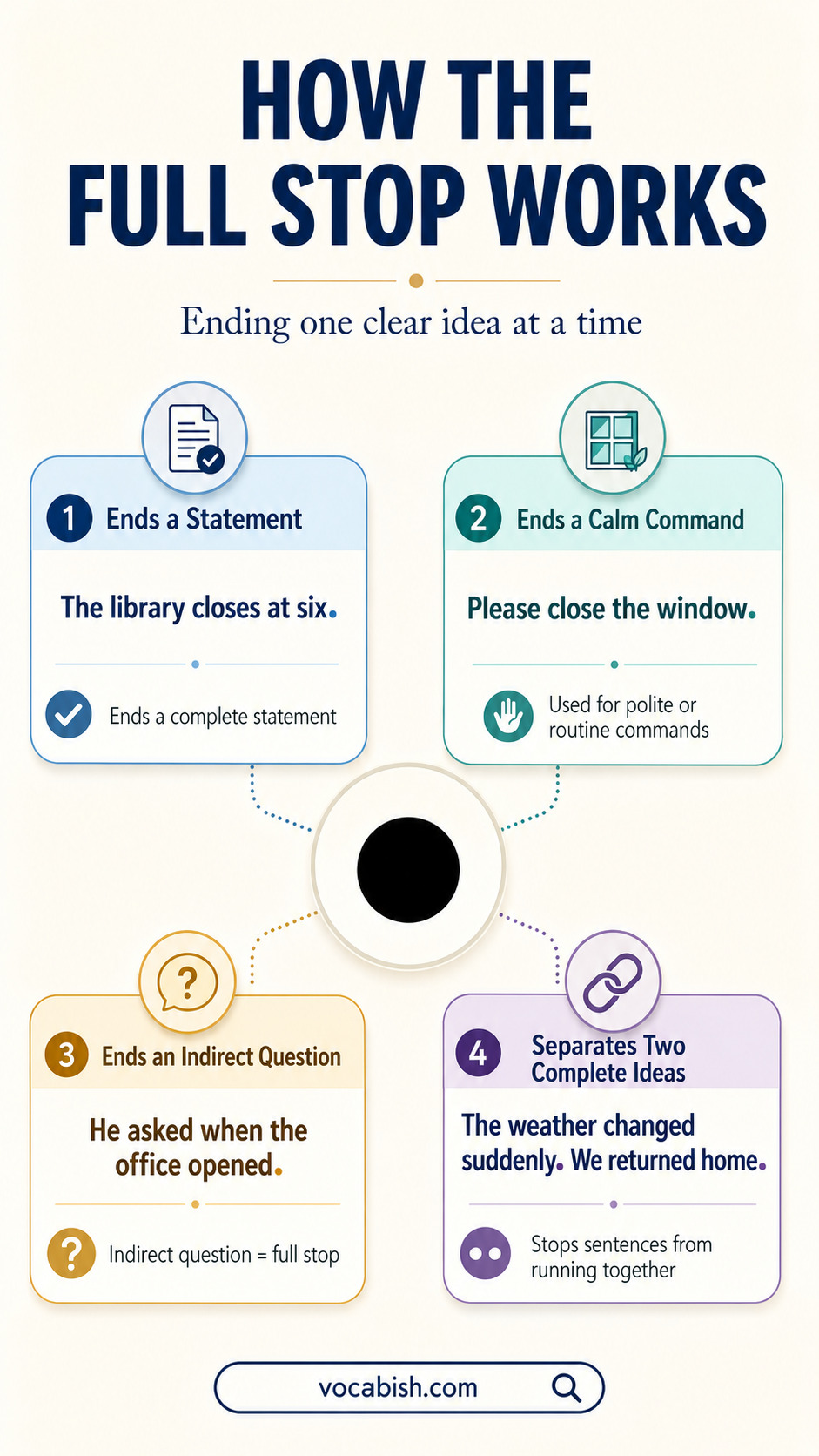
- The library closes at six.
- My sister studies biology.
- This road leads to the airport.
- English punctuation becomes easier with practice.
After Positive and Negative Statements
Use a full stop whether the statement is positive or negative.
- We have completed the project.
- We have not completed the project.
- Sara enjoys historical novels.
- Sara does not enjoy historical novels.
After Calm Commands
Commands do not always need an exclamation mark. Use a full stop when the instruction is neutral, polite, or routine.
- Please close the window.
- Turn to page twenty.
- Add the flour slowly.
- Submit your application before Friday.
Use an exclamation mark only when the command expresses urgency, danger, anger, or strong emotion.
- Watch out!
- Leave immediately!
After Indirect Questions
An indirect question reports or refers to a question without asking it directly. It normally ends with a full stop.
- She asked where the station was.
- I wonder why he left early.
- Could you tell me when the office opens.
- They wanted to know whether we were ready.
The third example may look like a question because it begins with “Could you,” but its punctuation depends on the intended structure. When it functions as a polite direct request, a question mark is usually more natural:
Could you tell me when the office opens?
A clearly reported question takes a full stop:
He asked when the office opened.
After Complete Sentences in a Paragraph
Every complete statement in normal prose needs its own end mark.
Incorrect:
The weather changed suddenly we decided to return home
Correct:
The weather changed suddenly. We decided to return home.
The full stop prevents two complete ideas from running together.
Full Stops in Abbreviations
A full stop may appear in an abbreviation, but abbreviation styles vary between British and American English.
Traditional Abbreviations
Some shortened forms traditionally contain full stops.
- e.g. — for example
- i.e. — that is
- a.m. — before midday
- p.m. — after midday
- etc. — and other similar things
Examples:
- Bring suitable equipment, e.g. gloves and boots.
- The meeting starts at 9.30 a.m.
- We sell notebooks, folders, pens, etc.
Many modern publications write abbreviations such as eg, ie, am, and pm without full stops. Follow the style required by your school, workplace, or publication.
Titles and Shortened Words
British and American conventions often differ.
British Style | American Style | Meaning |
|---|---|---|
Mr Khan | Mr. Khan | Mister Khan |
Mrs Ahmed | Mrs. Ahmed | Mistress Ahmed |
Dr Ali | Dr. Ali | Doctor Ali |
Prof Malik | Prof. Malik | Professor Malik |
Modern British English commonly omits the full stop when an abbreviation includes the original word’s final letter:
- Doctor → Dr
- Mister → Mr
- Street → St
American English usually places a period after abbreviated titles:
- Dr.
- Mr.
- Mrs.
- Prof.
Neither system is wrong. Choose one recognised style and use it consistently.
Initialisms and Acronyms
Do not normally place full stops between the letters of familiar organisations or acronyms.
- BBC
- UK
- USA
- NATO
- UNICEF
- ESL
Older writing may use forms such as U.S.A., but the closed style USA is now common in many contexts.
At the End of a Sentence
When an abbreviation containing a full stop comes at the end of a sentence, do not add a second full stop.
Incorrect:
The shop sells paper, pens, folders, etc..
Correct:
The shop sells paper, pens, folders, etc.
The abbreviation’s final full stop also ends the sentence.
Full Stops with Numbers and Initials
A full stop can appear within numbers and personal initials, but it performs a different job in each case.
Decimal Numbers
In English, a full stop separates a whole number from its decimal part. In this use, it is called a decimal point.
- 2.5 kilograms
- 7.25 metres
- 98.6 degrees
- Rs 450.75
- 3.14
Read the full stop as point:
- 2.5 → two point five
- 7.25 → seven point two five
- 3.14 → three point one four
Do not read 7.25 as seven point twenty-five in ordinary decimal reading.
Whole Numbers
Standard English writing usually uses commas, not full stops, to separate thousands.
Correct in Standard English | Meaning |
|---|---|
1,500 | One thousand five hundred |
25,000 | Twenty-five thousand |
1,000,000 | One million |
Writing 1.500 may mean one thousand five hundred in some countries, but in English it is usually understood as the decimal number one point five.
Numbered Sections and Versions
Full stops may separate levels or parts in numbering systems.
- Section 2.4
- Rule 5.1
- Version 3.2
- Chapter 7.3
These marks organise the numbers; they do not end a sentence.
Personal Initials
A full stop traditionally follows each initial in a person’s name.
- J. K. Rowling
- A. A. Milne
- T. S. Eliot
- M. A. Khan
Some modern styles omit the full stops:
- JK Rowling
- TS Eliot
- MA Khan
Use the form preferred by the person or required by the relevant style guide.