
Quotation marks are punctuation marks used to show someone’s exact words, identify certain titles, and separate quoted language from the rest of a sentence.
They appear in two common forms:
- Double quotation marks: “ ”
- Single quotation marks: ‘ ’
American English usually uses double quotation marks first, while British English often begins with single quotation marks. The basic purpose remains the same.
Direct Speech
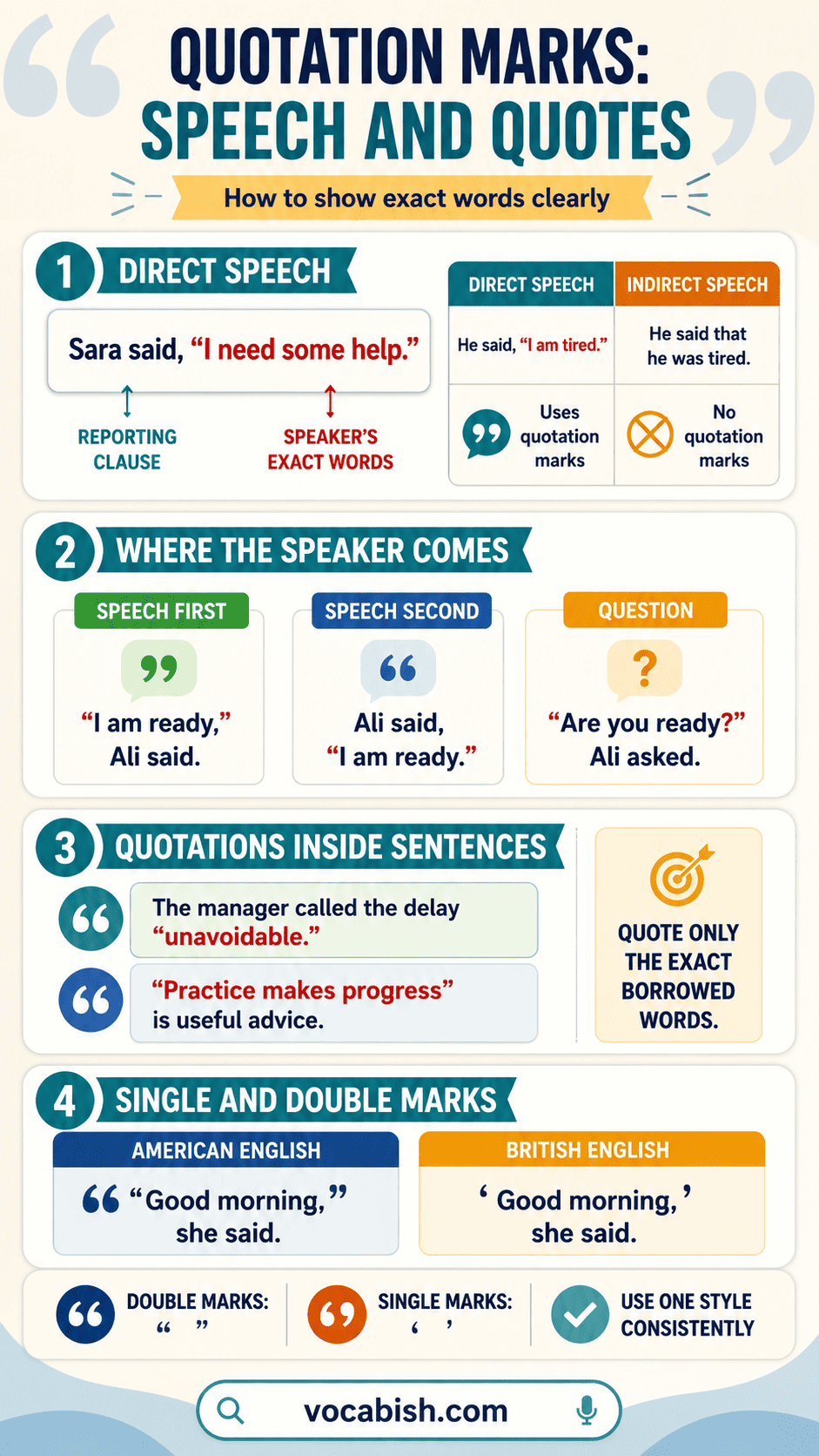
Use quotation marks around the exact words spoken by a person.
- Nadia said, “I need more time.”
- “The bus is here,” Ali announced.
- “Are you feeling better?” the doctor asked.
- “Be careful!” his mother shouted.
Only the speaker’s actual words belong inside the quotation marks.
Type | Example |
|---|---|
Direct speech | Hassan said, “I am working from home.” |
Indirect speech | Hassan said that he was working from home. |
Indirect speech reports the meaning rather than the exact words, so it does not need quotation marks.
Direct Speech Before a Reporting Clause
When the spoken words come first, place a comma before the closing quotation mark.
- “The food is ready,” Mum said.
- “We should leave now,” Farah suggested.
A question mark or exclamation mark replaces the comma when required.
- “Where are my glasses?” Grandfather asked.
- “Get out!” the guard ordered.
Direct Speech After a Reporting Clause
Place a comma after the reporting clause and begin the quotation with a capital letter.
- The teacher explained, “Your results will arrive tomorrow.”
- Hamza replied, “I have already completed the form.”
Do not use a comma when the quoted words are grammatically joined to the sentence.
- The notice described the building as “unsafe for public use.”
- She called the decision “completely unfair.”
Divided Direct Speech
A reporting clause can interrupt one person’s speech.
- “I cannot attend,” Mariam explained, “because I have an appointment.”
- “The problem,” he admitted, “is more serious than we expected.”
The second part normally begins with a lowercase letter when it continues the same sentence.
A New Speaker Needs a New Paragraph
Begin a new paragraph whenever the speaker changes.
- “Have you seen my notebook?” Adeel asked.
- “No, but I will help you find it,” Sana replied.
This makes conversations easier to follow.
Quotations Inside Sentences
A quotation can appear at the beginning, middle, or end of a sentence.
- “Practice makes progress” is a useful message for language learners.
- The manager described the delay as “unavoidable.”
- According to the report, the results were “better than expected.”
When quoting only part of a sentence:
- Keep the quotation grammatically connected to your own sentence.
- Do not add a capital letter unless the quoted words originally require one.
- Do not place quotation marks around words that merely summarize an idea.
Correct:
- The witness described the room as “dark and unusually quiet.”
Incorrect:
- The witness “said that the room was dark and quiet.”
The second sentence does not clearly separate the writer’s words from the witness’s exact words.
Introducing a Complete Quotation
A complete quotation may follow a comma or colon, depending on the sentence.
- The instructor gave one clear warning: “Do not switch off the machine.”
- Maria answered, “I have never visited London.”
A colon works well when the introductory words form a complete statement. A comma commonly follows a reporting verb such as said, asked, or replied.
Single and Double Quotation Marks
The preferred style depends mainly on the variety of English and the publication’s style guide.
Style | Primary Marks | Marks Inside a Quotation |
|---|---|---|
American English | Double: “ ” | Single: ‘ ’ |
British English | Often single: ‘ ’ | Double: “ ” |
Some British publications | Double: “ ” | Single: ‘ ’ |
American style:
- “The lesson was helpful,” Fatima said.
Common British style:
- ‘The lesson was helpful,’ Fatima said.
Both forms are correct when used consistently.
Do not confuse single quotation marks with apostrophes.
- Apostrophe: Aisha’s book
- Single quotation marks: ‘A difficult journey’
An apostrophe shows possession, omission, or a contracted form. Quotation marks enclose quoted language.
Quotes Within Quotes
When quoted speech contains another quotation, change the type of quotation marks for the inner quotation.
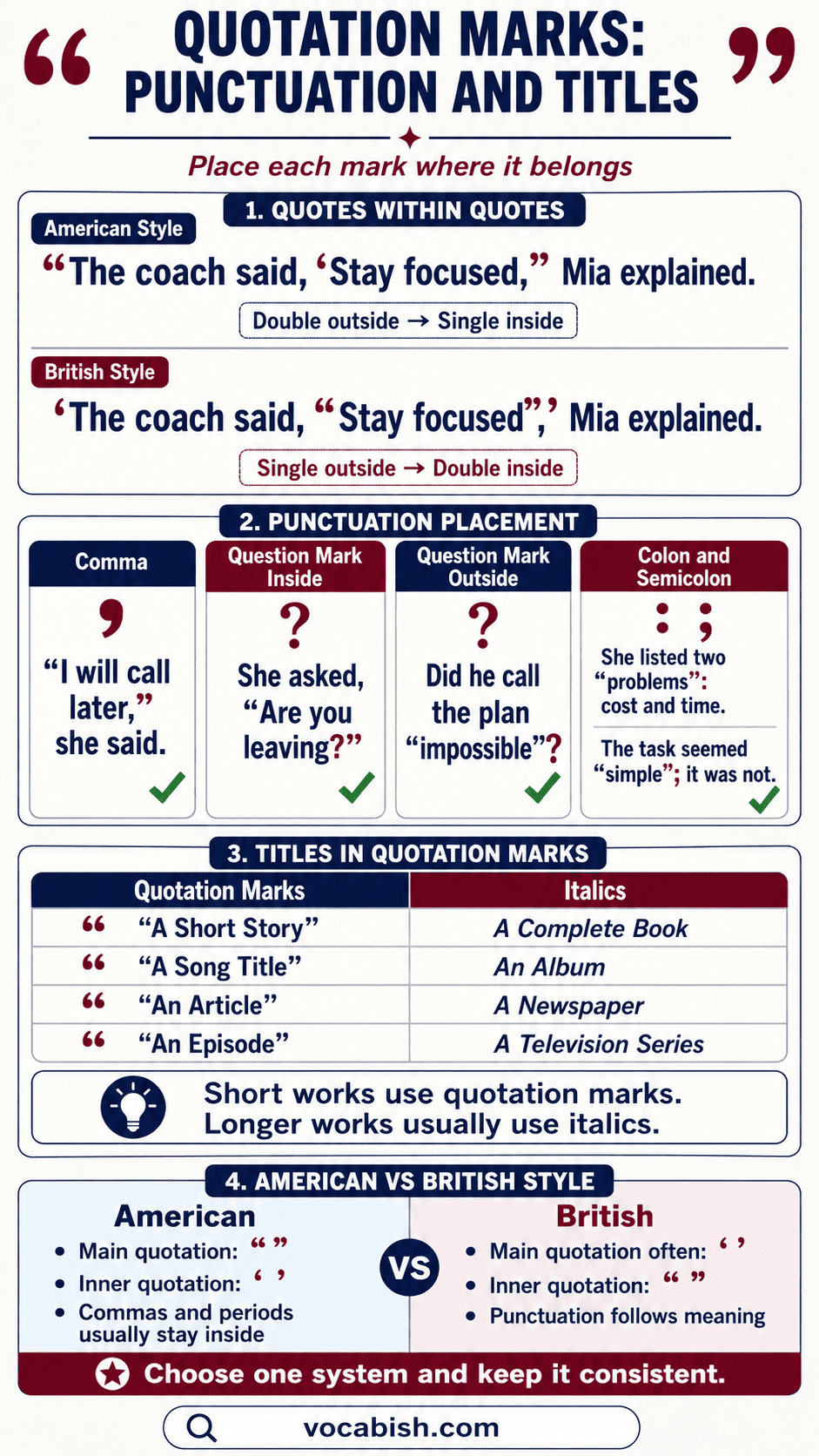
American Style
Use double marks outside and single marks inside.
- “The coach told us, ‘Stay focused until the final whistle,’” Imran explained.
- “Did she really say, ‘I am leaving’?” Nadia asked.
Common British Style
Use single marks outside and double marks inside.
- ‘The coach told us, “Stay focused until the final whistle”,’ Imran explained.
- ‘Did she really say, “I am leaving”?’ Nadia asked.
For a third level of quotation, alternate the marks again. Deeply nested quotations can become difficult to read, so rewriting is often clearer.
Punctuation with Quotation Marks
The position of punctuation depends on:
- The type of punctuation
- Whether it belongs to the quotation
- Whether American or British style is being followed
Commas and Full Stops
American English normally places commas and full stops inside closing quotation marks.
- She described the journey as “exhausting.”
- “I will contact you tomorrow,” he promised.
British English often uses logical punctuation. A comma or full stop goes inside only when it belongs to the quoted material.
- She described the journey as ‘exhausting’.
- He said, ‘The journey was exhausting.’
Direct speech normally keeps its required punctuation inside the quotation marks in both styles.
Question Marks
Place a question mark inside when the quoted words form a question.
- She asked, “Where did you put the keys?”
- The officer shouted, “Who opened this gate?”
Place it outside when the whole sentence is a question but the quoted words are not.
- Did he really call the plan “impossible”?
- Who described the situation as “perfectly normal”?
Do not use two question marks.
Incorrect:
- Did she ask, “Where are you going?”?
Correct:
- Did she ask, “Where are you going?”
The question mark inside the quotation completes both questions.
Exclamation Marks
Place an exclamation mark inside when the quoted words express strong emotion or an urgent command.
- The lifeguard shouted, “Move away from the water!”
- She cried, “I cannot believe we won!”
Place it outside when the emotion belongs to the complete sentence.
- I cannot believe he called that behaviour “acceptable”!
- She actually described the test as “easy”!
Colons and Semicolons
Colons and semicolons usually appear outside closing quotation marks unless they belong to the original quotation.
- She used the word “urgent”; however, she gave us no deadline.
- The document mentioned three “essential skills”: communication, planning, and teamwork.
Punctuation Overview
Punctuation Mark | Usual Position | Example |
|---|---|---|
Comma | Inside in American style; logical placement in British style | She said, “Come inside.” |
Full stop | Inside in American style; logical placement in British style | They called it “a success.” |
Question mark | According to meaning | Did she say, “I am ready”? |
Exclamation mark | According to meaning | He shouted, “Stop!” |
Colon | Usually outside | She listed two “problems”: cost and time. |
Semicolon | Usually outside | It seemed “simple”; it was not. |
Titles in Quotation Marks
Use quotation marks for the titles of shorter works that appear inside larger publications or collections.
Use Quotation Marks | Usually Use Italics |
|---|---|
Newspaper or magazine article | Newspaper or magazine |
Short story | Book or novel |
Poem | Poetry collection |
Song | Album |
Book chapter | Complete book |
Television episode | Television series |
Essay | Published collection |
Film scene or section | Complete film |
Examples:
- We read the article “How Cities Reduce Waste.”
- My favourite chapter is “The Unexpected Visitor.”
- She performed “Someone Like You” at the event.
- The class discussed Robert Frost’s poem “The Road Not Taken.”
- We watched the episode “The One with the Blackout.”
Quotation marks are not normally used around titles of books, films, newspapers, albums, or complete television series. These titles are usually italicized.
- Pride and Prejudice
- The Daily Times
- Finding Nemo
Capitalization rules for titles may vary by style guide.
British and American Differences
Both systems are correct, but mixing them in the same document can look careless.
Feature | American English | British English |
|---|---|---|
Main quotation marks | Usually double | Often single |
Quotation inside quotation | Usually single | Usually double |
Commas and full stops | Normally placed inside | Placed according to meaning |
Question and exclamation marks | Positioned according to meaning | Positioned according to meaning |
Common name | Quotation marks | Quotation marks or inverted commas |
American style:
- Maya called the film “surprisingly moving.”
- “I enjoyed it,” she said.
Common British style:
- Maya called the film ‘surprisingly moving’.
- ‘I enjoyed it,’ she said.
Choose one system and apply it consistently throughout the article, essay, or report.