
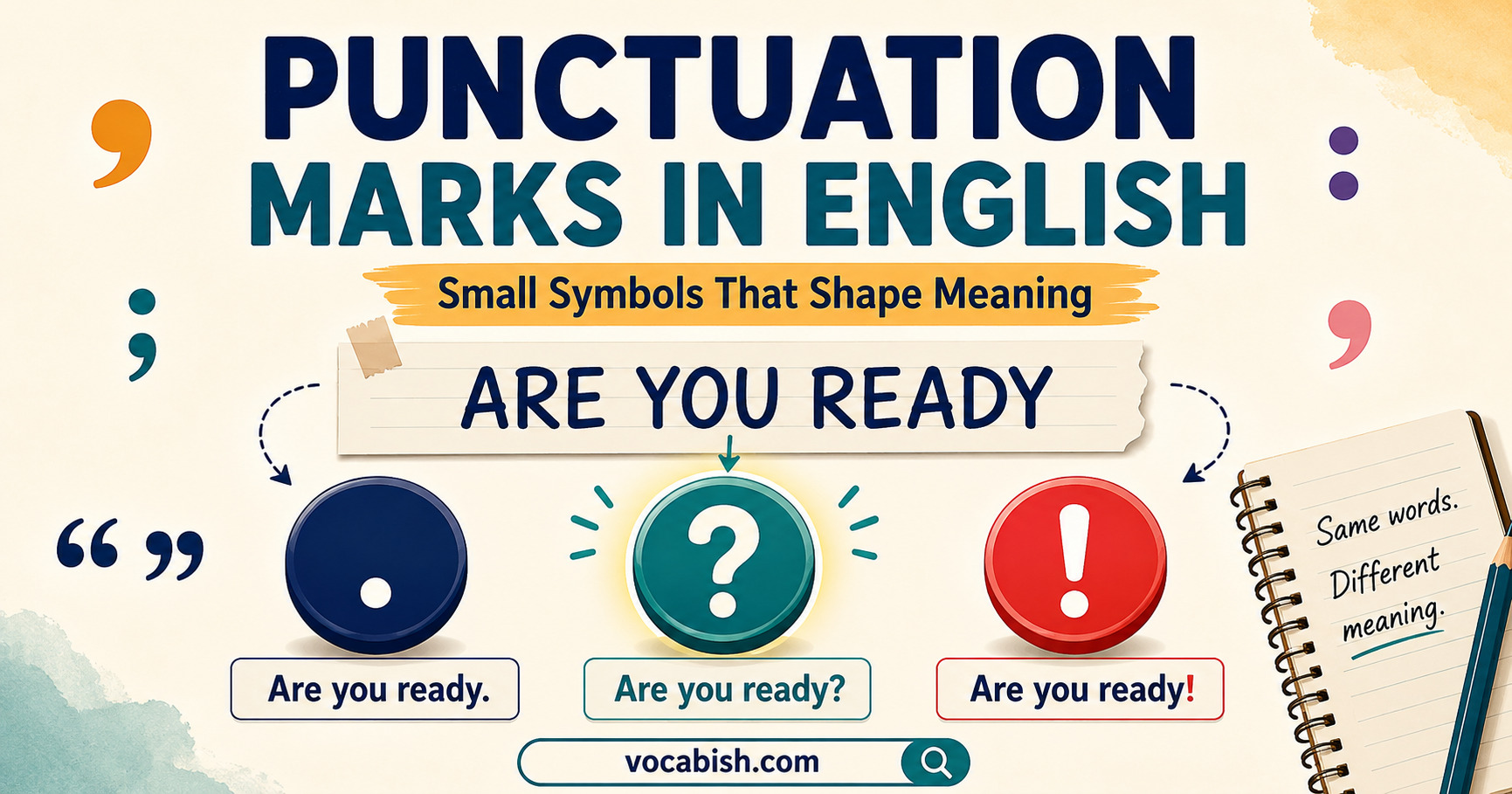

Punctuation marks in English are symbols that organise sentences, separate ideas, and show readers how a message should sound. A missing comma, apostrophe, or full stop can change the meaning of an entire sentence, which makes punctuation a basic part of clear writing.
What Are Punctuation Marks?
Punctuation marks are written symbols placed between or beside words. They help readers recognise:
- where a sentence begins and ends
- which ideas belong together
- when a speaker is asking a question
- where a writer has added extra information
- whether words are quoted directly
- when letters or words have been omitted
- how closely two sentence parts are connected
Compare:
- Let’s eat, Grandma.
The speaker is inviting Grandma to eat. - Let’s eat Grandma.
Without the comma, the sentence suggests that Grandma is the meal.
Punctuation does not replace grammar, but it makes grammatical relationships much easier to understand. Read more about punctuation symbols and their uses.
Why Punctuation Matters
Correct punctuation makes writing clearer, more accurate, and easier to read.
It helps writers:
- prevent confusing or unintended meanings
- separate complete thoughts
- show pauses and emphasis
- organise lists and explanations
- identify questions and strong reactions
- mark possession and contractions
- present another person’s exact words
- guide the natural rhythm of a sentence
Consider another example:
- The students who studied passed the test.
Only the students who studied passed. - The students, who studied, passed the test.
All the students studied, and all of them passed.
The commas change how the information relates to the noun.
Main Types of Punctuation Marks
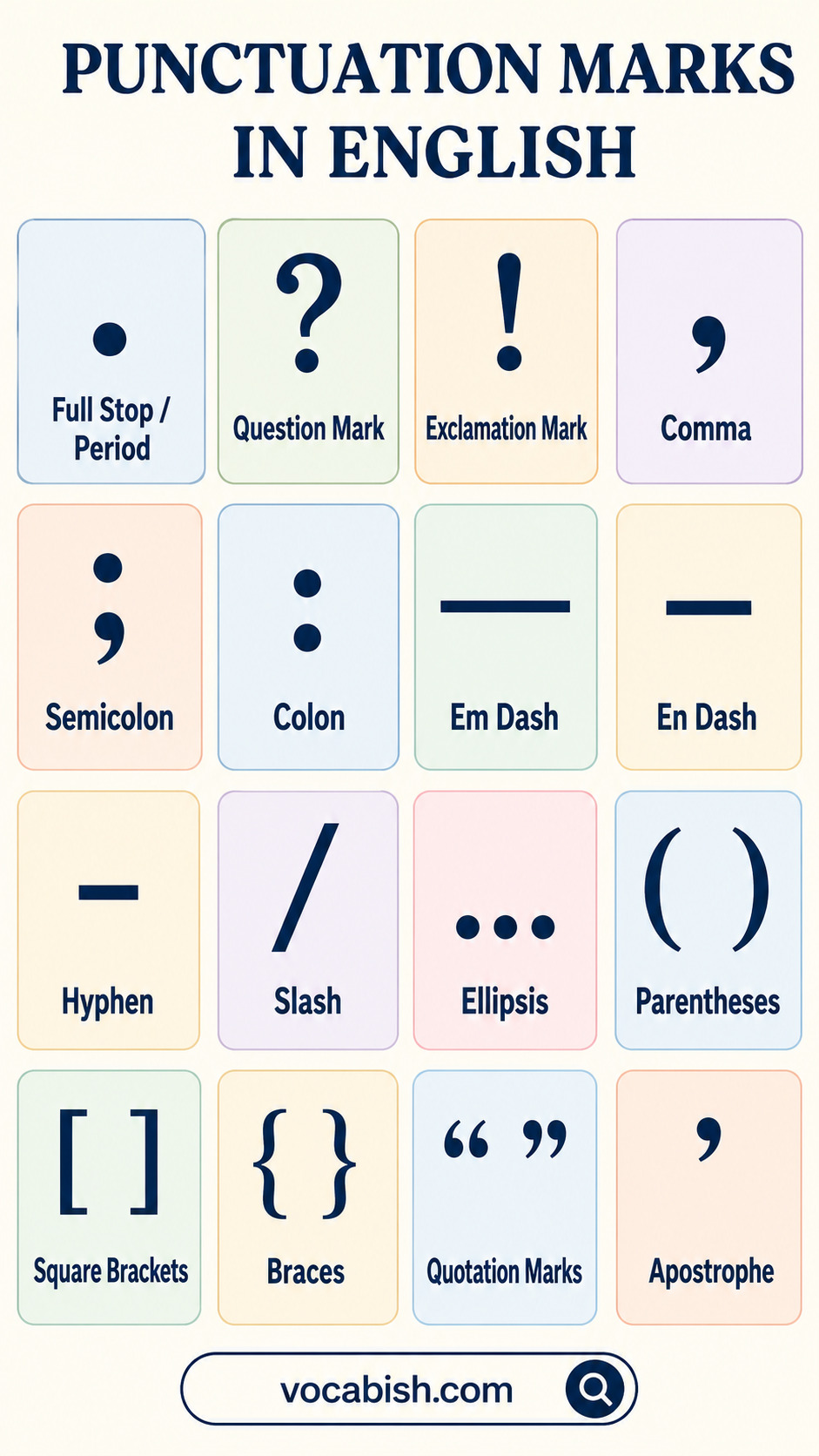
English punctuation marks can be grouped according to their main functions.
Category | Main Marks | General Function |
|---|---|---|
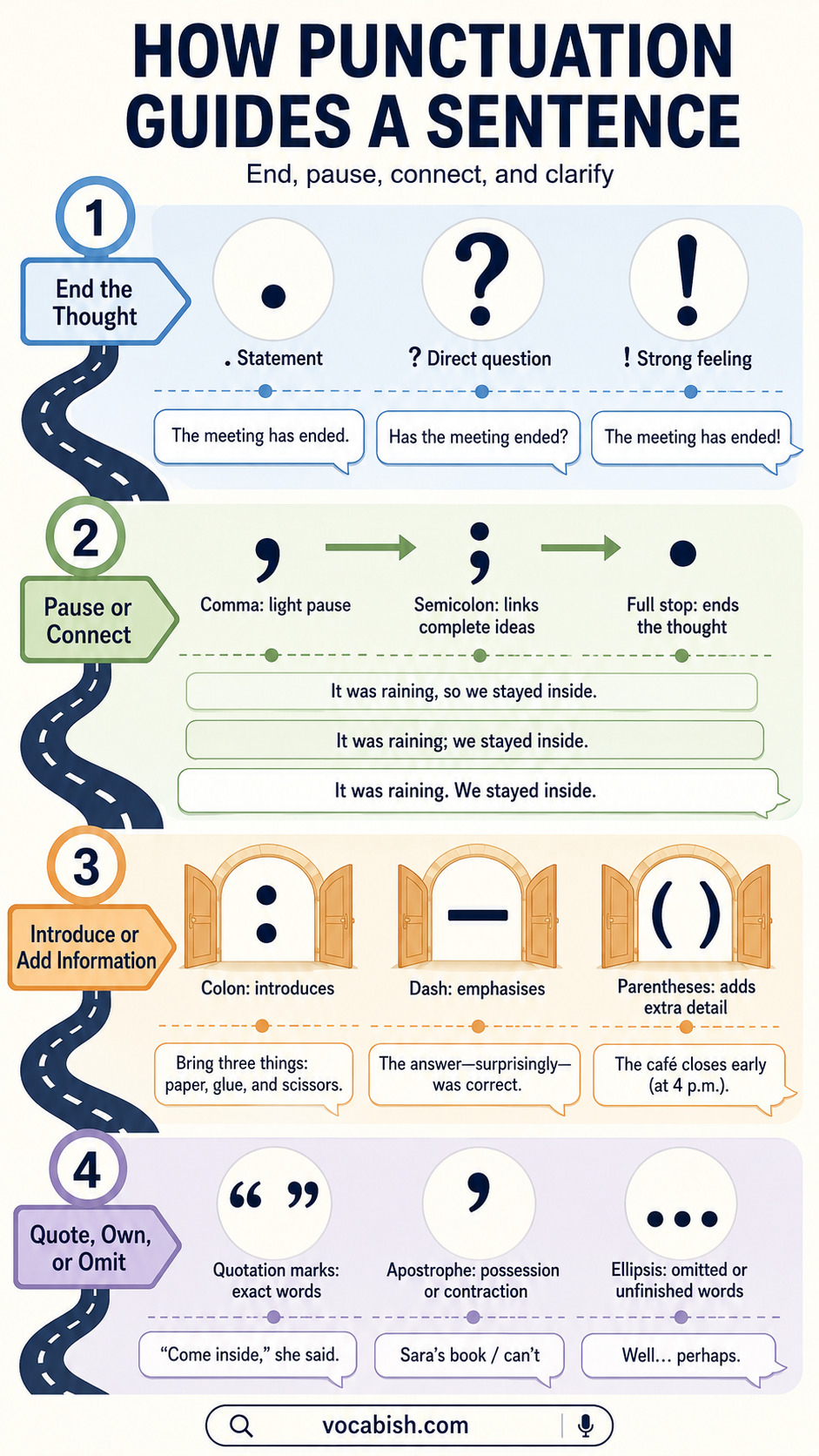
Sentence-ending marks | Full stop, question mark, exclamation mark | End complete sentences |
Marks used to separate ideas | Comma, semicolon, colon, dash, hyphen, slash, ellipsis | Divide, connect, or organise information |
Marks used for extra information | Parentheses, square brackets, braces | Add explanations or grouped details |
Marks used in quotations and possession | Quotation marks, apostrophe | Mark exact words, ownership, or omitted letters |
Some punctuation marks perform more than one function. A comma, for example, can separate list items, introduce a sentence, or mark additional information.
Sentence-Ending Marks
Full Stop or Period (.)
A full stop, called a period in American English, marks the end of a statement or command.
Main uses:
- ending a declarative sentence
- ending a complete command
- appearing in some abbreviations
Examples:
- The library closes at six.
- Please leave your shoes outside.
Do not place a full stop after a sentence that already ends with a question mark or exclamation mark.
Question Mark (?)
A question mark ends a direct question.
Main use:
- showing that the writer is directly asking for information
Examples:
- Where are my glasses?
- Have you finished the assignment?
Do not use a question mark after an indirect question:
- Correct: She asked where my glasses were.
- Incorrect: She asked where my glasses were?
Exclamation Mark (!)
An exclamation mark shows strong emotion, surprise, urgency, or a forceful command.
Main uses:
- expressing excitement or shock
- giving a warning
- showing a strong command
Examples:
- That was an amazing performance!
- Look behind you!
One exclamation mark is normally enough. Several marks can make formal writing appear exaggerated.
Marks Used to Separate Ideas
Comma (,)
A comma creates a light separation within a sentence. It does not normally end a complete thought.
Main uses:
- separating items in a list
- following an introductory word or phrase
- separating clauses joined by coordinating conjunctions
- marking non-essential information
- addressing someone directly
Examples:
- We bought rice, vegetables, milk, and bread.
- Before sunrise, the fishermen left the harbour.
- I called her, but she did not answer.
- Mr Khan, our new neighbour, is a doctor.
- Please sit down, Aisha.
The comma before the final item in a list is called the Oxford comma. Some style guides require it, while others treat it as optional.
Semicolon (;)
A semicolon creates a stronger break than a comma but a weaker break than a full stop.
Main uses:
- joining two closely related independent clauses
- separating complicated list items that already contain commas
Examples:
- The shop was closed; we returned the next morning.
- The guests came from Karachi, Pakistan; Muscat, Oman; and Doha, Qatar.
Both sides of a semicolon should usually be able to stand as complete sentences.
Colon (:)
A colon introduces information that explains or expands the statement before it.
Main uses:
- introducing a list
- introducing an explanation
- introducing an example or quotation
- separating hours from minutes
Examples:
- She packed everything she needed: clothes, medicine, and documents.
- His problem was simple: he had forgotten the password.
- The meeting begins at 10:30.
The words before a colon should normally form a complete clause.
Dash (— or –)
A dash creates a noticeable break or connection. The two common forms are the em dash and the en dash.
Em Dash (—)
An em dash can add emphasis, introduce an interruption, or set off extra information.
Examples:
- She finally found the letter—hidden inside an old book.
- I wanted to explain—but he had already left.
En Dash (–)
An en dash commonly shows a range or connection.
Examples:
- Read pages 25–40.
- The Karachi–Lahore flight was delayed.
A dash is longer than a hyphen and performs a different job.
Hyphen (-)
A hyphen joins words or word parts.
Main uses:
- forming some compound adjectives
- writing certain compound numbers
- joining prefixes when needed for clarity
Examples:
- She is a well-respected teacher.
- Twenty-one students attended.
- The company re-issued the document.
Compound-word hyphenation varies, so a current dictionary can help when the correct form is uncertain.
Slash (/)
A slash separates alternatives or shows a relationship between two items.
Main uses:
- meaning “or”
- meaning “per”
- separating lines of poetry in continuous text
- appearing in some dates and abbreviations
Examples:
- Please write yes/no beside each statement.
- The speed limit is 80 km/h.
Avoid using too many slashes in formal sentences because they can make the wording difficult to follow.
Ellipsis (…)
An ellipsis consists of three dots. It shows omitted words, an unfinished thought, or a trailing voice.
Main uses:
- removing part of a quotation
- showing hesitation
- suggesting that a thought remains unfinished
Examples:
- “The report stated that … further testing was required.”
- I thought you had already told her…
Spacing around an ellipsis may differ between publishing styles.
Marks Used for Extra Information
Parentheses or Round Brackets ( )
Parentheses contain information that is useful but not essential to the main sentence.
Main uses:
- adding a brief explanation
- giving an abbreviation
- including dates, references, or supporting details
Examples:
- The results will be announced on Friday (weather permitting).
- The World Health Organization (WHO) published the guidance.
The sentence should usually remain grammatically complete when the parenthetical information is removed.
Square Brackets [ ]
Square brackets add editorial information inside quoted material or place brackets within parentheses.
Main uses:
- clarifying a pronoun or reference in a quotation
- adding an editor’s explanation
- showing that quoted material has been changed for clarity
Example:
- The witness said, “She [the driver] left immediately.”
The bracketed words were added by the writer, not spoken by the original speaker.
Braces or Curly Brackets { }
Braces group related items, but they are uncommon in ordinary prose.
Main uses:
- grouping choices in technical material
- presenting sets in mathematics
- organising information in programming or specialist writing
Example:
- The word may function as a {noun, verb, adjective}.
In everyday English writing, parentheses or square brackets are usually more appropriate.