

Nouns can perform different jobs in a sentence. A noun may act as the subject, receive an action, show ownership, or directly address someone.
These grammatical roles are called noun cases in English. Unlike some languages, English does not usually change a noun’s form to show its case. Instead, meaning is mainly shown through word order, prepositions, and possessive endings.
What Is a Noun Case?
A noun case shows the grammatical relationship between a noun and the other words in a sentence.
Consider these examples:
- Daniel opened the door.
- Maria called Daniel.
- This is Daniel’s jacket.
- Daniel, please close the door.
The noun Daniel performs a different role in each sentence.
Noun case | Main function | Example |
|---|---|---|
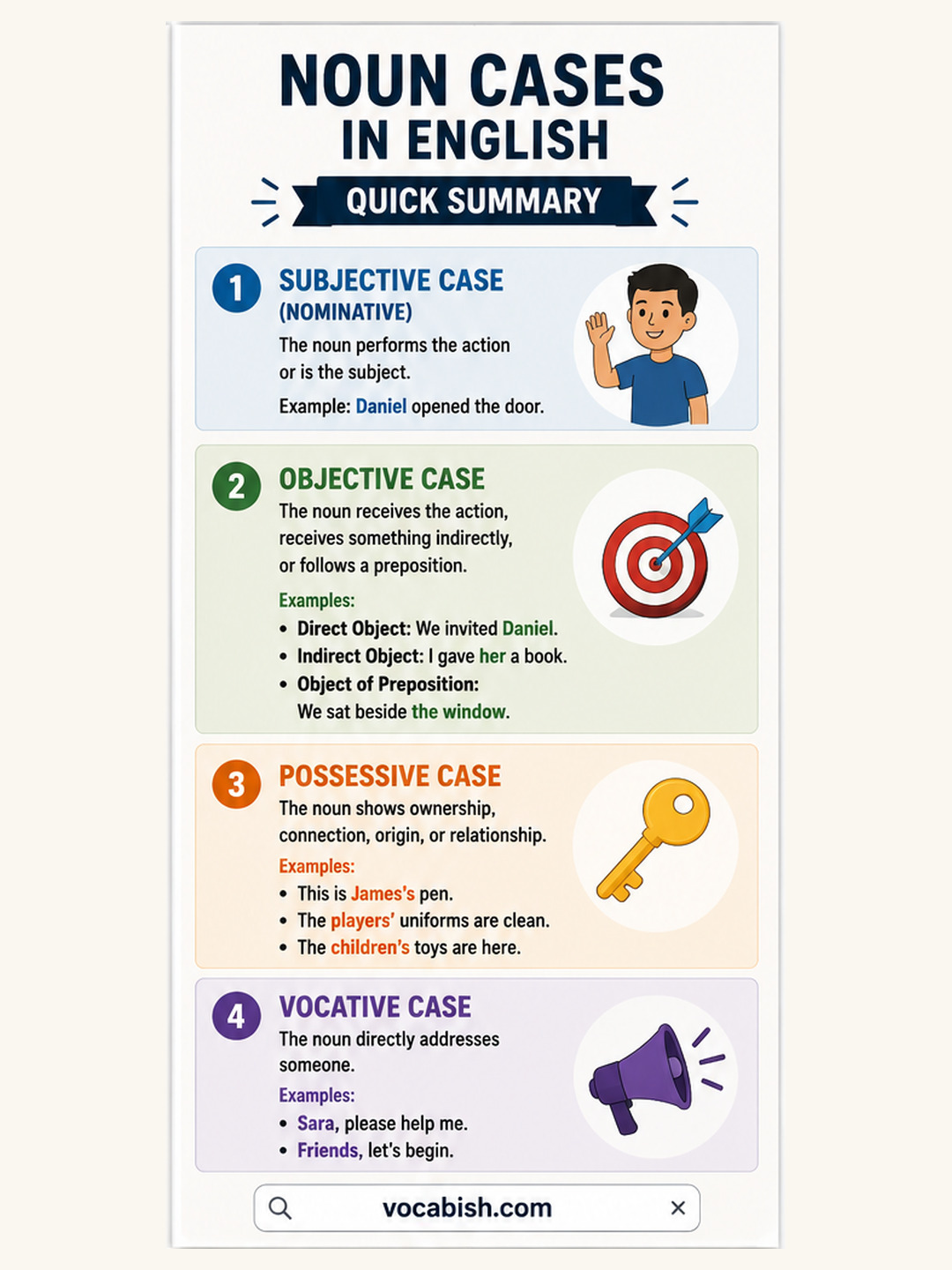
Subjective | Performs the action or acts as the subject | Daniel opened the door. |
Objective | Receives the action or follows a preposition | Maria called Daniel. |
Possessive | Shows ownership or connection | Daniel’s jacket is new. |
Vocative | Directly addresses someone | Daniel, come here. |
Subjective Case of a Noun
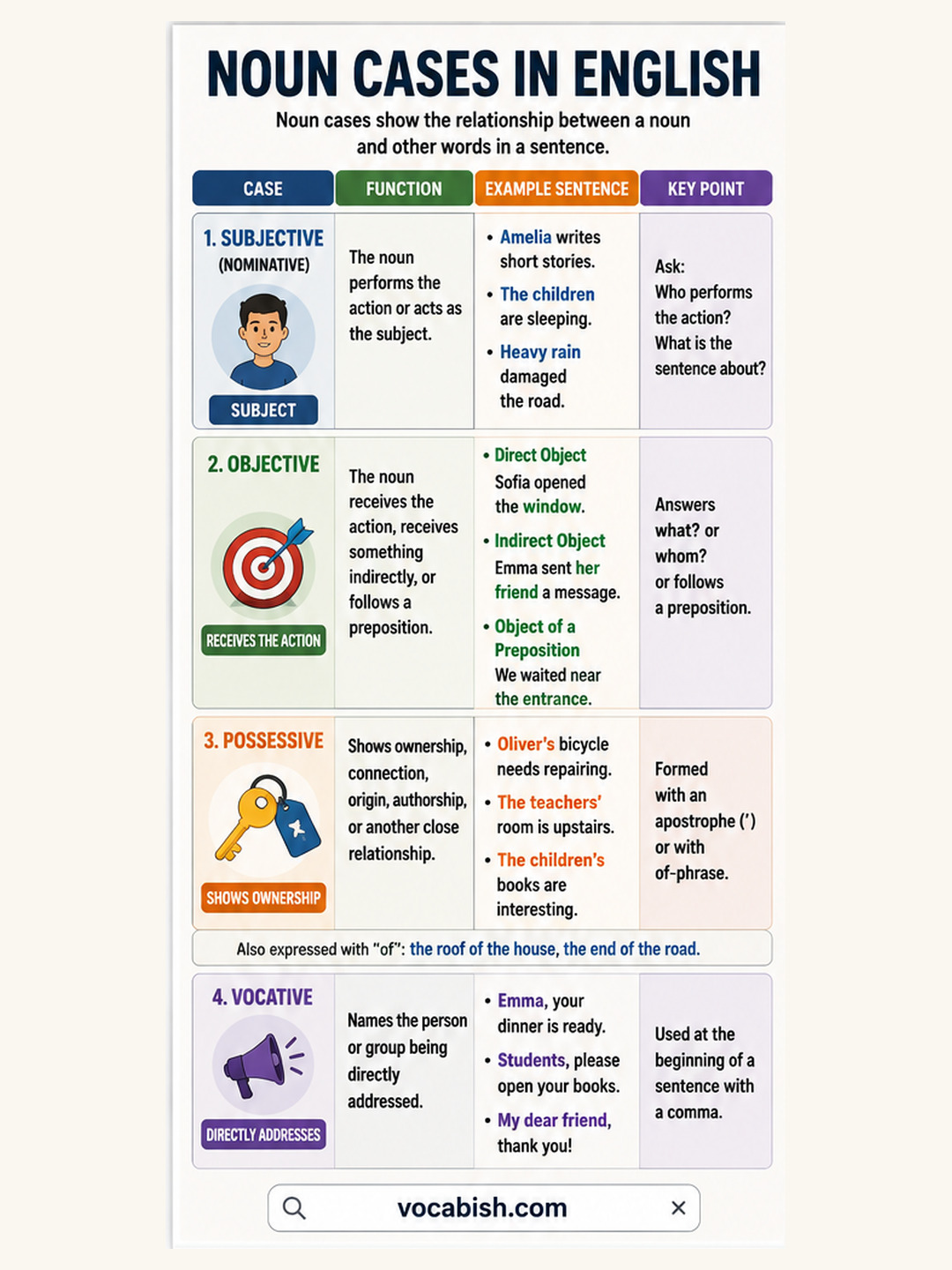
A noun is in the subjective case when it acts as the subject of a verb. It tells us who or what performs the action or experiences a condition.
- Amelia writes short stories.
- The children are sleeping.
- Heavy rain damaged the road.
- Patience requires practice.
To identify the subjective case, ask:
- Who performs the action?
- What is the sentence mainly about?
- Who or what experiences the condition?
In the sentence The teacher smiled, the teacher is in the subjective case because it performs the action.
The subjective case is also called the nominative case.
Objective Case of a Noun
A noun is in the objective case when it receives the action of a verb, receives something indirectly, or follows a preposition.
English nouns do not normally change their form in the objective case.
- The dog followed Maria.
- Liam gave his sister a gift.
- We waited near the entrance.
The objective case includes three common functions:
- Direct object
- Indirect object
- Object of a preposition
Direct Object
A direct object receives the action of a transitive verb. It answers what? or whom? after the verb.
- Sofia opened the window.
- The mechanic repaired the car.
- We invited Daniel.
- The storm damaged several houses.
In Sofia opened the window, ask:
- Sofia opened what?
- The window
Therefore, the window is a direct object in the objective case.
Not every sentence has a direct object:
- The baby slept.
- The guests arrived.
The verbs slept and arrived do not transfer their actions to objects.
Indirect Object
An indirect object tells us who receives something or benefits from an action. It often appears before the direct object.
- Emma sent her friend a message.
- The waiter brought the customers their meals.
- My uncle bought me a bicycle.
- The teacher gave the class extra time.
In Emma sent her friend a message:
- A message is the direct object.
- Her friend is the indirect object.
An indirect object can often be rewritten with to or for:
Without a preposition | With a preposition |
|---|---|
Emma sent her friend a message. | Emma sent a message to her friend. |
Dad cooked the family dinner. | Dad cooked dinner for the family. |
She bought her brother a jacket. | She bought a jacket for her brother. |
When the noun follows to or for, it becomes the object of a preposition.
Object of a Preposition
A noun is an object of a preposition when it follows a preposition and completes its meaning.
Common prepositions include:
- at
- by
- for
- from
- in
- near
- on
- to
- under
- with
Examples:
- The keys are on the table.
- We walked through the park.
- She received a letter from her cousin.
- The children sat beside the fireplace.
- They travelled by train.
A noun phrase can also function as the object:
- We met near the old railway station.
The complete noun phrase the old railway station is the object of near.
Possessive Case of a Noun
The possessive case shows ownership, connection, origin, authorship, or another close relationship.
It is usually formed with an apostrophe.
Noun type | Formation | Example |
|---|---|---|
Singular noun | Add ’s | the girl’s bag |
Regular plural ending in s | Add ’ | the players’ uniforms |
Irregular plural | Add ’s | the children’s books |
Compound noun | Add ’s to the final word | my mother-in-law’s car |
Examples in sentences:
- Oliver’s bicycle needs repairing.
- The teachers’ room is upstairs.
- The women’s team won the match.
- This is James’s notebook.
- We admired the building’s design.
Possession is not limited to ownership:
- today’s news
- the company’s future
- London’s population
- Shakespeare’s plays
- the dog’s behaviour
The possessive case may also be expressed with an of-phrase:
- the roof of the house
- the end of the road
- the colour of the wall
The of-structure is especially common with objects, places, and longer noun phrases.
Vocative Case of a Noun
The vocative case is used when a noun names the person or group being directly addressed.
- Emma, your dinner is ready.
- Please listen, children.
- Doctor, could you explain the results?
- Thank you, Mr Collins.
- Be careful, everyone.
A vocative noun is not the subject or object of the sentence. It stands outside the main grammatical structure.
Compare:
- Daniel opened the gate.
Daniel is the subject. - Please open the gate, Daniel.
Daniel is being addressed.
Vocative nouns are usually separated from the rest of the sentence by commas.
- Sarah, come inside.
- Come inside, Sarah.
- Come inside, Sarah, before it rains.
Noun Cases in Sentences
The same noun can appear in different cases without changing its basic form.
Sentence | Case of the bold noun | Reason |
|---|---|---|
Laura called the manager. | Subjective | Laura performs the action. |
The manager called Laura. | Objective | Laura receives the action. |
This is Laura’s office. | Possessive | Laura has a connection with the office. |
Laura, the manager is waiting. | Vocative | Laura is directly addressed. |
A single sentence may contain several noun cases:
Michael, the receptionist gave the visitor Michael’s message at the desk.
- Michael — vocative case
- The receptionist — subjective case
- The visitor — indirect object
- Michael’s — possessive case
- Message — direct object
- The desk — object of a preposition
Noun Case vs Pronoun Case
Nouns and pronouns can perform the same grammatical roles, but pronouns often change form according to their case.
Function | Noun example | Pronoun example |
|---|---|---|
Subjective | Maria arrived. | She arrived. |
Objective | I called Maria. | I called her. |
Possessive determiner | Maria’s coat | Her coat |
Possessive pronoun | The coat is Maria’s. | The coat is hers. |
Nouns usually remain unchanged:
- David saw Anna.
- Anna saw David.
Pronouns may change:
- He saw her.
- She saw him.
Common pronoun case forms include:
Subjective | Objective | Possessive |
|---|---|---|
I | me | my, mine |
we | us | our, ours |
he | him | his |
she | her | her, hers |
they | them | their, theirs |
who | whom | whose |
How Word Order Shows Noun Case
English relies heavily on word order because most nouns do not have separate subjective and objective forms.
The usual pattern is:
Subject + Verb + Object
Compare:
- The dog chased the cat.
- The cat chased the dog.
The nouns do not change, but reversing their positions changes their grammatical roles and the meaning of the sentence.
In the first sentence:
- The dog is subjective.
- The cat is objective.
In the second sentence:
- The cat is subjective.
- The dog is objective.
Prepositions also help show relationships:
- The book is under the chair.
- The book is beside the chair.
- The book is behind the chair.
The position of the chair remains similar, but each preposition creates a different relationship.
Common Learner Errors
- Confusing the subject with the first noun mentioned
Incorrect assumption: In After lunch, Maria called Ben, lunch is the subject.
Correct: Maria is the subject because she performs the action. - Treating every noun after a verb as a direct object
In Lena gave her brother a book, her brother is the indirect object, while a book is the direct object. - Using apostrophes for ordinary plural nouns
Incorrect: Three student’s arrived.
Correct: Three students arrived. - Forgetting the possessive apostrophe
Incorrect: The teachers desk
Correct: The teacher’s desk - Confusing objective pronouns with subjective pronouns
Incorrect: Maria invited Daniel and I.
Correct: Maria invited Daniel and me. - Missing commas with direct address
Incorrect: Let’s eat Grandma.
Correct: Let’s eat, Grandma.
Identification Exercise
Identify the case of each bold noun or noun phrase. Write subjective, objective, possessive, or vocative. For objective nouns, identify their specific function where possible.
- The librarian placed the books on the shelf.
- We visited the museum on Saturday.
- The coach gave the players new uniforms.
- This is Amina’s notebook.
- Please sit down, Mr Harris.
- The children played near the river.
- My younger brother studies engineering.
- The chef prepared a special meal.
- Parents’ opinions often influence school decisions.
- Lucy, could you help your sister?
- The company offered Daniel a new position.
- The windows of the building were damaged.
Answer Key
- The librarian — subjective case
- The museum — objective case; direct object
- The players — objective case; indirect object
- Amina’s — possessive case
- Mr Harris — vocative case
- The river — objective case; object of a preposition
- My younger brother — subjective case
- A special meal — objective case; direct object
- Parents’ — possessive case
- Lucy — vocative case
- Daniel — objective case; indirect object
- The building — objective case; object of a preposition
FAQs About Noun Cases in English
The main noun cases are subjective, objective, possessive, and vocative. Each case describes the particular grammatical role a noun performs in context.
Most English nouns keep the same form in subjective and objective positions. Only the possessive case normally requires an apostrophe or possessive ending.
A subjective noun performs the verb’s action or experiences a condition, while an objective noun receives the action or follows a preposition.
Yes, one sentence may contain subjects, direct objects, indirect objects, possessive nouns, prepositional objects, and vocative nouns performing different grammatical roles.
A vocative noun identifies the person being addressed but does not function as the sentence’s subject, object, or complement within its main structure.
Examine the noun’s function: determine whether it performs an action, receives something, follows a preposition, shows possession, or directly addresses someone.
English nouns rarely have separate case endings, so their positions before or after verbs often reveal whether they are subjects or objects.
Conclusion
Noun cases describe the jobs nouns perform in sentences. The subjective case marks the subject, the objective case marks objects, the possessive case shows relationships, and the vocative case identifies someone being addressed. Because English nouns rarely change form, learners must pay close attention to word order, prepositions, apostrophes, and sentence meaning.
You May Also Like