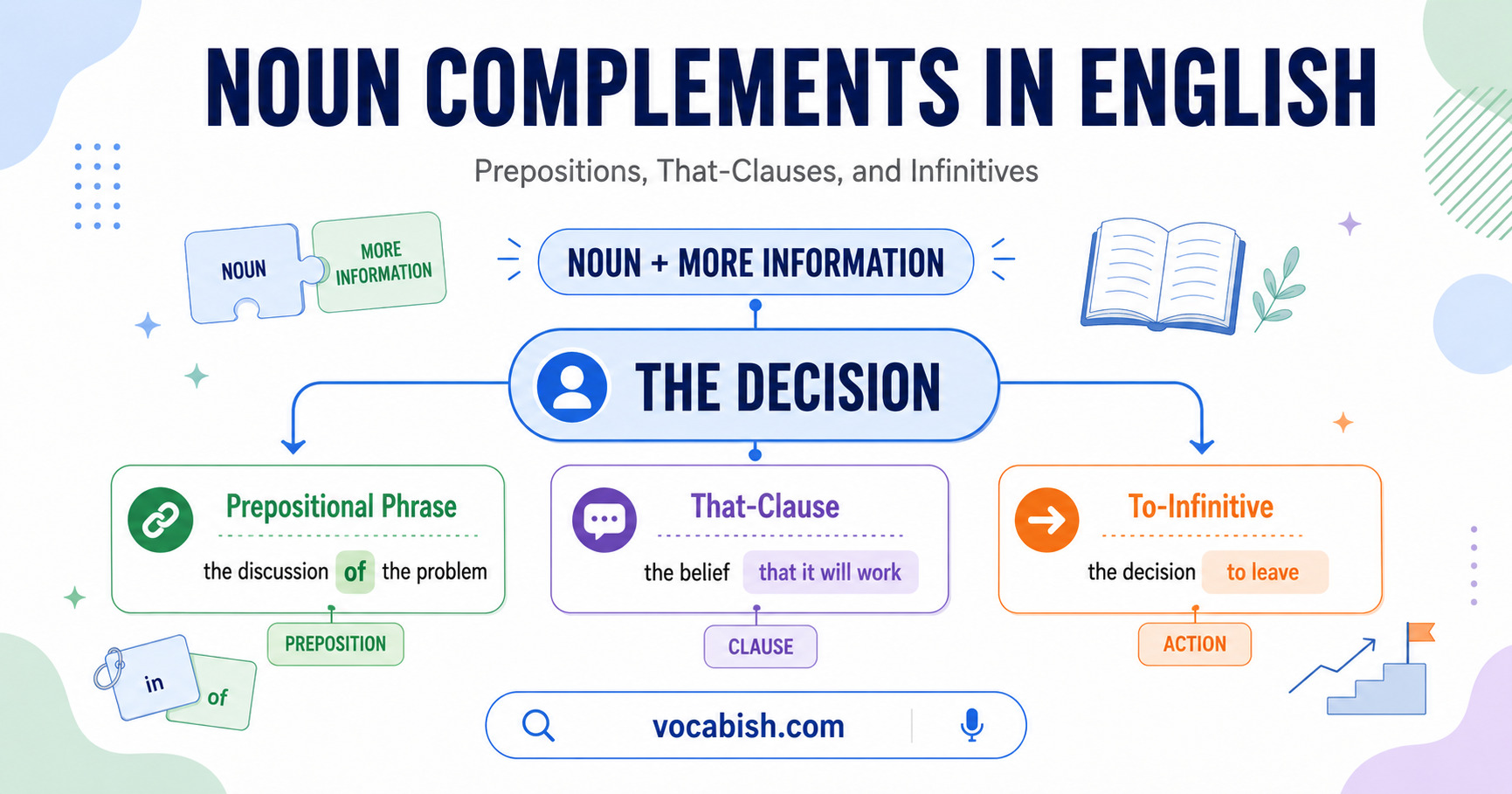

Noun complements are phrases or clauses that complete or clarify the meaning of a noun. They tell us what an idea concerns, what a decision involves, what someone believes, or which action is connected to the noun.
Compare the possibility with the possibility of rain. The first phrase is grammatically possible, but the second gives the information the listener is likely waiting for. Learning these patterns helps ESL learners build clearer noun phrases and choose the correct prepositions after common nouns.
What Is a Noun Complement?
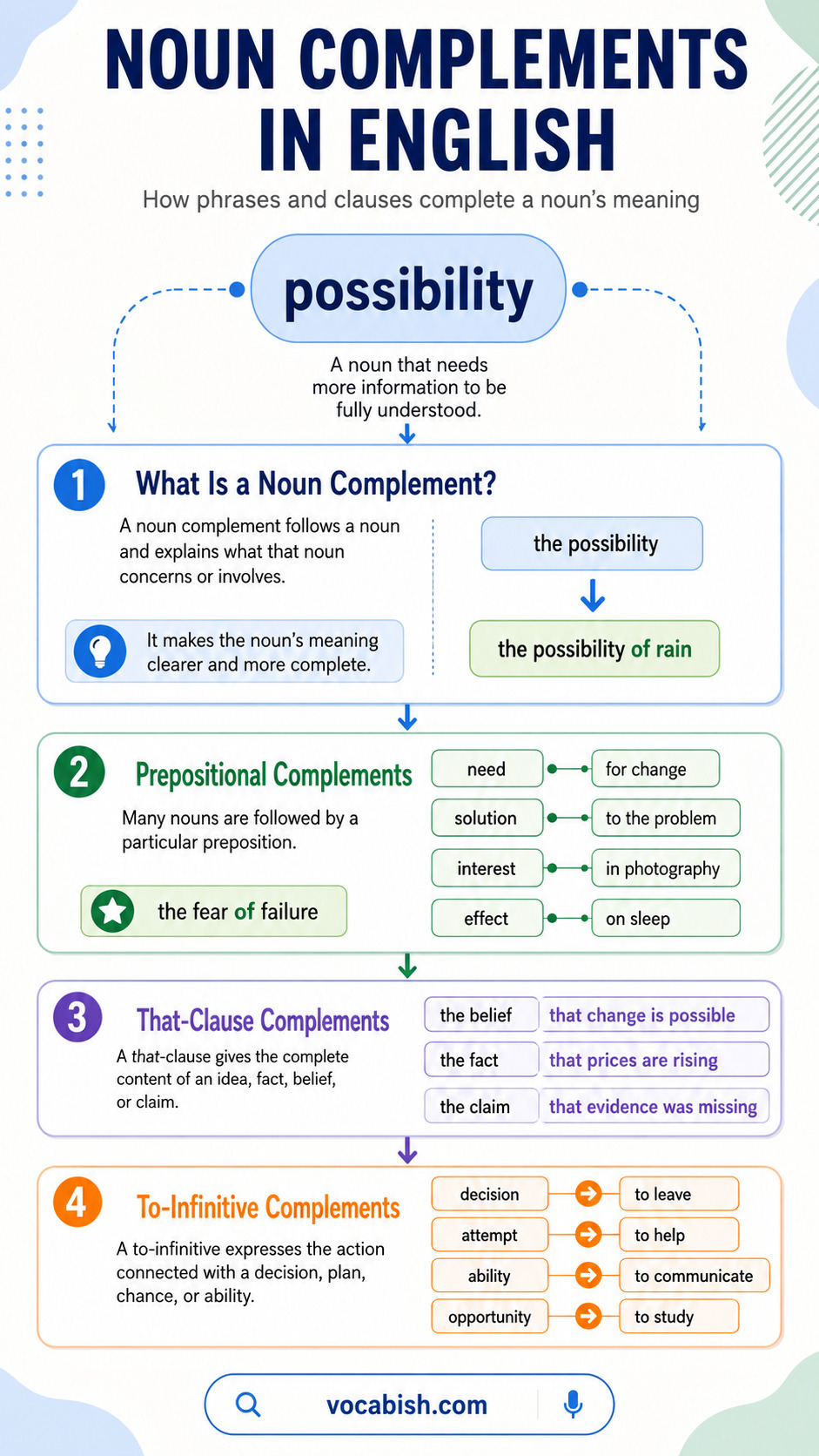
A noun complement is a word group placed after a noun to provide information closely connected to that noun’s meaning.
It may be:
- A prepositional phrase: the need for change
- A that-clause: the belief that everyone deserves respect
- A to-infinitive: her decision to resign
Noun complements often follow abstract nouns connected with:
- Ideas and beliefs
- Feelings and attitudes
- Decisions and plans
- Actions and results
- Possibility and evidence
Examples:
- We discussed the possibility of cancellation.
- She rejected the claim that the product was unsafe.
- His attempt to open the door failed.
Here, noun complement means a complement attached to a noun. It is different from a subject complement in a sentence such as Amina is a teacher.
Read More: How Noun Phrases are Formed and Expanded
Nouns Followed by “Of” Phrases
Many nouns take an of + noun phrase complement. The of-phrase commonly identifies the subject, object, content, or cause connected with the noun.
Noun pattern | Example |
|---|---|
awareness of | Public awareness of the problem is growing. |
fear of | Her fear of flying began in childhood. |
discussion of | The discussion of grammar rules continued. |
destruction of | The destruction of the bridge blocked traffic. |
possibility of | There is a possibility of rain tonight. |
knowledge of | His knowledge of English grammar is impressive. |
Common nouns followed by of include:
- Advantage of
- Cause of
- Danger of
- Discovery of
- Example of
- Importance of
- Lack of
- Memory of
- Result of
- Risk of
The complement may contain a noun or an -ing form:
- the risk of injury
- the risk of falling
- the importance of practice
- the importance of practising regularly
Nouns Followed by Other Prepositions
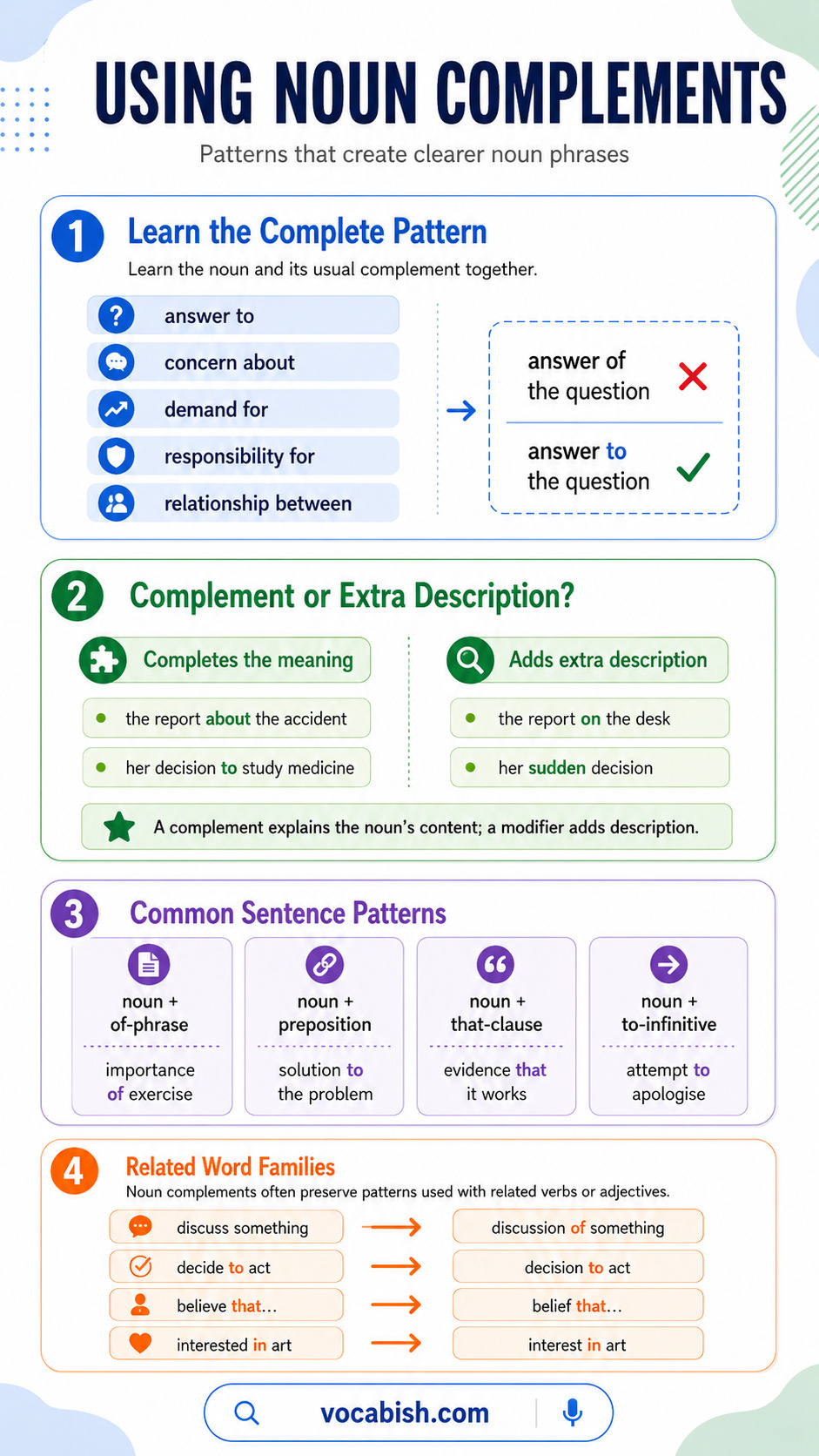
Some nouns select a particular preposition. These combinations should usually be learned together rather than translated word by word.
Noun | Usual pattern | Example |
|---|---|---|
answer | answer to | We finally found the answer to the question. |
concern | concern about | There is growing concern about pollution. |
demand | demand for | The demand for skilled workers has increased. |
effect | effect on | Stress can have an effect on sleep. |
interest | interest in | Her interest in languages began at school. |
need | need for | The report shows a need for better training. |
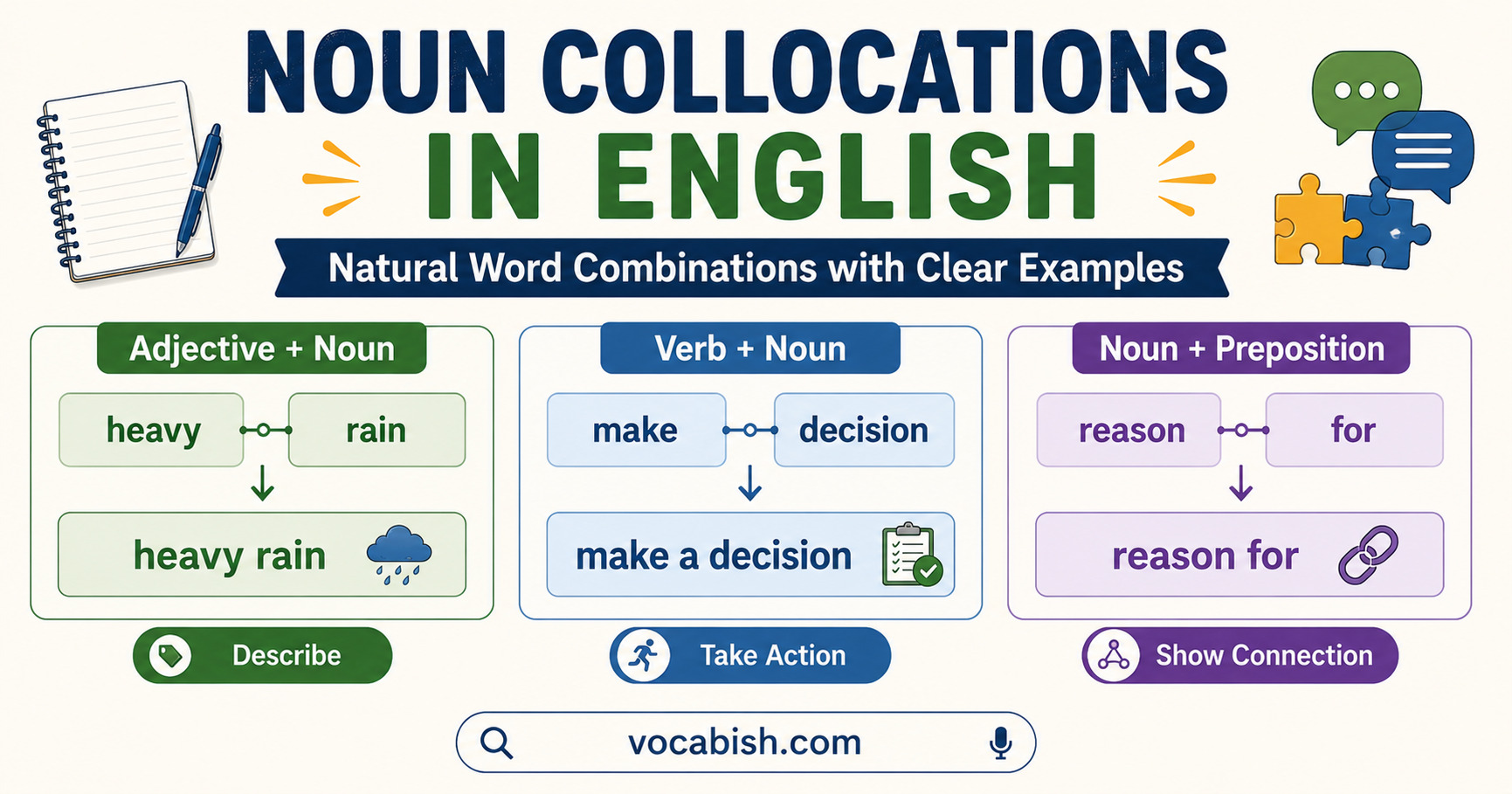
reason | reason for | What was the reason for his absence? |
relationship | relationship between | Researchers studied the relationship between diet and health. |
solution | solution to | We need a solution to this problem. |
responsibility | responsibility for | He accepted responsibility for the mistake. |
Watch these common errors:
- the answer of the question → the answer to the question
- a solution of the problem → a solution to the problem
- interest for science → interest in science
- the reason of the delay → the reason for the delay
A noun may sometimes allow more than one preposition, but the meaning can change:
- concern about safety: worry regarding safety
- concern for safety: care or consideration for safety
Related Resources: Common Noun Collocations and Preposition Patterns
Nouns Followed by “That” Clauses
A that-clause can state the complete content of a fact, belief, claim, idea, report, or possibility.
Noun | Example |
|---|---|
belief | She holds the belief that education should be free. |
claim | Police investigated the claim that evidence was missing. |
fact | We cannot ignore the fact that prices are rising. |
idea | I like the idea that everyone can participate. |
news | The news that she had recovered relieved us. |
possibility | They considered the possibility that he was mistaken. |
proof | Is there any proof that the document is genuine? |
rumour | We heard a rumour that the office would close. |
The word that introduces the clause but does not perform a role inside it:
- the belief that the plan will succeed
The clause has its own complete subject and verb:
- subject: the plan
- verb: will succeed
Do not confuse a complement clause with a relative clause:
- The claim that the figures were false caused concern.
That the figures were false gives the content of the claim. - The claim that shocked everyone was later withdrawn.
That shocked everyone describes which claim; it is a relative clause.
In informal English, that may occasionally be omitted, but keeping it often makes a long noun phrase easier to understand.
Nouns Followed by Infinitives
A to-infinitive often follows a noun connected with an action, intention, opportunity, decision, or ability.
Noun pattern | Example |
|---|---|
ability to | She has the ability to remain calm. |
attempt to | His attempt to escape was unsuccessful. |
chance to | Everyone deserves a chance to explain. |
decision to | Their decision to postpone the event surprised us. |
failure to | The company’s failure to respond caused frustration. |
opportunity to | I had an opportunity to study abroad. |
permission to | We received permission to enter the building. |
plan to | Their plan to expand the business looks promising. |
promise to | He kept his promise to return. |
refusal to | Her refusal to cooperate delayed the investigation. |
The infinitive usually expresses the action connected with the noun:
- a decision to leave
- an attempt to help
- the ability to communicate
- no reason to worry
The person performing the action may be shown through a possessive form:
- Ali’s decision to leave
- the manager’s refusal to comment
- their attempt to solve the issue
Noun Complements vs Optional Modifiers
A noun complement is closely linked to the meaning of the noun. A modifier adds descriptive information but is not selected by the noun itself.
Feature | Noun complement | Optional modifier |
|---|---|---|
Main purpose | Completes or specifies the noun’s meaning | Adds extra description |
Relationship | Closely connected to the noun | Loosely connected to the noun |
Common forms | Prepositional phrase, that-clause, infinitive | Adjective, relative clause, place or time phrase |
Example | the destruction of the building | the building near the station |
Example | the belief that she was honest | the belief popular among students |
Example | his decision to resign | his decision yesterday |
Compare:
- We examined the report about the accident.
The phrase identifies what the report concerns. - We examined the report on the desk.
The phrase only tells us where the report is.
Another comparison:
- Her decision to study medicine pleased her parents.
The infinitive explains the content of the decision. - Her sudden decision pleased her parents.
Sudden only describes the decision.
Removal is not a perfect test. A sentence may remain grammatical after a complement is removed, but important intended information may disappear.
Common Sentence Patterns
Pattern | Example |
|---|---|
noun + of + noun | We discussed the importance of exercise. |
noun + of + -ing form | She understands the benefits of reading. |
noun + other preposition + noun | They found a solution to the problem. |
noun + that-clause | There is evidence that the system works. |
noun + to-infinitive | He made an attempt to apologise. |
possessive + noun + complement | Sara’s decision to move surprised us. |
determiner + adjective + noun + complement | We noticed a sharp increase in prices. |
there is/are + noun + complement | There is no reason for concern. |
Useful noun families often keep relationships found in related verbs or adjectives:
- discuss something → a discussion of something
- decide to act → a decision to act
- believe that something is true → the belief that something is true
- interested in art → an interest in art
- responsible for safety → responsibility for safety
Explore More: Nouns Formed from Verbs and their Common Patterns
Identification Practice
Identify the noun complement and name its type.
- The possibility of failure worried the team.
- We welcomed her decision to stay.
- There is strong evidence that the account is accurate.
- His interest in photography began recently.
- They discussed the need for better equipment.
- The rumour that the school was closing spread quickly.
- Everyone should have a chance to speak.
- The destruction of ancient forests threatens wildlife.
Answers
- of failure — of-phrase
- to stay — infinitive
- that the account is accurate — that-clause
- in photography — prepositional phrase
- for better equipment — prepositional phrase
- that the school was closing — that-clause
- to speak — infinitive
- of ancient forests — of-phrase
FAQs About Noun Compliments
A noun complement is a phrase or clause that follows a noun and completes, specifies, or clarifies the meaning carried by that noun.
Yes. Nouns can take complements with prepositions such as to, for, about, in, on, and with, depending on the noun’s normal pattern.
No. A that-clause is a noun complement only when it completes a noun’s meaning, as in the belief that change is possible.
Nouns expressing plans, decisions, chances, needs, attempts, and abilities often take to-infinitive complements, especially when the noun points toward an action.
A complement is closely tied to the noun’s meaning, while a modifier adds optional description that can usually be removed without changing the core idea.
Yes. A noun may be followed by two related complements, although long or crowded structures are often clearer when rewritten as separate clauses.
Not always. Some nouns remain grammatical without them, but the complement may still be necessary to express the intended meaning clearly and precisely.
Short Summary
Noun complements complete or clarify the meaning of nouns. They commonly appear as:
- Of-phrases: the fear of failure
- Other prepositional phrases: the solution to the problem
- That-clauses: the fact that she returned
- Infinitives: his decision to leave
Unlike optional modifiers, complements express information closely connected to the noun’s meaning. Learning each noun with its usual pattern is the most reliable approach.
You May Also Like