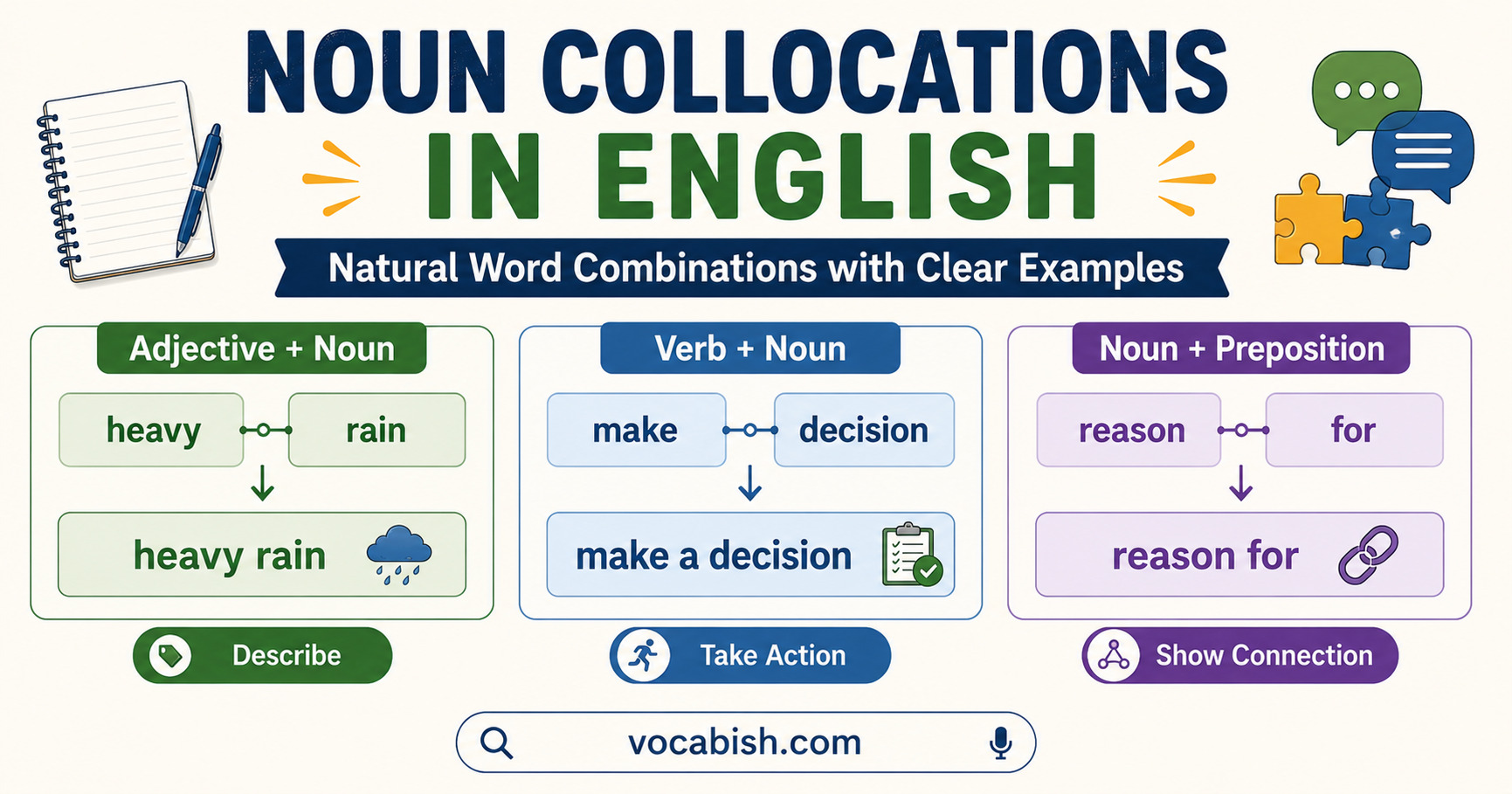

Noun collocations are natural combinations of words built around a noun, such as heavy rain, make a decision, and a sense of humour. Learning noun collocations helps you choose words that native and fluent English speakers commonly use together.
A sentence may be grammatically correct but still sound unnatural when its words do not form a usual collocation. For example, English speakers say “strong evidence,” not normally “powerful evidence.” Understanding these patterns makes speaking and writing smoother, clearer, and more natural.
What Is a Noun Collocation?
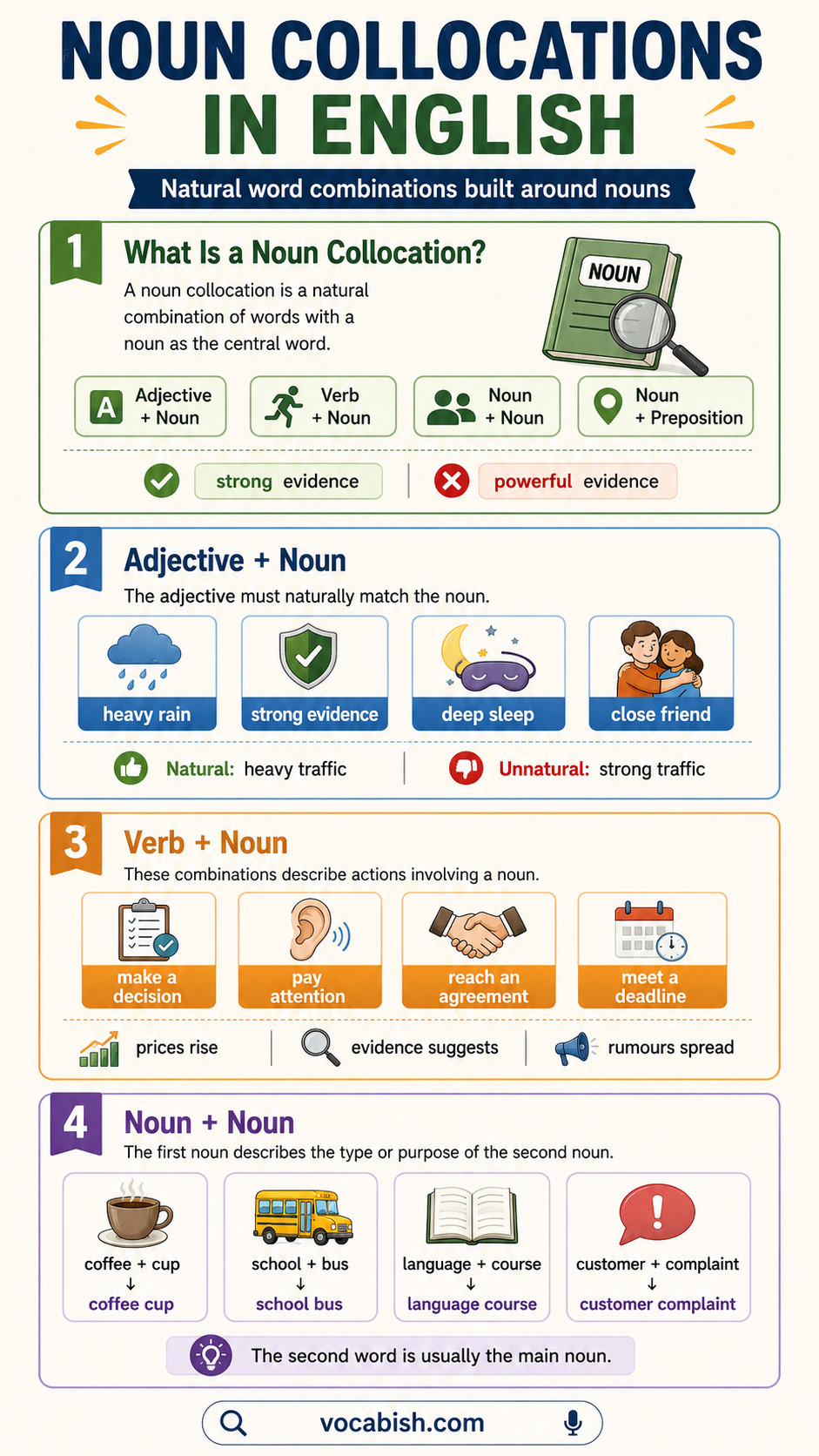
A noun collocation is a group of two or more words that regularly appear together, with a noun acting as the central word.
Common patterns include:
- Adjective + noun: heavy traffic
- Verb + noun: make progress
- Noun + noun: traffic jam
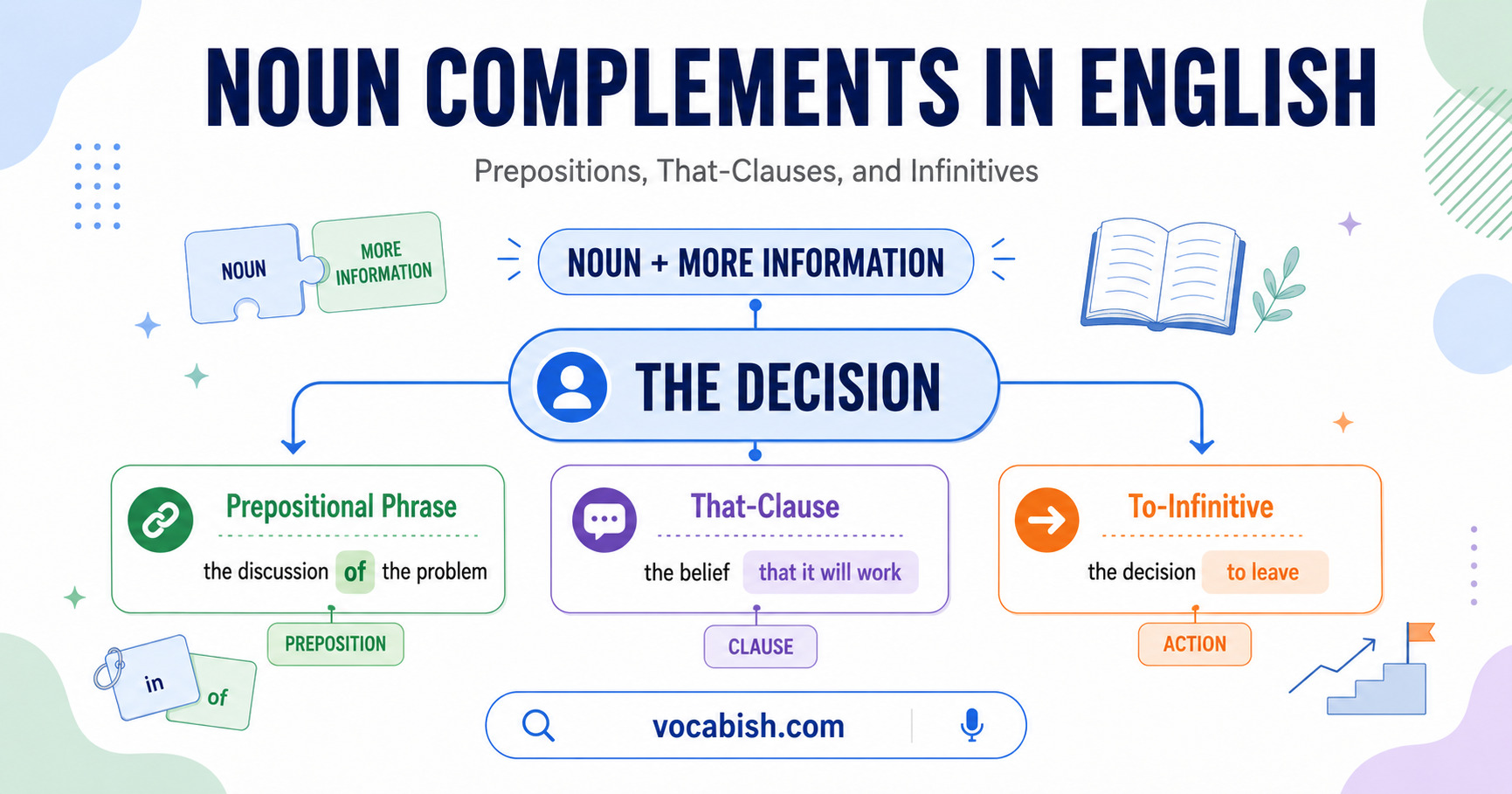
- Noun + preposition: reason for
- Preposition + noun: in trouble
These combinations are learned through common usage rather than grammar rules alone.
Natural collocation | Unnatural combination |
|---|---|
strong coffee | powerful coffee |
heavy rain | strong rain |
make a mistake | do a mistake |
deep concern | big concern |
pay attention | give attention |
a rise in prices | a rise of prices |
Some unnatural combinations are understandable, but they are not the phrases English speakers normally choose.
Explore More: Understand how nouns are formed from verbs, adjectives, and other nouns through common suffixes.
Adjective and Noun Collocations
In an adjective-and-noun collocation, the adjective describes the noun. The challenge is choosing the adjective that naturally fits that particular noun.
Common adjective + noun combinations
Collocation | Example sentence |
|---|---|
heavy rain | Heavy rain delayed the match. |
strong evidence | The police found strong evidence. |
deep sleep | The baby fell into a deep sleep. |
serious problem | We need to discuss a serious problem. |
close friend | Nadia is one of my closest friends. |
high demand | There is high demand for skilled workers. |
bitter disappointment | Losing the final was a bitter disappointment. |
bright future | She has a bright future ahead of her. |
valuable experience | The internship gave him valuable experience. |
growing concern | Air pollution is a growing concern. |
reasonable price | We found the furniture at a reasonable price. |
complete silence | The announcement was followed by complete silence. |
Notice that one adjective cannot freely replace another:
- heavy traffic, not strong traffic
- strong argument, not usually heavy argument
- deep concern, not normally tall concern
- high probability, not big probability
A useful learning habit is to record the adjective and noun as one vocabulary item. Instead of learning only evidence, learn strong evidence, clear evidence, and supporting evidence.
Related Resources: Study how nouns formed from adjectives express qualities, emotions, states, and conditions.
Verb and Noun Collocations
Verb-and-noun collocations describe actions involving a noun. These are especially useful because learners often choose the wrong general verb, such as do, make, get, or take.
Common verb + noun combinations
Collocation | Example sentence |
|---|---|
make a decision | We must make a decision today. |
take a break | Let us take a short break. |
pay attention | Please pay attention to the instructions. |
raise a question | Her comment raised an interesting question. |
reach an agreement | Both sides reached an agreement. |
gain experience | You can gain experience through volunteer work. |
meet a deadline | The team worked late to meet the deadline. |
solve a problem | We are trying to solve the problem. |
express concern | Several parents expressed concern about safety. |
draw a conclusion | We cannot draw a conclusion without more evidence. |
catch a cold | I caught a cold during the trip. |
file a complaint | The customer filed a formal complaint. |
The noun can also perform the action:
Noun + verb collocation | Example sentence |
|---|---|
prices rise | Food prices continue to rise. |
opportunity arises | A better opportunity may arise soon. |
problem occurs | The problem occurs during installation. |
evidence suggests | The evidence suggests a different explanation. |
tension grows | Tension grew between the two groups. |
rumour spreads | The rumour spread quickly online. |
company expands | The company plans to expand overseas. |
alarm rings | My alarm rings at six every morning. |
Pay attention to changes in grammar:
- They made a decision.
- A decision was made.
- Their decision caused confusion.
The noun remains part of a natural combination even when the sentence structure changes.
Explore More: Understand how nouns formed from verbs express actions, people, processes, and results.
Noun and Noun Combinations
Two nouns often appear together when the first noun identifies the type, purpose, material, user, place, or subject of the second noun.
In most noun + noun combinations, the second noun is the main noun:
- a coffee cup is a type of cup
- a school bus is a type of bus
- a language course is a type of course
- a customer complaint is a type of complaint
Common noun + noun patterns
Meaning | Collocation | Explanation |
|---|---|---|
Purpose | coffee machine | a machine for making coffee |
Place | office chair | a chair used in an office |
User | student visa | a visa for a student |
Material | stone wall | a wall made of stone |
Subject | grammar lesson | a lesson about grammar |
Time | summer holiday | a holiday during summer |
Content | water bottle | a bottle used for water |
Cause | stress headache | a headache caused by stress |
More examples include:
- bus station
- traffic accident
- job interview
- business meeting
- language learner
- safety regulations
- weather forecast
- research project
- phone call
- family member
- computer screen
- information technology
The first noun is usually singular:
- a shoe shop, not a shoes shop
- a ticket office, not a tickets office
- a car park, not a cars park
Some established combinations use a plural first noun:
- sports centre
- clothes shop
- savings account
- customs officer
These forms should be learned as complete expressions.
Nouns Followed by Prepositions
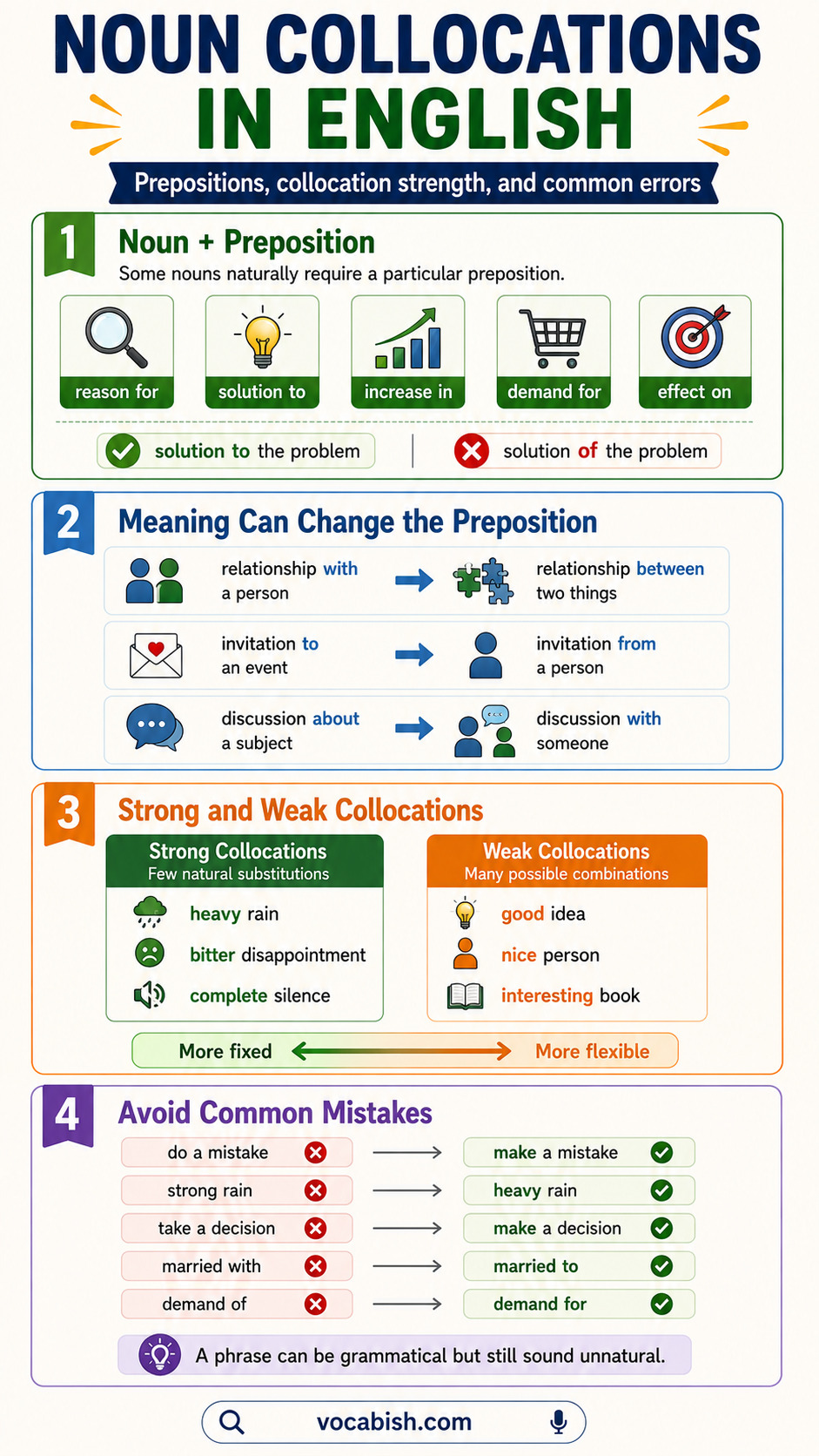
Many nouns are regularly followed by a particular preposition. Using the wrong preposition is one of the most common collocation errors.
Noun + preposition | Example |
|---|---|
reason for | What was the reason for the delay? |
solution to | We need a solution to this problem. |
increase in | There has been an increase in rent. |
decrease in | The report shows a decrease in crime. |
demand for | Demand for electric vehicles is growing. |
access to | Students need access to reliable information. |
effect on | Lack of sleep has an effect on concentration. |
impact on | The decision may have an impact on jobs. |
relationship with | She has a good relationship with her manager. |
connection between | Researchers found a connection between diet and sleep. |
advantage of | One advantage of online learning is flexibility. |
difficulty with | He has difficulty with pronunciation. |
attitude towards | Her attitude towards work has changed. |
responsibility for | The manager accepted responsibility for the error. |
need for | There is an urgent need for clean water. |
The preposition often changes according to meaning:
- a relationship with a person
- a relationship between two things
- an invitation to an event
- an invitation from a person
- a discussion about a subject
- a discussion with someone
Learn the complete phrase rather than choosing the preposition through direct translation.
Strong and Weak Collocations
Collocations differ in how fixed they are.
Strong collocations
A strong collocation has a limited number of natural alternatives. Replacing one word often sounds unusual.
Examples:
- bitter disappointment
- heavy rain
- strong evidence
- blatant lie
- complete silence
- keen interest
- overwhelming majority
- roaring success
We commonly say bitter disappointment, but not usually sour disappointment or spicy disappointment.
Weak collocations
A weak collocation contains words that combine naturally with many other words.
Examples:
- big house
- nice person
- good idea
- interesting book
- small problem
- difficult question
The adjective good can appear with many nouns:
- good idea
- good reason
- good chance
- good example
- good relationship
Strong collocation | Weak collocation |
|---|---|
Few natural substitutions | Many possible substitutions |
Often more fixed | More flexible |
Must usually be memorised | Often easier to predict |
heavy rain | good weather |
bitter disappointment | interesting experience |
compelling evidence | large building |
Strong and weak collocations are not two completely separate categories. Many combinations fall somewhere between them.
List of All Main Noun-Collocation Patterns
The following table brings the main patterns together. English contains thousands of individual collocations, so the examples represent the main types rather than every possible expression.
Pattern | Common collocations |
|---|---|
Adjective + noun | heavy rain, strong evidence, close friend, serious risk |
Verb + noun | make progress, take action, reach an agreement, raise awareness |
Noun + verb | prices rise, evidence shows, trouble starts, opportunity arises |
Noun + noun | traffic jam, business plan, language course, customer service |
Noun + preposition | reason for, solution to, increase in, effect on |
Preposition + noun | in danger, under pressure, at risk, on purpose |
Noun + of + noun | piece of advice, sense of humour, lack of sleep |
Quantifier + noun | a round of applause, a burst of laughter, a range of options |
Fixed noun phrase | food for thought, matter of fact, state of mind |
Adverb + adjective + noun | highly successful campaign, deeply personal experience |
Common Collocation Mistakes
Many errors happen because a learner translates a combination directly from another language or uses a general verb where English prefers a specific one.
Incorrect | Correct | Example |
|---|---|---|
do a mistake | make a mistake | Everyone makes mistakes. |
make homework | do homework | I need to do my homework. |
take a decision | make a decision | We made a final decision. |
strong rain | heavy rain | Heavy rain flooded the road. |
big possibility | strong possibility | There is a strong possibility of delays. |
say a lie | tell a lie | He admitted that he had told a lie. |
give an exam | take an exam | The students will take an exam tomorrow. |
make a party | have a party | We are having a party on Saturday. |
high temperature weather | hot weather | The plants cannot survive hot weather. |
married with someone | married to someone | She is married to a doctor. |
solution of the problem | solution to the problem | We finally found a solution to the problem. |
demand of workers | demand for workers | Demand for trained workers has increased. |
To improve your accuracy:
- Learn words in short phrases, not in isolation.
- Notice repeated combinations while reading.
- Check uncertain combinations in a learner’s dictionary.
- Write one personal sentence for each new collocation.
- Review collocations by pattern.
- Avoid translating complete phrases word for word.
Sentence-Completion Practice
Complete each sentence with the most natural word.
- We need to ______ a decision before Friday.
- Heavy ______ caused several flight delays.
- The campaign aims to raise public ______ of the problem.
- Scientists found strong ______ supporting the theory.
- There has been a sharp increase ______ fuel prices.
- Please pay close ______ to the safety instructions.
- Both companies finally reached an ______.
- The new policy could have a serious impact ______ small businesses.
- She gained valuable ______ during her summer internship.
- The police are trying to solve the ______.
- Is there a connection ______ stress and poor sleep?
- He accepted responsibility ______ the mistake.
Answers
- make
- rain
- awareness
- evidence
- in
- attention
- agreement
- on
- experience
- crime
- between
- for
Short Summary
- Noun collocations are word combinations centred on a noun.
- Major patterns include adjective + noun, verb + noun, noun + noun, and noun + preposition.
- Some collocations are flexible, while others allow very few substitutions.
- A grammatically possible combination may still sound unnatural.
- Learning complete phrases improves fluency, accuracy, and vocabulary recall.
- Reading, listening, dictionary checking, and sentence practice help collocations become familiar.
FAQs About Noun Collocations
Noun collocations are natural word combinations built around nouns, such as heavy traffic, make a decision, and a sense of humour.
Learning noun collocations helps you sound more natural, choose words faster, and avoid combinations that are grammatically possible but uncommon.
Some patterns follow general grammar rules, but individual collocations usually need to be learned through reading, listening, and repeated practice.
A strong collocation allows few substitutes, while a weak collocation combines words that can naturally appear with many different partners.
Yes. A noun can combine with an adjective, verb, another noun, or preposition, depending on its meaning and grammatical function.
Record the complete phrase, write one natural example sentence, and review it in context rather than memorising the noun alone.
Not always. Many mistakes come from translating directly from another language, even when every individual English word is grammatically correct.
You May Also Like