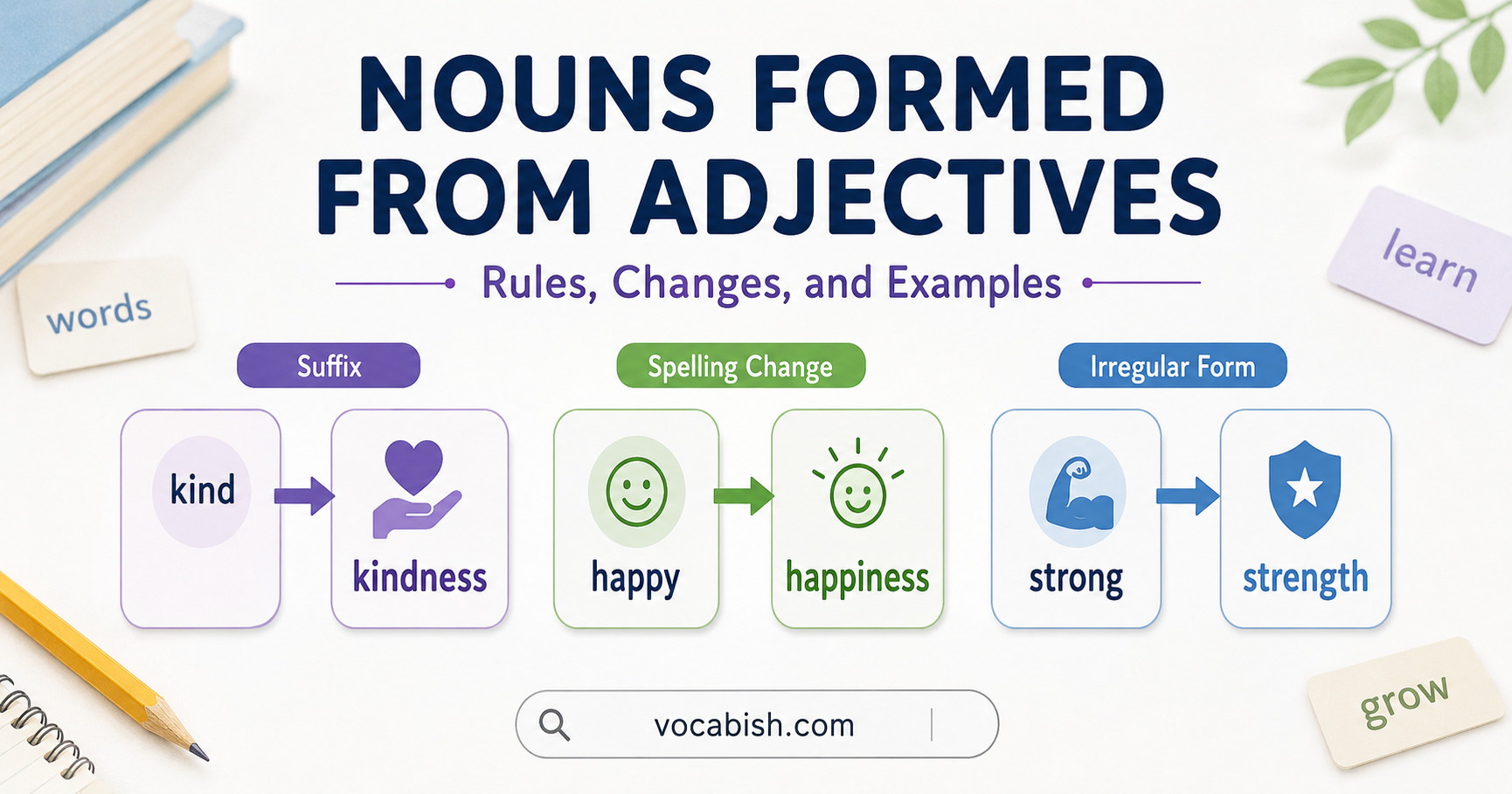

Nouns formed from adjectives name the quality, feeling, state, or condition described by an adjective. For example, kind becomes kindness, happy becomes happiness, and strong becomes strength.
These noun forms help us talk about ideas and qualities as things. Instead of saying that someone is honest, we can discuss their honesty.
How Adjectives Change into Nouns
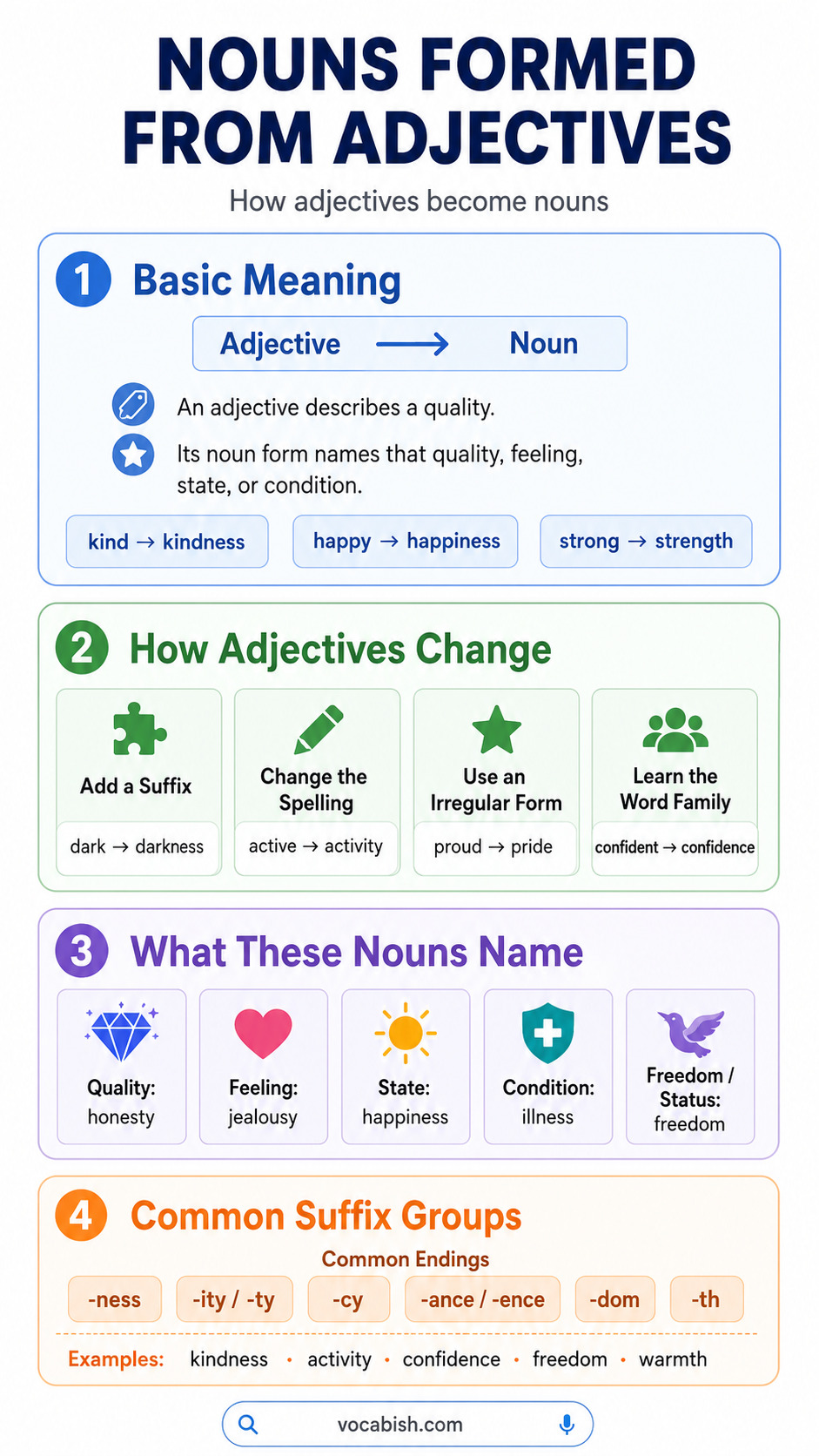
An adjective describes a person, place, object, or situation. Its noun form names the quality or condition itself.
Adjective | Noun | What the Noun Names |
|---|---|---|
kind | kindness | the quality of being kind |
happy | happiness | the state of being happy |
weak | weakness | the condition of being weak |
patient | patience | the quality of being patient |
different | difference | the state of being different |
strong | strength | the quality of being strong |
Adjectives usually become nouns in one of three ways:
- A suffix is added: dark → darkness
- The spelling changes: active → activity
- An irregular form is used: proud → pride
Not every adjective follows the same pattern. The correct noun form must be learned as part of the word family.
Qualities, Feelings, and Conditions
Adjective-based nouns can express different kinds of meanings.
Meaning | Adjective | Noun | Example |
|---|---|---|---|
Quality | honest | honesty | Everyone respected her honesty. |
Feeling | jealous | jealousy | Jealousy damaged their friendship. |
State | happy | happiness | Money does not always bring happiness. |
Condition | ill | illness | His illness lasted several weeks. |
Ability | intelligent | intelligence | Intelligence alone does not guarantee success. |
Freedom or status | free | freedom | The prisoners hoped for freedom. |
Many of these nouns are abstract nouns because they name ideas, emotions, or qualities that cannot be physically touched.
Common Adjective-to-Noun Suffixes
The following suffixes frequently form nouns from adjectives.
Suffix | Adjective | Noun | Example Sentence |
|---|---|---|---|
-ness | kind | kindness | Her kindness helped everyone. |
-ness | dark | darkness | Darkness covered the street. |
-ity | active | activity | Physical activity improves health. |
-ity | responsible | responsibility | This job requires responsibility. |
-ty | safe | safety | Passenger safety comes first. |
-ty | loyal | loyalty | The dog showed great loyalty. |
-cy | accurate | accuracy | Please check the accuracy of the figures. |
-cy | private | privacy | Everyone deserves privacy. |
-ance | important | importance | She understands the importance of sleep. |
-ence | confident | confidence | Practice will increase your confidence. |
-dom | free | freedom | They fought for freedom. |
-dom | wise | wisdom | Age does not always bring wisdom. |
-y | honest | honesty | Honesty builds trust. |
-th | warm | warmth | We enjoyed the warmth of the fire. |
Useful Patterns
- -ness is common with everyday adjectives:
soft → softness, lonely → loneliness, careless → carelessness - -ity often appears in more formal words:
equal → equality, possible → possibility, flexible → flexibility - -ance and -ence often replace adjective endings such as -ant and -ent:
important → importance, patient → patience, different → difference
Irregular Noun Forms
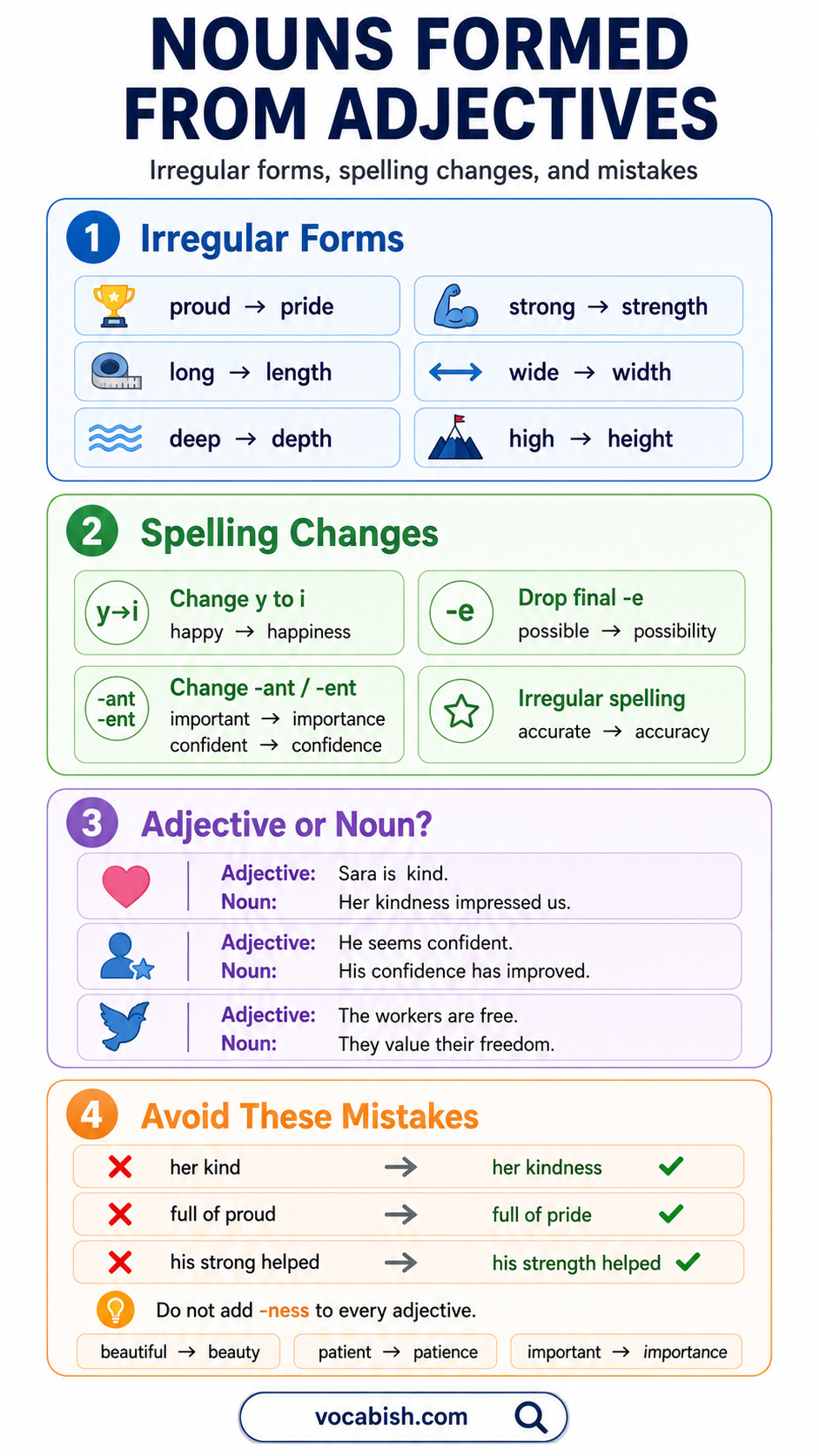
Some nouns do not follow a simple suffix pattern. Their spelling or word form changes noticeably.
Adjective | Noun | Example |
|---|---|---|
proud | pride | She takes pride in her work. |
strong | strength | Exercise builds strength. |
long | length | Measure the length of the table. |
wide | width | What is the width of the door? |
deep | depth | We tested the depth of the water. |
high | height | The wall has a height of two metres. |
true | truth | He finally told the truth. |
young | youth | He spent his youth in Lahore. |
poor | poverty | Poverty affects educational opportunities. |
beautiful | beauty | We admired the beauty of the landscape. |
These forms are best learned through reading, listening, and word-family practice.
Important Spelling Changes
Adding a noun suffix may change the spelling of the adjective.
Spelling Rule | Adjective | Noun |
|---|---|---|
Change final y to i | happy | happiness |
Change final y to i | lazy | laziness |
Drop final e | possible | possibility |
Drop or change part of the ending | active | activity |
Change -ant to -ance | important | importance |
Change -ent to -ence | confident | confidence |
Change -ate to -acy | accurate | accuracy |
Use an irregular spelling | strong | strength |
Remember these common forms:
- happy → happiness, not happyness
- possible → possibility, not possibleity
- patient → patience, not patientness
- accurate → accuracy, not accurateness in normal usage
- strong → strength, not strongness
Adjective and Noun Use in Sentences
An adjective describes a noun or follows a linking verb. A noun can act as the subject or object of a sentence.
Adjective Use | Noun Use |
|---|---|
Sara is kind. | Sara’s kindness impressed us. |
The children are happy. | Their happiness was easy to see. |
He seems confident. | His confidence has improved. |
This task is difficult. | The difficulty surprised the students. |
The room became dark. | Darkness filled the room. |
These figures are accurate. | We checked their accuracy. |
The workers are free. | They value their freedom. |
Quick Sentence Test
Use an adjective after words such as:
- be
- seem
- become
- look
- feel
She feels confident.
Use a noun after:
- an article: the importance
- a possessive: her confidence
- a preposition: with patience
- an adjective: great kindness
She answered with confidence.
List of Nouns Formed from Adjectives
No. | Adjectives | Noun | Suffix Used |
|---|---|---|---|
1 | kind | kindness | -ness |
2 | happy | happiness | -ness |
3 | dark | darkness | -ness |
4 | weak | weakness | -ness |
5 | careless | carelessness | -ness |
6 | lonely | loneliness | -ness |
7 | active | activity | -ity |
8 | equal | equality | -ity |
9 | possible | possibility | -ity |
10 | responsible | responsibility | -ity |
11 | flexible | flexibility | -ity |
12 | safe | safety | -ty |
13 | loyal | loyalty | -ty |
14 | certain | certainty | -ty |
15 | honest | honesty | -y |
16 | jealous | jealousy | -y |
17 | accurate | accuracy | -cy |
18 | private | privacy | -cy |
19 | fluent | fluency | -cy |
20 | important | importance | -ance |
21 | tolerant | tolerance | -ance |
22 | confident | confidence | -ence |
23 | different | difference | -ence |
24 | patient | patience | -ence |
25 | free | freedom | -dom |
26 | wise | wisdom | -dom |
27 | warm | warmth | -th |
28 | deep | depth | -th |
29 | strong | strength | -th with spelling change |
30 | true | truth | -th with spelling change |
31 | wide | width | -th with spelling change |
32 | high | height | -th with spelling change |
33 | proud | pride | Irregular form |
34 | young | youth | Irregular form |
35 | beautiful | beauty | Irregular spelling change |
Common Word-Form Mistakes
Incorrect | Correct | Reason |
|---|---|---|
Her kind impressed me. | Her kindness impressed me. | A noun is needed after her. |
She has very confident. | She has great confidence. | A noun is needed after has. |
He is full of proud. | He is full of pride. | The irregular noun is pride. |
This work requires patient. | This work requires patience. | The verb requires needs a noun object. |
She is confidence. | She is confident. | An adjective is needed after is. |
The importance decision was delayed. | The important decision was delayed. | An adjective must describe decision. |
His strong helped the team. | His strength helped the team. | A noun is needed as the subject. |
Avoid creating noun forms by adding -ness to every adjective. English often uses an established form:
- beautiful → beauty
- important → importance
- proud → pride
- strong → strength
- patient → patience
Also remember that expressions such as the rich, the poor, and the elderly refer to groups of people. The adjective does not become a singular countable noun.
The rich should help the poor.
Not: a rich or two poors
Practice Exercise
Complete each sentence with the correct noun form of the adjective in brackets.
- Her __________ made the new student feel welcome. (kind)
- Regular exercise can improve your health and __________. (active)
- The children shouted with __________ when they saw the gifts. (happy)
- Please answer the customer with __________. (patient)
- The bridge was tested for safety and __________. (strong)
- He felt great __________ after completing the project. (proud)
- We checked the __________ of every measurement. (accurate)
- People should have the __________ to express their opinions. (free)
- The main __________ was finding enough time. (difficult)
- Her unexpected __________ caused several problems. (absent)
Answers:
- kindness
- activity
- happiness
- patience
- strength
- pride
- accuracy
- freedom
- difficulty
- absence
FAQs
A noun formed from an adjective names the quality, feeling, state, or condition expressed by that adjective, such as kindness from kind.
Many adjectives become nouns by taking suffixes such as -ness, -ity, -ence, or -dom, while others change spelling or use irregular forms.
No. Many adjectives take other endings, and some have irregular nouns, so learners should check the accepted form instead of guessing.
Happy changes to happiness because a final consonant plus y usually changes to i before the suffix -ness is added.
The noun form of strong is strength. It is an irregular form with a spelling change, not the regular addition of -ness.
Yes, some words can serve both roles, but sentence position and meaning show whether the word describes something or names it.
In “the rich,” rich remains an adjective used for a group of people. It does not become a singular countable noun.
Short Summary
Nouns formed from adjectives name qualities, feelings, states, and conditions. They may use suffixes such as -ness, -ity, -cy, -ence, and -dom.
Some forms require spelling changes, while others are irregular. Learning complete word families—such as strong, strength and confident, confidence—helps prevent common grammar mistakes.
You May Also Like