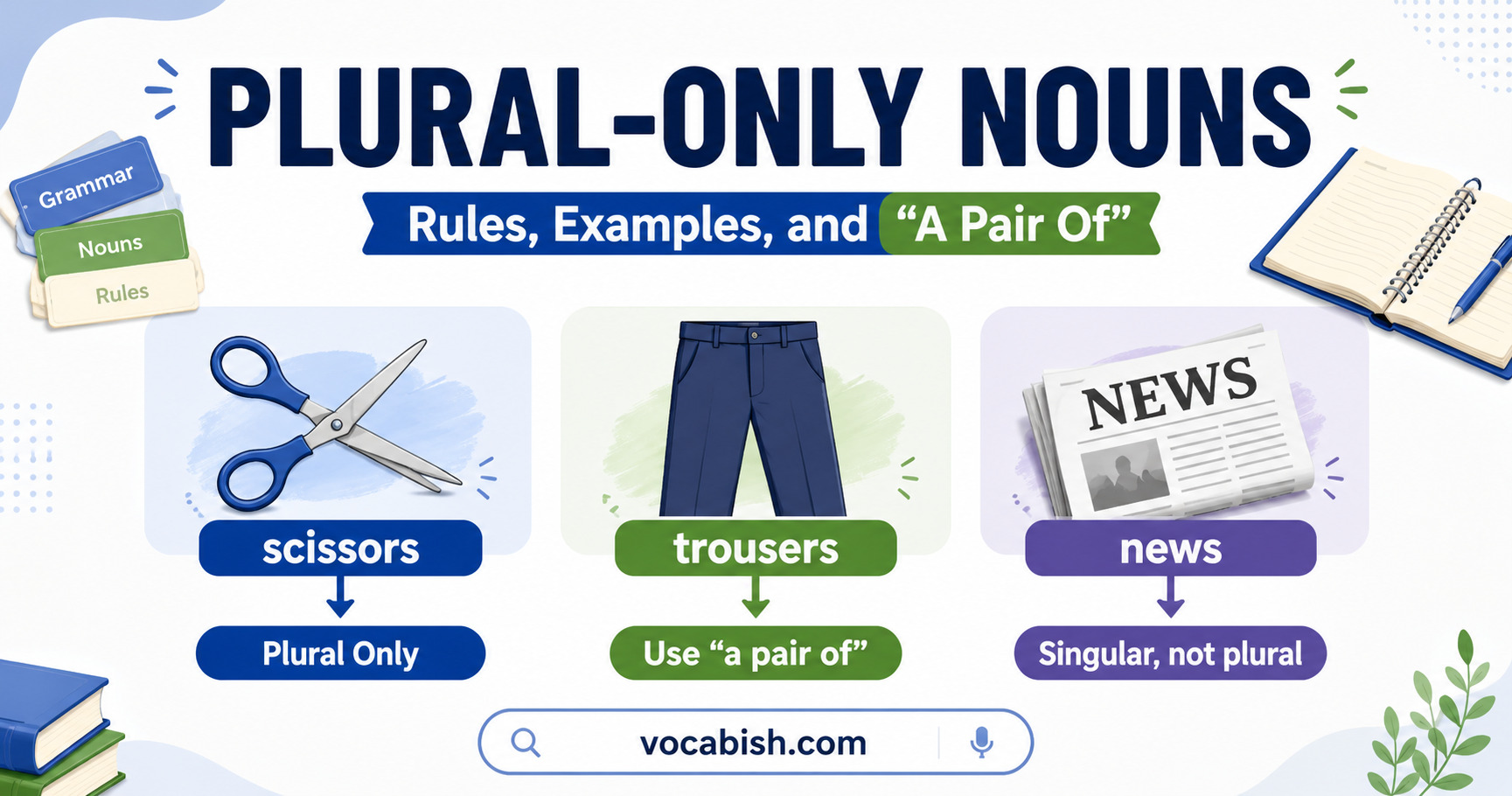

Plural-only nouns are nouns that are normally used only in a plural form, even when they describe one object, group, or idea. They take plural verbs, while two-part objects are often counted with a pair of, as in a pair of scissors.
What Are Plural-Only Nouns?
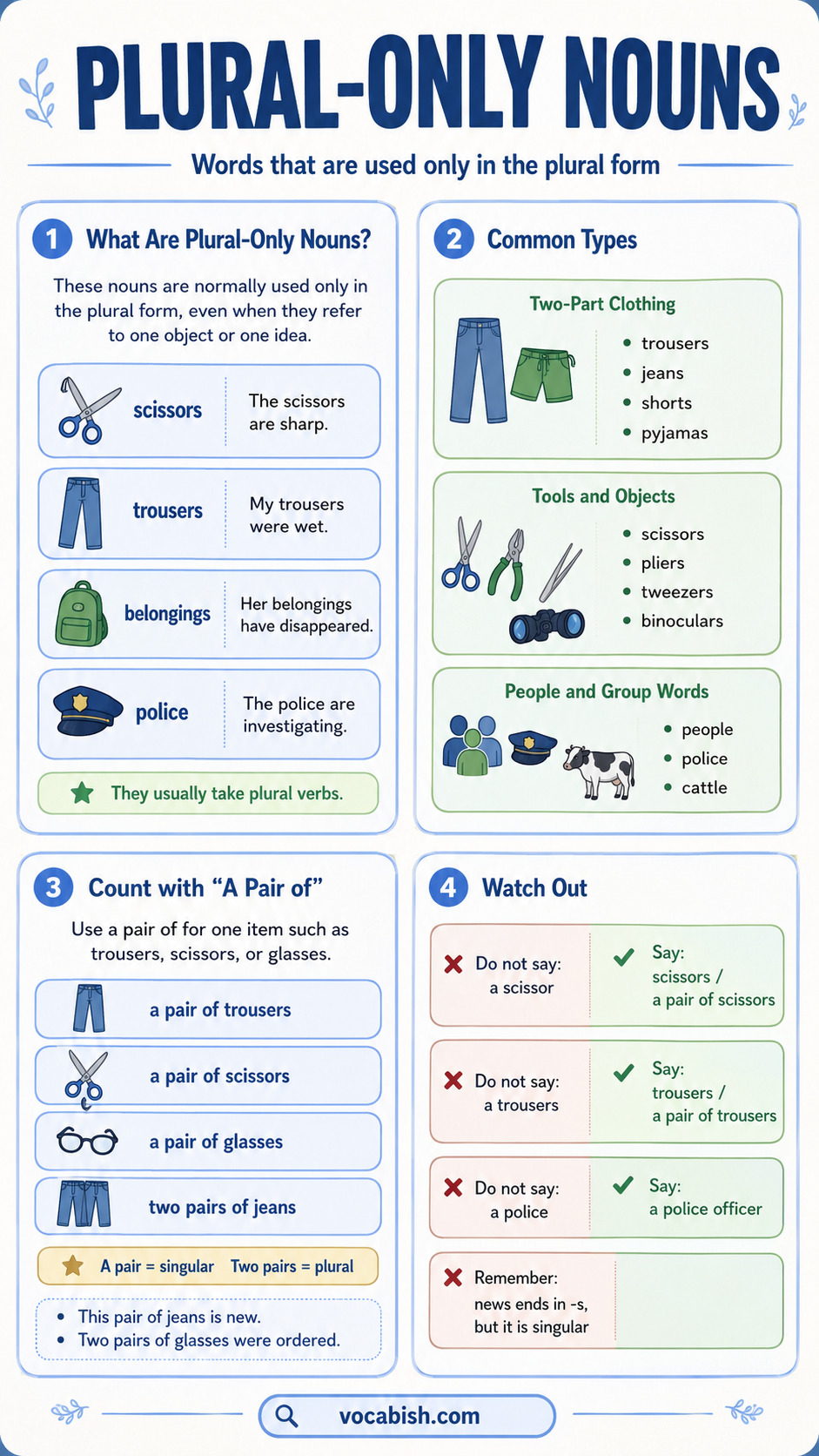
Plural-only nouns have a plural form and usually end in -s, but they do not have a normal singular equivalent.
- The scissors are sharp.
- My trousers were wet.
- Her belongings have disappeared.
- The police are investigating the incident.
These nouns are sometimes called pluralia tantum, meaning “plural only.”
Not every noun ending in -s is plural:
- The news is encouraging.
- Mathematics is difficult for some learners.
- This series is popular.
Related: Singular and Plural Nouns with Examples
Clothing and Two-Part Objects
Many plural-only nouns describe clothing with two matching parts or objects made of two connected sections.
Category | Common Examples | Example |
|---|---|---|
Lower-body clothing | trousers, jeans, shorts, pants | These jeans are comfortable. |
Other clothing | pyjamas, tights, leggings | Her pyjamas were on the bed. |
General clothing | clothes | Your clothes are dry. |
Cutting tools | scissors, shears | The scissors are in the drawer. |
Gripping tools | pliers, tweezers, tongs | These pliers are rusty. |
Eyewear | glasses, spectacles, goggles | My glasses need cleaning. |
Viewing equipment | binoculars | The binoculars belong to Ahmed. |
In American English, pants usually means trousers. In British English, pants commonly refers to underwear. Both uses are grammatically plural.
People and Group Nouns
Some words describing people or animals also behave as plural nouns.
Plural Noun | One Individual | Correct Example |
|---|---|---|
people | a person | Several people are waiting. |
police | a police officer | The police have arrived. |
cattle | a cow, bull, or animal | The cattle are grazing. |
Important points:
- Do not say a police. Say a police officer.
- Do not say one people for one individual. Say one person.
- Do not say a cattle. Name the animal or say one head of cattle.
The expression a people is possible, but it has a different meaning. It refers to a nation, culture, or ethnic community.
- The Māori are a people with a rich cultural heritage.
Other Common Plural-Only Words
The following nouns are normally plural in these particular meanings.
Noun | Meaning | Example |
|---|---|---|
belongings | personal possessions | His belongings are in the suitcase. |
contents | things inside something | The contents were damaged. |
surroundings | the area around someone | Our surroundings are peaceful. |
remains | what is left | The remains were carefully examined. |
goods | products for sale | These goods have already been paid for. |
premises | a building and its land | The premises are protected by cameras. |
outskirts | the outer parts of a town | The outskirts are less crowded. |
valuables | expensive personal items | Her valuables were locked away. |
earnings | money earned from work | His earnings have increased. |
savings | money kept for future use | Their savings are in a secure account. |
proceedings | an organised series of events | The proceedings were recorded. |
clothes | items worn on the body | My clothes are still wet. |
Some of these words have related singular forms with different meanings. For example, content may mean satisfaction, while contents means the things inside something.
Verb Agreement with Plural-Only Nouns
A plural-only noun takes a plural verb.
Subject | Correct Verb | Example |
|---|---|---|
trousers | are | These trousers are too long. |
scissors | were | The scissors were on the table. |
police | have | The police have questioned him. |
belongings | seem | Her belongings seem safe. |
premises | are | The premises are currently closed. |
Use plural pronouns when referring back to these nouns:
- My glasses are broken. They need repairing.
- The trousers are expensive, but they fit well.
- Where are the scissors? I left them here.
When pair becomes the main noun, the verb agrees with pair, not with the plural-only noun.
- This pair of trousers is new.
- One pair of scissors was missing.
- Two pairs of glasses were ordered.
Related Resources: Noun-Verb Agreement in English
Counting with “A Pair of”
Use a pair of when referring to one two-part object or one item of clothing such as trousers or shorts.
Quantity | Correct Form |
|---|---|
one | a pair of trousers |
two | two pairs of trousers |
one | a pair of scissors |
three | three pairs of scissors |
one | a pair of binoculars |
several | several pairs of binoculars |
Notice the verb agreement:
- A pair of jeans is hanging outside.
- Two pairs of jeans are hanging outside.
- These jeans are too loose.
- This pair of jeans is too loose.
Do not normally use a pair of clothes. Use:
- an item of clothing
- two items of clothing
- several pieces of clothing
- some clothes
Common Usage Mistakes
Incorrect | Correct | Reason |
|---|---|---|
I need a scissor. | I need scissors. | Scissors has no normal singular form. |
My trousers is dirty. | My trousers are dirty. | Trousers takes a plural verb. |
This glasses are mine. | These glasses are mine. | Use the plural determiner these. |
These pair of jeans is new. | This pair of jeans is new. | Pair is singular. |
I bought two pair of shorts. | I bought two pairs of shorts. | Use plural pairs after two. |
A police questioned me. | A police officer questioned me. | Police does not mean one officer. |
One cattle escaped. | One cow escaped. | Cattle has no singular form. |
My clothes is upstairs. | My clothes are upstairs. | Clothes is grammatically plural. |
The news are surprising. | The news is surprising. | News is grammatically singular. |
This scissors is blunt. | These scissors are blunt. | Use plural agreement with scissors. |
Practice Exercise
Choose the correct answer.
- These trousers (is / are) too tight.
- A pair of tweezers (was / were) on the shelf.
- The police (has / have) closed the road.
- Her belongings (was / were) found outside.
- I bought two (pair / pairs) of shorts.
- One (cattle / cow) was separated from the herd.
- The news (is / are) not confirmed.
- Where (is / are) my scissors?
- The contents of the box (seems / seem) valuable.
- This pair of glasses (need / needs) a new case.
Answers:
- are
- was
- have
- were
- pairs
- cow
- is
- are
- seem
- needs
FAQs About Plural-Only Nouns
Plural-only nouns normally appear in the plural form, take plural verbs, and usually lack an ordinary singular form with the same meaning.
Many developed from words naming paired parts, collections, or groups, so standard English now treats their usual form as grammatically plural.
Do not use a directly before these nouns. Say a pair of trousers, a pair of scissors, or simply trousers and scissors.
Yes, when the plural-only noun itself is the subject: the scissors are sharp, the trousers were wet, and the police have arrived.
In that structure, pair is the head noun and is singular. Scissors only identifies the object contained in the singular pair.
In everyday use, people is the plural of person. However, a people can mean one nation or distinct ethnic community.
No. Although news ends in s, it is grammatically singular, so we say the news is surprising, not the news are surprising.
Short Summary
- Plural-only nouns normally have no standard singular form.
- They take plural verbs: The scissors are sharp.
- Use a pair of to count trousers, scissors, glasses, and similar objects.
- One pair takes a singular verb; two pairs take a plural verb.
- Words such as police, cattle, clothes, belongings, premises, and surroundings normally require plural agreement.
- An -s ending does not always indicate a plural noun; news is singular.
You May Also Like