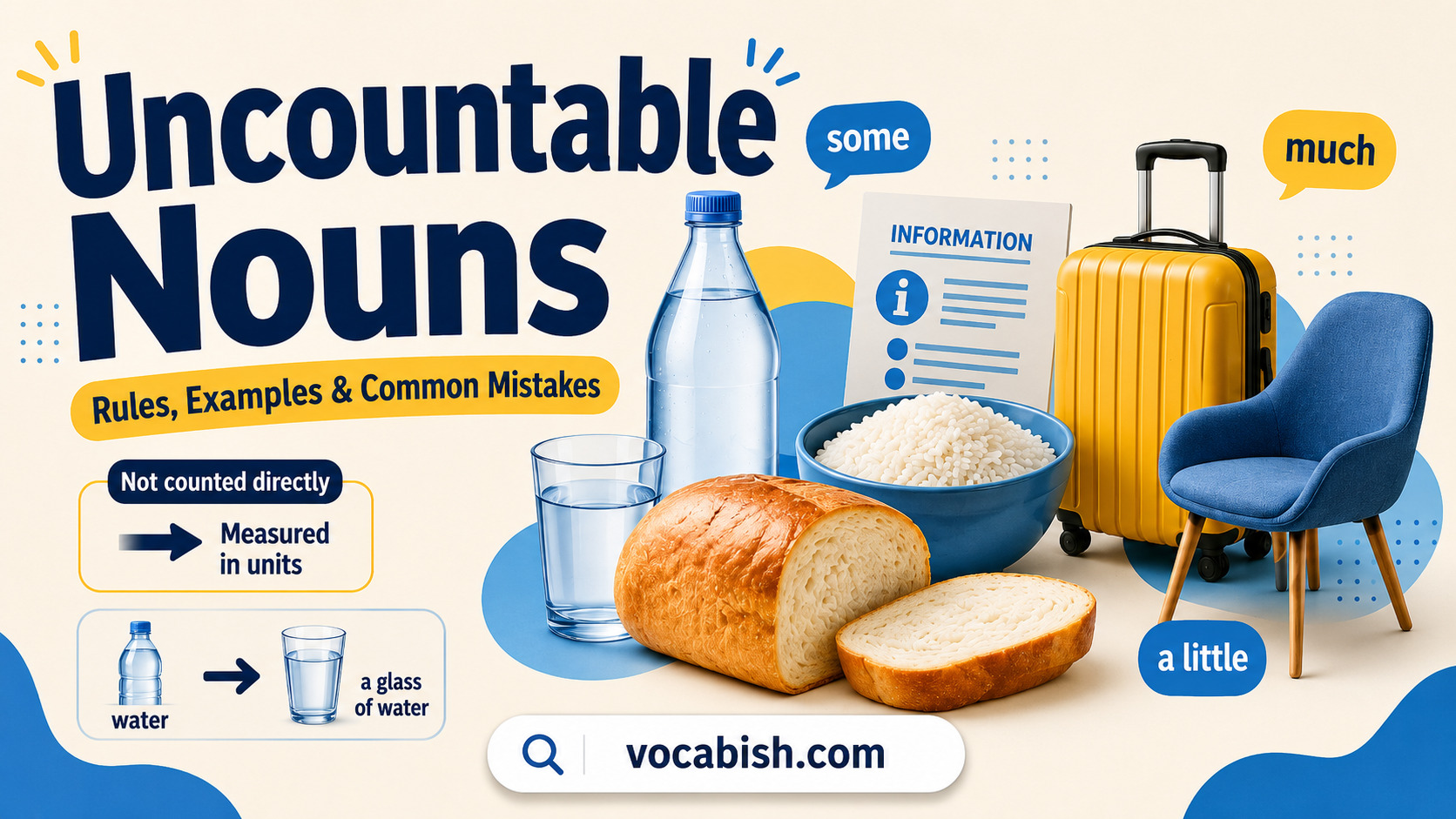

Some nouns refer to things we can count separately: one chair, two chairs, three chairs. Other nouns describe substances, ideas, activities, or groups that English does not normally divide into individual units. These are called uncountable nouns.
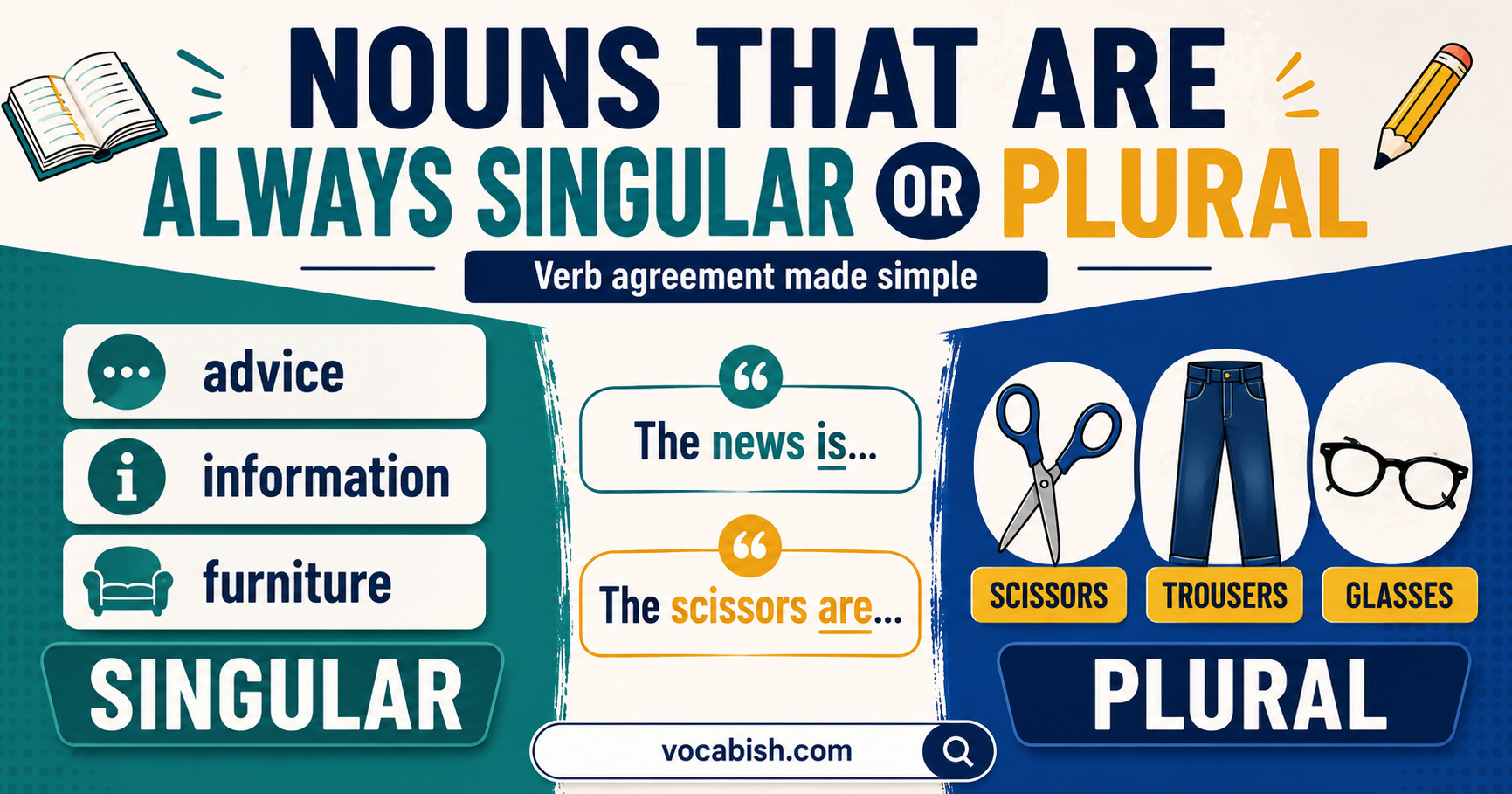
Words such as water, advice, furniture, and information are uncountable. We do not normally say two waters, an advice, or three informations. Instead, we use suitable quantifiers or measurement phrases.
What Is an Uncountable Noun?
An uncountable noun names something that is not normally counted as separate individual items.
Uncountable nouns usually:
- Have no regular plural form
- Do not take a or an
- Use a singular verb
- Appear with words such as some, much, little, and a great deal of
- Need a unit phrase when an exact quantity is required
Examples:
- We need some information.
- Her advice is helpful.
- There is little water left.
- They bought two pieces of furniture.
Main Groups of Uncountable Nouns
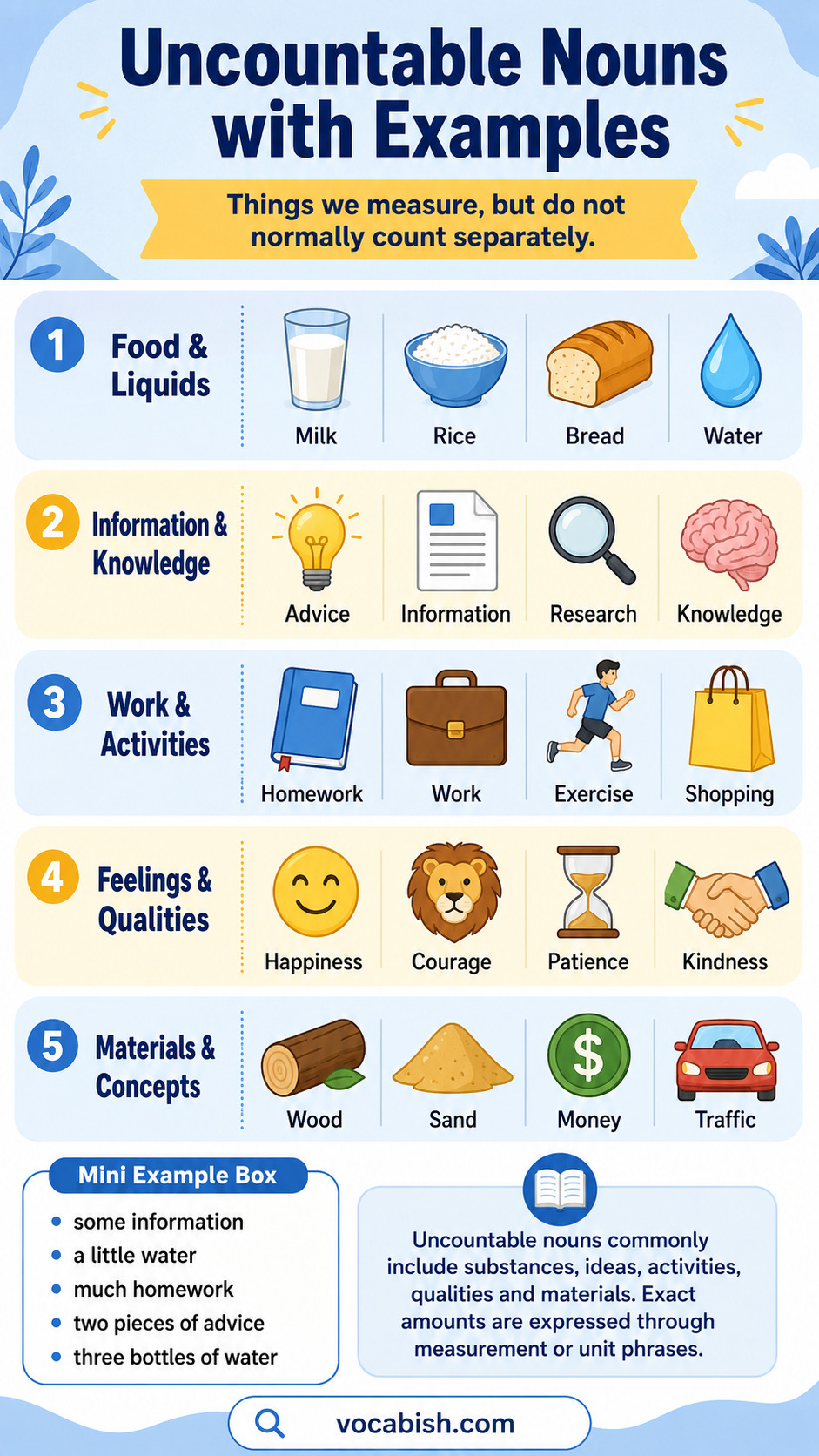
Uncountable nouns appear in several common groups.
Category | Common examples |
|---|---|
Food and substances | rice, bread, milk, sugar |
Information and knowledge | advice, information, knowledge |
Activities and work | work, homework, research |
Feelings and qualities | happiness, courage, patience |
Natural materials | wood, gold, iron, sand |
General concepts | time, traffic, progress, luck |
Food and Substances
Food, liquids, powders, and similar substances are often uncountable because they are viewed as a mass.
- bread
- butter
- cheese
- coffee
- flour
- meat
- milk
- rice
- salt
- sugar
- tea
- water
Examples:
- We need some rice.
- There is milk in the fridge.
- She added a little sugar.
- He bought a loaf of bread.
Some food nouns can become countable when they mean servings or varieties:
- Two coffees, please.
Meaning: two cups of coffee - The shop sells several Italian cheeses.
Meaning: several kinds of cheese
Information and Knowledge
Words connected with facts, learning, and understanding are often uncountable.
- advice
- education
- evidence
- information
- intelligence
- knowledge
- research
Examples:
- Can you give me some advice?
- This website provides useful information.
- The police found enough evidence.
- Her knowledge of grammar is impressive.
Use measurement phrases when individual units are needed:
- a piece of advice
- two pieces of information
- an item of evidence
- several research studies
Activities and Work
Many nouns describing work, study, travel, and other activities are uncountable.
- exercise
- homework
- housework
- research
- shopping
- training
- travel
- work
Examples:
- I have too much homework.
- She is looking for work.
- Regular exercise is good for you.
- The team carried out extensive research.
The noun job is countable, but work is usually uncountable:
- I have a lot of work today.
- I completed three jobs today.
Feelings and Qualities
Feelings, personal qualities, and emotional states are usually treated as general ideas.
- anger
- bravery
- confidence
- courage
- happiness
- honesty
- kindness
- patience
- pride
- sadness
Examples:
- Her kindness was unforgettable.
- Success requires patience.
- He showed great courage.
- Money cannot always bring happiness.
Natural Materials
Materials and raw substances are usually uncountable when we discuss them generally.
- coal
- cotton
- glass
- gold
- iron
- oil
- paper
- plastic
- sand
- silver
- stone
- wood
Examples:
- This table is made of wood.
- The ring contains pure gold.
- We need more paper.
- The children played in the sand.
A material noun can become countable when its meaning changes:
- a glass of water
- three drinking glasses
- an important paper
- several decorative stones
General Concepts
Abstract ideas, conditions, and general situations are often uncountable.
- accommodation
- behavior
- damage
- fun
- luck
- money
- permission
- progress
- traffic
- transportation
- weather
Examples:
- We had good weather.
- The project is making progress.
- Heavy traffic delayed us.
- You need permission to enter.
- The storm caused serious damage.
Common Uncountable Nouns in English
Uncountable noun | Correct example |
|---|---|
accommodation | We found suitable accommodation. |
advice | She gave me useful advice. |
bread | I bought some bread. |
clothing | Warm clothing is necessary. |
equipment | The equipment is expensive. |
evidence | There is little evidence. |
furniture | The furniture looks modern. |
homework | My homework is finished. |
information | We need more information. |
knowledge | His knowledge is limited. |
luggage | Your luggage is downstairs. |
money | I do not have much money. |
music | The music sounds relaxing. |
news | The news is encouraging. |
progress | You are making good progress. |
research | The research was published. |
traffic | Traffic is heavy today. |
transportation | Public transportation is available. |
work | I have some work to complete. |
weather | The weather is improving. |
Grammar Rules for Uncountable Nouns
No Regular Plural Form
Most uncountable nouns do not take -s or -es.
Incorrect | Correct |
|---|---|
advices | advice |
equipments | equipment |
furnitures | furniture |
homeworks | homework |
informations | information |
luggages | luggage |
progresses | progress |
researches | research |
Correct examples:
- She gave me two pieces of advice.
- We bought several items of equipment.
- The report contains useful information.
Some uncountable nouns can have plural forms when they refer to different types:
- traditional foods
- expensive wines
- tropical woods
- modern technologies
No “A” or “An”
Do not place a or an directly before an uncountable noun.
Incorrect | Correct |
|---|---|
an advice | some advice |
an equipment | a piece of equipment |
a furniture | a piece of furniture |
an information | some information |
a luggage | a piece of luggage |
a news | some news |
Examples:
- Could you give me some advice?
- We received a piece of information.
- She bought an item of furniture.
Singular Verb Agreement
Uncountable nouns normally take singular verbs.
- The information is accurate.
- Her advice was useful.
- The furniture looks expensive.
- Your luggage has arrived.
- The news sounds promising.
Do not use a plural verb simply because the noun describes many things:
- The equipment is ready.
- The traffic was terrible.
- The research shows clear results.
Related Resources: Uncountable Nouns with Singular Verbs
Quantifiers Used with Uncountable Nouns
Much
Use much to ask about or describe a large quantity. It is most common in questions and negative sentences.
- How much money do you need?
- We do not have much time.
- There was not much traffic.
In affirmative sentences, a lot of often sounds more natural:
- We have a lot of work.
- She has a lot of patience.
Little and A Little
Little means almost none. It often has a negative meaning.
- We have little time left.
- There is little hope of success.
A little means some, although not a large amount.
- We have a little time before class.
- Add a little salt.
- She has a little experience.
Expression | Meaning |
|---|---|
little water | almost no water |
a little water | some water |
little patience | almost no patience |
a little patience | some patience |
Some and Any
Use some mainly in affirmative sentences.
- I need some information.
- There is some milk in the fridge.
- She gave me some advice.
Use any mainly in questions and negative sentences.
- Do you have any luggage?
- We do not have any bread.
- Is there any evidence?
Some is also common in offers and requests:
- Would you like some coffee?
- Could I have some water?
A Great Deal of
A great deal of means a large amount. It is more formal than a lot of.
- The project requires a great deal of work.
- She has a great deal of experience.
- The decision caused a great deal of confusion.
The verb agrees with the uncountable noun:
- A great deal of money was spent.
- A great deal of research is needed.
How Much
Use how much to ask about the quantity of an uncountable noun.
- How much water do you drink?
- How much homework did you receive?
- How much luggage are you carrying?
- How much information do we need?
Use how many with countable plural nouns:
- How many bottles do you need?
- How many assignments did you complete?
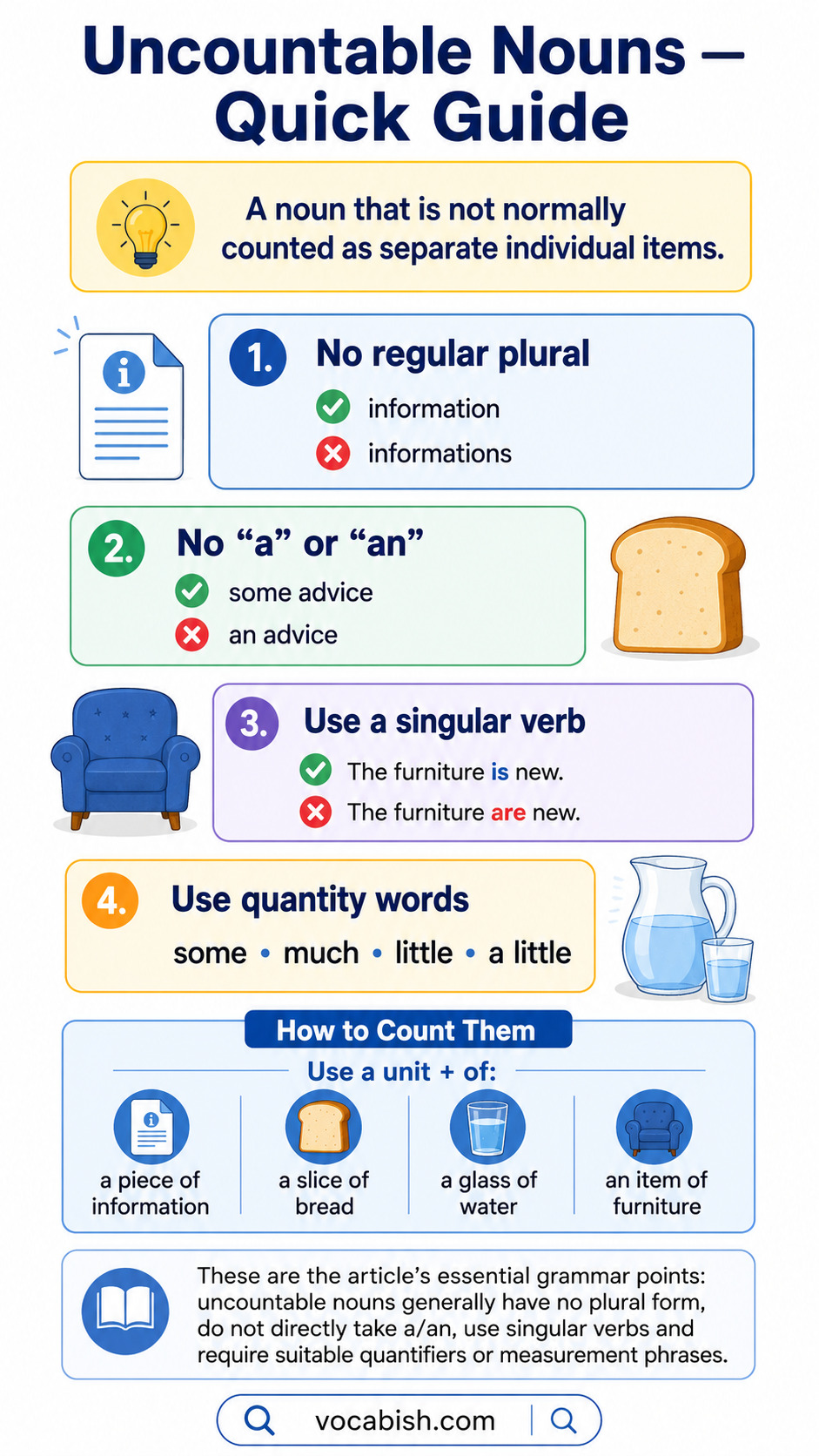
Measuring Uncountable Nouns
To count an uncountable noun, add a countable unit, container, measurement, or portion.
Structure | Example |
|---|---|
number + unit + of + noun | two pieces of advice |
number + container + of + noun | three bottles of water |
number + portion + of + noun | four slices of bread |
A Piece of
A piece of is used with many abstract nouns and objects viewed collectively.
- a piece of advice
- a piece of information
- a piece of evidence
- a piece of furniture
- a piece of luggage
- a piece of news
Examples:
- She gave me a useful piece of advice.
- We received three pieces of information.
- He bought two pieces of furniture.
A Glass of
Use a glass of for the amount of liquid held in a drinking glass.
- a glass of water
- a glass of milk
- a glass of juice
Examples:
- May I have a glass of water?
- She drank two glasses of milk.
A Bottle of
Use a bottle of for liquids stored or served in bottles.
- a bottle of water
- a bottle of oil
- a bottle of juice
Examples:
- We bought three bottles of water.
- Add half a bottle of oil.
A Slice of
Use a slice of for thin, flat portions.
- a slice of bread
- a slice of cheese
- a slice of meat
- a slice of cake
Examples:
- He ate two slices of bread.
- Would you like a slice of cheese?
An Item of
Use an item of for one object from a larger uncountable category.
- an item of clothing
- an item of equipment
- an item of furniture
- an item of luggage
Examples:
- Each item of equipment is checked.
- One item of luggage was missing.
- This is our most expensive item of furniture.
Countable Nouns vs Uncountable Nouns
Feature | Countable nouns | Uncountable nouns |
|---|---|---|
Can be counted directly | one book, three books | not normally |
Singular form | a chair | furniture |
Plural form | chairs | usually no plural |
a book, an apple | no a or an | |
Common quantifiers | many, few, several | much, little, a little |
Question form | how many? | how much? |
Verb agreement | singular or plural | usually singular |
Examples:
- There are many chairs in the room.
- There is a lot of furniture in the room.
- I completed three assignments.
- I finished some homework.
- She owns two suitcases.
- She has a lot of luggage.
Here’s a complete guide: Countable and Uncountable Nouns
Nouns That Change Meaning When Countable
Some nouns can be countable or uncountable, but their meaning changes.
Noun | Uncountable meaning | Countable meaning |
|---|---|---|
chicken | meat | an animal |
coffee | the drink | a serving or type |
experience | knowledge gained | an event |
glass | material | a drinking container |
hair | hair generally | one strand |
light | illumination | a lamp |
paper | material | an article or document |
room | available space | a separate area |
time | the general concept | an occasion |
work | activity or employment | a creative production |
Examples:
- There is not enough room in the car.
- The house has six rooms.
- I need more paper for the printer.
- She published three academic papers.
- He has little teaching experience.
- Visiting the village was an unforgettable experience.
- Her hair is wet.
- I found a hair on my jacket.
- We ate chicken for dinner.
- There are five chickens on the farm.
Common Uncountable Noun Mistakes
Advice
- Incorrect: She gave me an advice.
- Incorrect: He gave me many advices.
- Correct: She gave me some advice.
- Correct: He gave me two pieces of advice.
Information
- Incorrect: I need an information.
- Incorrect: These informations are useful.
- Correct: I need some information.
- Correct: These pieces of information are useful.
Furniture
- Incorrect: We bought new furnitures.
- Incorrect: A furniture was damaged.
- Correct: We bought new furniture.
- Correct: A piece of furniture was damaged.
Equipment
- Incorrect: The equipments are expensive.
- Incorrect: They purchased an equipment.
- Correct: The equipment is expensive.
- Correct: They purchased an item of equipment.
Luggage
- Incorrect: My luggages are heavy.
- Incorrect: I carried a luggage.
- Correct: My luggage is heavy.
- Correct: I carried one piece of luggage.
Homework
- Incorrect: I have many homeworks.
- Incorrect: The teacher gave us a homework.
- Correct: I have a lot of homework.
- Correct: The teacher gave us a homework assignment.
News
- Incorrect: The news are surprising.
- Incorrect: I heard a good news.
- Correct: The news is surprising.
- Correct: I heard some good news.
Error-Correction Exercise
Correct the uncountable noun mistake in each sentence.
- She gave me three useful advices.
- We need an information about the course.
- The new furniture are very expensive.
- He carried two heavy luggages.
- I do not have many homework tonight.
- The news were quite surprising.
- They bought several new equipments.
- How many money did you spend?
- There are only a few milk left.
- She has many experience in teaching.
- I need a paper to write this note.
- The storm caused several damages.
Answers with Explanations
- She gave me three useful pieces of advice.
Advice is uncountable, so it needs the unit phrase pieces of. - We need some information about the course.
Information cannot normally follow a or an. - The new furniture is very expensive.
Furniture is uncountable and takes a singular verb. - He carried two heavy pieces of luggage.
Use pieces of luggage when counting separate bags or suitcases. - I do not have much homework tonight.
Use much, not many, with an uncountable noun. - The news was quite surprising.
News ends in -s, but it takes a singular verb. - They bought several new items of equipment.
Equipment has no regular plural form. - How much money did you spend?
Use how much with uncountable nouns. - There is only a little milk left.
Use a little for a small amount of an uncountable noun. - She has a lot of experience in teaching.
Experience is uncountable when it means knowledge or skill gained over time. - I need a piece of paper to write this note.
Paper is uncountable when it refers to the writing material. - The storm caused a great deal of damage.
Damage is normally uncountable when referring to physical harm generally.
FAQs About Uncountable Nouns
Information refers to knowledge as a mass, not separate units. Use some information or a piece of information, never an information.
Some become plural when their meaning changes or when referring to types. For example, wines means different kinds of wine.
Uncountable nouns normally take singular verbs because grammar treats them as one mass or idea: The furniture looks new here.
Use a unit or container phrase, such as a glass of water, two bottles of water, or three bags of rice.
Yes. News ends in s, but it is uncountable and takes a singular verb: The news is surprising to everyone.
Little means almost none and often sounds negative. A little means some, usually enough for the immediate situation or purpose.
Hair is uncountable when referring to all hair generally, but a hair means one individual strand found or noticed separately.
Short Summary on Uncountable Nouns
Uncountable nouns name substances, ideas, activities, materials, and general concepts that English does not normally count separately. They usually have no plural form, do not take a or an, and use singular verbs. Quantifiers such as much, some, and a little describe their quantity. To count them, use phrases such as a piece of, a bottle of, or an item of.
You May Also Like