
Collective nouns are words used to name groups of people, animals, or things as one unit. Words such as team, class, flock, herd, and collection help us describe groups clearly without naming every individual member. In this guide, you will learn common collective nouns, see how they are used in sentences, and understand whether they take singular or plural verbs in American and British English.
What Is a Collective Noun?
A collective noun is a noun that names a group as a single unit.
- team = a group of players
- flock = a group of birds
- fleet = a group of ships
- collection = a group of related objects
Although a collective noun refers to several members, its basic form is usually singular.
- The family is having dinner.
- The crowd was waiting outside.
Collective nouns can also have plural forms when we mean more than one group.
- Three teams entered the competition.
- Several families live in this building.
Collective Nouns for People
Collective nouns for people often describe groups connected by work, education, activity, or location.
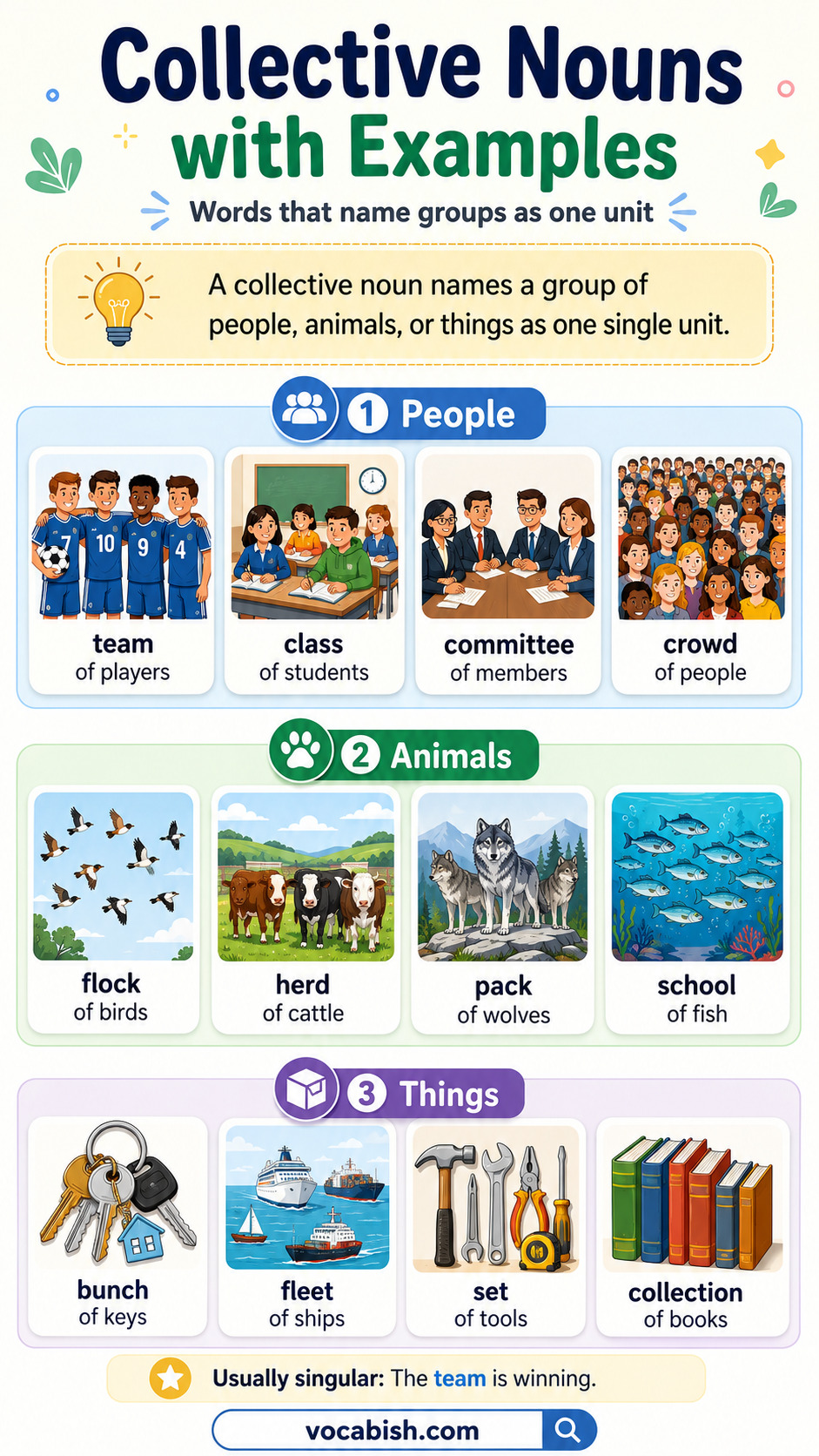
A Team of Players
A team is a group of players who compete or work together.
- A team of players entered the field.
- Our football team trains every morning.
- The team celebrated its victory.
A Class of Students
A class is a group of students who study together.
- A class of students visited the museum.
- The class is preparing for the examination.
- Our class has twenty students.
A Committee of Members
A committee is a group of people chosen to discuss, plan, or make decisions.
- A committee of members reviewed the proposal.
- The committee has approved the new rules.
- She joined the school committee.
A Crowd of People
A crowd is a large group of people gathered in one place.
- A crowd of people stood near the entrance.
- The crowd was waiting for the singer.
- A large crowd filled the street.
You May Also Like: 100+ Collective Nouns for People with Pictures
Collective Nouns for Animals
Different animal groups have their own collective nouns. Some are common in everyday English, while others mainly appear in nature writing.
A Flock of Birds
A flock is a group of birds moving, feeding, or living together.
- A flock of birds flew across the sky.
- We watched the flock land near the lake.
- A flock of sheep was grazing nearby.
A Herd of Cattle
A herd refers to cattle and other large animals that live or move together.
- A herd of cattle crossed the road.
- The farmer owns a large herd.
- We saw a herd of elephants near the river.
A Pack of Wolves
A pack is a group of wolves or certain other animals that hunt or travel together.
- A pack of wolves moved through the forest.
- The pack followed the leader.
- We heard a pack of dogs barking outside.
A School of Fish
A school is a large group of fish swimming together.
- A school of fish passed beneath the boat.
- The school moved quickly through the water.
- Divers photographed a colourful school of fish.
The word shoal can also describe a group of fish.
Explore More: 100+ Collective Nouns for Animals with Pictures
Collective Nouns for Things
Objects can also be arranged or described as groups.
A Bunch of Keys
A bunch is a group of similar things held or joined together.
- A bunch of keys was lying on the table.
- She carried a bunch of flowers.
- He bought a bunch of bananas.
A Fleet of Ships
A fleet is a group of ships, boats, or vehicles controlled by one organization.
- A fleet of ships left the harbour.
- The company operates a fleet of trucks.
- The fishing fleet returned before sunset.
A Set of Tools
A set is a group of related items used together.
- He bought a new set of tools.
- This set of dishes belongs to my grandmother.
- The game includes a complete set of cards.
A Collection of Books
A collection is a group of objects gathered because they are related or valuable.
- She owns a collection of books about history.
- The museum displayed a rare art collection.
- His stamp collection is growing quickly.
Related Resources: 100+ Collective Nouns for Things with Pictures
Collective Nouns in Sentences
Collective noun | Group named | Example sentence |
|---|---|---|
team | players | The team is practising today. |
family | relatives | Her family lives in Karachi. |
audience | viewers or listeners | The audience enjoyed the performance. |
committee | selected members | The committee has announced its decision. |
flock | birds or sheep | A flock of birds flew overhead. |
herd | cattle or large animals | The herd moved towards the river. |
pack | wolves or dogs | A pack of wolves crossed the valley. |
school | fish | A school of fish surrounded the boat. |
fleet | ships or vehicles | The fleet returned to the harbour. |
collection | related objects | His collection includes rare coins. |
Collective Nouns vs Plural Nouns
A collective noun names a group as one unit. A plural noun directly names more than one person, animal, place, or thing.
Feature | Collective noun | Plural noun |
|---|---|---|
Meaning | Names one group | Names several individuals |
Examples | team, crowd, flock | players, people, birds |
Focus | The group as a unit | The separate members |
Usual verb | Often singular | Plural |
Example | The team is ready. | The players are ready. |
Example | A flock is approaching. | The birds are approaching. |
Compare:
- The committee has reached a decision.
- The members have reached a decision.
- A crowd was standing outside.
- Several people were standing outside.
Singular or Plural Verbs with Collective Nouns?
A singular collective noun may take a singular or plural verb depending on the variety of English and the intended meaning.
Use a singular verb when the group acts as one unit:
- The team is playing well.
- The family has moved to London.
- The committee agrees with the proposal.
A plural verb may be used when the members act separately, especially in British English:
- The team are changing their clothes.
- The family are discussing their different plans.
- The committee are divided in their opinions.
Keep the verb and pronoun consistent:
- Correct: The team is proud of its performance.
- Correct: The team are proud of their performances.
- Incorrect: The team is proud of their performance.
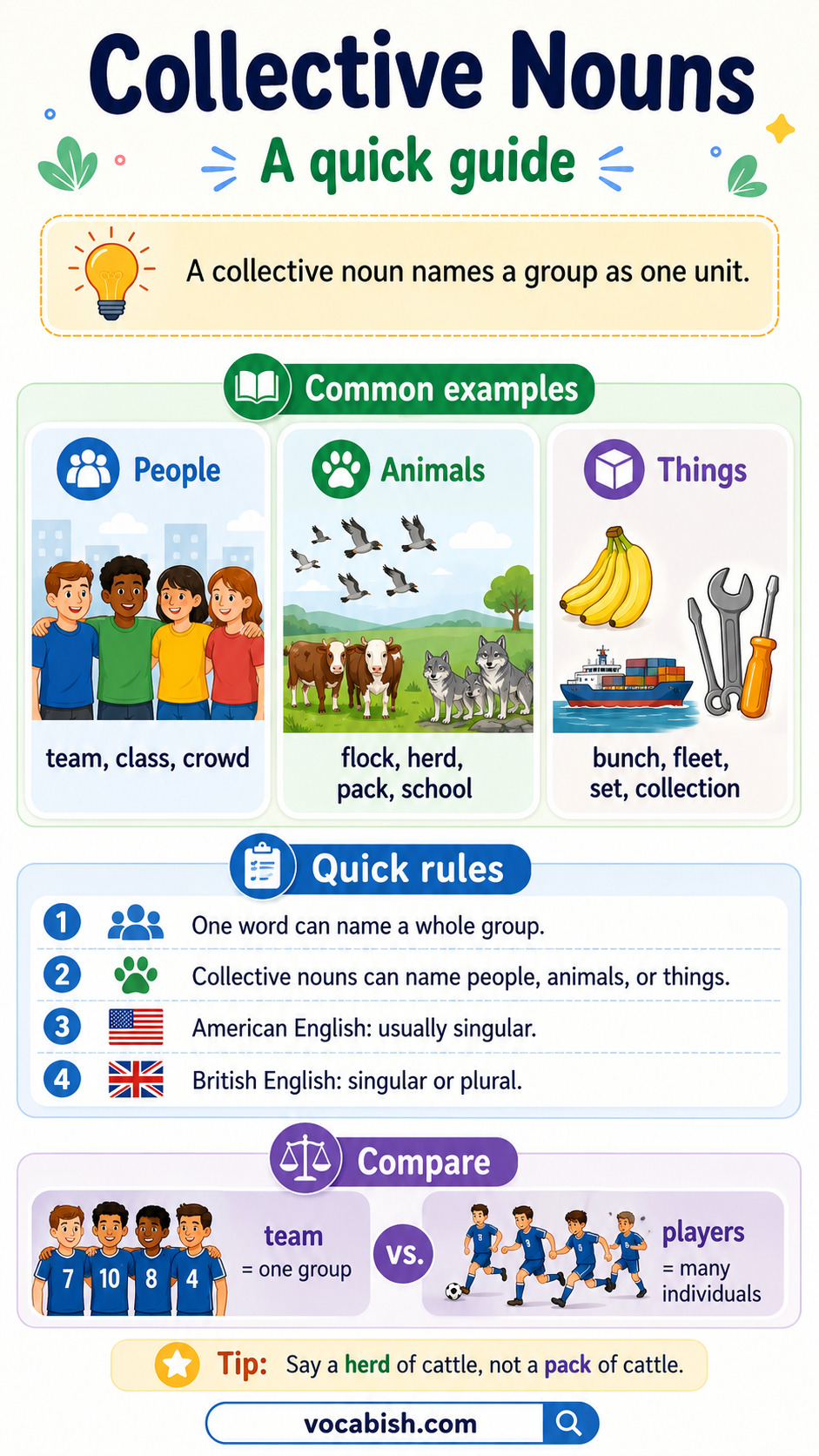
Collective Nouns in American English
American English normally treats a singular collective noun as one unit.
- The government has announced its decision.
- The company is changing its policy.
- The team is wearing its new uniform.
When the members are acting separately, American English usually names them directly:
- The committee members are disagreeing.
- The team members are changing their clothes.
- The family members have different opinions.
This avoids using a plural verb with a singular-looking subject.
Collective Nouns in British English
British English allows both singular and plural verbs with collective nouns.
Use a singular verb when the group acts together:
- The government has introduced a new policy.
- The team is ready to begin.
Use a plural verb when focusing on individual members:
- The government are divided over the issue.
- The team are returning to their homes.
The verb changes the focus, not the basic meaning of the collective noun.
Common and Unusual Collective Nouns
Common expression | Group described | Less common or unusual expression | Group described |
|---|---|---|---|
a team of players | players | a parliament of owls | owls |
a herd of cattle | cattle | a murder of crows | crows |
a flock of birds | birds | a crash of rhinoceroses | rhinoceroses |
a pack of wolves | wolves | a dazzle of zebras | zebras |
a school of fish | fish | a tower of giraffes | giraffes |
a swarm of bees | bees | a business of ferrets | ferrets |
a bunch of keys | keys | a galaxy of stars | stars |
a fleet of ships | ships | a quiver of arrows | arrows |
Unusual collective nouns are often traditional, descriptive, or playful. In everyday communication, common group words are usually more useful.
You May Also Like: Collective Noun Verb Agreement
Common Mistakes with Collective Nouns
- Using the wrong group word: Say a herd of cattle, not a pack of cattle.
- Using a singular noun after “of”: Say a flock of birds, not a flock of bird.
- Confusing the group with its members: Team is collective; players is plural.
- Mixing verb and pronoun forms: Avoid The team is wearing their uniform.
- Overusing unusual expressions: Use familiar group words unless a special term suits the context.
Choose the Correct Collective Noun Exercise
Choose the correct word in parentheses.
- A ______ of wolves moved through the forest.
(pack / fleet) - A ______ of ships entered the harbour.
(class / fleet) - We saw a ______ of fish beneath the bridge.
(school / committee) - She found a ______ of keys near the door.
(bunch / herd) - A ______ of cattle was grazing in the field.
(herd / collection) - A ______ of students visited the science centre.
(class / pack) - He owns a valuable ______ of books.
(collection / flock) - The ______ of players celebrated after the match.
(team / set) - A ______ of birds landed on the roof.
(flock / fleet) - The mechanic opened his ______ of tools.
(set / crowd)
Answer Key
Question | Answer |
|---|---|
1 | pack |
2 | fleet |
3 | school |
4 | bunch |
5 | herd |
6 | class |
7 | collection |
8 | team |
9 | flock |
10 | set |
FAQs About Collective Nouns
A collective noun is a word that names a group of people, animals, or things as one complete unit in English grammar.
Yes. Most collective nouns are countable, so they can use singular or plural forms, such as team and teams in English.
Collective nouns usually take singular verbs in American English when the group acts together as one complete unit in a sentence.
British English may use singular or plural verbs, depending on whether the group acts together or its members act separately.
Team is a collective noun because it names several players who belong to one organized group and regularly work together.
People is normally a plural noun, while crowd is a collective noun naming people gathered together as one complete group.
Some collective nouns are unusual, but learners should prioritize common expressions such as a flock of birds or a herd of cattle.
Short Summary on Collective Nouns
Collective nouns name groups of people, animals, or things as single units. Common examples include team, class, flock, herd, pack, fleet, set, and collection. American English usually uses singular verbs with them, while British English may use singular or plural verbs according to meaning.
You May Also Like