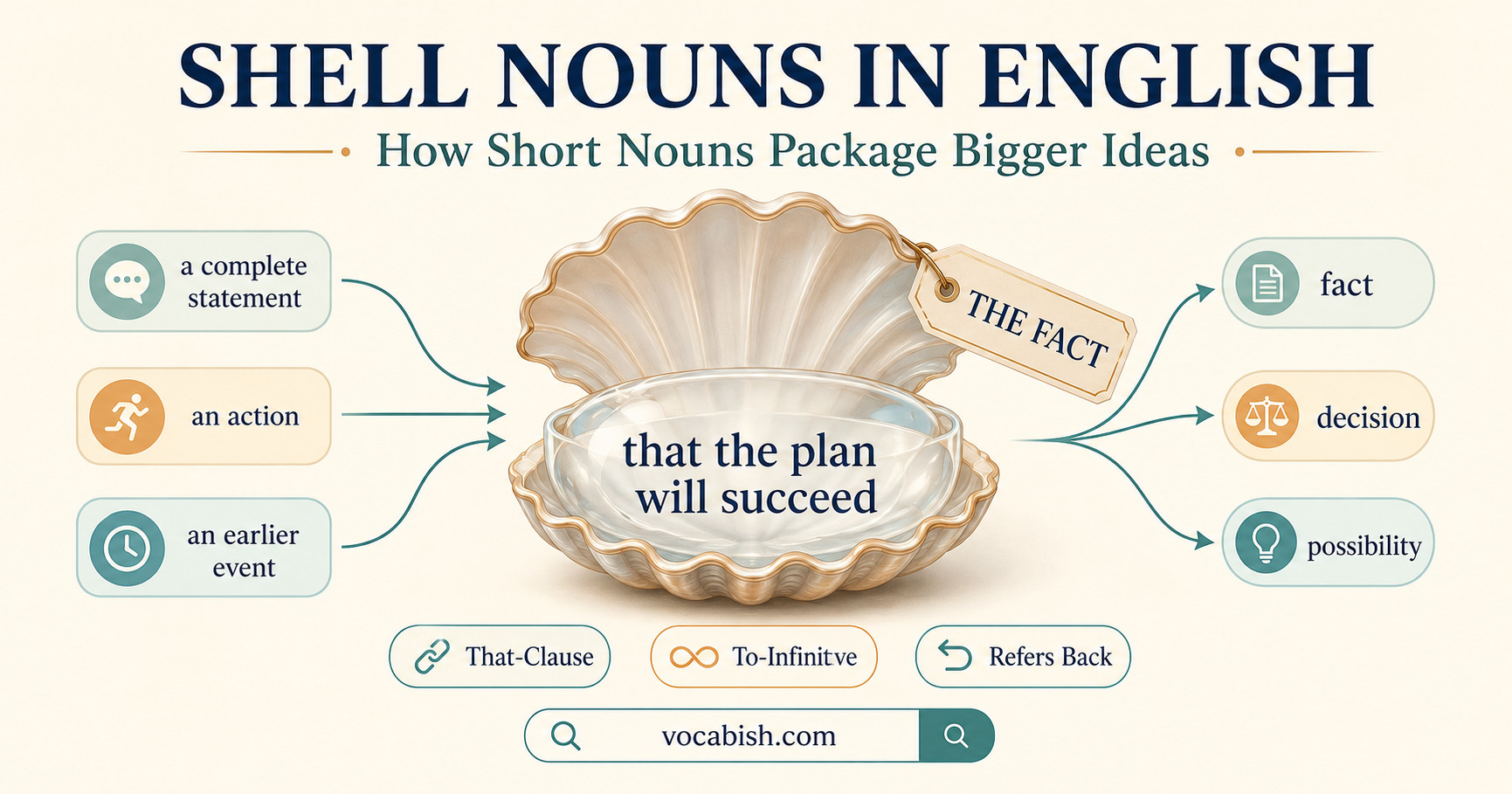

Shell nouns are abstract nouns that package, summarize, or point to a larger piece of information. They allow speakers and writers to refer to a complete idea using a short noun such as fact, problem, reason, or possibility.
Think of a shell noun as a small container. The noun gives the information a label, while a nearby clause, phrase, sentence, or paragraph supplies its full meaning:
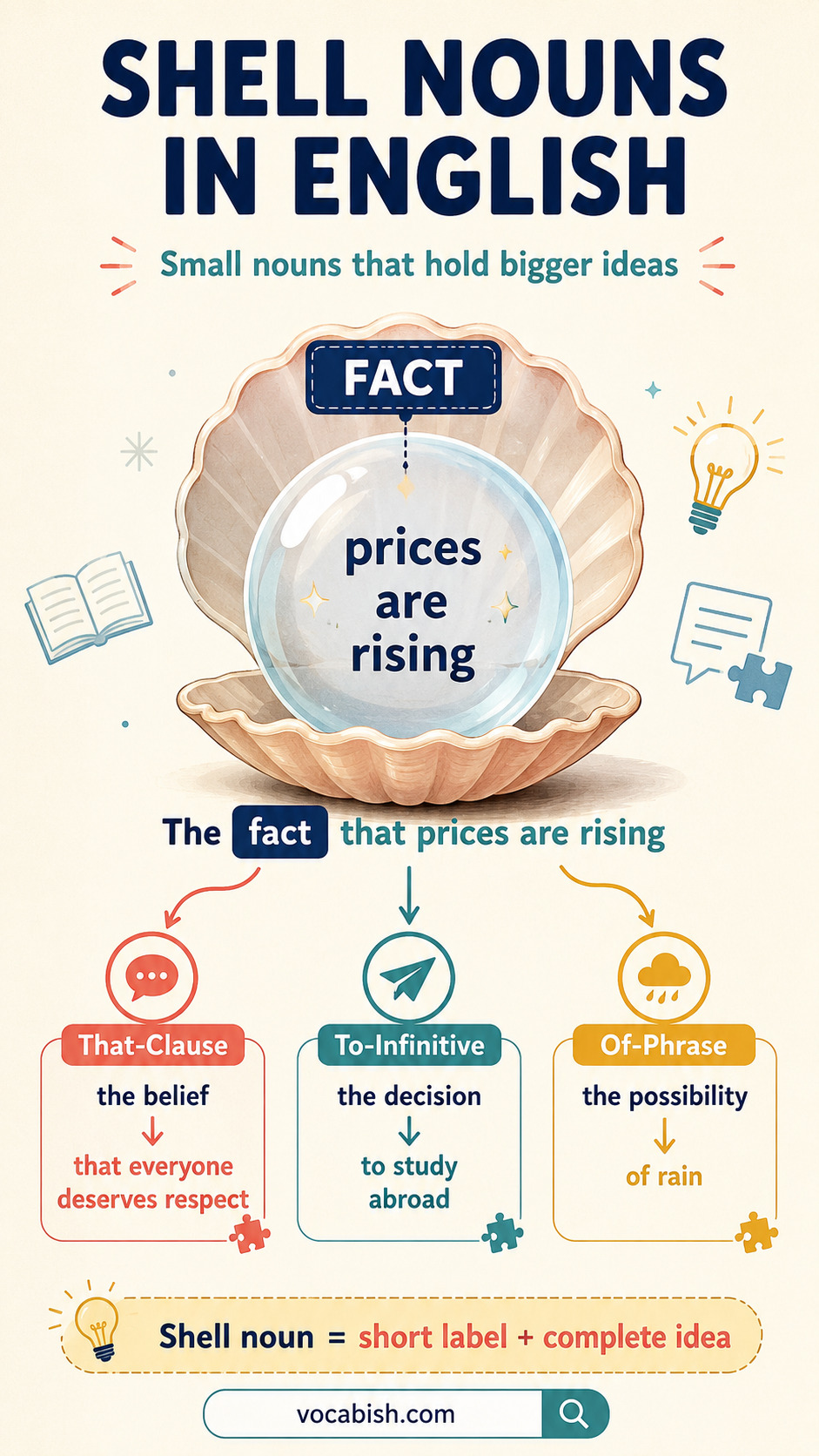
- The fact that prices are rising worries consumers.
- We missed the final bus. The problem was completely avoidable.
- Her decision to study abroad surprised her family.
In each example, the bold noun cannot be fully understood without the information around it.
What Is a Shell Noun?
A shell noun is a noun whose exact meaning comes from the surrounding text. It usually refers to an idea, claim, event, situation, plan, or piece of information rather than a physical object.
Common shell nouns include:
- fact
- idea
- problem
- reason
- possibility
- claim
- belief
- decision
- aim
- issue
- question
- evidence
- result
- situation
- assumption
Consider the noun fact:
The fact that Mariam passed the exam pleased everyone.
The word fact creates a label. The clause that Mariam passed the exam tells us what the fact is.
A noun does not function as a shell noun in every sentence:
- We checked several facts in the report.
- The fact that the figures were incorrect changed our conclusion.
In the first sentence, facts has a general meaning. In the second, fact packages the complete statement that follows it.
Pattern | Example | Information supplied |
|---|---|---|
Shell noun + that-clause | The claim that the product is harmless needs evidence. | A complete statement |
Shell noun + infinitive | Their plan to expand was approved. | An intended action |
Shell noun + of-phrase | The possibility of rain remains high. | An event or situation |
Shell noun referring backward | Sales fell sharply. This result was unexpected. | Earlier information |
Shell nouns usually belong to the broader group of abstract nouns. Read more about how abstract nouns represent ideas, qualities, and situations.
Shell Nouns Followed by “That” Clauses
A that-clause often explains the content of a shell noun. It answers a question such as “What fact?”, “Which idea?”, or “What possibility?”
- The fact that the door was unlocked worried us.
- Her belief that everyone deserves respect guides her work.
- We cannot ignore the possibility that the data is incomplete.
- The claim that the treatment works immediately has not been proven.
- Their assumption that the journey would be easy caused problems.
This pattern is useful when presenting statements, opinions, findings, or judgments.
Common combinations include:
- the fact that
- the idea that
- the belief that
- the possibility that
- the claim that
- the assumption that
- the evidence that
- the argument that
The shell noun also shows how the writer views the statement:
- The fact that the shop closed early annoyed customers.
The information is presented as true. - The claim that the shop closed early needs confirmation.
The information is presented as something someone has said. - The possibility that the shop closed early should be considered.
The information is presented as uncertain.
Choosing the right noun therefore changes the meaning and level of certainty.
Shell Nouns Followed by Infinitives
A shell noun may be followed by a to-infinitive. This structure commonly describes plans, attempts, decisions, abilities, needs, opportunities, or goals.
- The company announced its decision to reduce waste.
- We had an opportunity to speak with the director.
- His attempt to repair the computer was unsuccessful.
- Their plan to open another branch was delayed.
- There is an urgent need to improve road safety.
- The team achieved its aim to finish before Friday.
Frequently used nouns in this pattern include:
- decision to
- plan to
- attempt to
- ability to
- opportunity to
- need to
- failure to
- refusal to
- intention to
- aim to
The noun and infinitive should have a logical relationship:
- Her decision to leave surprised us.
- His refusal to answer created suspicion.
- Our ability to adapt helped us succeed.
Avoid using a vague noun when a more accurate one is available:
- Weak: We discussed the thing to change the timetable.
- Better: We discussed the proposal to change the timetable.
Shell Nouns Followed by “Of” Phrases
An of-phrase can supply the content of a shell noun. The word after of is often a noun or an -ing form.
- The possibility of cancellation upset the passengers.
- The problem of rising costs affects small businesses.
- She rejected the idea of moving overseas.
- The risk of losing important data is serious.
- We discussed the question of who should lead the project.
- Their method of collecting information needs improvement.
This structure is especially common when referring to:
- possible events: the possibility of rain
- difficulties: the problem of overcrowding
- risks: the risk of injury
- proposed actions: the idea of working remotely
- methods: the method of measuring progress
- topics for discussion: the question of responsibility
Some meanings can be expressed through more than one pattern:
- the possibility that the match will be cancelled
- the possibility of the match being cancelled
- the possibility of cancellation
All three are grammatical, but the final version is the most compact.
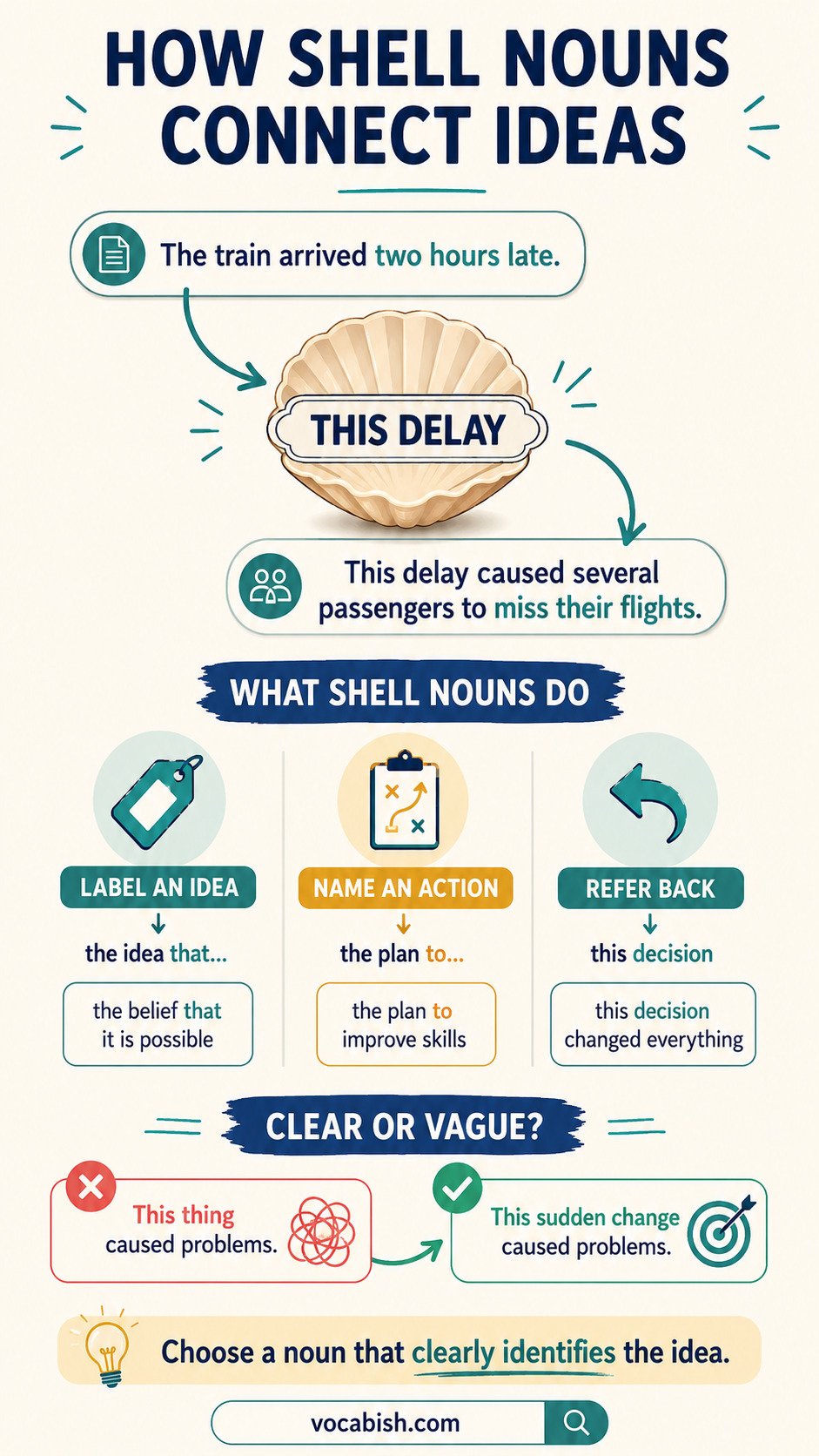
Referring Back to Earlier Information
A shell noun can summarize information that has already appeared. This helps writers avoid repeating an entire sentence.
The landlord increased the rent without warning. This decision angered several tenants.
The phrase this decision refers back to the rent increase.
Other examples:
- The train arrived two hours late. This delay caused several passengers to miss their flights.
- Online orders doubled within one month. This increase surprised the business owner.
- Several employees shared the same password. This practice created a serious security risk.
- The school introduced free evening classes. This initiative attracted many adult learners.
- The experiment produced different results each time. This inconsistency required further investigation.
Choose a noun that accurately identifies the earlier information:
Earlier information | Clear reference | Less helpful reference |
|---|---|---|
A company closed three factories | this decision | this thing |
Attendance fell by 30 percent | this decline | this situation |
A researcher questioned the results | this criticism | this point |
The council built a public library | this initiative | this matter |
The machine repeatedly stopped | this problem | this event |
A specific shell noun tells readers how to interpret what came before. Learn more about the Functions of Nouns in English.
Organizing Arguments with Shell Nouns
Shell nouns help connect ideas and guide readers through an argument. They can introduce a point, evaluate evidence, identify a problem, or present a conclusion.
Useful functions include:
- Introducing a position:
The argument that homework should be limited deserves attention. - Presenting evidence:
The evidence that regular exercise improves sleep is convincing. - Identifying uncertainty:
The possibility that the survey was biased cannot be dismissed. - Explaining a cause:
The main reason for the decline was poor planning. - Naming a difficulty:
The central problem is that many residents lack transport. - Stating a conclusion:
These figures support the conclusion that demand is increasing.
Compare these paragraphs:
Many students study online. Online learning is flexible. Online learning can also feel isolating.
Many students now study online. The advantage of this arrangement is its flexibility, although the problem of social isolation still requires attention.
The second version gives each point a clear role. It does not merely list information; it shows how the ideas relate.
Vague Shell Noun Problems
Shell nouns become confusing when readers cannot identify what they refer to.
The manager changed the schedule after speaking to the staff, and this created a problem.
What created the problem—the schedule change, the conversation, or something else?
A clearer version names the exact issue:
The manager changed the schedule with only one day’s notice. This sudden change created staffing problems.
Watch for vague nouns such as:
- thing
- issue
- matter
- situation
- point
- aspect
- idea
- fact
These words are not always wrong, but they need clear supporting information.
Use these checks:
- Can the reader identify exactly what the noun refers to?
- Is the explanation placed close to the shell noun?
- Does the noun accurately classify the information?
- Could a more specific noun replace thing, issue, or situation?
- Is the noun presenting the information as fact, opinion, possibility, or claim?
Compare:
- Vague: This issue affected the project.
- Clearer: This shortage of materials delayed the project.
- Vague: The fact that he might arrive is encouraging.
- Clearer: The possibility that he might arrive is encouraging.
The second correction matters because might expresses uncertainty, while fact normally presents information as true.
Paragraph-Writing Practice
Complete the paragraph by choosing suitable shell nouns from the box.
decision — possibility — problem — evidence — aim
The city has introduced more electric buses. Its main ______ is to reduce air pollution. Early reports provide ______ that pollution levels are beginning to fall. However, the ______ of high operating costs remains. Officials are now considering the ______ of adding solar charging stations. Their final ______ will be announced next month.
Suggested answers:
- aim
- evidence
- problem
- possibility
- decision
Now write a short paragraph of four to five sentences about one of these topics:
- studying from home
- reducing plastic waste
- using artificial intelligence in education
- improving public transport
Include:
- one shell noun followed by a that-clause
- one shell noun followed by an infinitive
- one shell noun referring back to an earlier sentence
Model paragraph:
Many schools now provide lessons online. The idea that students can learn from any location has made education more accessible. Some schools have also introduced a plan to lend laptops to learners. Not every student, however, has a reliable internet connection. This problem can prevent equal participation.
FAQs About Shell Nouns
No. Many shell nouns are abstract, but abstract nouns do not always summarize or point to specific information in the surrounding text.
A noun becomes a shell noun when its meaning depends on nearby information, such as a that-clause, infinitive, phrase, or earlier sentence.
Shell nouns are abstract nouns that package a longer idea, statement, event, or situation so writers can discuss it more easily.
Common shell nouns before that-clauses include fact, idea, claim, possibility, problem, belief, assumption, and evidence, depending on the intended meaning.
Writers use shell nouns to connect ideas, introduce explanations, evaluate claims, avoid repetition, and guide readers through an argument or paragraph.
A shell noun is vague when readers cannot clearly identify the idea, event, or situation to which the noun refers.
Choose a specific noun, place the explanation close to it, and replace unclear words such as thing, issue, or situation whenever possible.
Short Summary
Shell nouns give short labels to larger ideas, statements, actions, and situations. They may be followed by that-clauses, infinitives, or of-phrases, or they may refer back to earlier information. Accurate shell nouns make paragraphs easier to follow, while vague choices can leave readers unsure about the intended meaning.
You May Also Like