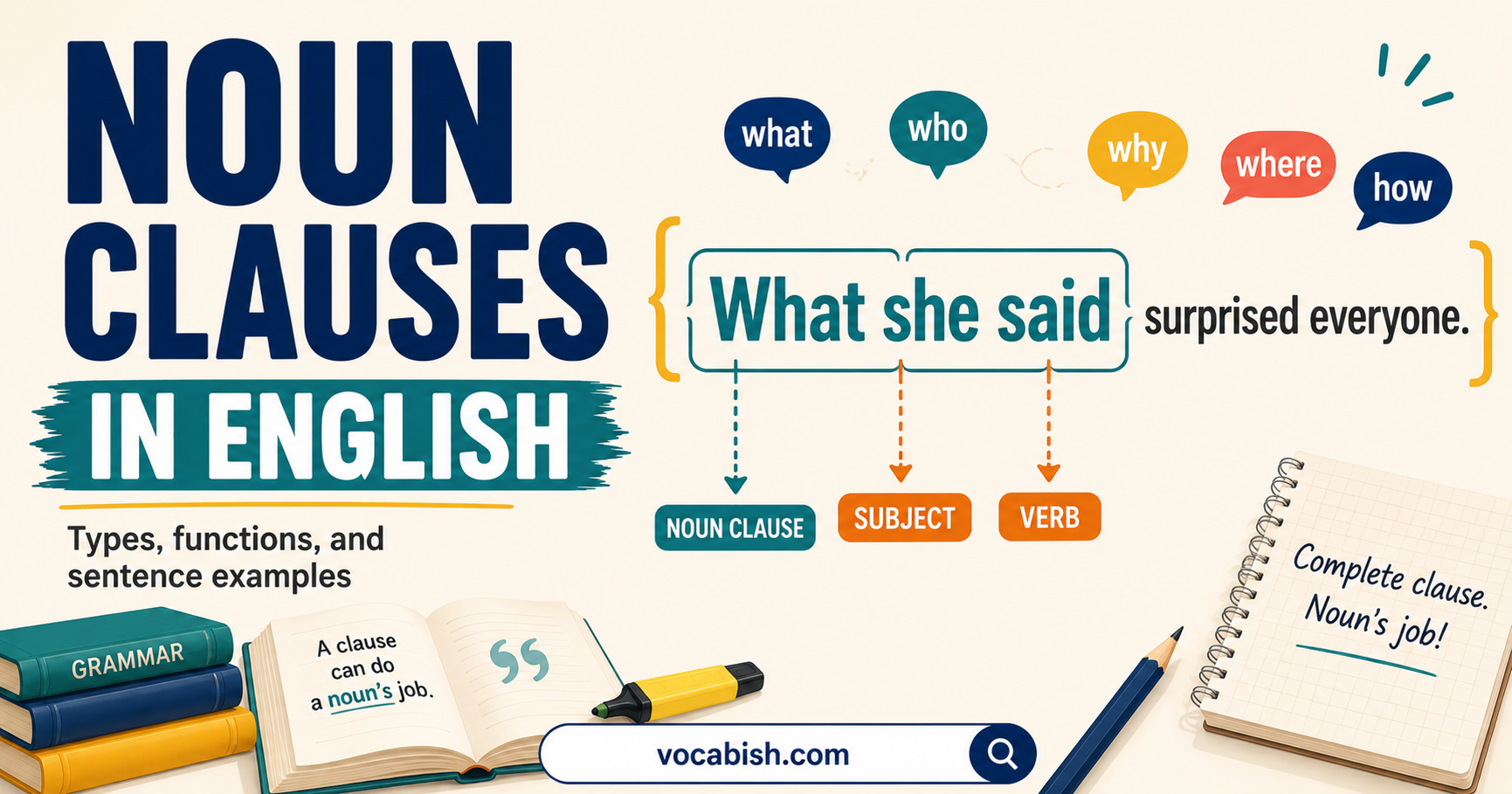

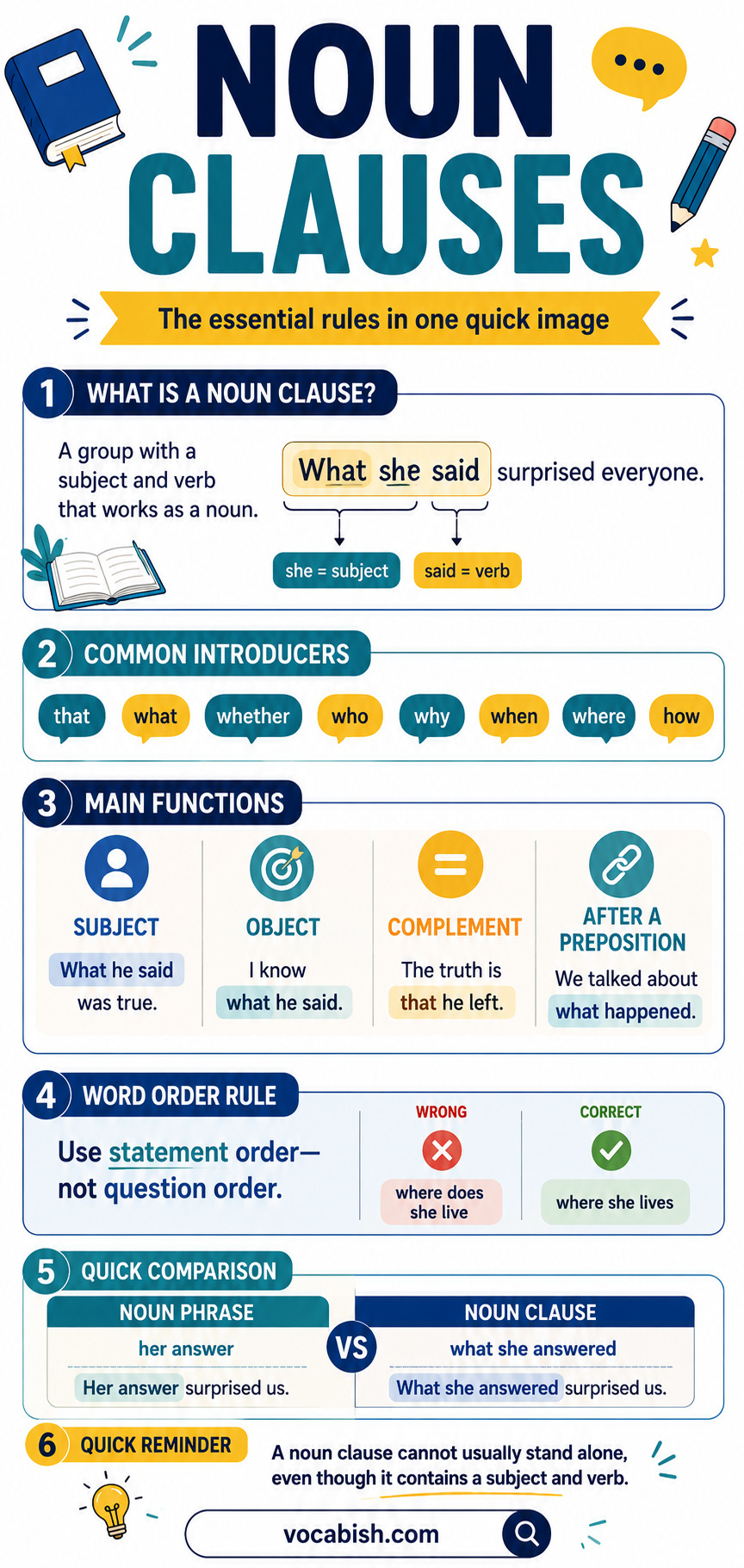
A noun clause is a group of words that contains a subject and a verb but works as a noun within a larger sentence. It can name an idea, fact, question, person, place, or situation.
Noun clauses commonly function as subjects, objects, subject complements, and objects of prepositions.
What Is a Noun Clause?
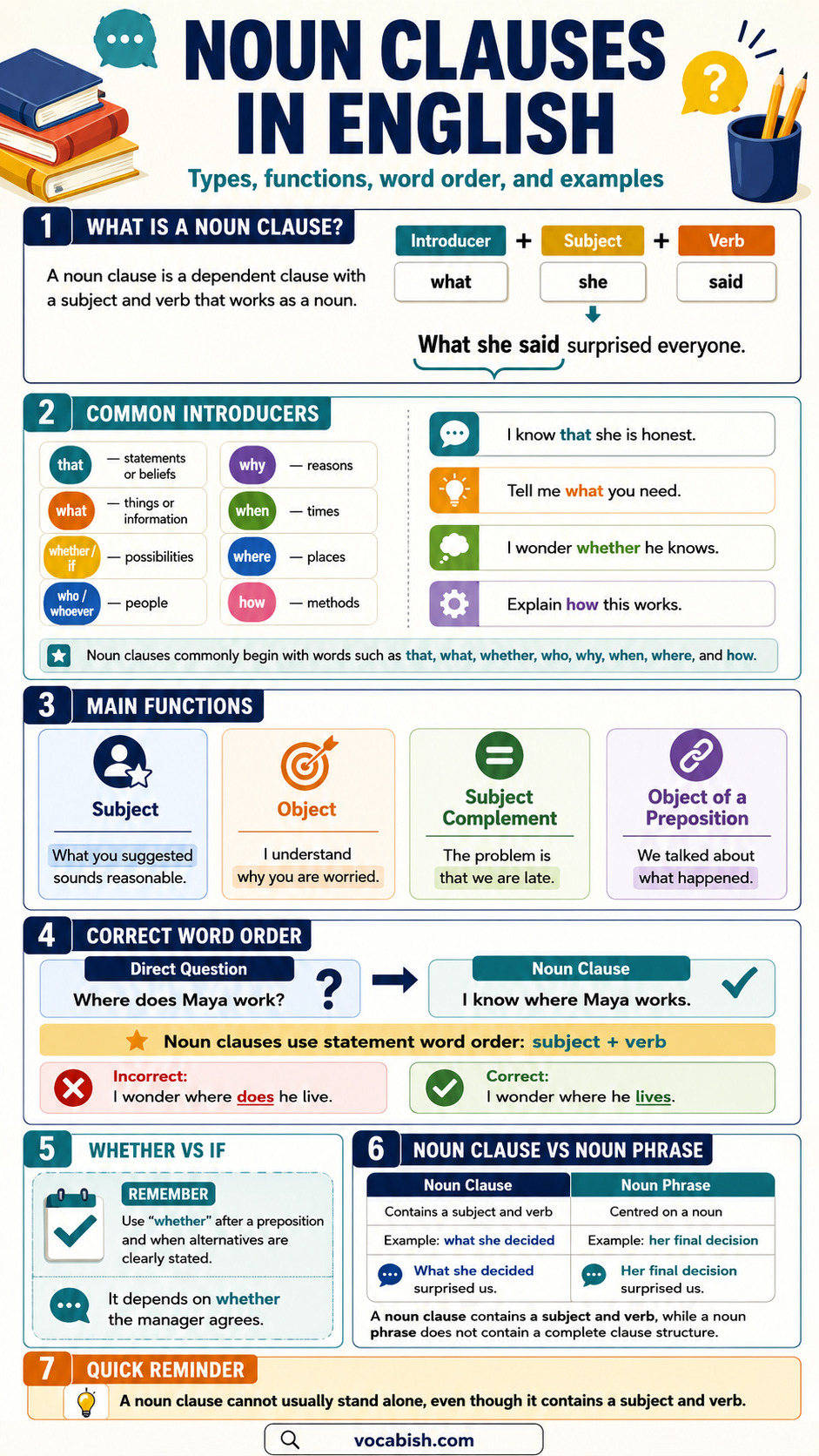
A noun clause is a dependent clause that performs the job of a noun.
It has:
- A subject
- A verb
- A complete role within another sentence
Examples:
- What she said surprised everyone.
- I understand why you are worried.
- The problem is that we are late.
- We talked about what happened yesterday.
A noun clause usually cannot stand alone as a complete sentence.
Incorrect:
- What she decided.
Correct:
- What she decided changed our plans.
Words That Introduce Noun Clauses
Noun clauses often begin with the following words:
Introducer | Main Use | Example |
|---|---|---|
that | Statements, beliefs, and facts | I believe that she is honest. |
what | Things or information | Tell me what you need. |
whether, if | Yes-or-no possibilities | I wonder whether he knows. |
who, whom, whoever | People | We know who called. |
why | Reasons | She explained why she left. |
when | Times | Tell me when you are ready. |
where | Places | I remember where we met. |
how | Methods or conditions | Show me how this works. |
That
That introduces noun clauses expressing statements, facts, opinions, beliefs, or reports.
- I know that the answer is correct.
- She believes that her team can win.
- The teacher explained that the test was optional.
When a that-clause is the object of a verb, that can often be omitted.
- I think that he is ready.
- I think he is ready.
However, keeping that may make a long or complex sentence easier to understand.
What
What means “the thing that” or “the things that.”
- I understand what you mean.
- What he wrote was incorrect.
- Please take what you need.
Do not place another noun before a noun clause beginning with what.
Incorrect:
- I understand the thing what you mean.
Correct:
- I understand what you mean.
- I understand the thing that you mean.
Whether and If
Whether and if introduce indirect yes-or-no questions.
- I do not know whether she received the message.
- I do not know if she received the message.
- Please ask whether they are available.
Use whether instead of if:
- After a preposition
- Before an infinitive
- When clear alternatives are presented
- With or not when the contrast is important
Examples:
- It depends on whether the manager agrees.
- We cannot decide whether we should stay or leave.
- She asked whether or not the office was open.
Who, Whom, and Whoever
These words introduce noun clauses referring to people.
Who
Use who as the subject within the clause.
- I know who sent the email.
- Whoever finishes first will receive a prize.
Whom
Use whom as the object within the clause, especially in formal English.
- I do not know whom they selected.
- She asked whom we had invited.
In everyday conversation, many speakers use who instead of whom.
Whoever
Whoever means “any person who” or “the person who.”
- Give the form to whoever needs it.
- Whoever broke the window should admit it.
Why, When, Where, and How
These words introduce noun clauses that report indirect questions or provide information.
- I understand why she refused.
- Tell me when the lesson begins.
- Nobody knows where he went.
- Please explain how this machine works.
Word | Refers To | Example |
|---|---|---|
why | A reason | I know why they complained. |
when | A time | Tell us when you arrived. |
where | A place | She remembers where she parked. |
how | A method or condition | Show me how you solved it. |
Noun Clause as the Subject
A noun clause can be the subject of a sentence.
- What you suggested sounds reasonable.
- Why he resigned remains unclear.
- Whether they will attend is still uncertain.
- Whoever wins the election will face several challenges.
The complete noun clause normally takes a singular verb.
- What she said was surprising.
- How they escaped remains a mystery.
A long that-clause often appears after introductory it because this sounds more natural.
Formal:
- That she rejected the offer was surprising.
More natural:
- It was surprising that she rejected the offer.
Noun Clause as the Object
A noun clause can receive the action of a verb.
- I know what she wants.
- He explained why the meeting was cancelled.
- We believe that the plan will work.
- She asked whether I needed assistance.
Noun clauses commonly follow verbs such as:
- Ask
- Believe
- Decide
- Discover
- Explain
- Forget
- Guess
- Know
- Remember
- Think
- Understand
- Wonder
Noun Clause as a Subject Complement
A subject complement follows a linking verb and gives more information about the subject.
- The truth is that nobody informed us.
- My question is whether we have enough time.
- The main issue is how we will pay for it.
- Her concern was what the neighbours might think.
The noun clause explains or identifies the subject.
Subject | Linking Verb | Noun Clause |
|---|---|---|
The truth | is | that nobody called |
The question | is | whether we should wait |
Our concern | is | how they will react |
Noun Clause after a Preposition
A noun clause can function as the object of a preposition.
- We talked about what happened.
- Success depends on how well you prepare.
- She is interested in what the course offers.
- They argued over who should lead the project.
Use whether, not normally if, directly after a preposition.
Incorrect:
- It depends on if he agrees.
Better:
- It depends on whether he agrees.
A that-clause does not normally follow a preposition directly. Use the fact that when necessary.
- We were surprised by the fact that he refused.
- She complained about the fact that nobody listened.
Word Order in Noun Clauses
Noun clauses use normal statement word order:
Subject + verb
They do not use direct-question word order.
Direct Question | Noun Clause |
|---|---|
Where does Maya work? | I know where Maya works. |
Why did he leave? | Tell me why he left. |
When will they arrive? | Do you know when they will arrive? |
Is she ready? | I wonder whether she is ready. |
What does this word mean? | Can you explain what this word means? |
Incorrect:
- I wonder where does he live.
- Do you know why did she leave?
Correct:
- I wonder where he lives.
- Do you know why she left?
Use a question mark only when the entire sentence is a question.
- I wonder where she went.
- Do you know where she went?
Noun Clause vs Noun Phrase
Both noun clauses and noun phrases perform noun functions, but their structures are different.
Feature | Noun Clause | Noun Phrase |
|---|---|---|
Contains a subject | Yes | Usually no |
Contains a verb | Yes | No complete verb |
Can act as a noun | Yes | Yes |
Example | what she decided | her final decision |
In a sentence | What she decided surprised us. | Her final decision surprised us. |
More examples:
- Noun phrase: the new English teacher
- Noun clause: whoever teaches the class
- Noun phrase: his reason
- Noun clause: why he resigned
Noun Clause vs Relative Clause
A noun clause performs the job of a noun. A relative clause describes a noun already mentioned.
Feature | Noun Clause | Relative Clause |
|---|---|---|
Main function | Acts as a noun | Describes a noun |
Needs a noun before it | No | Usually yes |
Example | I know who called. | The woman who called left a message. |
Role of clause | Object of “know” | Describes “woman” |
Compare:
- I remember what she bought.
The clause is the object of remember. - I remember the dress that she bought.
The relative clause describes the dress.
Another comparison:
- Whoever arrives first can open the door.
- The person who arrives first can open the door.
Common Noun Clause Mistakes
- Using question word order
Incorrect: I know where is the station.
Correct: I know where the station is. - Leaving out the subject or verb
Incorrect: Tell me what the problem.
Correct: Tell me what the problem is. - Using if after a preposition
Incorrect: It depends on if she agrees.
Correct: It depends on whether she agrees. - Adding an unnecessary noun before what
Incorrect: Show me the thing what you found.
Correct: Show me what you found. - Confusing noun clauses with relative clauses
Noun clause: I know who won.
Relative clause: The player who won received a medal. - Using a question mark with a statement
Incorrect: I wonder where he went?
Correct: I wonder where he went.
Practice Exercise
Complete or correct each sentence.
- ______ she said shocked everyone.
- I believe ______ the information is accurate.
- We cannot decide ______ we should accept the offer.
- Do you know ______ the nearest pharmacy is?
- The truth is ______ nobody checked the figures.
- We spoke about ______ should represent the class.
- Correct the sentence:
I wonder where does your brother work. - Identify the function of the noun clause:
What you wrote was easy to understand. - Identify the function of the noun clause:
She explained why she had missed the meeting. - Identify the function of the noun clause:
The main question is whether we can finish today. - Identify the function of the noun clause:
Everything depends on how the manager responds. - Choose the correct sentence:
a. Can you tell me where is the library?
b. Can you tell me where the library is?
Answer Key
- What she said shocked everyone.
- I believe that the information is accurate.
- We cannot decide whether we should accept the offer.
- Do you know where the nearest pharmacy is?
- The truth is that nobody checked the figures.
- We spoke about who should represent the class.
- I wonder where your brother works.
- Subject
- Object of the verb explained
- Subject complement
- Object of the preposition on
- b. Can you tell me where the library is?
FAQs About Noun Clauses
A noun clause is a dependent clause containing a subject and verb that performs the job of a noun in a sentence.
A noun clause can work as a subject, object, subject complement, or object of a preposition, depending on its position.
Yes. When a that-clause is the object of a verb, that is often omitted without changing the basic meaning of the sentence.
Use whether after a preposition, before an infinitive, and when presenting alternatives. If is common in ordinary yes-or-no noun clauses.
No. A noun clause uses statement word order, so write where she lives, not where does she live inside the larger sentence.
A noun phrase has no complete subject-verb structure, while a noun clause contains both and still functions as a noun.
A relative clause describes a noun already stated, while a noun clause itself fills a noun position in the sentence.
You May Also Like