
Complex sentence examples become much easier to understand when you see how one main idea connects with a dependent idea. You use complex sentences, subordinating conjunctions, and dependent clauses every day, often without noticing.
For example, “I stayed home because it was raining” is a complex sentence. It gives a complete idea while adding a reason. Once you understand this pattern, you can make your English more natural, detailed, and expressive.
This article contains 100 examples of complex sentences arranged by purpose, including everyday conversation, school English, work situations, time, reason, condition, contrast, and common patterns rather than putting them in one single list.
What Is a Complex Sentence?
A complex sentence contains:
- One independent clause that can stand alone as a complete sentence.
- At least one dependent clause that cannot stand alone.
- A word or phrase that connects the clauses, often called a subordinating conjunction.
Basic pattern
Independent clause + subordinating conjunction + dependent clause
Example:
- I stayed inside because it was raining.
The main clause is “I stayed inside.”
The dependent clause is “because it was raining.”
You can also reverse the order:
- Because it was raining, I stayed inside.
When the dependent clause comes first, a comma is usually used before the main clause.
What makes a sentence complex?
A sentence is complex because its clauses have different roles. One clause gives the main message, while another adds information such as:
- Time
- Reason
- Condition
- Contrast
- Purpose
- Place
- Result
- Possibility
A complex sentence does not simply mean a long sentence. A long sentence can still be grammatically incorrect, while a short sentence can be complex.
How to Identify a Complex Sentence
A quick way to identify one is to look for a dependent marker such as because, although, when, if, while, since, unless, or before.
Try this:
I will call you when I arrive.
“I will call you” can stand alone.
“When I arrive” cannot express a complete thought by itself.
Therefore, the sentence is complex.
A Useful Test
Ask these three questions:
- Does the sentence have a complete main idea?
- Is there another clause that depends on that idea?
- Is there a connecting word joining the clauses?
If the answer is yes to all three, you probably have a complex sentence.
Common Words Used in Complex Sentences
Many complex sentence examples use subordinating conjunctions and relative words.
Words showing reason
- because
- since
- as
Words showing time
- when
- while
- before
- after
- until
- once
- whenever
- as soon as
Words showing condition
- if
- unless
- provided that
- as long as
Words showing contrast
- although
- even though
- though
- whereas
- while
Words showing purpose
- so that
- in order that
Words showing place
- where
- wherever
These words help you connect ideas more clearly instead of writing many short sentences.
100 Complex Sentence Examples
Below are 100 examples of complex sentences with natural situations and everyday meanings. The examples gradually move from common conversational patterns to more advanced uses.
Everyday Complex Sentence Examples
These examples are useful in ordinary conversations with friends, family, classmates, and coworkers.
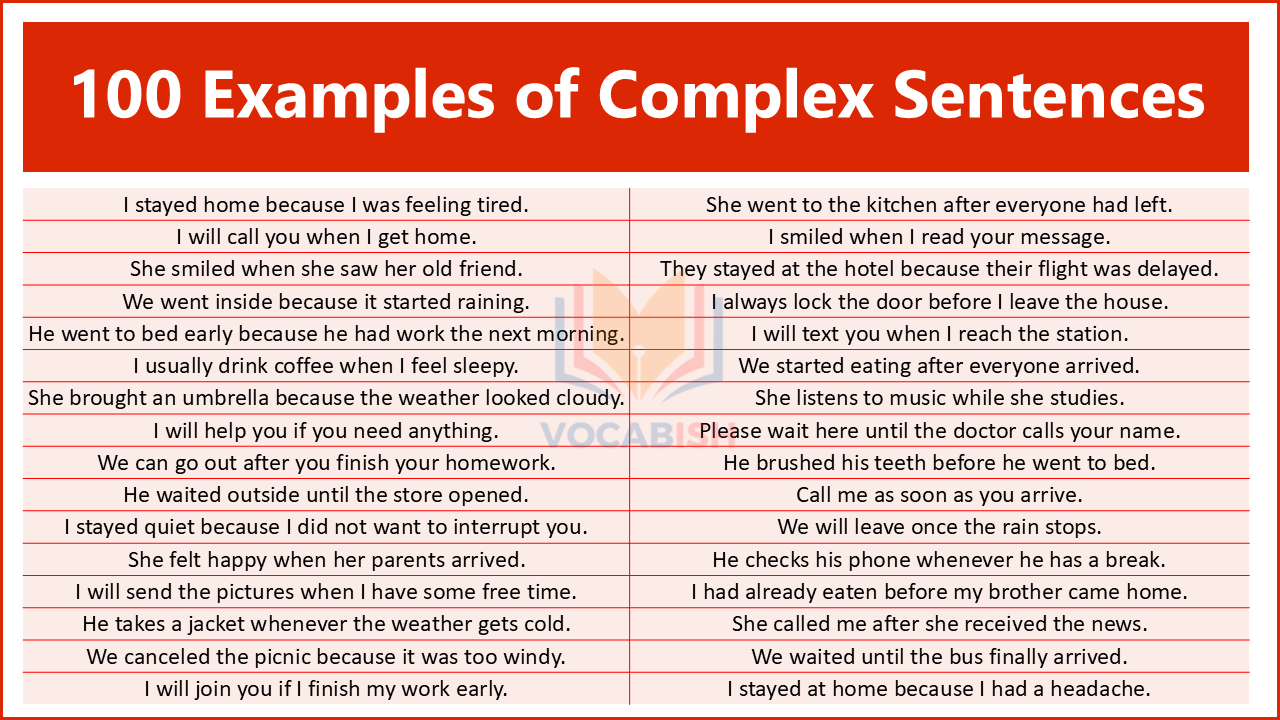
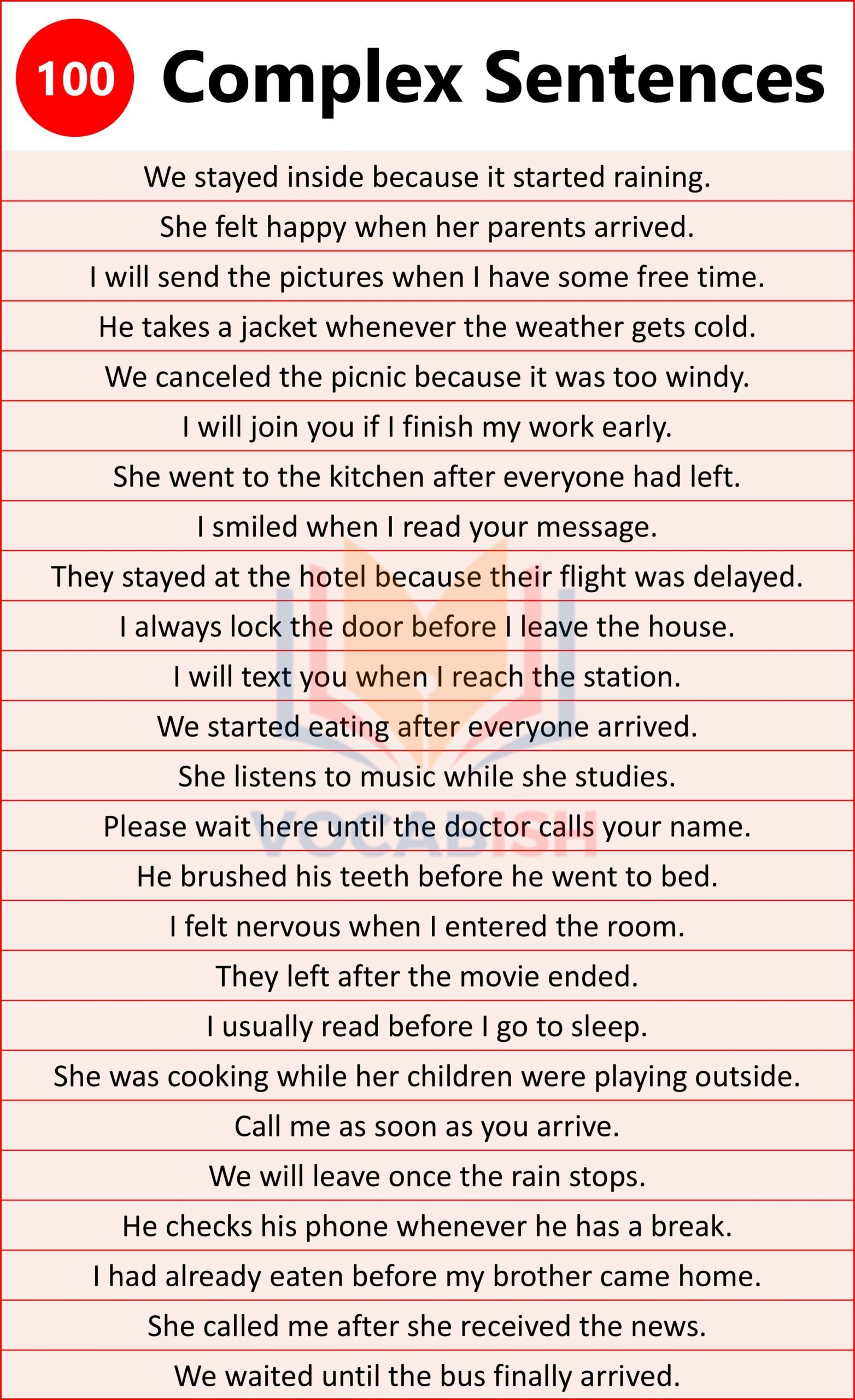
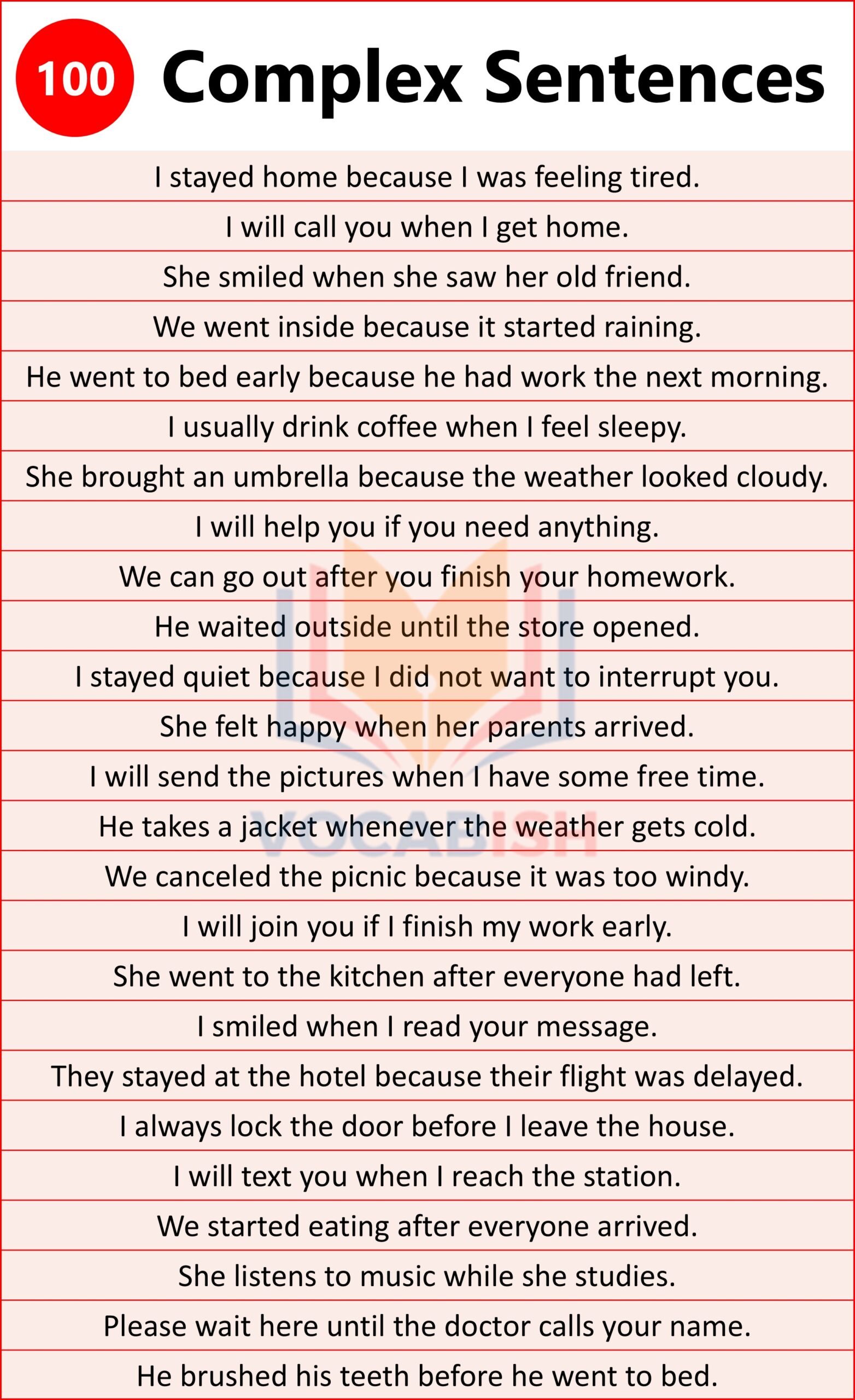
- I stayed home because I was feeling tired.
- I will call you when I get home.
- She smiled when she saw her old friend.
- We went inside because it started raining.
- He went to bed early because he had work the next morning.
- I usually drink coffee when I feel sleepy.
- She brought an umbrella because the weather looked cloudy.
- I will help you if you need anything.
- We can go out after you finish your homework.
- He waited outside until the store opened.
- I stayed quiet because I did not want to interrupt you.
- She felt happy when her parents arrived.
- I will send the pictures when I have some free time.
- He takes a jacket whenever the weather gets cold.
- We canceled the picnic because it was too windy.
- I will join you if I finish my work early.
- She went to the kitchen after everyone had left.
- I smiled when I read your message.
- They stayed at the hotel because their flight was delayed.
- I always lock the door before I leave the house.
Complex Sentence Examples Showing Time
Time clauses tell us when something happens, happened, or will happen.
- I will text you when I reach the station.
- We started eating after everyone arrived.
- She listens to music while she studies.
- Please wait here until the doctor calls your name.
- He brushed his teeth before he went to bed.
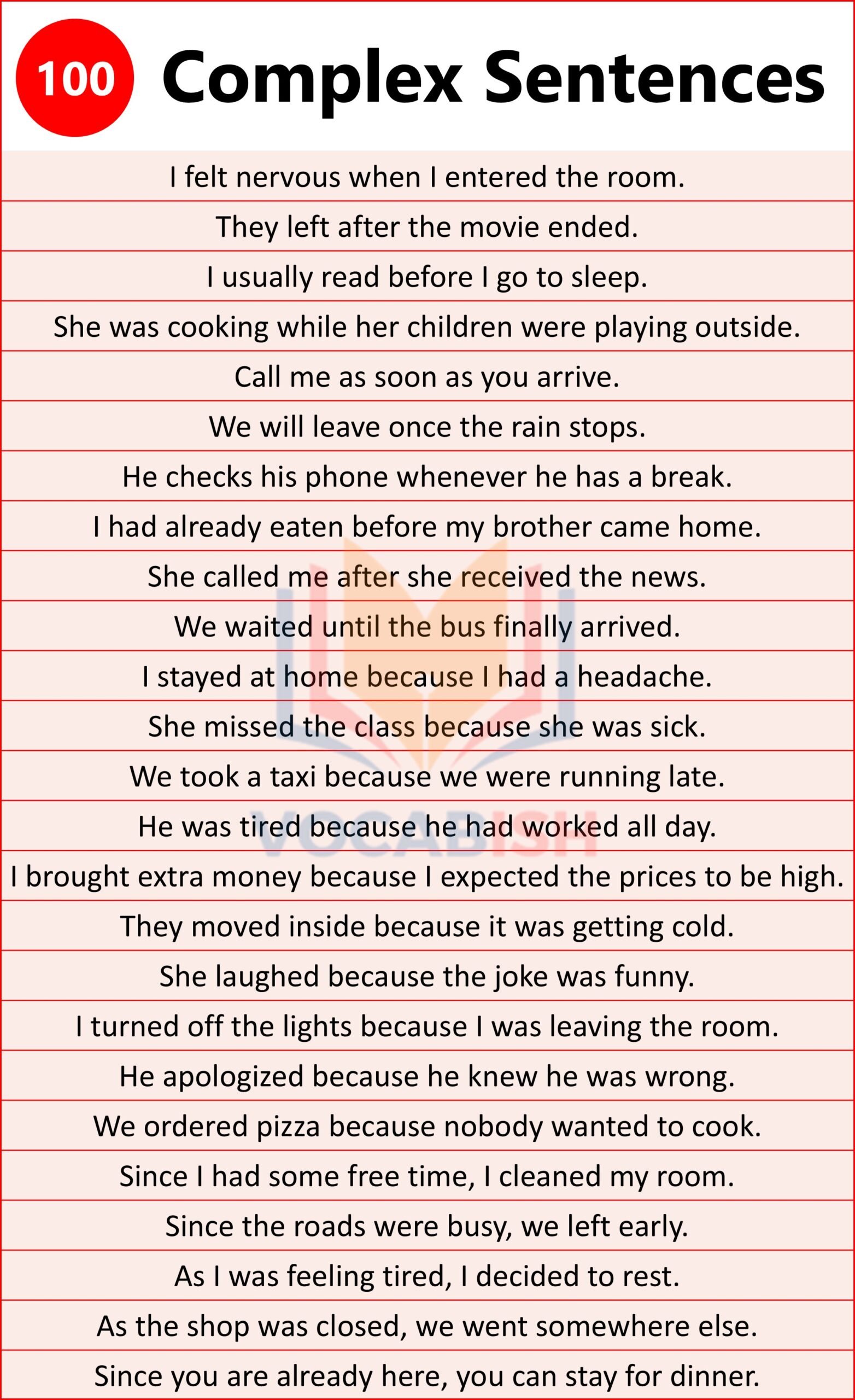
- I felt nervous when I entered the room.
- They left after the movie ended.
- I usually read before I go to sleep.
- She was cooking while her children were playing outside.
- Call me as soon as you arrive.
- We will leave once the rain stops.
- He checks his phone whenever he has a break.
- I had already eaten before my brother came home.
- She called me after she received the news.
- We waited until the bus finally arrived.
Why these are complex:
Words such as when, after, before, while, until, once, whenever, and as soon as introduce dependent clauses. The other part carries the main message.
Complex Sentence Examples Showing Reason
These sentences explain why something happens.
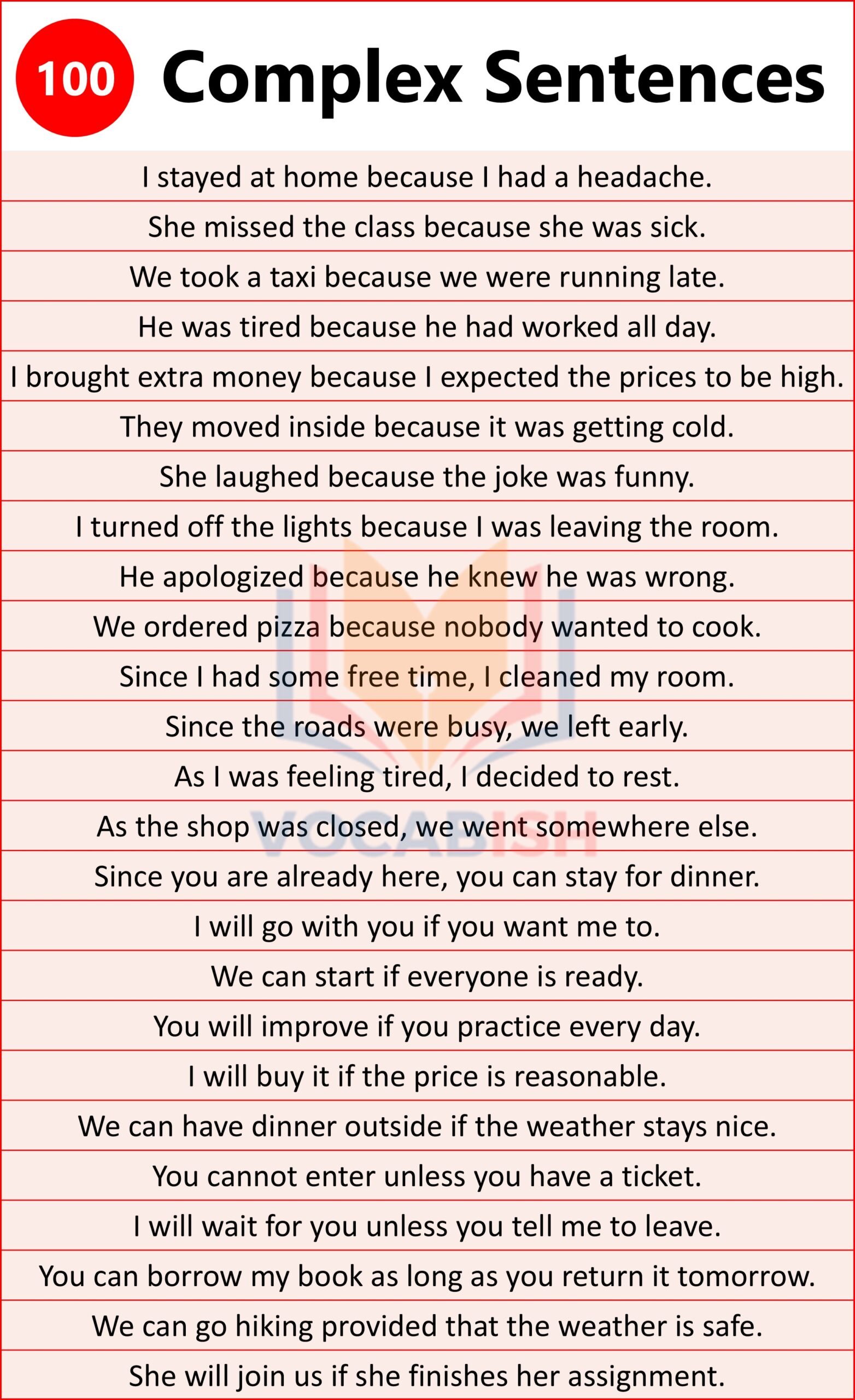
- I stayed at home because I had a headache.
- She missed the class because she was sick.
- We took a taxi because we were running late.
- He was tired because he had worked all day.
- I brought extra money because I expected the prices to be high.
- They moved inside because it was getting cold.
- She laughed because the joke was funny.
- I turned off the lights because I was leaving the room.
- He apologized because he knew he was wrong.
- We ordered pizza because nobody wanted to cook.
More examples with “since” and “as”
- Since I had some free time, I cleaned my room.
- Since the roads were busy, we left early.
- As I was feeling tired, I decided to rest.
- As the shop was closed, we went somewhere else.
- Since you are already here, you can stay for dinner.
In these examples, since and as introduce the reason.
Complex Sentence Examples Showing Conditions
Condition clauses explain what must happen for another action or result to occur.
- I will go with you if you want me to.
- We can start if everyone is ready.
- You will improve if you practice every day.
- I will buy it if the price is reasonable.
- We can have dinner outside if the weather stays nice.
- You cannot enter unless you have a ticket.
- I will wait for you unless you tell me to leave.
- You can borrow my book as long as you return it tomorrow.
- We can go hiking provided that the weather is safe.
- She will join us if she finishes her assignment.
- If you need help, I will be here.
- If it rains tonight, we will stay home.
- Unless you hurry, you will miss the bus.
- As long as you are honest, I will trust you.
- If I have enough money, I will buy a new laptop.
Remember:
If introduces a condition.
Unless usually means if not.
For example:
- Unless you hurry, you will miss the bus.
- If you do not hurry, you will miss the bus.
Complex Sentence Examples Showing Contrast
Contrast clauses show that two ideas are different or unexpected.
- Although I was tired, I finished my homework.
- Although the restaurant was crowded, we found a table.
- Even though he was nervous, he gave the presentation.
- Though she was busy, she answered my call.
- Although the test was difficult, I passed it.
- Even though it was expensive, they bought the computer.
- While I like coffee, my brother prefers tea.
- Although the road was long, the trip was enjoyable.
- Even though she disagreed with me, she listened carefully.
- Though he was young, he was very responsible.
A useful pattern is:
Although + dependent clause, + independent clause
Example:
- Although it was late, we continued talking.
The same relationship can appear in another order:
- We continued talking although it was late.
Complex Sentence Examples Showing Purpose
Purpose clauses explain why someone does something or what result they want.
- I woke up early so that I could catch the train.
- She saved money so that she could buy a new phone.
- He spoke slowly so that everyone could understand him.
- We left early so that we would not miss the meeting.
- I wrote the instructions clearly so that nobody would get confused.
- She turned down the music so that the baby could sleep.
- He studied hard so that he could pass the exam.
- We carried an umbrella so that we would stay dry.
- I set an alarm so that I would not oversleep.
- They practiced every day so that they could perform well.
These are useful when you want to explain the goal behind an action.
Complex Sentence Examples Showing Place
Place clauses tell us where something happens.
- Sit wherever you feel comfortable.
- I will meet you where we had lunch yesterday.
- She followed him wherever he went.
- We stopped where the road became narrow.
- Put the box where nobody can trip over it.
- I will wait wherever you want to meet.
- They built the house where the land was cheaper.
- He works where his father used to work.
- Stay where you can see the children.
- We found the keys where you had left them.
Complex Sentence Examples With Relative Clauses
A relative clause gives more information about a person, place, or thing.
Common relative words include who, whom, whose, which, and that.
- The woman who lives next door is a teacher.
- The book that you gave me is very interesting.
- I met a student who speaks four languages.
- This is the phone that I wanted to buy.
- The man who helped us was very kind.
- She has a friend whose brother works abroad.
- I visited the town where my grandfather was born.
- The movie that we watched last night was funny.
- I found the bag that I had lost.
- The teacher who teaches us English is very patient.
A relative clause can make your writing more informative without forcing you to use several short sentences.
Complex Sentences for Everyday Conversation
Knowing grammar is helpful, but learners also need sentences they can actually use when speaking.
Here are natural examples for common situations.
At Home
- I will wash the dishes after I finish eating.
- Please close the window because it is getting cold.
- I will clean my room when I have time.
- We can watch a movie if you are not busy.
- I went to bed early because I was exhausted.
With Friends
- I will come with you if you are still going.
- Let me know when you get there.
- We stayed longer because everyone was having fun.
- Although I was tired, I enjoyed the evening.
- I will call you when I reach home.
At School
- I studied hard because I wanted to pass the exam.
- I asked the teacher for help when I did not understand the question.
- Although the assignment was difficult, I completed it.
- I will submit my project after I check it one more time.
- You can use my notes if you need extra information.
At Work
- I finished the report before the manager arrived.
- I stayed late because I had a deadline.
- We can discuss the project when everyone is available.
- Although the meeting was long, we reached an agreement.
- I will email you as soon as I receive the documents.
While Shopping
- I will buy this shirt if it is available in my size.
- I chose the cheaper phone because I wanted to save money.
- Although the jacket looked nice, it was too expensive.
- I will take it after I try it on.
- Please tell me where I can find the shoes.
While Traveling
- We stayed at the airport because our flight was delayed.
- I will call you when we land.
- We took a different road because the main road was closed.
- Although the journey was long, we had a great time.
- I will book the hotel if the reviews are good.
Complex Sentence Examples by Meaning
One of the easiest ways to learn complex sentences is to connect the grammar pattern with its purpose.
For Giving a Reason
- I left early because I was feeling sick.
- She stayed home because she had a lot of work.
- We took the train because the traffic was heavy.
- He apologized because he realized his mistake.
- I turned off my phone because I needed to concentrate.
For Talking About Time
- I will eat when I get home.
- Call me after you finish work.
- She smiled when she heard the news.
- We waited until the rain stopped.
- He studied before he took the exam.
For Giving a Condition
- I will help you if you ask me.
- We will go outside if the weather improves.
- You will succeed if you keep practicing.
- Unless you hurry, you will miss the train.
- You can stay here as long as you are comfortable.
For Showing Contrast
- Although I was nervous, I spoke confidently.
- Even though it was raining, we went outside.
- Though he was tired, he continued working.
- Although the task looked difficult, I finished it.
- Even though they disagreed, they remained friends.
For Explaining a Goal
- I studied hard so that I could pass.
- She whispered so that the baby would not wake up.
- We left early so that we could avoid traffic.
- He saved money so that he could travel.
- I repeated the question so that everyone could hear.
For Giving Extra Information
- The girl who won the race is my cousin.
- I lost the pen that you gave me.
- The teacher who helped me was very kind.
- This is the house where I grew up.
- She met a man whose daughter studies with us.
10 Examples of Complex Sentences
The following examples show how complex sentences can make ordinary communication more specific.
- I cannot come tonight because I have an important appointment.
- When you finish your work, we can go for coffee.
- Although he was angry, he remained polite.
- If you need a ride, I can pick you up.
- She wore a jacket because the evening was cold.
- Before you leave, please turn off the lights.
- I will wait here until you come back.
- Even though the shop was closing, they let us enter.
- You can choose whatever you like as long as it fits your budget.
- I called you when I heard what happened.
Common Mistakes With Complex Sentences
Complex sentences are useful, but learners often make a few predictable errors.
- Mistake: Joining two complete sentences with only a comma.
Incorrect: I was tired, I went home because it was late.
Better: I was tired, so I went home because it was late. - Mistake: Forgetting the main clause.
Incorrect: Because I was tired.
Better: Because I was tired, I went to bed early. - Mistake: Using the wrong word for the intended relationship.
“Because” shows reason, while “although” shows contrast. - Mistake: Using an unnecessary comma.
Usually, no comma is needed when the dependent clause comes after the main clause.
Example: I stayed home because it was raining. - Mistake: Confusing “unless” with “until.”
“Unless” introduces a condition, while “until” relates to time.
Complex Sentence vs. Other Sentence Types
Understanding the difference makes grammar much easier.
Simple Sentence
A simple sentence has one independent clause.
- She studies English.
Compound Sentence
A compound sentence joins two independent clauses, often with and, but, or, so.
- She studies English, and her brother studies Spanish.
Complex Sentence
A complex sentence has one independent clause and at least one dependent clause.
- She studies English because she wants to work abroad.
The key difference is not the number of words. It is the relationship between the clauses. Here’s a complete guide on: The 4 Types of Sentences
Practice: Complete the Complex Sentences
Complete each sentence with a suitable word or phrase such as because, although, when, if, unless, before, after, while, until, or so that.
- I will call you ______ I arrive home.
- She stayed inside ______ it was raining.
- ______ he was tired, he finished his work.
- We can go out ______ the weather improves.
- Please wait here ______ I come back.
- He studied hard ______ he could pass the exam.
- I always check the door ______ I leave.
- ______ you hurry, you will miss the bus.
- She listened to music ______ she was cleaning.
- We went home ______ the movie ended.
Answers to the Practice
- I will call you when I arrive home.
- She stayed inside because it was raining.
- Although he was tired, he finished his work.
- We can go out if the weather improves.
- Please wait here until I come back.
- He studied hard so that he could pass the exam.
- I always check the door before I leave.
- Unless you hurry, you will miss the bus.
- She listened to music while she was cleaning.
- We went home after the movie ended.
How to Make Your Own Complex Sentences
You can create a complex sentence by following a few easy patterns.
Pattern 1: Reason
Main clause + because + reason
- I stayed home because I was sick.
Pattern 2: Time
Main clause + when + time clause
- I will call you when I arrive.
Pattern 3: Condition
Main clause + if + condition
- We will go if the weather improves.
Pattern 4: Contrast
Although + contrast clause + main clause
- Although I was nervous, I gave my speech.
Pattern 5: Purpose
Main clause + so that + purpose
- I spoke loudly so that everyone could hear me.
Once you learn these patterns, creating your own complex sentence examples becomes much easier.
Helpful Tips for ESL Learners
When practicing complex sentences, focus on meaning rather than memorizing grammar terms.
Start by asking what relationship you want to express:
- Why? Use because, since, or as.
- When? Use when, before, after, until, or while.
- What condition? Use if, unless, or as long as.
- What contrast? Use although, though, or even though.
- What purpose? Use so that.
- Where? Use where or wherever.
Then build two ideas and connect them.
For example:
Idea 1: I stayed home.
Idea 2: I was sick.
Connection: because
Result:
- I stayed home because I was sick.
This method is more useful than trying to memorize complicated grammar definitions.
FAQs About Complex Sentence Examples
A complex sentence contains one independent clause and at least one dependent clause connected by a subordinating conjunction or another dependent-clause marker.
Five examples are: “I stayed home because it rained,” “Call me when you arrive,” and “Although I was tired, I worked.”
Common words include because, although, when, if, unless, while, before, after, until, since, where, and so that.
Look for one complete main clause plus a dependent clause that cannot stand alone and is introduced by a connector such as “because” or “when.”
A complex sentence combines an independent clause with a dependent clause, while a compound sentence joins two independent clauses.
Yes. For example, “I left because I was tired” is short but still complex because it contains one independent and one dependent clause.
Yes. Native speakers use them constantly to explain reasons, conditions, timing, preferences, plans, and relationships between ideas.
No. A comma is commonly used when the dependent clause comes first, but it is usually unnecessary when the dependent clause follows the main clause.
Conclusion
These 100 complex sentence examples show how English speakers connect ideas about time, reason, condition, contrast, purpose, place, and extra information.
The easiest way to master complex sentences is to notice the relationship between the clauses. Start with familiar connectors such as because, when, if, although, before, after, and unless, then practice creating sentences about your own daily life.
Once these patterns become familiar, complex sentences will feel much more natural in both speaking and writing.
Read More Related Articles