
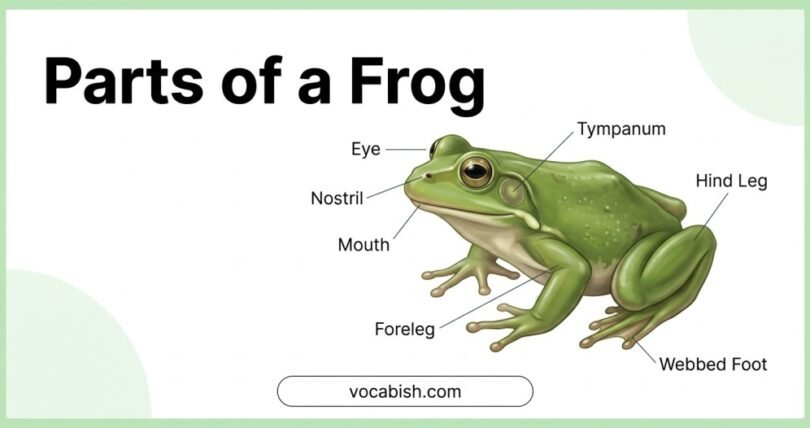

The parts of a frog include its head, eyes, nostrils, mouth, skin, trunk, forelegs, hind legs, and internal organs. Each part performs a specific function, helping the frog catch food, breathe, move, and survive in its habitat. Its powerful hind legs support jumping, while its moist skin allows gas exchange and helps maintain moisture. The eyes help it detect prey, and its tongue catches insects and other small animals. In this article, you will learn the names of the main frog body parts, their functions, and the differences between external and internal anatomy through labelled diagrams and easy-to-understand explanations.
External Parts of a Frog
A frog’s external body parts are the features visible from the outside. They include the head, eyes, nostrils, mouth, trunk, skin, forelegs, hind legs, and feet.
Most frogs have a short, broad body without a tail in adulthood. Their body shape and long hind legs help them move efficiently through their habitats.
Parts of a Frog and Their Functions
The following table lists the main frog body parts and explains what each one does.
Frog Part | Location | Function |
|---|---|---|
Head | Front of the body | Contains the brain, eyes, nostrils, and mouth. |
Eyes | Upper part of the head | Help the frog detect movement and find food. |
Eyelids | Around the eyes | Protect the eyes and help keep them moist. |
Nictitating membrane | Across each eye | A transparent or translucent membrane that protects the eye, especially underwater. |
Nostrils | Near the tip of the snout | Allow air to enter and leave the nasal passages. |
Mouth | Front of the head | Takes in food and allows air to enter the lungs. |
Tongue | Inside the mouth | Helps catch and draw prey into the mouth. |
Tympanum | Behind each eye in many frogs | Detects sound vibrations and helps the frog hear. |
Trunk | Main body | Houses most internal organs. |
Skin | Covers the body | Protects the body and helps with breathing and moisture regulation. |
Forelegs | Front of the body | Support the body and help absorb impact when landing. |
Hind legs | Rear of the body | Provide power for jumping and swimming. |
Toes | Ends of the feet | Help with movement and gripping surfaces. |
Webbing | Between some toes | Helps many aquatic frogs push against water when swimming. |
Cloaca | At the rear of the body | Serves as a shared opening for digestive, urinary, and reproductive systems. |
Parts of a Frog Diagram
A labelled frog diagram helps you identify each body part by its position. A side view is useful for recognising the head, tympanum, trunk, forelegs, hind legs, and feet.
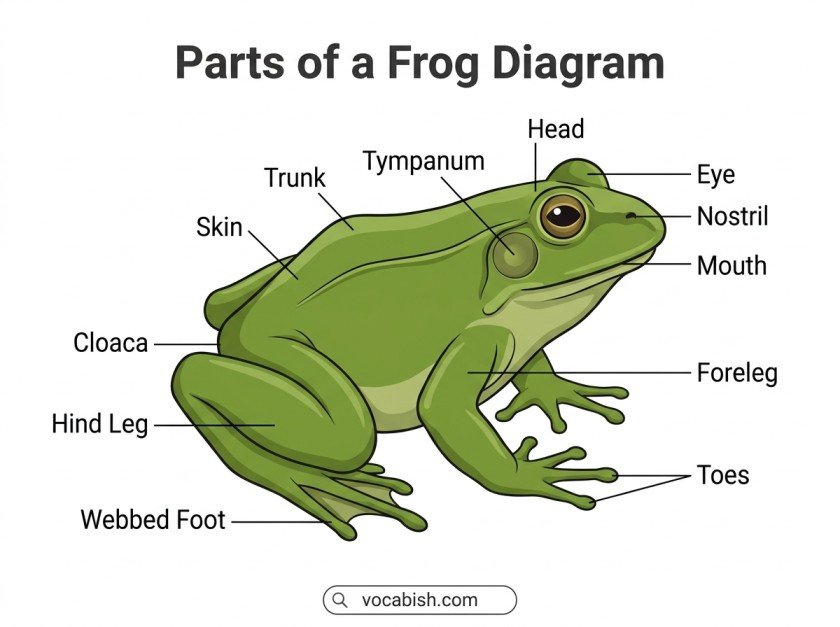
A frog diagram may show different details depending on whether it focuses on external anatomy or internal organs. Check the labels carefully when comparing diagrams.
Head Parts of a Frog
The frog’s head contains the structures used for seeing, hearing, smelling, eating, and taking in air. These parts help it locate prey, detect danger, and respond to its surroundings.
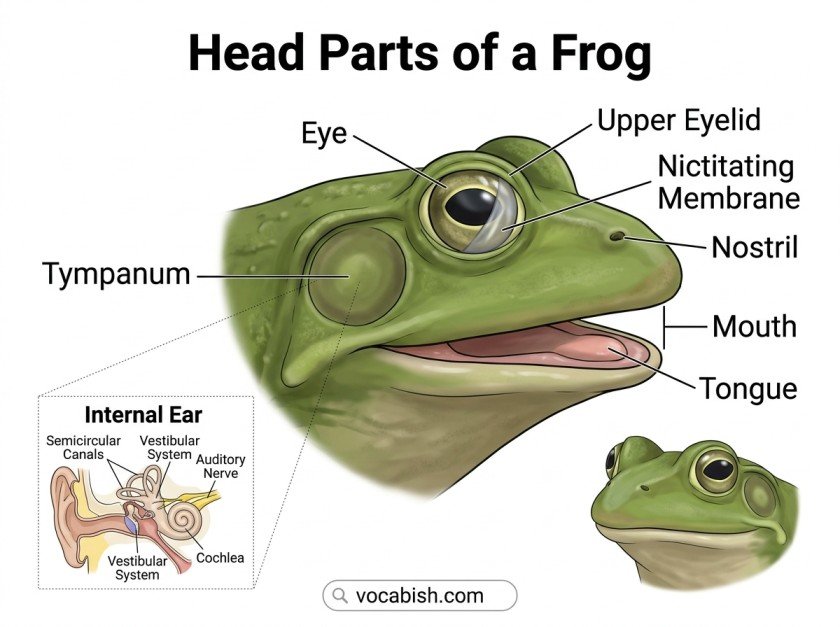
Frogs do not have external ears like humans. The tympanum performs the role of an external eardrum.
Body Parts of a Frog
The trunk is the main body section behind the head. It contains the heart, lungs, digestive organs, kidneys, and reproductive organs.
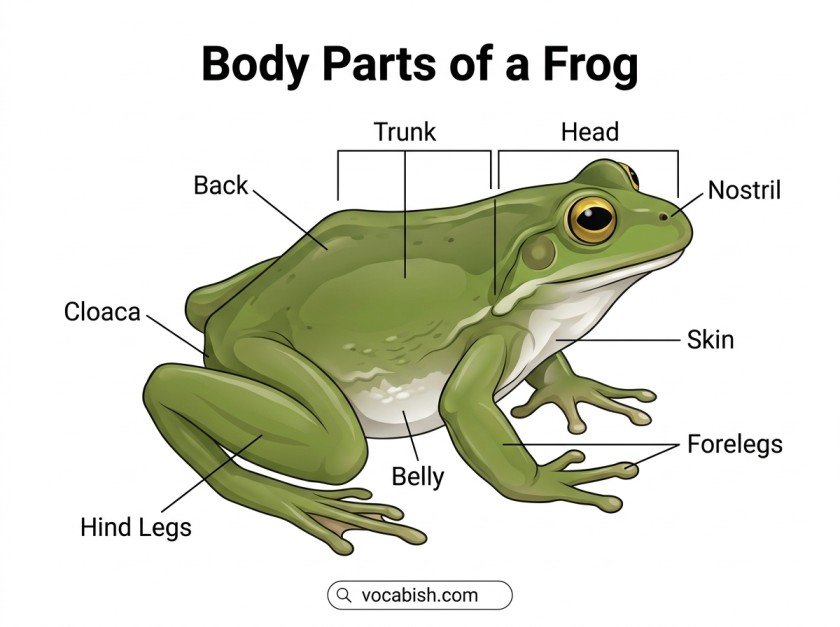
A frog’s body is adapted to life in moist environments, although some species live mainly on land or in trees.
Frog Skin and Its Functions
Frog skin is thin, moist, and permeable, meaning that some substances can pass through it. It is different from the dry, scaly skin of many reptiles.
Its main functions include:
- Breathing: Oxygen can pass through the moist skin into the blood, and carbon dioxide can leave.
- Protection: Skin provides a physical barrier and may contain protective secretions.
- Moisture balance: The skin helps frogs exchange water with their surroundings.
- Camouflage: Skin colour and patterns help many frogs blend into their habitat.
Because frog skin can lose water easily, many species need damp conditions or behavioural adaptations to avoid drying out.
Legs and Feet of a Frog
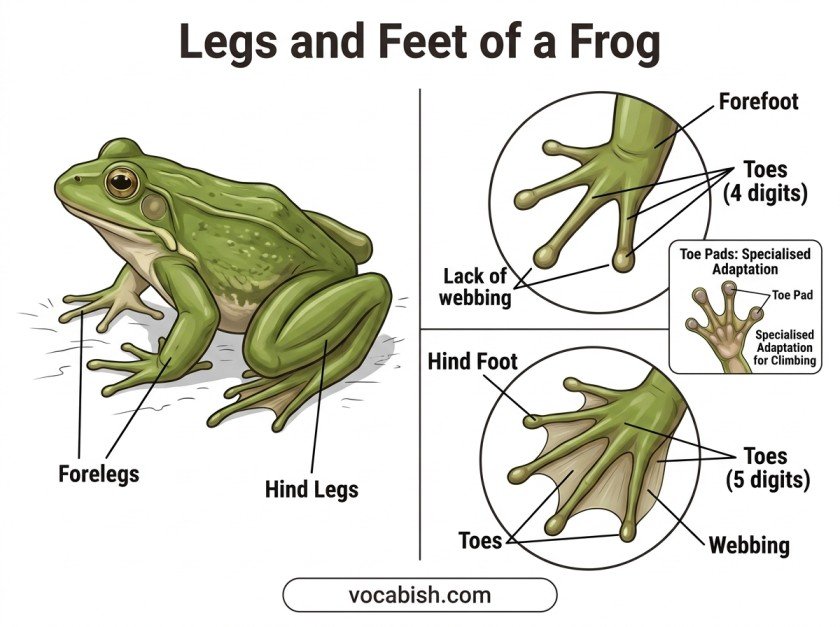
Frogs have four limbs: two forelegs and two hind legs. Their hind legs are usually longer and stronger because they provide much of the force needed for jumping and swimming.
Forelegs
The forelegs are the front limbs. They support the body and help frogs steady themselves, climb, and absorb impact after a jump.
Each foreleg typically ends in a hand-like foot with four digits, although anatomy can vary among species.
Hind Legs
The hind legs are powerful, muscular limbs adapted for movement. Many frogs use them to leap away from predators or propel themselves through water.
Each hind foot typically has five digits.
Toes and Webbed Feet
A frog’s toes help it move across different surfaces. Many aquatic frogs have webbing between their toes, which increases the surface area of the feet and helps push water backward during swimming.
Not every frog has strongly webbed feet. Tree frogs, for example, may have expanded toe pads that help them grip leaves and branches.
Internal Parts of a Frog
A frog’s internal organs perform the same broad life functions found in other vertebrates: breathing, circulation, digestion, waste removal, and reproduction. Their arrangement reflects the frog’s amphibian biology.
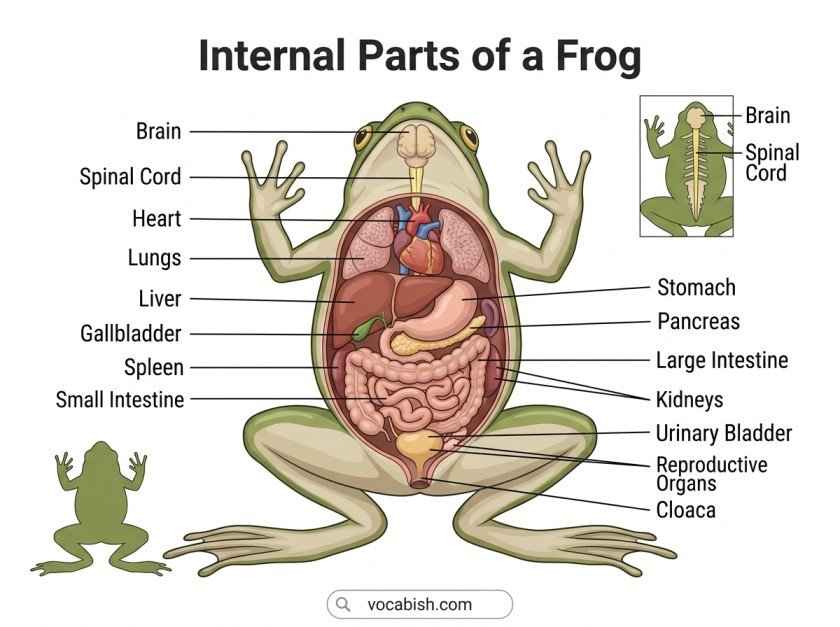
The table below summarises the main internal parts and their functions.
Internal Part | Main Function |
|---|---|
Brain | Controls behaviour, movement, and body responses. |
Spinal cord | Carries signals between the brain and the rest of the body. |
Heart | Pumps blood around the body. |
Lungs | Exchange oxygen and carbon dioxide with the air. |
Liver | Produces bile and processes nutrients and other substances. |
Gallbladder | Stores bile produced by the liver. |
Stomach | Begins the digestion of food. |
Small intestine | Completes much digestion and absorbs most nutrients. |
Large intestine | Absorbs water and moves waste toward the cloaca. |
Pancreas | Produces digestive enzymes and hormones, including insulin. |
Kidneys | Filter blood and regulate water and salts. |
Urinary bladder | Stores urine before it leaves the body. |
Spleen | Helps filter blood and supports immune functions. |
Reproductive organs | Produce eggs or sperm, depending on sex. |
Cloaca | Receives material from several body systems before it exits the body. |
How Does a Frog Breathe?
Frogs use more than one method of breathing, depending on their species, life stage, and activity.
- Through the skin: Oxygen and carbon dioxide diffuse across the moist skin.
- Through the lungs: Adult frogs use lungs to exchange gases with the air.
- Through the mouth lining: The moist lining of the mouth can also exchange gases.
Most adult frogs do not breathe by expanding and contracting their chests as humans do. They commonly use movements of the floor of the mouth to push air into the lungs.
Frog Circulatory System
A frog’s heart generally has three chambers: two atria and one ventricle. The heart pumps blood through the circulatory system, delivering oxygen and nutrients while carrying away waste products.
This differs from the four-chambered heart found in mammals and birds.
Frog Digestive System
The digestive system breaks down food and absorbs nutrients that provide energy for movement, growth, and other body functions.
The main pathway is:
Mouth → Oesophagus → Stomach → Small Intestine → Large Intestine → Cloaca
The liver, gallbladder, and pancreas also support digestion by producing or storing substances that help process food.
How Frog Body Parts Help It Survive
A frog’s anatomy supports its ability to find food, escape predators, and live in different environments. The exact adaptations vary by species.
Body Part | Survival Advantage | Example |
|---|---|---|
Eyes | Detect movement and help locate prey. | A frog spots an insect. |
Tongue | Captures prey quickly. | A frog catches a fly. |
Moist skin | Allows gas exchange and water movement. | A frog absorbs oxygen through its skin. |
Hind legs | Produce powerful jumps. | A frog escapes a predator. |
Webbed feet | Improve swimming efficiency. | An aquatic frog moves through a pond. |
Camouflaged skin | Helps the frog blend into its surroundings. | A green frog hides among plants. |
Tympanum | Detects sound vibrations. | A frog responds to calls or nearby sounds. |
Nictitating membrane | Protects the eyes, especially in water. | A frog keeps its eyes protected while swimming. |
Common Confusions About Frog Parts
Some frog anatomy terms sound similar or are easy to mix up. These distinctions help students identify the correct structures.
- Tympanum vs. ear: The tympanum is the visible eardrum-like membrane; other hearing structures lie inside the head.
- Forelegs vs. hind legs: Forelegs are at the front, while hind legs are at the rear and usually provide greater jumping power.
- Skin vs. scales: Frogs generally have moist, permeable skin rather than the scales typical of many reptiles.
- Lungs vs. skin breathing: Frogs can exchange gases through both their lungs and their skin.
- Cloaca vs. anus: The cloaca is a shared opening for several body systems, not an opening used only for digestive waste.
Frequently Asked Questions
The main parts of a frog include the head, eyes, nostrils, mouth, trunk, skin, forelegs, hind legs, toes, and cloaca.
Frog parts have names such as tympanum, nictitating membrane, trunk, forelimbs, hind limbs, webbed feet, lungs, heart, and cloaca.
A frog’s skin protects its body, helps regulate moisture, and allows oxygen and carbon dioxide to pass through during gas exchange.
A frog has four legs: two forelegs and two hind legs. Its strong hind legs provide much of the power for jumping.
The tympanum is a membrane that detects sound vibrations and transfers them to the frog’s inner ear for hearing.
A frog can exchange gases through its moist skin and lungs. The moist lining of its mouth also contributes to gas exchange.
The internal parts include the brain, heart, lungs, liver, stomach, intestines, kidneys, urinary bladder, pancreas, and reproductive organs.
No. Many aquatic frogs have webbed feet for swimming, while some tree frogs have enlarged toe pads for gripping branches and leaves.
Conclusion
The parts of a frog work together to support movement, feeding, breathing, and survival. External structures such as the eyes, mouth, skin, and powerful hind legs help frogs interact with their environment, while internal organs manage digestion, circulation, and waste removal. Learning these frog parts and their functions makes it easier to read a labelled diagram, recognise anatomical terms, and understand how amphibians live both in water and on land.