
The parts of a lamp work together to produce light and support the lamp’s structure. A typical lamp has a lampshade, light bulb, socket, switch, stem, base, and power cord. Each component has a different purpose, from holding the bulb to controlling the light. Some lamps also have adjustable arms, reflectors, or dimmers. Learning lamp parts names and their functions helps you identify common lighting equipment, describe household objects, and understand how different lamps work.
What Are the Main Parts of a Lamp?
A lamp is a device that provides artificial light using electricity or another energy source. Most modern household lamps use an electric light bulb or a built-in LED light source.
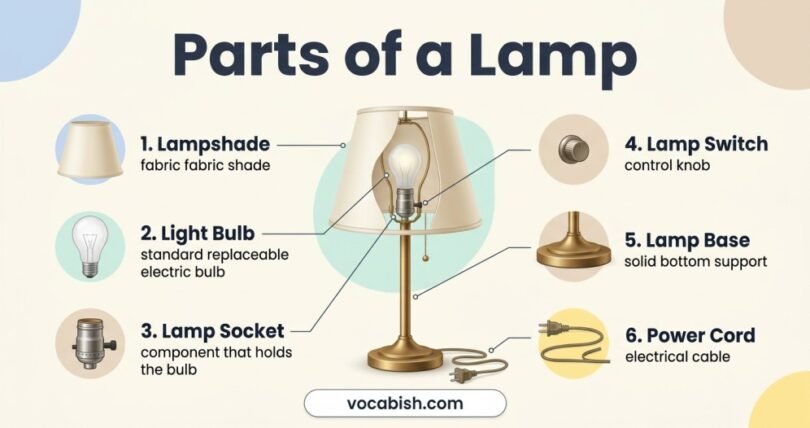
The main parts of a typical table lamp include:
- Lampshade: Softens and directs the light.
- Light Bulb: Produces the light.
- Lamp Socket: Holds and connects the bulb.
- Lamp Switch: Turns the light on or off.
- Lamp Stem: Supports the upper lamp parts.
- Lamp Base: Keeps the lamp stable.
- Power Cord: Carries electricity to the lamp.
- Electrical Plug: Connects the cord to a power outlet.
Not every lamp contains all these parts. For example, a rechargeable desk lamp may use a battery instead of a power cord during operation.
Parts of a Lamp with Names and Functions
Different lamp components have specific jobs. Some provide light, while others support the structure, protect electrical connections, or help control the direction and brightness of the light.
Here, you will learn the common lamp parts, including components found in table lamps, floor lamps, and adjustable desk lamps.
No. | Lamp Part | Function |
|---|---|---|
1 | Lampshade | Covers the light source and reduces glare. |
2 | Light Bulb | Produces light when supplied with electricity. |
3 | Lamp Socket | Holds the bulb and provides electrical contact. |
4 | Lamp Base | Supports the lamp and prevents tipping. |
5 | Lamp Stem | Connects the base to the upper lamp assembly. |
6 | Lamp Switch | Controls whether the light is on or off. |
7 | Power Cord | Carries electricity from the power outlet. |
8 | Electrical Plug | Connects the lamp to an electrical outlet. |
9 | Harp | Supports the lampshade above the bulb. |
10 | Finial | Secures the lampshade on a harp assembly. |
11 | Shade Fitter | Attaches the lampshade to its support. |
12 | Lamp Neck | Connects the upper lamp assembly to its support. |
13 | Lamp Holder | Holds the bulb in its operating position. |
14 | Dimmer Switch | Adjusts light brightness on compatible lamps. |
15 | Pull Chain | Operates a switch by pulling a small chain. |
16 | Rotary Switch | Turns or adjusts the light using a rotating control. |
17 | Touch Sensor | Allows the lamp to respond to touch. |
18 | Reflector | Directs light toward a particular area. |
19 | Diffuser | Spreads light more evenly and reduces glare. |
20 | Adjustable Arm | Changes the position of the light source. |
21 | Gooseneck | Bends to direct light in different directions. |
22 | Lamp Head | Houses the light source in many desk lamps. |
23 | Socket Shell | Covers and protects parts of the bulb socket. |
24 | Insulator | Separates electrical contacts to prevent unwanted current flow. |
25 | Internal Wiring | Connects the lamp’s electrical components. |
26 | Cord Grip | Helps prevent pulling forces from damaging internal connections. |
27 | LED Module | Produces light using integrated light-emitting diodes. |
28 | LED Driver | Regulates electrical power for compatible LED modules. |
29 | Battery Compartment | Holds batteries in battery-powered lamps. |
30 | Charging Port | Connects a rechargeable lamp to its charging supply. |
Note: A lamp socket and lamp holder often refer to the same component. Parts such as harps, finials, batteries, and LED drivers appear only in certain designs.
Parts of a Lamp Diagram
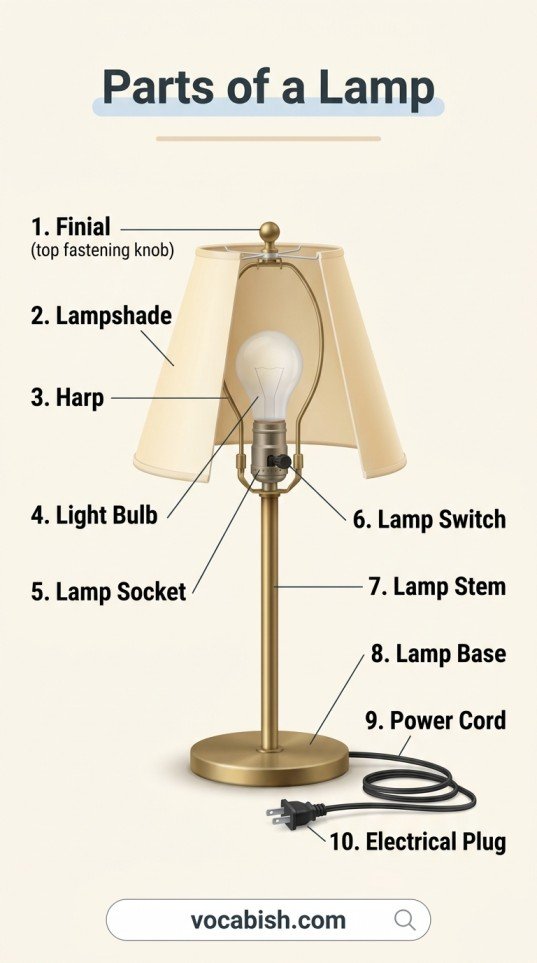
The visible parts of a table lamp are generally arranged as follows:
Position | Lamp Part | Purpose |
|---|---|---|
Top | Finial | Holds the shade assembly in place. |
Upper section | Lampshade | Controls glare and light distribution. |
Inside the shade | Light Bulb | Creates illumination. |
Below the bulb | Socket | Holds and powers the bulb. |
Middle | Stem | Supports the upper assembly. |
Lower section | Base | Keeps the lamp upright. |
Along the cord or lamp body | Switch | Controls the light. |
Outside the lamp | Cord and Plug | Connect the lamp to electricity. |
How Does a Lamp Work?
An electric lamp converts electrical energy into light. Its switch controls the electrical circuit, while the light source produces illumination.
In a typical plug-in LED table lamp, the process works like this:
- Power connection: The electrical plug connects to a suitable outlet.
- Electricity supply: The power cord carries electricity into the lamp.
- Switch operation: Turning on the switch completes the electrical circuit.
- Light production: The LED bulb uses electrical energy to produce light.
- Light distribution: The lampshade or diffuser spreads and directs the light.
When the switch is turned off, the circuit opens and the bulb stops producing light.
All Types of Lamps and Their Functions
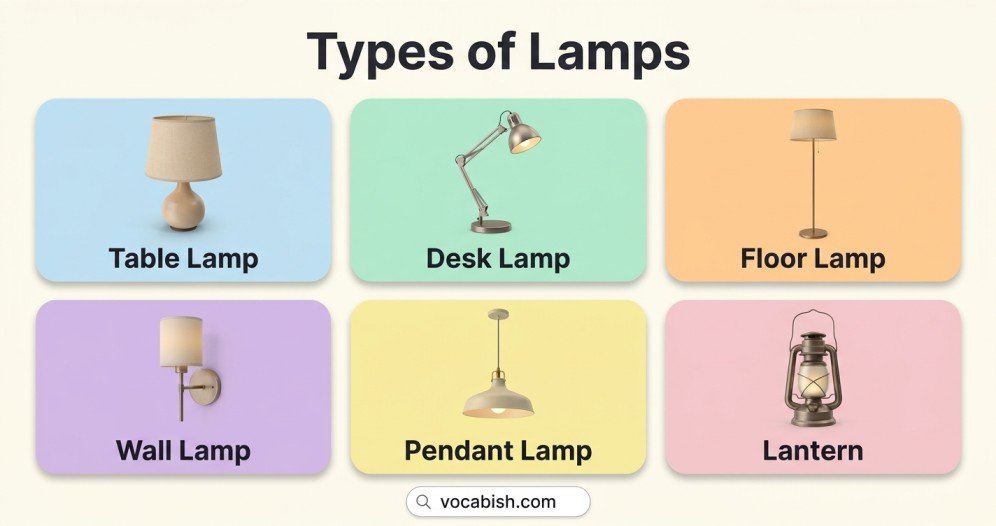
Lamps come in different shapes and designs according to where and how they are used. Some provide general room lighting, while others focus light on reading, studying, or specific tasks.
Lamp Type | Main Function | Common Location |
|---|---|---|
Table Lamp | Provides local lighting. | Bedroom or living room |
Desk Lamp | Illuminates a work surface. | Study desk or office |
Floor Lamp | Provides room or reading light. | Living room |
Bedside Lamp | Provides convenient light near a bed. | Bedroom |
Reading Lamp | Directs light toward books. | Reading area |
Wall Lamp | Provides lighting from a wall-mounted fixture. | Hallway or bedroom |
Pendant Lamp | Hangs from the ceiling to illuminate an area. | Kitchen or dining room |
Ceiling Lamp | Provides overhead lighting. | Living room or bedroom |
Chandelier | Provides decorative overhead lighting. | Dining room |
Clip-On Lamp | Attaches to furniture for focused lighting. | Desk or shelf |
Gooseneck Lamp | Allows flexible light positioning. | Workstation |
Task Lamp | Focuses light on detailed activities. | Workshop or office |
Night Lamp | Provides low-level lighting at night. | Bedroom or hallway |
Rechargeable Lamp | Operates using a rechargeable battery. | Home or outdoor area |
Emergency Lamp | Provides backup lighting during power failures. | Home or workplace |
Lantern | Provides portable lighting. | Camping or outdoor area |
Solar Lamp | Uses energy collected from sunlight. | Garden or pathway |
Heat Lamp | Produces radiant heat for warming. | Bathroom or animal enclosure |
Difference Between Common Lamp Parts
Some lamp parts look similar or have related functions, but their meanings are different. Knowing these differences helps learners describe lamps accurately.
Lamp Part | Compared With | Main Difference |
|---|---|---|
Bulb | Lampshade | A bulb produces light; a shade controls its distribution. |
Socket | Switch | A socket connects the bulb; a switch controls the circuit. |
Base | Stem | A base provides stability; a stem supports the upper assembly. |
Harp | Finial | A harp supports the shade; a finial secures it. |
Reflector | Diffuser | A reflector redirects light; a diffuser spreads it. |
Plug | Power Cord | A plug connects to the outlet; a cord carries electricity. |
Dimmer | Regular Switch | A dimmer adjusts brightness; a regular switch controls on and off. |
LED Bulb | LED Module | An LED bulb is usually replaceable; a module may be built into the lamp. |
Common Lamp Vocabulary Mistakes
Sometimes you will be confused about the lamp components with other lighting terms. These distinctions help you avoid common mistakes. Read carefully:
- Lamp vs. bulb: A lamp can mean the complete lighting device, while a bulb is the light-producing component.
- Lampshade vs. lamp cover: A lampshade is a specific part that controls light; cover is a broader word.
- Socket vs. outlet: A lamp socket holds the bulb, while an electrical outlet supplies power through a plug.
- Stem vs. stand: A stem supports the upper lamp assembly; a stand can refer more broadly to a supporting structure.
- Light vs. lamp: Light is the illumination produced, while a lamp is the device that provides it.
FAQs About Parts of a Lamp
The main parts of a typical table lamp are the lampshade, bulb, socket, switch, stem, base, power cord, and electrical plug.
The top part may be called the finial, lampshade, or lamp head, depending on the lamp’s design and the component being described.
The bottom part is called the lamp base. It supports the structure, distributes weight, and helps prevent the lamp from tipping over.
The lamp socket, also called the lamp holder, holds the bulb and provides the electrical contacts needed for the bulb to operate.
A lampshade helps reduce glare, directs light, and affects how illumination spreads throughout a room. It may also provide a decorative appearance.
A lamp is a complete lighting device, while a light bulb is a component that produces light. Some lamps contain integrated LEDs instead.
Common lamp switches include rotary switches, push-button switches, toggle switches, pull-chain switches, and touch controls. Some lamps also have dimming functions.
No. Lamp components vary by design. Some use replaceable bulbs and power cords, while others have built-in LEDs, batteries, or charging ports.
Conclusion
Understanding the parts of a lamp helps you identify lighting components and describe their functions correctly. The bulb produces light, the socket holds it, the switch controls it, and the base supports the lamp. Other parts, such as the lampshade, reflector, and adjustable arm, control how light is directed. Learning these names also makes it easier to recognise different lamp types used at home, in classrooms, and in workplaces.