
Have you ever wondered whether a fuel-saving car is economic or economical? The difference can be confusing because both adjectives come from the word economy and often appear in discussions about money, costs, business, and resources.
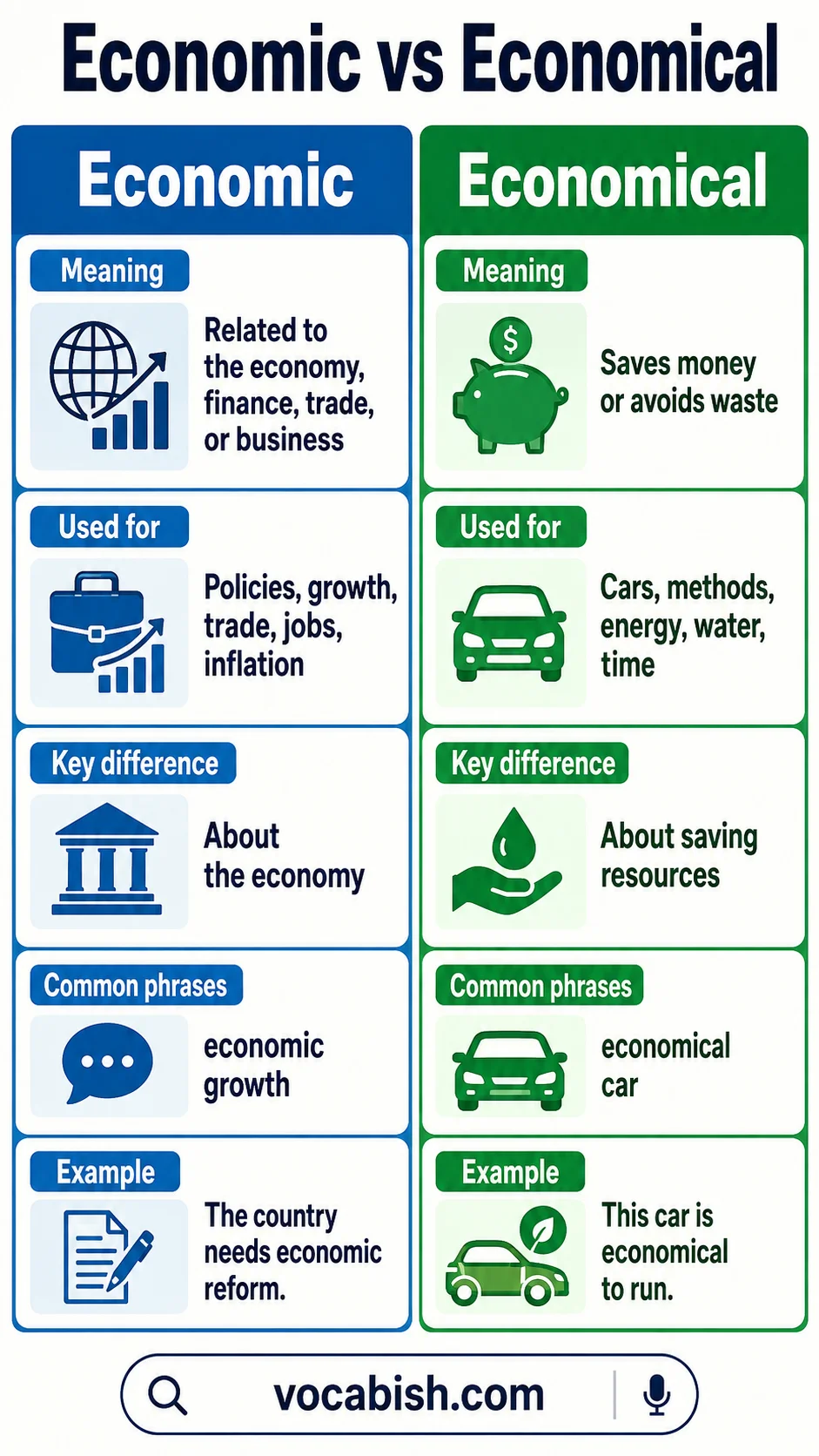
The main difference in economic vs economical is straightforward: economic usually relates to the economy, finance, trade, or business, while economical describes something that saves money, fuel, time, or other resources.
Economic vs Economical: The Quick Answer
Both words are adjectives, but they describe different ideas. One connects something to an economy, while the other focuses on saving money or avoiding waste.
Economic = related to the economy, finance, trade, production, or business
Economical = inexpensive to use or careful with money and resources
Consider these examples:
- The country is experiencing strong economic growth.
- This small car is very economical to run.
- The government introduced a new economic policy.
- Taking the train may be more economical than driving.
A useful memory rule is:
Use economic for the world of money.
Use economical for saving money.
Why Are Economic and Economical Confusing?
The words look and sound similar because they belong to the same word family. They also both appear in conversations about money, which makes their meanings seem closer than they are.
However, their focus is different:
- Economic describes systems, conditions, activities, and decisions connected with an economy.
- Economical describes people, products, methods, or choices that use little money or avoid waste.
For example, an economic problem affects businesses, jobs, prices, or the wider economy. An economical solution solves a problem without costing too much.
What Does Economic Mean?
Economic is an adjective meaning related to the economy, money, business, industry, production, or trade. It often describes large financial systems and their effects on countries, companies, and communities.
Pronunciation of Economic
Economic is commonly pronounced:
ee-kuh-NOM-ik or ek-uh-NOM-ik
The main stress falls on NOM.
Common Meanings of Economic
1. Related to a Country’s Economy
Use economic when discussing national income, employment, inflation, production, government spending, or financial development.
Examples:
- The country has faced several economic challenges.
- Tourism plays an important role in economic development.
- Rising energy prices may slow economic growth.
- The report examines the region’s economic performance.
2. Related to Business, Trade, or Finance
The word can describe commercial activities, financial decisions, and the movement of goods and money.
Examples:
- The two countries have developed stronger economic ties.
- The new railway could bring significant economic benefits.
- Political uncertainty has affected economic activity.
- International trade creates many economic opportunities.
3. Financially Possible or Profitable
In formal business English, economic can also mean financially practical or likely to produce enough value or profit.
Examples:
- It is no longer economic to repair the old machine.
- The mine is not economic at current metal prices.
- The project will become economic only if production costs fall.
This meaning is common in business, engineering, investment, and industry. In everyday English, however, economical is usually the better word for something that saves money.
What Does Economical Mean?
Economical is an adjective describing something that does not cost much to use, wastes few resources, or provides good value for money.
It can refer to products, transport, household choices, working methods, or people’s use of resources.
Pronunciation of Economical
Economical is commonly pronounced:
ee-kuh-NOM-i-kuhl or ek-uh-NOM-i-kuhl
The main stress also falls on NOM.
Common Meanings of Economical
1. Inexpensive to Use
An economical product may not have the lowest purchase price, but it costs less to operate or maintain.
Examples:
- Small electric heaters can be economical in well-insulated rooms.
- The new printer is more economical because it uses less ink.
- We need an economical car for daily travel.
- LED bulbs are an economical choice over the long term.
2. Avoiding Waste
Something can be economical because it uses fuel, water, electricity, materials, or time carefully.
Examples:
- The machine provides an economical use of energy.
- This washing cycle is more economical with water.
- The design is both practical and economical.
- Cooking several meals together can be an economical use of time.
3. Careful With Money or Resources
The word may also describe a person who avoids unnecessary spending or waste. However, frugal or thrifty is often more natural when describing someone’s lifestyle.
Examples:
- She is an economical shopper who compares prices carefully.
- He is economical in his use of paper and office supplies.
- Their family became more economical after moving to a single income.
Being economical does not necessarily mean buying the cheapest item. It means using money or resources wisely.
Economic vs Economical: Key Differences
The following table shows how the two words differ in meaning and usage.
Point | Economic | Economical |
|---|---|---|
Main meaning | Related to the economy, finance, business, or trade | Saving money or using resources carefully |
Typical focus | Countries, markets, policies, industries, and financial systems | Products, methods, transport, energy, time, and personal choices |
Common question | Does it concern the economy? | Does it reduce cost or waste? |
Example phrase | economic growth | economical car |
Example sentence | The region needs more economic investment. | This heating system is economical to operate. |
Close synonyms | financial, commercial, monetary, fiscal | cost-effective, efficient, thrifty, fuel-efficient |
Opposite ideas | non-economic, financial loss, decline | expensive, wasteful, inefficient |
The Difference in One Sentence
Economic tells us that something concerns money or the economy; economical tells us that something saves money or resources.
How to Choose Between Economic and Economical
Choosing the correct word becomes easier when you identify what the sentence is describing. Ask whether the focus is an economy or the careful use of resources.
Use Economic for Large Financial Matters
Choose economic when the sentence refers to:
- The economy of a country or region
- Employment and unemployment
- Business activity
- Trade and industry
- Inflation and prices
- Government financial policy
- Production and national growth
- Financial effects on society
Examples:
- The city needs a long-term economic strategy.
- The factory closure caused serious economic hardship.
- Higher employment can support economic recovery.
Use Economical for Savings and Efficiency
Choose economical when the sentence refers to:
- Low running costs
- Fuel efficiency
- Careful spending
- Reduced waste
- Efficient use of water or electricity
- Affordable methods
- Good value over time
Examples:
- Cycling is an economical way to travel.
- This boiler is more economical than the old one.
- Buying ingredients in larger quantities can be economical.
A Two-Question Test
Ask yourself:
- Is this connected with an economy, trade, finance, or business?
Use economic. - Does this save money, fuel, time, or materials?
Use economical.
Compare:
- an economic crisis = a crisis affecting the economy
- an economical response = a response that does not cost too much
Common Collocations With Economic and Economical
A collocation is a group of words that commonly appear together. Learning these natural combinations can help you choose the correct adjective quickly.
Common Words Used With Economic
Collocation | Meaning |
|---|---|
economic growth | An increase in production, income, or business activity |
economic crisis | A period of serious financial difficulty |
economic policy | A government plan concerning money, trade, taxes, or spending |
economic development | Improvement in a country’s income, industries, and living conditions |
economic activity | The production, buying, and selling of goods and services |
economic recovery | Improvement after a period of financial decline |
economic impact | A financial effect on people, businesses, or society |
economic conditions | The current state of an economy |
economic inequality | Unequal distribution of income, wealth, or opportunity |
economic opportunity | A chance to earn income, invest, trade, or develop a business |
economic system | The way a society organizes production and distribution |
economic stability | A condition with relatively steady prices, employment, and growth |
Examples:
- The storm had a major economic impact on local farms.
- New businesses are creating economic opportunities.
- The government hopes to maintain economic stability.
Common Words Used With Economical
Collocation | Meaning |
|---|---|
economical car | A car that uses little fuel or costs little to run |
economical choice | An option that saves money or provides good value |
economical method | A way of doing something without unnecessary cost |
economical solution | An effective answer that is not too expensive |
economical to run | Having low operating or maintenance costs |
economical with fuel | Using fuel efficiently |
economical use | Careful use without waste |
economical alternative | A less expensive but suitable option |
economical design | A design that uses space, money, or materials efficiently |
economical model | A product version with relatively low running costs |
Examples:
- Public transport is often the most economical option.
- The appliance is compact and economical to run.
- Reusing containers is an economical use of materials.
Sentence Pairs That Show the Difference
These pairs demonstrate how changing the adjective changes the meaning of the sentence.
1. Policy and Choice
- The government announced a new economic policy.
- Using less electricity is an economical choice.
The first sentence concerns the economy. The second concerns saving money and energy.
2. Effect and Solution
- The factory brought several economic benefits to the town.
- Repairing the existing equipment was the most economical solution.
The benefits relate to jobs, income, and business. The solution costs less than the alternatives.
3. Conditions and Transport
- Poor economic conditions have reduced consumer spending.
- The bus is an economical form of transport.
The first sentence describes the state of the economy. The second describes a low-cost way to travel.
4. Development and Heating
- The area needs investment for economic development.
- Modern insulation makes home heating more economical.
Development concerns jobs and financial progress. Economical heating uses less energy and costs less.
5. Decision and Method
- Closing the store was an economic decision based on falling sales.
- Ordering supplies together is a more economical method.
An economic decision is based on financial or business factors. An economical method avoids unnecessary costs.
6. Pressure and Appliance
- Families are facing growing economic pressure.
- This refrigerator is quiet and economical.
Economic pressure means financial difficulty. An economical refrigerator uses relatively little electricity.
Can Something Be Both Economic and Economical?
Yes. The two words may describe different qualities of the same thing.
For example:
Affordable public transport can support economic development while giving commuters an economical way to travel.
Here, public transport is:
- Economic because it affects jobs, trade, productivity, and regional growth.
- Economical because passengers can travel at a relatively low cost.
Another example:
Solar power can produce economic benefits and provide an economical source of energy after installation.
The first phrase refers to wider financial benefits. The second refers to reduced operating costs.
Economic Car or Economical Car?
In most everyday situations, economical car is correct when you mean a car that uses little fuel or costs little to maintain.
Correct:
- We are looking for an economical car.
- This model is economical to run.
- Small hybrid cars are often more economical with fuel.
The phrase economic car would not normally mean fuel-efficient. It might appear in a specialized context where a vehicle is being discussed in relation to an industry, market, or financial category.
Compare:
- economical car = inexpensive to operate
- economic importance of cars = their importance to business, jobs, and trade
Economic Use or Economical Use?
Both phrases are possible, but they usually express different ideas.
Economical Use
Economical use means careful, efficient, or non-wasteful use.
- We should encourage the economical use of water.
- The software allows a more economical use of storage space.
- Good planning leads to an economical use of time.
Economic Use
Economic use is more specialized. It may refer to using something for financial, commercial, or productive purposes.
- The land has little economic use in its present condition.
- Researchers studied the economic use of local natural resources.
For ordinary discussions about avoiding waste, economical use is usually the clearer choice.
Word Formation and Grammar
Understanding the word family can make the difference easier to remember. These terms share a common connection with managing money, production, and resources.
The Economy Word Family
Word | Part of Speech | Meaning | Example |
|---|---|---|---|
economy | noun | A system of production, trade, income, and spending | The economy is growing. |
economics | noun | The study of how money and resources are produced and used | She studies economics. |
economist | noun | A person who studies or works in economics | The economist analyzed the data. |
economic | adjective | Related to an economy, finance, or trade | Economic activity increased. |
economical | adjective | Saving money or avoiding waste | The car is economical. |
economically | adverb | In a way related to the economy or in a cost-saving way | The region is economically important. |
economize | verb | To reduce spending or waste | We need to economize on electricity. |
Understanding the Endings
A useful learning pattern is:
- -ic in economic helps form an adjective meaning “related to the economy.”
- -al in economical helps create the meaning “careful or efficient in the use of money and resources.”
This pattern helps with these two words, but it should not be treated as a rule for every English word ending in -ic or -ical.
Grammar Patterns With Economic
Economic usually comes before a noun:
- economic reform
- economic damage
- economic theory
- economic freedom
- economic change
It may also follow a linking verb in formal language:
- The project is not economic.
- Continued production may become economic next year.
In these examples, economic means financially worthwhile or commercially practical.
Grammar Patterns With Economical
Economical can appear before a noun:
- an economical vehicle
- an economical method
- an economical meal plan
It can also follow a linking verb:
- The vehicle is economical.
- This method seems economical.
- The system became more economical after the update.
Common patterns include:
- economical to operate
- economical to maintain
- economical to run
- economical with fuel
- economical in its use of water
Economical, Cheap, Affordable, and Cost-Effective
These words are related, but they are not exact synonyms. Choosing the right one makes your meaning more precise.
Word | Meaning | Example |
|---|---|---|
economical | Uses little money or few resources over time | The engine is economical to run. |
cheap | Has a low price; may sometimes suggest low quality | The shoes were cheap. |
affordable | Not too expensive for someone to buy | The apartments are affordable. |
cost-effective | Produces a good result for the amount spent | Online training is cost-effective. |
efficient | Works well without wasting time, energy, or materials | The new system is energy-efficient. |
frugal | Careful about spending money | He follows a frugal lifestyle. |
thrifty | Careful and practical with money | She is a thrifty shopper. |
An item can be expensive to buy but economical in the long term. For example, an energy-efficient appliance may have a higher purchase price but lower electricity costs.
Common Mistakes to Avoid
These errors often happen because learners connect both words only with money. Pay attention to whether the sentence discusses the economy or savings.
1: Economical Crisis
Incorrect:
- The country is facing an economical crisis.
Correct:
- The country is facing an economic crisis.
A crisis affecting a country’s economy is economic, not economical.
2: Economic Car
Incorrect in most everyday contexts:
- I want an economic car that uses less fuel.
Correct:
- I want an economical car that uses less fuel.
The car saves fuel and money, so economical is the correct choice.
3: Economical Growth
Incorrect:
- The region experienced rapid economical growth.
Correct:
- The region experienced rapid economic growth.
Growth in production, income, or business activity is economic growth.
4: Economic With Water
Incorrect:
- This washing machine is economic with water.
Correct:
- This washing machine is economical with water.
The machine avoids waste, so use economical.
5: Choosing Cheap as an Exact Synonym
Less precise:
- This car is cheap because it uses little fuel.
Better:
- This car is economical because it uses little fuel.
Cheap usually refers to the purchase price. Economical often refers to ongoing use and running costs.
Practice: Economic or Economical?
Choose the correct word to complete each sentence.
- The government is trying to improve __________ conditions.
- This compact car is very __________ with fuel.
- The new airport may bring major __________ benefits.
- Cooking at home is usually more __________ than eating out.
- Inflation is a serious __________ issue.
- We need a more __________ way to heat the building.
- The country is recovering from an __________ crisis.
- The machine is reliable and __________ to maintain.
- Tourism supports local __________ development.
- Reusing packaging is an __________ use of materials.
Answers
- economic
- economical
- economic
- economical
- economic
- economical
- economic
- economical
- economic
- economical
FAQs About Economic vs Economical
Economic relates to economies, finance, trade, and business. Economical describes something that saves money, reduces waste, or uses resources efficiently.
A fuel-efficient car is economical because it uses less fuel and costs less to operate. Economic car is usually incorrect here.
Not usually. Economic generally means economy-related. In formal business language, it can mean financially worthwhile, profitable, or practical to continue.
Cheap means low in purchase price. Economical means inexpensive to use or efficient with resources, even when the initial price is higher.
Use economic growth because the phrase describes an increase in production, income, trade, or business activity within an economy.
Public transport may be economical for passengers and economically important for a city. Each word describes a different feature or effect.
Yes. An economical person avoids unnecessary spending or waste, although frugal and thrifty are often more natural for personal habits.
Usually not. Use economically beneficial for financial advantages, economical for cost savings, or environmentally friendly for reduced environmental harm.
Conclusion
The difference in economic vs economical depends on the idea you want to express. Use economic for matters connected with an economy, including finance, trade, employment, business, policy, and national growth.
Use economical for something that saves money, has low running costs, or avoids wasting fuel, time, energy, and materials.
Remember the quickest rule:
Economic concerns the economy. Economical helps you economize.
Once you connect economic and economical with these two separate ideas, choosing the correct word becomes much easier.
You May Also Like
