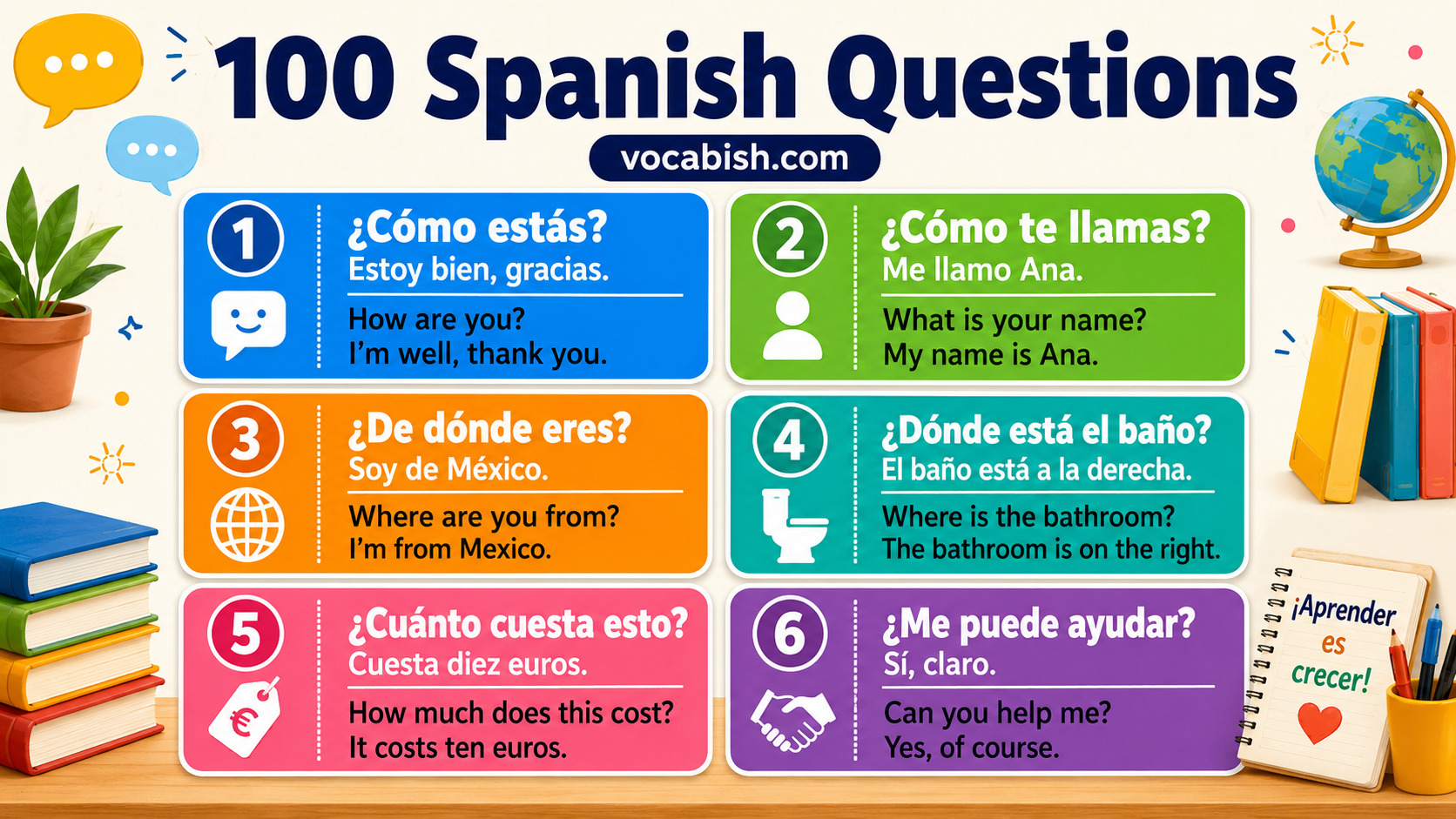

Learning Spanish becomes much easier when you study full questions with natural answers. Single words help, but full question-and-answer pairs show you how Spanish works in daily conversation.
In this article, you’ll learn 100 Questions and Answers in Spanish with pronunciation help and English translations. Each example is short, useful, and easy to practice out loud.
Use these questions when meeting people, asking for help, ordering food, shopping, traveling, or keeping a friendly conversation going.
How to Ask Questions in Spanish
Asking questions in Spanish is not difficult once you understand the basic patterns. In many cases, you can turn a normal sentence into a question by changing your voice when speaking or adding question marks when writing.
Spanish questions always use two question marks: an inverted question mark at the beginning and a regular question mark at the end.
- ¿Hablas español?
- Pronunciation: AH-blahs ehs-pah-NYOHL
- English: Do you speak Spanish?
- ¿Tienes tiempo?
- Pronunciation: TYEH-nehs TYEHM-poh
- English: Do you have time?
1. Use Question Words
Many Spanish questions begin with a question word. These words help you ask for specific information.
- ¿Qué quieres?
- Pronunciation: keh KYEH-rehs
- English: What do you want?
- ¿Dónde vives?
- Pronunciation: DOHN-deh VEE-behs
- English: Where do you live?
- ¿Cuándo llegas?
- Pronunciation: KWAHN-doh YEH-gahs
- English: When do you arrive?
2. Change Your Voice for Yes/No Questions
For yes/no questions, Spanish often keeps the same word order as a normal sentence. Your rising tone shows that you are asking a question.
- Tú estudias español.
- English: You study Spanish.
- ¿Tú estudias español?
- Pronunciation: too ehs-TOO-dyahs ehs-pah-NYOHL
- English: Do you study Spanish?
- Ella trabaja aquí.
- English: She works here.
- ¿Ella trabaja aquí?
- Pronunciation: EH-yah trah-BAH-hah ah-KEE
- English: Does she work here?
3. Put the Verb Before the Subject
Spanish can also place the verb before the subject, especially in more direct or formal questions.
- ¿Vives tú aquí?
- Pronunciation: VEE-behs too ah-KEE
- English: Do you live here?
- ¿Trabaja él hoy?
- Pronunciation: trah-BAH-hah el oy
- English: Is he working today?
This structure sounds natural in many situations, but learners can also use the easier pattern with normal word order.
4. Use Polite Question Phrases
When speaking to strangers, workers, teachers, or older people, polite question phrases are very useful.
- ¿Me puede ayudar?
- Pronunciation: meh PWEH-deh ah-yoo-DAHR
- English: Can you help me?
- ¿Puede repetir, por favor?
- Pronunciation: PWEH-deh reh-peh-TEER por fah-BOR
- English: Can you repeat, please?
- ¿Me puede decir dónde está el baño?
- Pronunciation: meh PWEH-deh deh-SEER DOHN-deh ehs-TAH el BAH-nyoh
- English: Can you tell me where the bathroom is?
5. Add “No” to Confirm Something
Spanish often uses ¿no? at the end of a sentence to confirm information, similar to “right?” in English.
- Vienes mañana, ¿no?
- Pronunciation: BYEH-nehs mah-NYAH-nah noh
- English: You’re coming tomorrow, right?
- Está cerca, ¿no?
- Pronunciation: ehs-TAH SEHR-kah noh
- English: It’s nearby, right?
Quick Spanish Question Formula
You can build many Spanish questions with this pattern:
Question word + verb + extra information
- ¿Qué comes?
- English: What are you eating?
- ¿Dónde trabajas?
- English: Where do you work?
- ¿Cuánto cuesta esto?
- English: How much does this cost?
For yes/no questions, use this pattern:
¿Normal sentence + rising tone?
- ¿Tienes hambre?
- English: Are you hungry?
- ¿Hablas inglés?
- English: Do you speak English?
- ¿Quieres café?
- English: Do you want coffee?
Basic Questions in Spanish for Everyday Situations
Below are useful Spanish questions you can use in common daily situations. Each question includes pronunciation and an English translation.
- ¿A dónde vas?
- Pronunciation: ah DOHN-deh bahs
- English: Where are you going?
- ¿A qué hora abren?
- Pronunciation: ah keh OH-rah AH-bren
- English: What time do they open?
- ¿A qué hora cierran?
- Pronunciation: ah keh OH-rah SYEH-rahn
- English: What time do they close?
- ¿A qué hora llegas?
- Pronunciation: ah keh OH-rah YEH-gahs
- English: What time do you arrive?
- ¿Acepta tarjetas?
- Pronunciation: ah-SEHP-tah tar-HEH-tahs
- English: Do you take cards?
- ¿Cómo dices?
- Pronunciation: KOH-moh DEE-sehs
- English: What did you say?
- ¿Cómo dormiste?
- Pronunciation: KOH-moh dor-MEES-teh
- English: How did you sleep?
- ¿Cómo estás?
- Pronunciation: KOH-moh ehs-TAHS
- English: How are you?
- ¿Cómo hiciste esto?
- Pronunciation: KOH-moh ee-SEES-teh EHS-toh
- English: How did you do this?
- ¿Cómo se dice…?
- Pronunciation: KOH-moh seh DEE-seh
- English: How do you say…?
- ¿Cómo te sientes?
- Pronunciation: KOH-moh teh SYEN-tehs
- English: How are you feeling?
- ¿Cómo va tu día?
- Pronunciation: KOH-moh bah too DEE-ah
- English: How is your day going?
- ¿Cuál es el problema?
- Pronunciation: kwahl ehs el proh-BLEH-mah
- English: What is the problem?
- ¿Cuánto cuesta…?
- Pronunciation: KWAHN-toh KWEHS-tah
- English: How much does… cost?
- ¿Cuánto es?
- Pronunciation: KWAHN-toh ehs
- English: How much is it?
- ¿De quién es esto?
- Pronunciation: deh kyehn ehs EHS-toh
- English: Whose is this?
- ¿Dónde está…?
- Pronunciation: DOHN-deh ehs-TAH
- English: Where is…?
- ¿En qué piensas?
- Pronunciation: en keh PYEHN-sahs
- English: What are you thinking about?
- ¿Está bien?
- Pronunciation: ehs-TAH byen
- English: Is it okay? / Are you okay?
- ¿Estás de acuerdo?
- Pronunciation: ehs-TAHS deh ah-KWEHR-doh
- English: Do you agree?
- ¿Estás listo?
- Pronunciation: ehs-TAHS LEES-toh
- English: Are you ready?
- ¿Está ocupado?
- Pronunciation: ehs-TAH oh-koo-PAH-doh
- English: Is this seat taken? / Is it occupied?
- ¿Hablas español?
- Pronunciation: AH-blahs ehs-pah-NYOHL
- English: Do you speak Spanish?
- ¿Me lo puedo probar?
- Pronunciation: meh loh PWEH-doh proh-BAHR
- English: Can I try it on?
- ¿Me puede ayudar?
- Pronunciation: meh PWEH-deh ah-yoo-DAHR
- English: Can you help me?
- ¿Me puede hacer un favor?
- Pronunciation: meh PWEH-deh ah-SEHR oon fah-BOR
- English: Can you do me a favor?
- ¿Le puedo ayudar?
- Pronunciation: leh PWEH-doh ah-yoo-DAHR
- English: Can I help you?
- ¿Lo puedo probar?
- Pronunciation: loh PWEH-doh proh-BAHR
- English: Can I try it?
- ¿Por dónde está…?
- Pronunciation: por DOHN-deh ehs-TAH
- English: Which way is…?
- ¿Por qué no?
- Pronunciation: por keh noh
- English: Why not?
- ¿Puedo abrir una ventana?
- Pronunciation: PWEH-doh ah-BREER OO-nah ben-TAH-nah
- English: Can I open a window?
- ¿Puede hablar más despacio?
- Pronunciation: PWEH-deh ah-BLAHR mahs dehs-PAH-syoh
- English: Can you speak more slowly?
- ¿Qué día es hoy?
- Pronunciation: keh DEE-ah ehs oy
- English: What day is today?
- ¿Qué dijo?
- Pronunciation: keh DEE-hoh
- English: What did you say? / What did he or she say?
- ¿Qué dijiste?
- Pronunciation: keh dee-HEES-teh
- English: What did you say?
- ¿Qué es eso?
- Pronunciation: keh ehs EH-soh
- English: What is that?
- ¿Qué haces?
- Pronunciation: keh AH-sehs
- English: What are you doing?
- ¿Qué hora es?
- Pronunciation: keh OH-rah ehs
- English: What time is it?
- ¿Qué se le ofrece?
- Pronunciation: keh seh leh oh-FREH-seh
- English: What can I do for you?
- ¿Qué significa…?
- Pronunciation: keh seeg-nee-FEE-kah
- English: What does… mean?
- ¿Qué vas a hacer?
- Pronunciation: keh bahs ah ah-SEHR
- English: What are you going to do?
- ¿Sabe si hay algún banco por aquí?
- Pronunciation: SAH-beh see eye ahl-GOON BAHN-koh por ah-KEE
- English: Do you know if there is a bank around here?
- ¿Tienes cambio?
- Pronunciation: TYEH-nehs KAHM-byoh
- English: Do you have change?
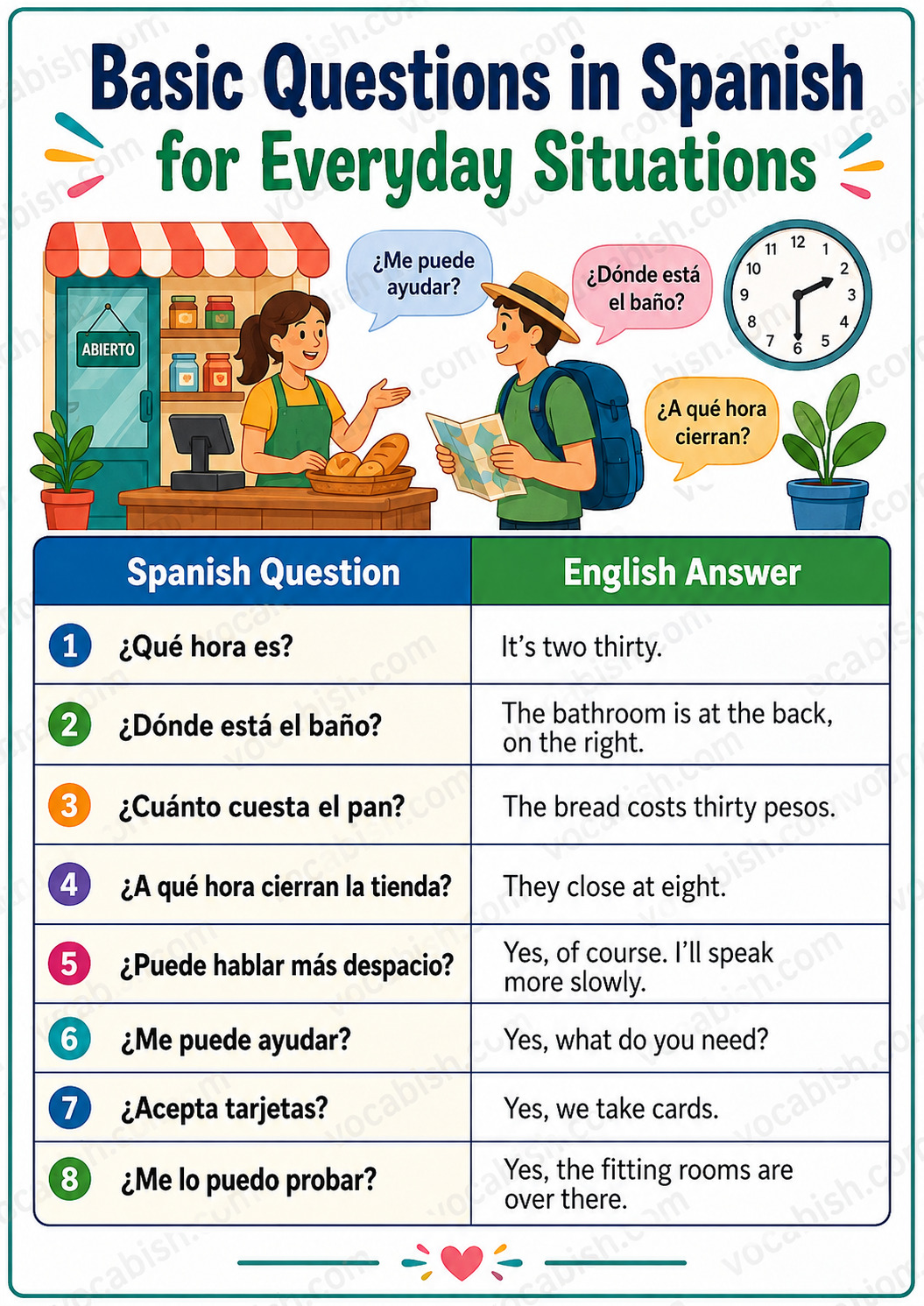
Example Answers for Everyday Spanish Questions
Question | Answer |
|---|---|
¿Qué hora es? English question: What time is it? | Spanish answer: Son las dos y media. English answer: It’s two thirty. |
¿Dónde está el baño? English question: Where is the bathroom? | Spanish answer: El baño está al fondo, a la derecha. English answer: The bathroom is at the back, on the right. |
¿Cuánto cuesta el pan? English question: How much does the bread cost? | Spanish answer: El pan cuesta treinta pesos. English answer: The bread costs thirty pesos. |
¿A qué hora cierran la tienda English question: What time does the store close? | Spanish answer: Cierran a las ocho. English answer: They close at eight. |
¿Puede hablar más despacio English question: Can you speak more slowly? | Spanish answer: Sí, claro. Hablo más despacio. English answer: Yes, of course. I’ll speak more slowly. |
¿Me puede ayudar? English question: Can you help me? | Spanish answer: Sí, ¿qué necesita? English answer: Yes, what do you need? |
¿Acepta tarjetas? English question: Do you take cards? | Spanish answer: Sí, aceptamos tarjetas. English answer: Yes, we take cards. |
¿Me lo puedo probar? English question: Can I try it on? | Spanish answer: Sí, los probadores están allí. English answer: Yes, the fitting rooms are over there. |
Why Learn Questions and Answers in Spanish?
Questions help you start conversations. Answers help you keep them going.
Instead of memorizing random phrases, it is better to learn both sides of a conversation. For example, if you only learn ¿Cómo estás?, you may understand the question, but you also need to know how to answer it naturally.
That is why these Questions and Answers in Spanish include:
- Spanish question
- Pronunciation
- English question translation
- Spanish answer
- English answer translation
Practice them slowly at first. Then say them faster as your confidence grows.
Quick Note on Spanish Pronunciation
Spanish pronunciation is usually consistent. Once you learn the sound of each letter, reading becomes easier.
Keep these points in mind:
- ¿…? Spanish uses an upside-down question mark at the start of a question.
- ll often sounds like y in “yes.”
- ñ sounds like ny in “canyon.”
- j sounds like a strong h in English.
- r can be tapped or rolled, depending on the word.
The pronunciation below uses easy English-style sounds, so you can practice quickly.
50 Questions and Answers in Spanish
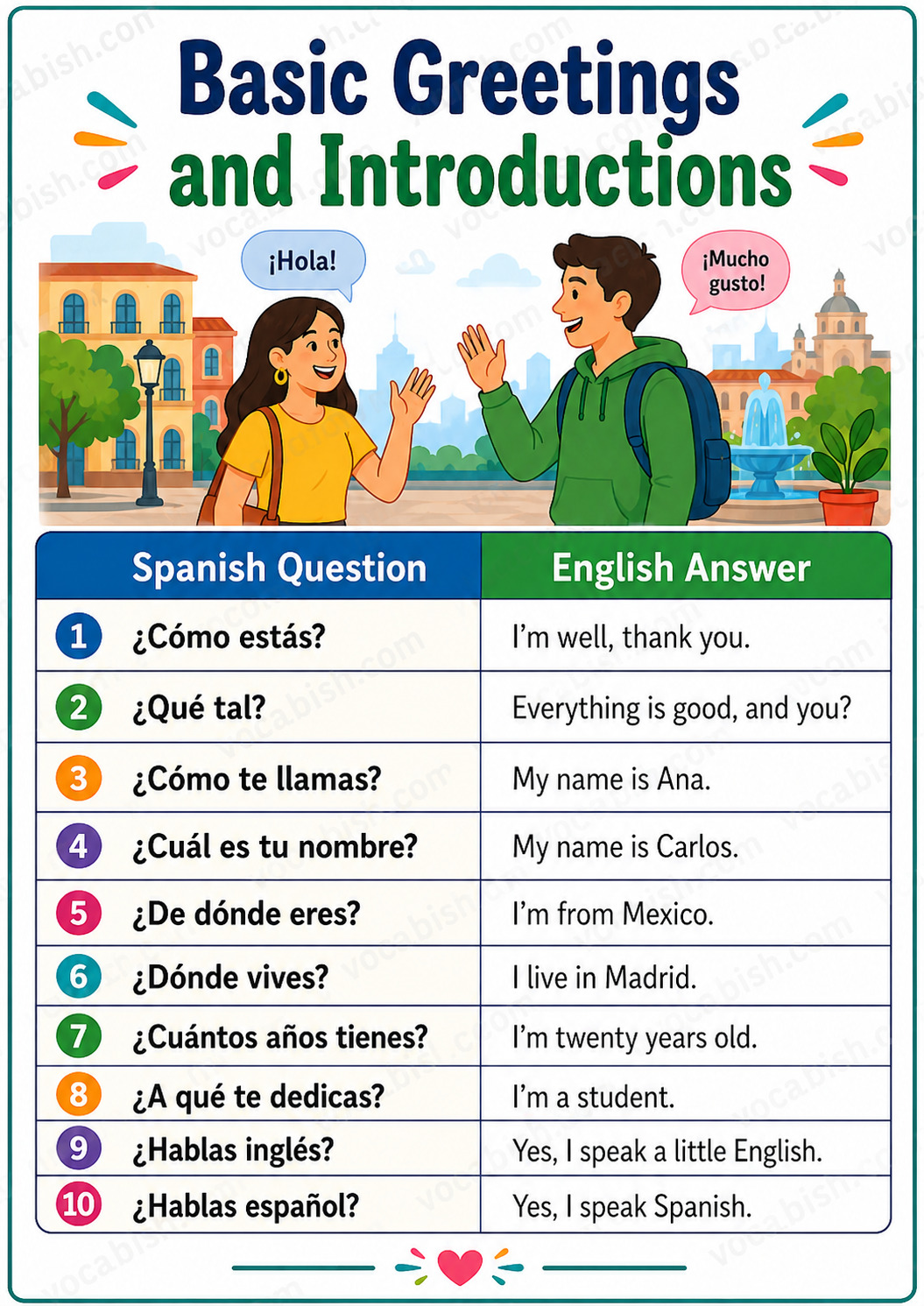
Basic Greetings and Introductions
- 1. ¿Cómo estás?
- Pronunciation: KOH-moh ehs-TAHS
- English question: How are you?
- Spanish answer: Estoy bien, gracias.
- English answer: I’m well, thank you.
- 2. ¿Qué tal?
- Pronunciation: keh TAHL
- English question: How’s it going?
- Spanish answer: Todo bien, ¿y tú?
- English answer: Everything is good, and you?
- 3. ¿Cómo te llamas?
- Pronunciation: KOH-moh teh YAH-mahs
- English question: What is your name?
- Spanish answer: Me llamo Ana.
- English answer: My name is Ana.
- 4. ¿Cuál es tu nombre?
- Pronunciation: kwahl ehs too NOHM-breh
- English question: What is your name?
- Spanish answer: Mi nombre es Carlos.
- English answer: My name is Carlos.
- 5. ¿De dónde eres?
- Pronunciation: deh DOHN-deh EH-rehs
- English question: Where are you from?
- Spanish answer: Soy de México.
- English answer: I’m from Mexico.
- 6. ¿Dónde vives?
- Pronunciation: DOHN-deh VEE-behs
- English question: Where do you live?
- Spanish answer: Vivo en Madrid.
- English answer: I live in Madrid.
- 7. ¿Cuántos años tienes?
- Pronunciation: KWAHN-tohs AH-nyohs TYEH-nehs
- English question: How old are you?
- Spanish answer: Tengo veinte años.
- English answer: I’m twenty years old.
- 8. ¿A qué te dedicas?
- Pronunciation: ah keh teh deh-DEE-kahs
- English question: What do you do?
- Spanish answer: Soy estudiante.
- English answer: I’m a student.
- 9. ¿Hablas inglés?
- Pronunciation: AH-blahs een-GLEHS
- English question: Do you speak English?
- Spanish answer: Sí, hablo un poco de inglés.
- English answer: Yes, I speak a little English.
- 10. ¿Hablas español?
- Pronunciation: AH-blahs ehs-pah-NYOHL
- English question: Do you speak Spanish?
- Spanish answer: Sí, hablo español.
- English answer: Yes, I speak Spanish.
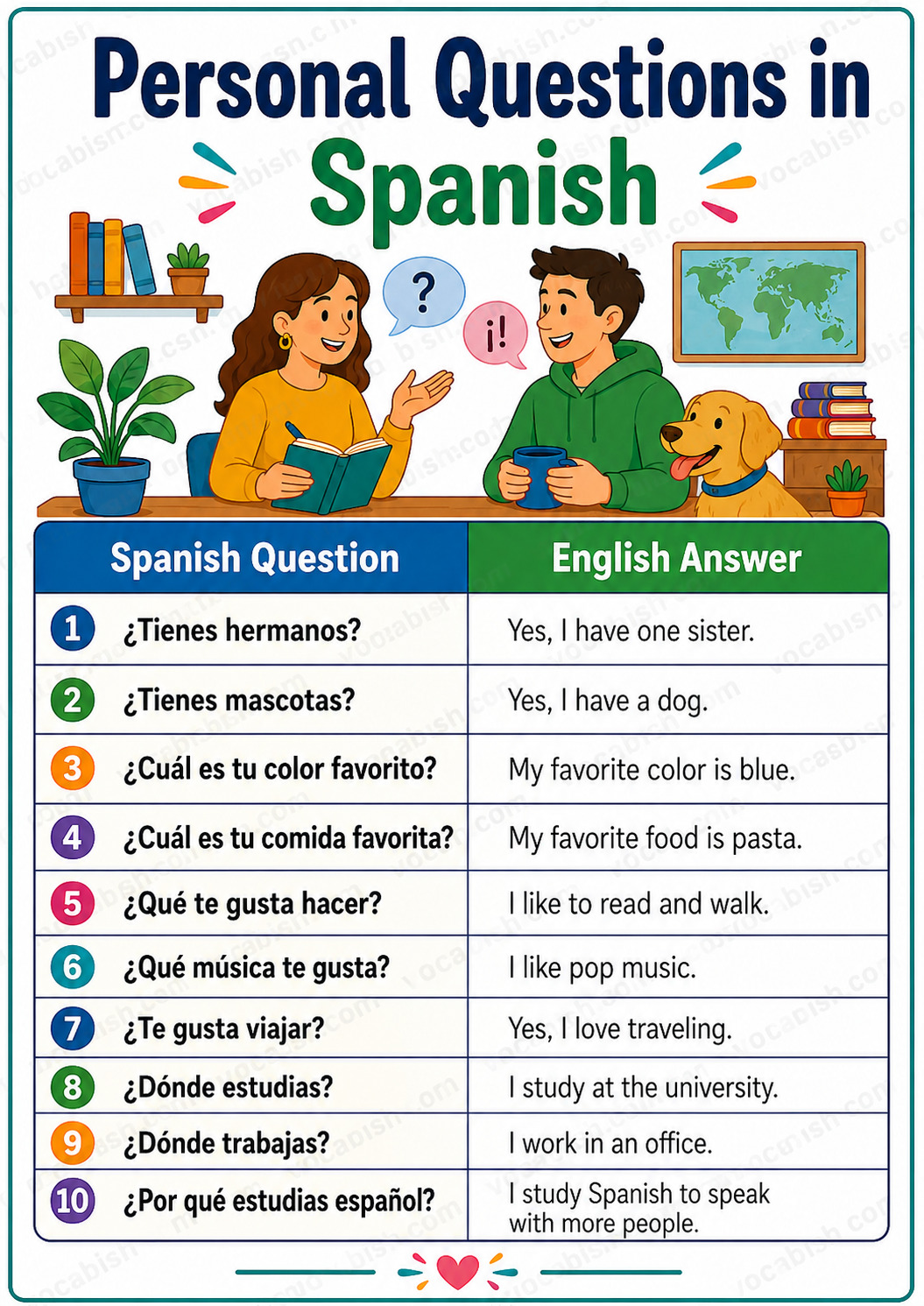
Personal Questions in Spanish
- 11. ¿Tienes hermanos?
- Pronunciation: TYEH-nehs ehr-MAH-nohs
- English question: Do you have siblings?
- Spanish answer: Sí, tengo una hermana.
- English answer: Yes, I have one sister.
- 12. ¿Tienes mascotas?
- Pronunciation: TYEH-nehs mahs-KOH-tahs
- English question: Do you have pets?
- Spanish answer: Sí, tengo un perro.
- English answer: Yes, I have a dog.
- 13. ¿Cuál es tu color favorito?
- Pronunciation: kwahl ehs too koh-LOR fah-boh-REE-toh
- English question: What is your favorite color?
- Spanish answer: Mi color favorito es el azul.
- English answer: My favorite color is blue.
- 14. ¿Cuál es tu comida favorita?
- Pronunciation: kwahl ehs too koh-MEE-dah fah-boh-REE-tah
- English question: What is your favorite food?
- Spanish answer: Mi comida favorita es la pasta.
- English answer: My favorite food is pasta.
- 15. ¿Qué te gusta hacer?
- Pronunciation: keh teh GOOS-tah ah-SEHR
- English question: What do you like to do?
- Spanish answer: Me gusta leer y caminar.
- English answer: I like to read and walk.
- 16. ¿Qué música te gusta?
- Pronunciation: keh MOO-see-kah teh GOOS-tah
- English question: What music do you like?
- Spanish answer: Me gusta la música pop.
- English answer: I like pop music.
- 17. ¿Te gusta viajar?
- Pronunciation: teh GOOS-tah bee-ah-HAHR
- English question: Do you like to travel?
- Spanish answer: Sí, me encanta viajar.
- English answer: Yes, I love traveling.
- 18. ¿Dónde estudias?
- Pronunciation: DOHN-deh ehs-TOO-dyahs
- English question: Where do you study?
- Spanish answer: Estudio en la universidad.
- English answer: I study at the university.
- 19. ¿Dónde trabajas?
- Pronunciation: DOHN-deh trah-BAH-hahs
- English question: Where do you work?
- Spanish answer: Trabajo en una oficina.
- English answer: I work in an office.
- 20. ¿Por qué estudias español?
- Pronunciation: por keh ehs-TOO-dyahs ehs-pah-NYOHL
- English question: Why are you studying Spanish?
- Spanish answer: Estudio español para hablar con más personas.
- English answer: I study Spanish to speak with more people.
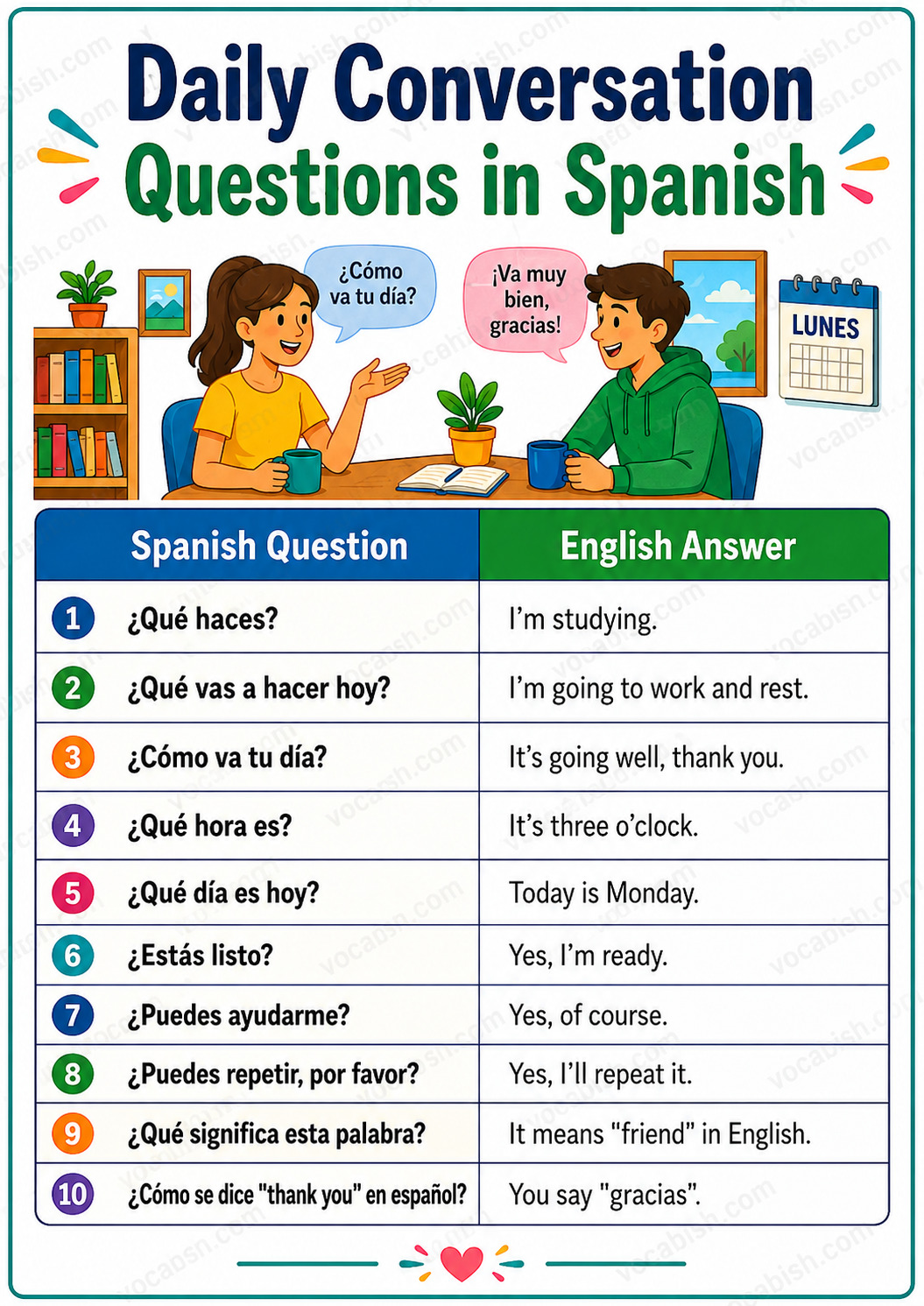
Daily Conversation Questions in Spanish
- 21. ¿Qué haces?
- Pronunciation: keh AH-sehs
- English question: What are you doing?
- Spanish answer: Estoy estudiando.
- English answer: I’m studying.
- 22. ¿Qué vas a hacer hoy?
- Pronunciation: keh bahs ah ah-SEHR oy
- English question: What are you going to do today?
- Spanish answer: Voy a trabajar y descansar.
- English answer: I’m going to work and rest.
- 23. ¿Cómo va tu día?
- Pronunciation: KOH-moh bah too DEE-ah
- English question: How is your day going?
- Spanish answer: Va bien, gracias.
- English answer: It’s going well, thank you.
- 24. ¿Qué hora es?
- Pronunciation: keh OH-rah ehs
- English question: What time is it?
- Spanish answer: Son las tres.
- English answer: It’s three o’clock.
- 25. ¿Qué día es hoy?
- Pronunciation: keh DEE-ah ehs oy
- English question: What day is today?
- Spanish answer: Hoy es lunes.
- English answer: Today is Monday.
- 26. ¿Estás listo?
- Pronunciation: ehs-TAHS LEES-toh
- English question: Are you ready?
- Spanish answer: Sí, estoy listo.
- English answer: Yes, I’m ready.
- 27. ¿Puedes ayudarme?
- Pronunciation: PWEH-dehs ah-yoo-DAHR-meh
- English question: Can you help me?
- Spanish answer: Sí, claro.
- English answer: Yes, of course.
- 28. ¿Puedes repetir, por favor?
- Pronunciation: PWEH-dehs reh-peh-TEER por fah-BOR
- English question: Can you repeat, please?
- Spanish answer: Sí, lo repito.
- English answer: Yes, I’ll repeat it.
- 29. ¿Qué significa esta palabra?
- Pronunciation: keh seeg-nee-FEE-kah EHS-tah pah-LAH-brah
- English question: What does this word mean?
- Spanish answer: Significa “friend” en inglés.
- English answer: It means “friend” in English.
- 30. ¿Cómo se dice “thank you” en español?
- Pronunciation: KOH-moh seh DEE-seh “thank you” en ehs-pah-NYOHL
- English question: How do you say “thank you” in Spanish?
- Spanish answer: Se dice “gracias.”
- English answer: You say “gracias.”
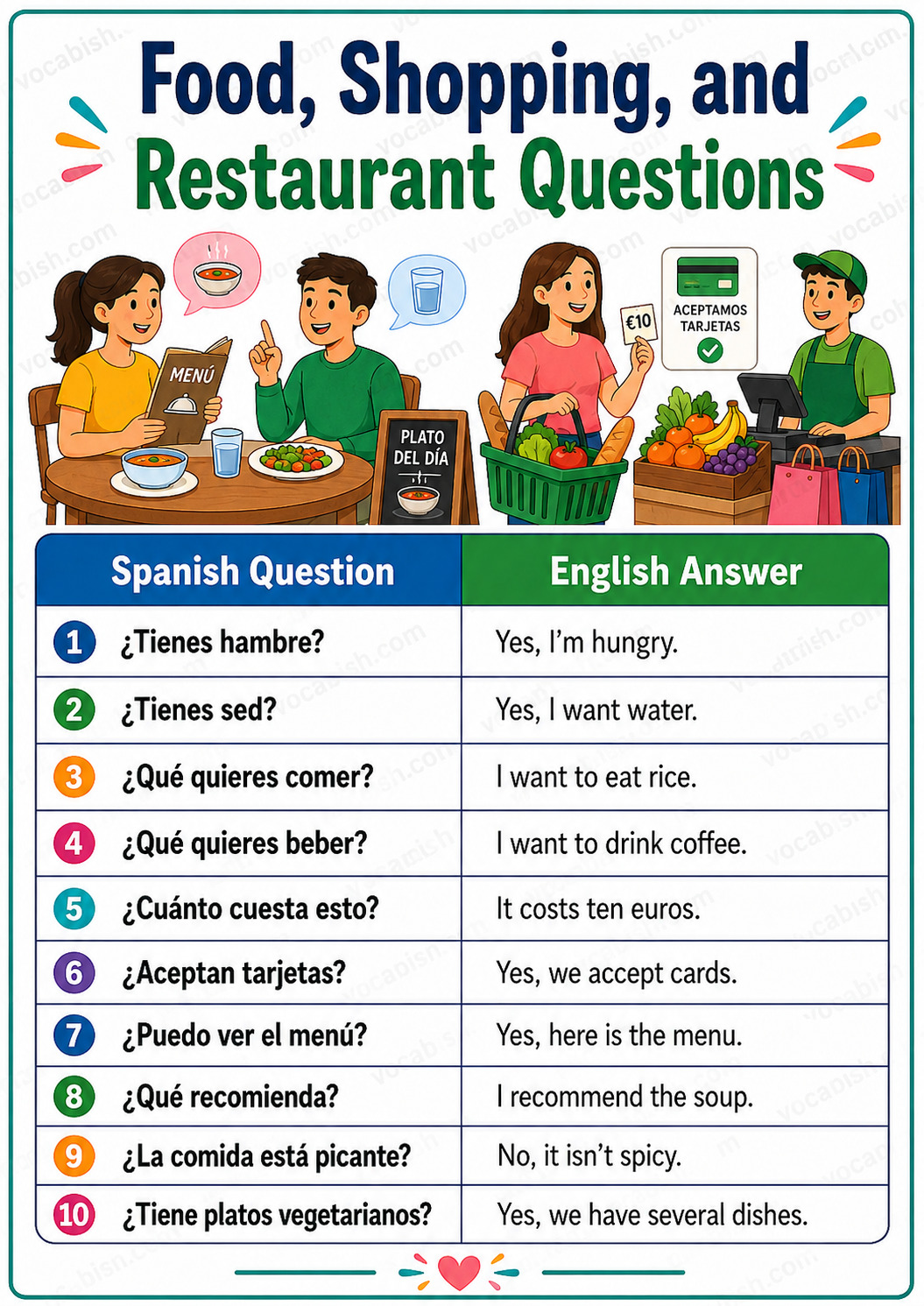
Food, Shopping, and Restaurant Questions in Spanish
- 31. ¿Tienes hambre?
- Pronunciation: TYEH-nehs AHM-breh
- English question: Are you hungry?
- Spanish answer: Sí, tengo hambre.
- English answer: Yes, I’m hungry.
- 32. ¿Tienes sed?
- Pronunciation: TYEH-nehs sed
- English question: Are you thirsty?
- Spanish answer: Sí, quiero agua.
- English answer: Yes, I want water.
- 33. ¿Qué quieres comer?
- Pronunciation: keh KYEH-rehs koh-MEHR
- English question: What do you want to eat?
- Spanish answer: Quiero comer arroz.
- English answer: I want to eat rice.
- 34. ¿Qué quieres beber?
- Pronunciation: keh KYEH-rehs beh-BEHR
- English question: What do you want to drink?
- Spanish answer: Quiero beber café.
- English answer: I want to drink coffee.
- 35. ¿Cuánto cuesta esto?
- Pronunciation: KWAHN-toh KWEHS-tah EHS-toh
- English question: How much does this cost?
- Spanish answer: Cuesta diez euros.
- English answer: It costs ten euros.
- 36. ¿Aceptan tarjetas?
- Pronunciation: ah-SEHP-tahn tar-HEH-tahs
- English question: Do you accept cards?
- Spanish answer: Sí, aceptamos tarjetas.
- English answer: Yes, we accept cards.
- 37. ¿Puedo ver el menú?
- Pronunciation: PWEH-doh behr el meh-NOO
- English question: Can I see the menu?
- Spanish answer: Sí, aquí tiene el menú.
- English answer: Yes, here is the menu.
- 38. ¿Qué recomienda?
- Pronunciation: keh reh-koh-MYEHN-dah
- English question: What do you recommend?
- Spanish answer: Recomiendo la sopa.
- English answer: I recommend the soup.
- 39. ¿La comida está picante?
- Pronunciation: lah koh-MEE-dah ehs-TAH pee-KAHN-teh
- English question: Is the food spicy?
- Spanish answer: No, no está picante.
- English answer: No, it isn’t spicy.
- 40. ¿Tiene platos vegetarianos?
- Pronunciation: TYEH-neh PLAH-tohs beh-heh-tah-RYAH-nohs
- English question: Do you have vegetarian dishes?
- Spanish answer: Sí, tenemos varios platos.
- English answer: Yes, we have several dishes.
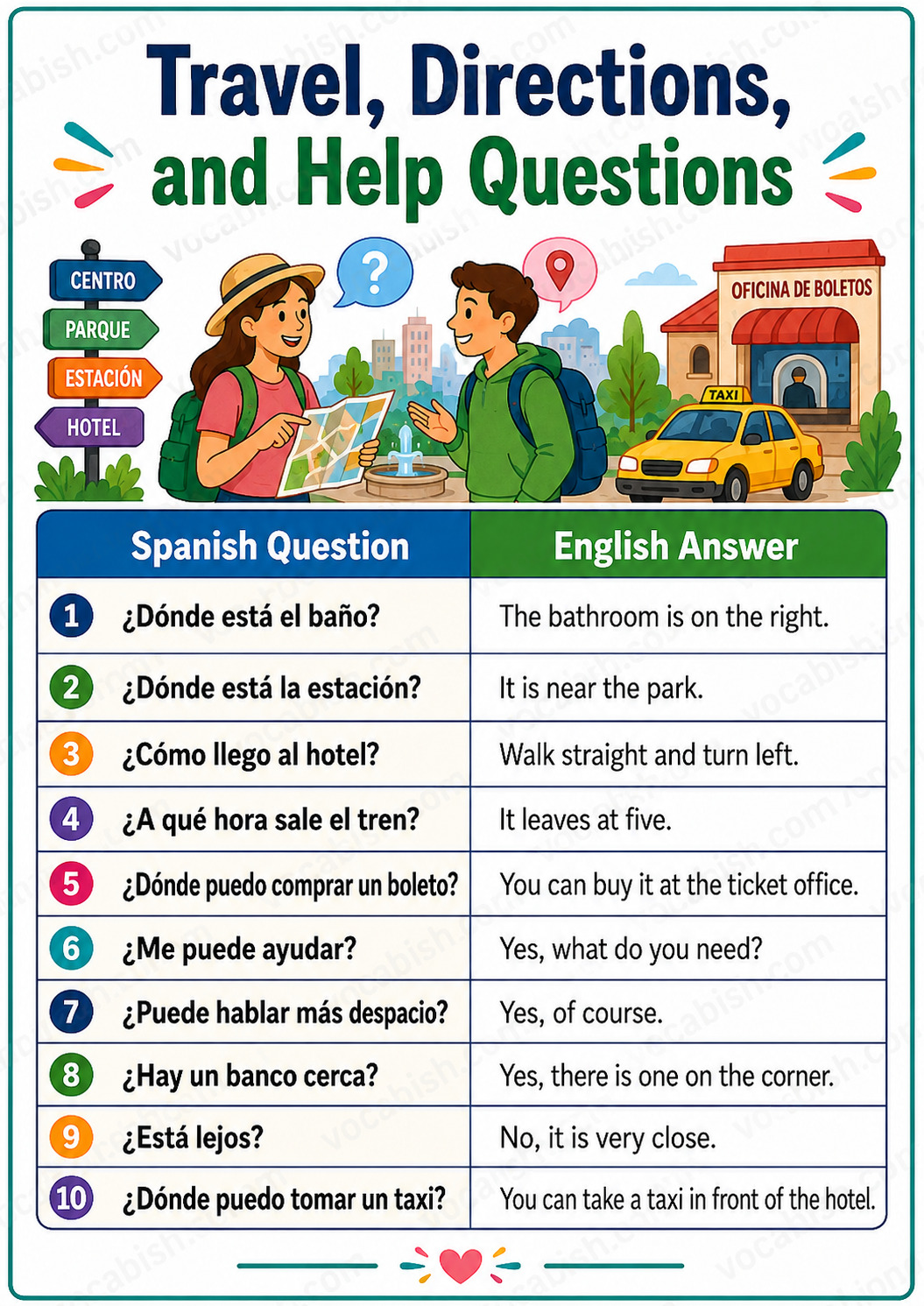
Travel, Directions, and Help Questions in Spanish
- 41. ¿Dónde está el baño?
- Pronunciation: DOHN-deh ehs-TAH el BAH-nyoh
- English question: Where is the bathroom?
- Spanish answer: El baño está a la derecha.
- English answer: The bathroom is on the right.
- 42. ¿Dónde está la estación?
- Pronunciation: DOHN-deh ehs-TAH lah ehs-tah-SYOHN
- English question: Where is the station?
- Spanish answer: Está cerca del parque.
- English answer: It is near the park.
- 43. ¿Cómo llego al hotel?
- Pronunciation: KOH-moh YEH-goh al oh-TEL
- English question: How do I get to the hotel?
- Spanish answer: Camine derecho y gire a la izquierda.
- English answer: Walk straight and turn left.
- 44. ¿A qué hora sale el tren?
- Pronunciation: ah keh OH-rah SAH-leh el tren
- English question: What time does the train leave?
- Spanish answer: Sale a las cinco.
- English answer: It leaves at five.
- 45. ¿Dónde puedo comprar un boleto?
- Pronunciation: DOHN-deh PWEH-doh kohm-PRAHR oon boh-LEH-toh
- English question: Where can I buy a ticket?
- Spanish answer: Puede comprarlo en la taquilla.
- English answer: You can buy it at the ticket office.
- 46. ¿Me puede ayudar?
- Pronunciation: meh PWEH-deh ah-yoo-DAHR
- English question: Can you help me?
- Spanish answer: Sí, ¿qué necesita?
- English answer: Yes, what do you need?
- 47. ¿Puede hablar más despacio?
- Pronunciation: PWEH-deh ah-BLAHR mahs dehs-PAH-syoh
- English question: Can you speak more slowly?
- Spanish answer: Sí, claro.
- English answer: Yes, of course.
- 48. ¿Hay un banco cerca?
- Pronunciation: eye oon BAHN-koh SEHR-kah
- English question: Is there a bank nearby?
- Spanish answer: Sí, hay uno en la esquina.
- English answer: Yes, there is one on the corner.
- 49. ¿Está lejos?
- Pronunciation: ehs-TAH LEH-hohs
- English question: Is it far?
- Spanish answer: No, está muy cerca.
- English answer: No, it is very close.
- 50. ¿Dónde puedo tomar un taxi?
- Pronunciation: DOHN-deh PWEH-doh toh-MAHR oon TAK-see
- English question: Where can I take a taxi?
- Spanish answer: Puede tomar un taxi frente al hotel.
- English answer: You can take a taxi in front of the hotel.
Common Question Words in Spanish
To build your own Spanish questions, learn these question words:
- Qué — what
- Quién — who
- Dónde — where
- Cuándo — when
- Por qué — why
- Cómo — how
- Cuál — which / what
- Cuánto / Cuánta — how much
- Cuántos / Cuántas — how many
A helpful pattern is:
- Question word + verb + extra information
- ¿Dónde vives? — Where do you live?
- ¿Qué quieres comer? — What do you want to eat?
- ¿Cómo llego al hotel? — How do I get to the hotel?
Formal and Informal Spanish Questions
Spanish often changes depending on who you are speaking to.
Use informal Spanish with friends, family, classmates, and people your age:
- ¿Cómo estás? — How are you?
- ¿Dónde vives? — Where do you live?
- ¿Puedes ayudarme? — Can you help me?
Use formal Spanish with strangers, older people, customers, teachers, or in professional settings:
- ¿Cómo está? — How are you?
- ¿Dónde vive? — Where do you live?
- ¿Puede ayudarme? — Can you help me?
If you are unsure, formal Spanish is usually safer and more polite.
How to Practice These Questions and Answers in Spanish
The best way to learn these phrases is to use them out loud. You do not need a long study session. A few minutes each day can help.
Try this method:
- Read one question out loud.
- Read the pronunciation slowly.
- Say the Spanish answer.
- Cover the English translation.
- Try to remember the meaning.
- Practice with a friend or record your voice.
You can also choose five questions each day and use them in short conversations. For example:
- Day 1: Greetings
- Day 2: Personal questions
- Day 3: Daily conversation
- Day 4: Food and shopping
- Day 5: Travel and help
Small, steady practice works better than rushing through all 50 at once.
Short Practice Conversation in Spanish
Here is a short conversation using some of the questions from the list.
- A: Hola, ¿cómo te llamas?
- B: Me llamo Ana. ¿Y tú?
- A: Me llamo Carlos. ¿De dónde eres?
- B: Soy de México. ¿Dónde vives?
- A: Vivo en Madrid. ¿Hablas español?
- B: Sí, hablo un poco de español.
- A: Muy bien. ¿Qué te gusta hacer?
- B: Me gusta leer y viajar.
English translation:
- A: Hello, what is your name?
- B: My name is Ana. And you?
- A: My name is Carlos. Where are you from?
- B: I’m from Mexico. Where do you live?
- A: I live in Madrid. Do you speak Spanish?
- B: Yes, I speak a little Spanish.
- A: Very good. What do you like to do?
- B: I like to read and travel.
Download the 100 Spanish Questions PDF
You’ve now practiced 100 useful Spanish questions for everyday conversations, from greetings and personal details to travel, shopping, food, and asking for help.
To make learning easier, we’ve put the full list into a downloadable PDF with Spanish questions, English translations, pronunciation help, and example answers. You can save it, print it, or review a few questions each day whenever you have time.
Use the PDF as a quick study sheet to build your Spanish vocabulary, improve your speaking confidence, and practice common questions at your own pace.
FAQs About Questions and Answers in Spanish
Some basic Spanish questions are ¿Cómo te llamas?, ¿De dónde eres?, ¿Hablas español?, ¿Qué haces?, and ¿Dónde está el baño?
Practice five short pairs aloud daily, repeat the pronunciation, then answer without looking to build memory, speed, and speaking confidence.
Start with greetings, name questions, location questions, food requests, prices, directions, and polite help phrases for everyday Spanish conversations first.
Spanish places an inverted question mark at the beginning so readers know the sentence is a question from the start.
Learn questions for directions, prices, transportation, restaurants, bathrooms, hotels, and help because these solve common travel problems quickly.
Write Spanish questions with an inverted question mark at the beginning and a regular question mark at the end, like ¿Cómo estás?
Yes. Basic Spanish questions include ¿Cómo estás?, ¿Dónde vives?, ¿Qué hora es?, ¿Cuánto cuesta?, and ¿Puede ayudarme? for daily conversations.
Common Spanish phrases and questions include Hola, Gracias, Por favor, ¿Cómo estás?, ¿Cuánto cuesta?, and ¿Dónde está la estación? for travelers.
No, short answers are often natural in Spanish, but full answers help learners understand grammar, vocabulary, and sentence structure.
Final Thoughts
These Questions and Answers in Spanish give you a strong base for everyday conversation. Start with the questions you will use most, such as greetings, names, locations, food, prices, and help phrases.
Do not worry about speaking perfectly at first. Focus on being clear, polite, and confident. The more you repeat these Spanish questions and answers, the more natural they will feel.
You May Also Like: