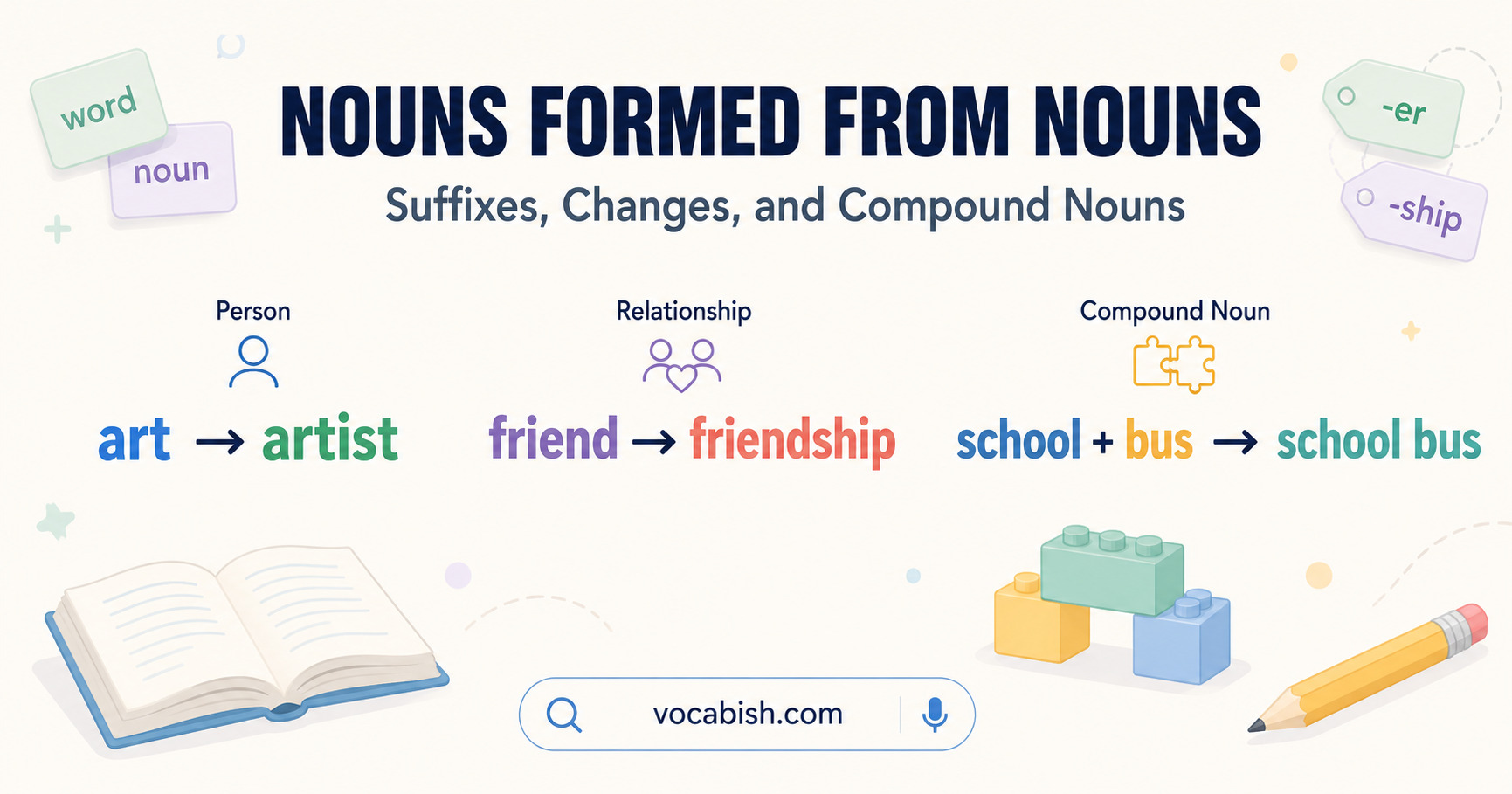

Nouns formed from nouns are new nouns created by adding a suffix, changing the spelling, or combining two existing nouns. These derived nouns often name people, professions, relationships, conditions, groups, periods, places, or smaller objects.
For example, art becomes artist, friend becomes friendship, and child becomes childhood. The new word remains connected to the meaning of the original noun.
How One Noun Forms Another Noun
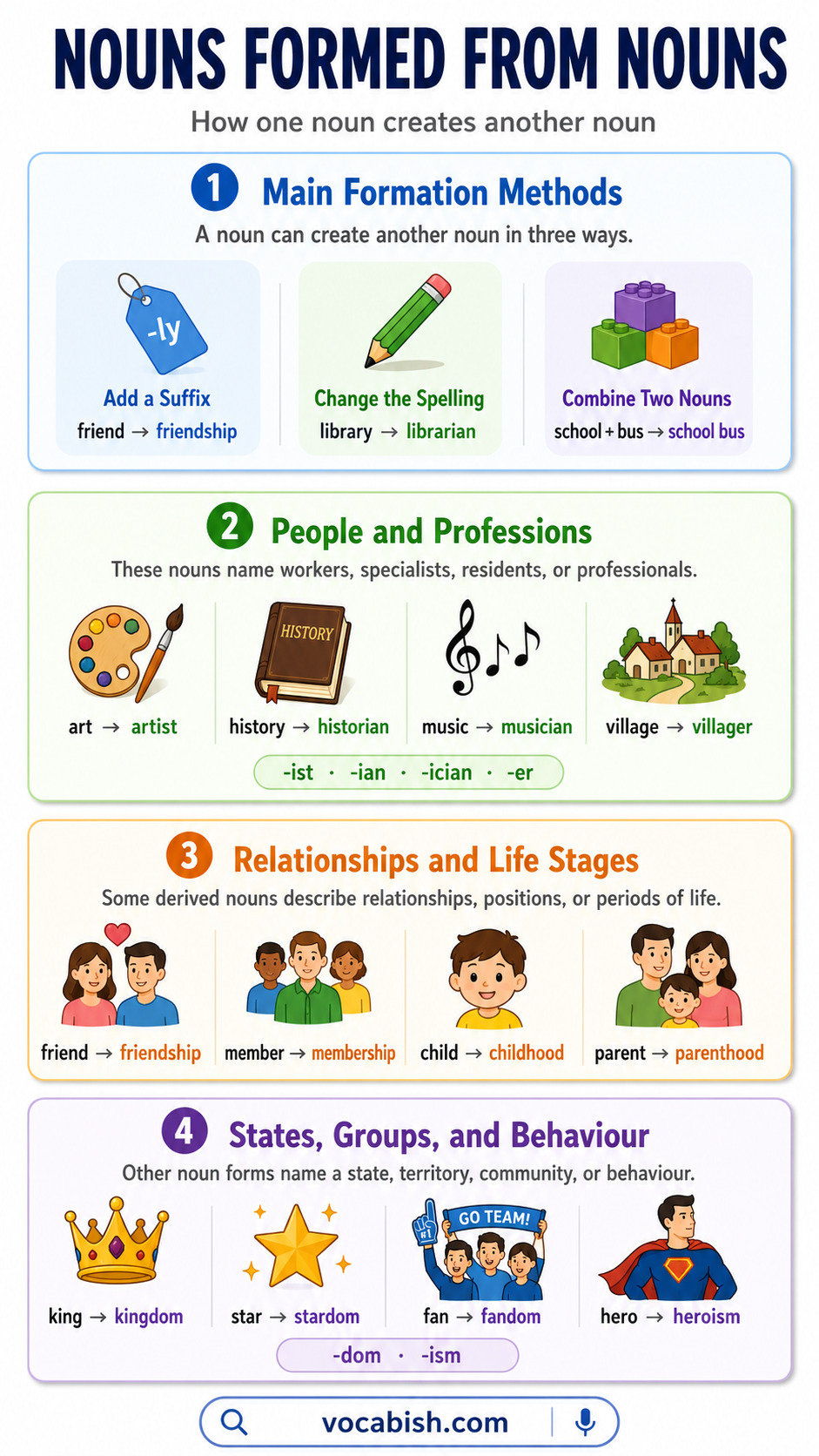
A noun can form another noun in three main ways:
Formation Method | Base Noun | New Noun | Change |
|---|---|---|---|
Adding a suffix | friend | friendship | Add -ship |
Adding a suffix with a spelling change | library | librarian | Change final letters and add -ian |
Combining two nouns | school + bus | school bus | Form a compound noun |
The original word is called the base noun. The new word created from it is called the derived noun.
- art is the base noun in artist.
- child is the base noun in childhood.
- king is the base noun in kingdom.
- school and bus are base nouns in school bus.
A suffix cannot be added freely to every noun. English usually has an established form that learners need to recognise and remember.
Nouns for People and Professions
Several suffixes change nouns into words for people, specialists, workers, residents, or members of a profession.
Base Noun | Person or Profession | Suffix | Meaning |
|---|---|---|---|
art | artist | -ist | A person who creates art |
science | scientist | -ist | A person who studies science |
novel | novelist | -ist | A person who writes novels |
journal | journalist | -ist | A person who reports news |
violin | violinist | -ist | A person who plays the violin |
history | historian | -ian | A person who studies history |
library | librarian | -ian | A person who works in a library |
music | musician | -ician | A person who performs or writes music |
politics | politician | -ician | A person involved in politics |
comedy | comedian | -ian | A person who performs comedy |
pharmacy | pharmacist | -ist | A person trained in pharmacy |
village | villager | -er | A person who lives in a village |
island | islander | -er | A person who lives on an island |
prison | prisoner | -er | A person kept in prison |
Notice that the same suffix does not always have the same spelling pattern:
- art + -ist → artist
- science + -ist → scientist
- history + -ian → historian
- music + -ician → musician
Nouns for Relationships and States
Suffixes such as -ship, -hood, -dom, and -ism often describe relationships, social positions, periods of life, conditions, or systems of thought.
Base Noun | Derived Noun | Meaning |
|---|---|---|
friend | friendship | The relationship between friends |
partner | partnership | A relationship between partners |
member | membership | The state of being a member |
owner | ownership | The state or right of owning something |
leader | leadership | The position or ability of a leader |
citizen | citizenship | The legal status of a citizen |
child | childhood | The period of being a child |
parent | parenthood | The state of being a parent |
mother | motherhood | The state or experience of being a mother |
brother | brotherhood | A relationship or association between brothers |
adult | adulthood | The period of being an adult |
widow | widowhood | The state of being a widow |
king | kingdom | A country ruled by a king or queen |
star | stardom | The state of being famous |
fan | fandom | A community of enthusiastic fans |
hero | heroism | Brave behaviour associated with a hero |
patriot | patriotism | Love and support for one’s country |
critic | criticism | The expression of judgement or disapproval |
Meaning differences:
- Friendship describes a relationship.
- Membership describes belonging to a group.
- Childhood describes a period of life.
- Kingdom can describe a territory or system.
- Heroism describes a quality or type of behaviour.
Common Noun-to-Noun Suffixes
Suffix | Common Meaning | Base Noun | Derived Noun |
|---|---|---|---|
-ist | Person connected with a subject or activity | art | artist |
-ian | Specialist or person connected with a field | history | historian |
-ician | Skilled or professional person | music | musician |
-er | Resident or person connected with a place | village | villager |
-ship | Relationship, position, or state | friend | friendship |
-hood | Period, condition, or relationship | child | childhood |
-dom | State, group, or territory | king | kingdom |
-ism | Belief, practice, quality, or behaviour | hero | heroism |
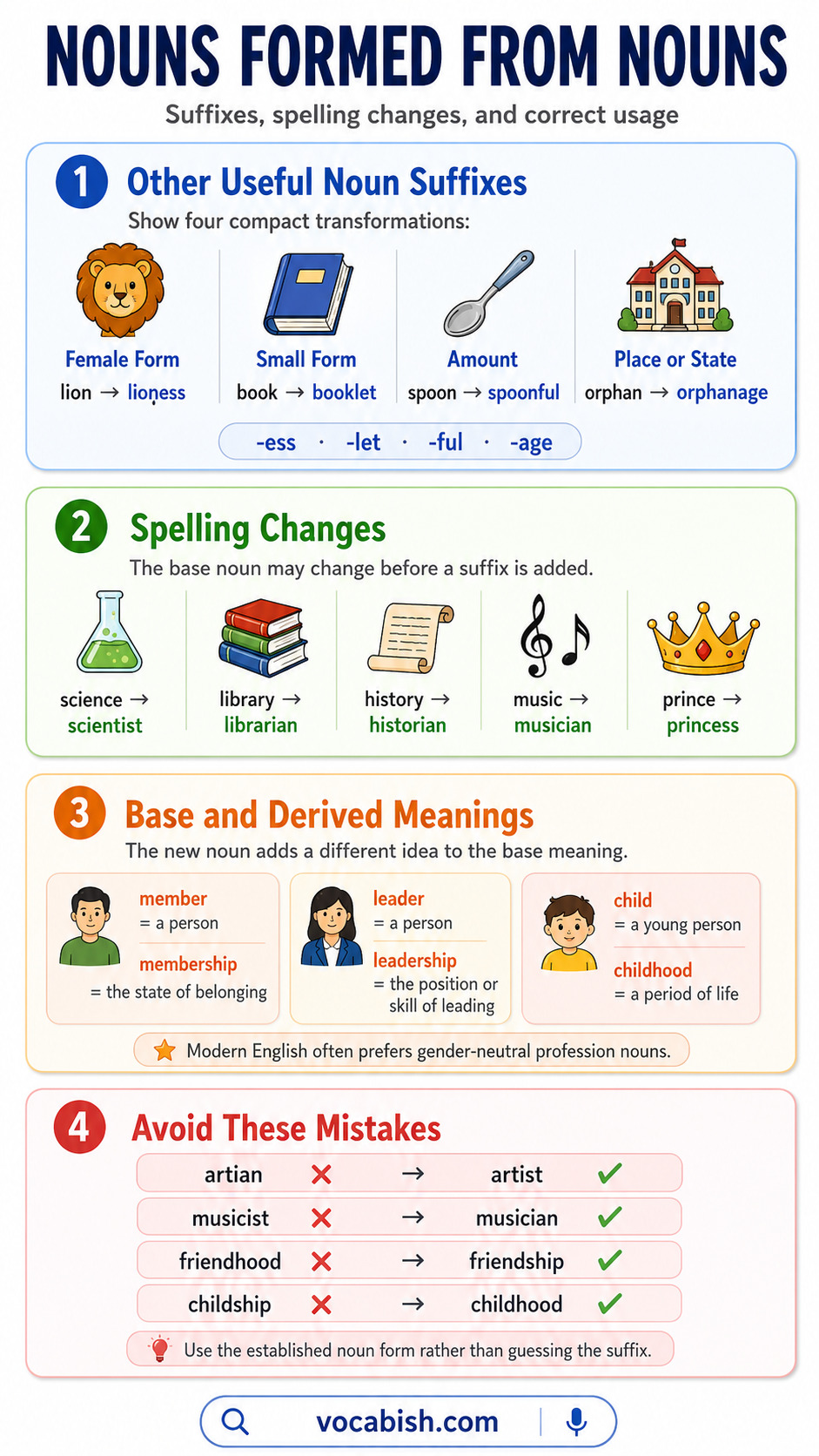
-ess | Female person or animal | lion | lioness |
-let | Small form of something | book | booklet |
-ful | An amount held by something | spoon | spoonful |
-age | State, place, connection, or collective idea | orphan | orphanage |
Important Usage Note
The suffix -ess traditionally marks a female person or animal:
- lion → lioness
- prince → princess
- host → hostess
However, many modern professions use gender-neutral nouns. For example, actor, host, and waiter may be used without adding -ess, depending on context and personal preference.
Meaning and Spelling Changes
Adding a suffix may change both the meaning and spelling of the original noun.
Spelling Pattern | Base Noun | Derived Noun | Change |
|---|---|---|---|
No major change | art | artist | Add -ist |
Drop final e | science | scientist | Remove e, then add -ist |
Remove or change final y | library | librarian | Replace the final letters |
Remove or change final y | history | historian | Change y before adding the suffix |
Change ending before suffix | comedy | comedian | Change -y to form -ian noun |
Change final sound and spelling | music | musician | Add -ician |
Change ending | politics | politician | Replace part of the ending |
Drop final e | prince | princess | Remove e and add -ess |
Double or adjust letters | host | hostess | Add -ess |
No spelling change | friend | friendship | Add -ship |
These changes do not follow one rule in every case. It is better to learn the base noun and derived noun together:
- science – scientist
- library – librarian
- music – musician
- comedy – comedian
- prince – princess
Base and Derived Nouns in Sentences
The base noun and its derived form usually perform different roles in a sentence.
Base Noun Sentence | Derived Noun Sentence |
|---|---|
Her art was displayed in the gallery. | The artist displayed her work. |
He enjoys studying science. | He hopes to become a scientist. |
Their friend introduced them. | Their friendship began at school. |
The child played in the garden. | She spent her childhood in the countryside. |
The king addressed the people. | The kingdom remained peaceful. |
She studied music at college. | She became a professional musician. |
Every member received a card. | Her membership ends next month. |
The hero returned safely. | His heroism inspired the town. |
The owner repaired the building. | The documents prove his ownership. |
He wrote a successful novel. | The novelist received an award. |
The derived noun does not simply repeat the base meaning. It adds a new idea:
- member means a person.
- membership means the state or period of belonging.
- leader means a person.
- leadership means a position, skill, or system of leading.
Examples of All Nouns Formed from Nouns
The following table presents common noun-to-noun formations used in everyday English.
No. | Base Noun | Derived Noun | Suffix Used |
|---|---|---|---|
1 | art | artist | -ist |
2 | science | scientist | -ist |
3 | novel | novelist | -ist |
4 | journal | journalist | -ist |
5 | violin | violinist | -ist |
6 | pharmacy | pharmacist | -ist |
7 | history | historian | -ian |
8 | library | librarian | -ian |
9 | comedy | comedian | -ian |
10 | music | musician | -ician |
11 | politics | politician | -ician |
12 | village | villager | -er |
13 | island | islander | -er |
14 | prison | prisoner | -er |
15 | friend | friendship | -ship |
16 | partner | partnership | -ship |
17 | member | membership | -ship |
18 | owner | ownership | -ship |
19 | leader | leadership | -ship |
20 | citizen | citizenship | -ship |
21 | child | childhood | -hood |
22 | parent | parenthood | -hood |
23 | mother | motherhood | -hood |
24 | brother | brotherhood | -hood |
25 | adult | adulthood | -hood |
26 | widow | widowhood | -hood |
27 | king | kingdom | -dom |
28 | star | stardom | -dom |
29 | fan | fandom | -dom |
30 | serf | serfdom | -dom |
31 | hero | heroism | -ism |
32 | patriot | patriotism | -ism |
33 | critic | criticism | -ism |
34 | tourist | tourism | -ism |
35 | lion | lioness | -ess |
36 | prince | princess | -ess |
37 | host | hostess | -ess |
38 | book | booklet | -let |
39 | pig | piglet | -let |
40 | spoon | spoonful | -ful |
41 | cup | cupful | -ful |
42 | orphan | orphanage | -age |
43 | parent | parentage | -age |
44 | school + bus | school bus | Compound noun |
45 | tooth + paste | toothpaste | Compound noun |
46 | bed + room | bedroom | Compound noun |
47 | foot + ball | football | Compound noun |
48 | coffee + shop | coffee shop | Compound noun |
Here’s a comprehensive guide: 1000+ Compound Words in English
Common Formation Mistakes
One suffix cannot be used with every base noun. Use the established English form rather than creating a new form by guesswork.
Incorrect Form | Correct Form | Explanation |
|---|---|---|
artian | artist | Art normally takes -ist |
musicist | musician | Music forms musician |
scienceist | scientist | The final e is removed |
libraryian | librarian | The ending changes before -ian |
friendhood | friendship | A relationship between friends is friendship |
childship | childhood | The period of being a child is childhood |
kingness | kingdom | A territory ruled by a monarch is a kingdom |
heroist | heroism | Brave behaviour is called heroism |
bookling | booklet | A small book is a booklet |
spoonness | spoonful | The amount held by a spoon is a spoonful |
Other common mistakes include:
- Adding a suffix without checking the spelling change.
- Using a person noun when a state noun is required.
- Confusing a derived noun with a compound noun.
- Assuming that every word ending in the same letters uses the same suffix.
- Using uncommon gendered forms when a neutral noun is more suitable.
Practice Exercise
A. Complete each derived noun
- art → __________
- child → __________
- friend → __________
- music → __________
- king → __________
- book → __________
- spoon → __________
- orphan → __________
- history → __________
- hero → __________
B. Choose the correct noun
- Her lifelong friendship / friendhood began at university.
- The musicist / musician played the piano beautifully.
- His brave act was an example of heroism / herohood.
- We renewed our club memberhood / membership.
- The libraryian / librarian helped me find the book.
- The prince returned safely to the kingdom / kingness.
- She hopes to become a scienceist / scientist.
- Add one spoonful / spoonness of sugar.
Answers
A:
- artist
- childhood
- friendship
- musician
- kingdom
- booklet
- spoonful
- orphanage
- historian
- heroism
B:
- friendship
- musician
- heroism
- membership
- librarian
- kingdom
- scientist
- spoonful
FAQs About Nouns Formed from Nouns
These are derived nouns created from existing nouns, usually through suffixes, spelling adjustments, or compounding, while keeping a clear connection to the base meaning.
Common suffixes include -ist, -ian, -ship, -hood, -dom, -ism, -ess, -let, -ful, and -age, although each suffix adds a different meaning.
Yes. Two nouns can combine to create a compound noun, as in school bus, toothpaste, bedroom, football, and coffee shop.
No. Some bases change before the suffix is added, as in library to librarian, science to scientist, and prince to princess.
The base noun is the original word, while the derived noun is the new form created from it, such as friend and friendship.
Not always. Many modern professions use gender-neutral terms, so actor, waiter, or host may be preferred instead of actress, waitress, or hostess.
Group words by suffix, learn each noun with its base form, notice spelling changes, and practise using both words in short sentences.
Short Summary
Nouns can form other nouns through suffixes, spelling changes, and noun combinations. Common endings include -ist, -ian, -ship, -hood, -dom, and -ism.
Some derived nouns name people, such as artist and historian. Others express relationships, conditions, or periods, such as friendship, membership, and childhood. Because spelling and suffix choices are not always predictable, learners should study each base noun with its correct derived form.
You May Also Like