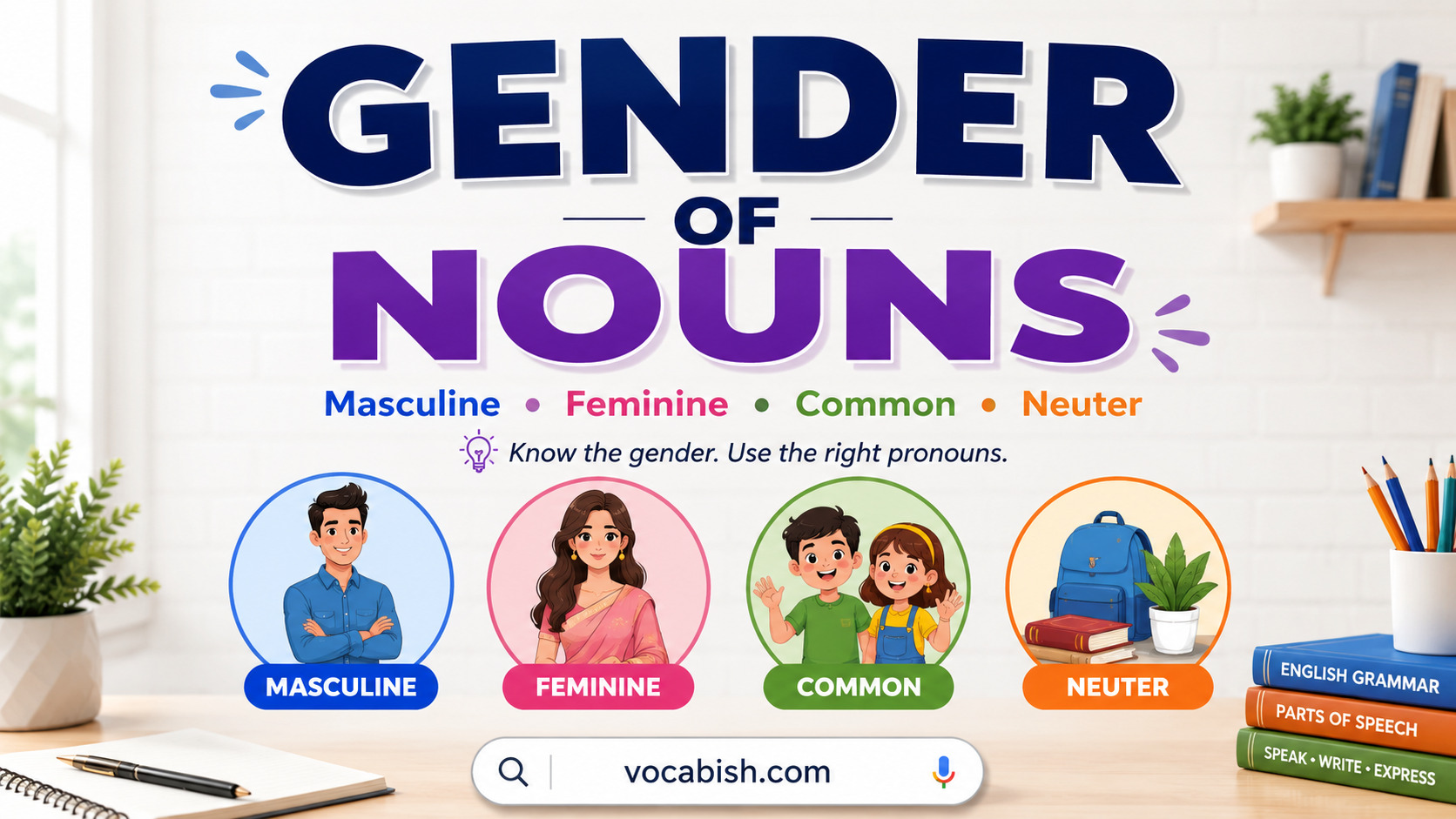

The word gender often makes learners think about men and women. In English grammar, however, the gender of nouns also includes nouns that can refer to any person and nouns that name objects, places, or ideas.
English does not give every noun a masculine or feminine form. Most nouns keep the same form, and their gender becomes clear through meaning, context, or pronouns.
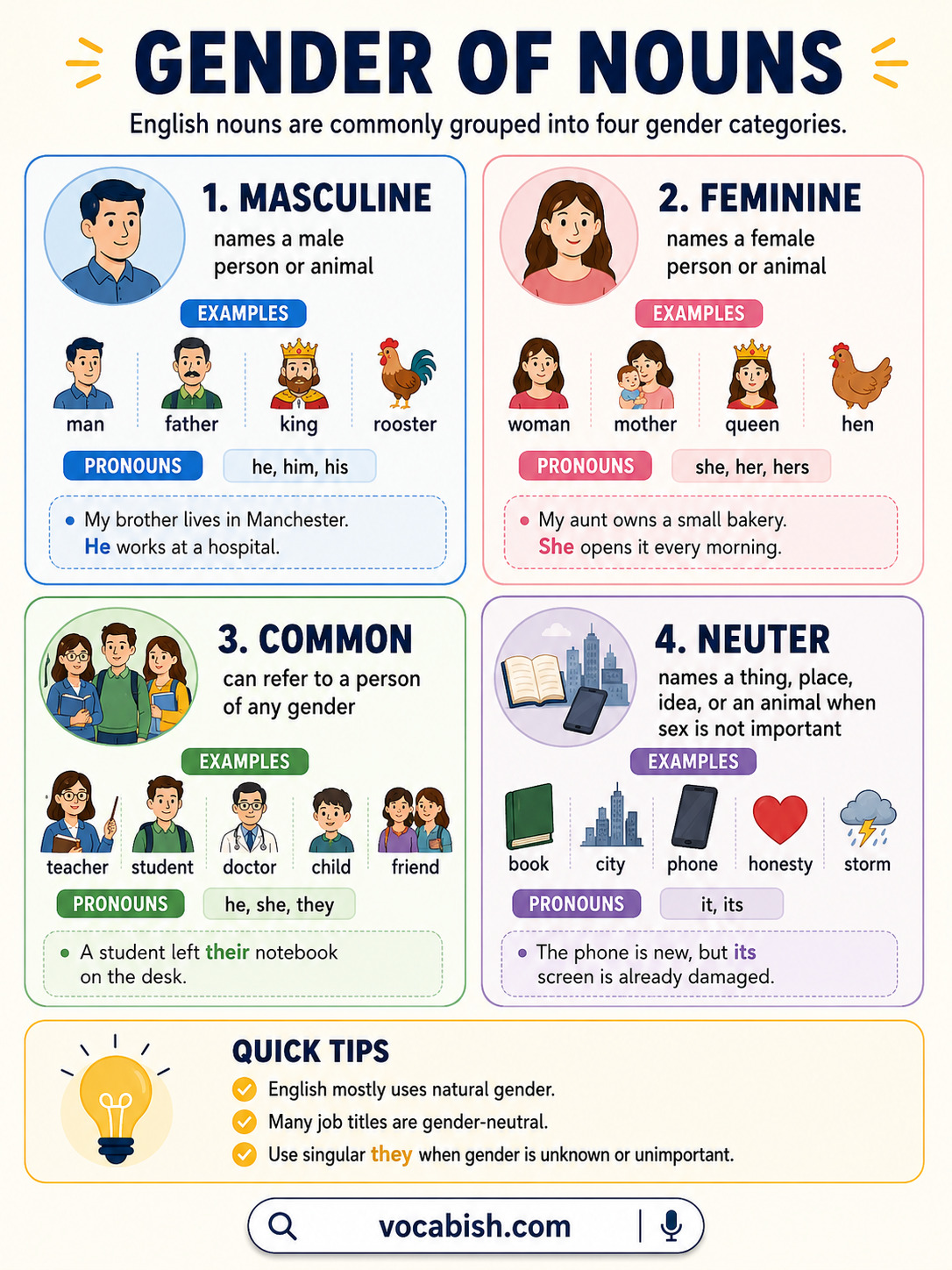
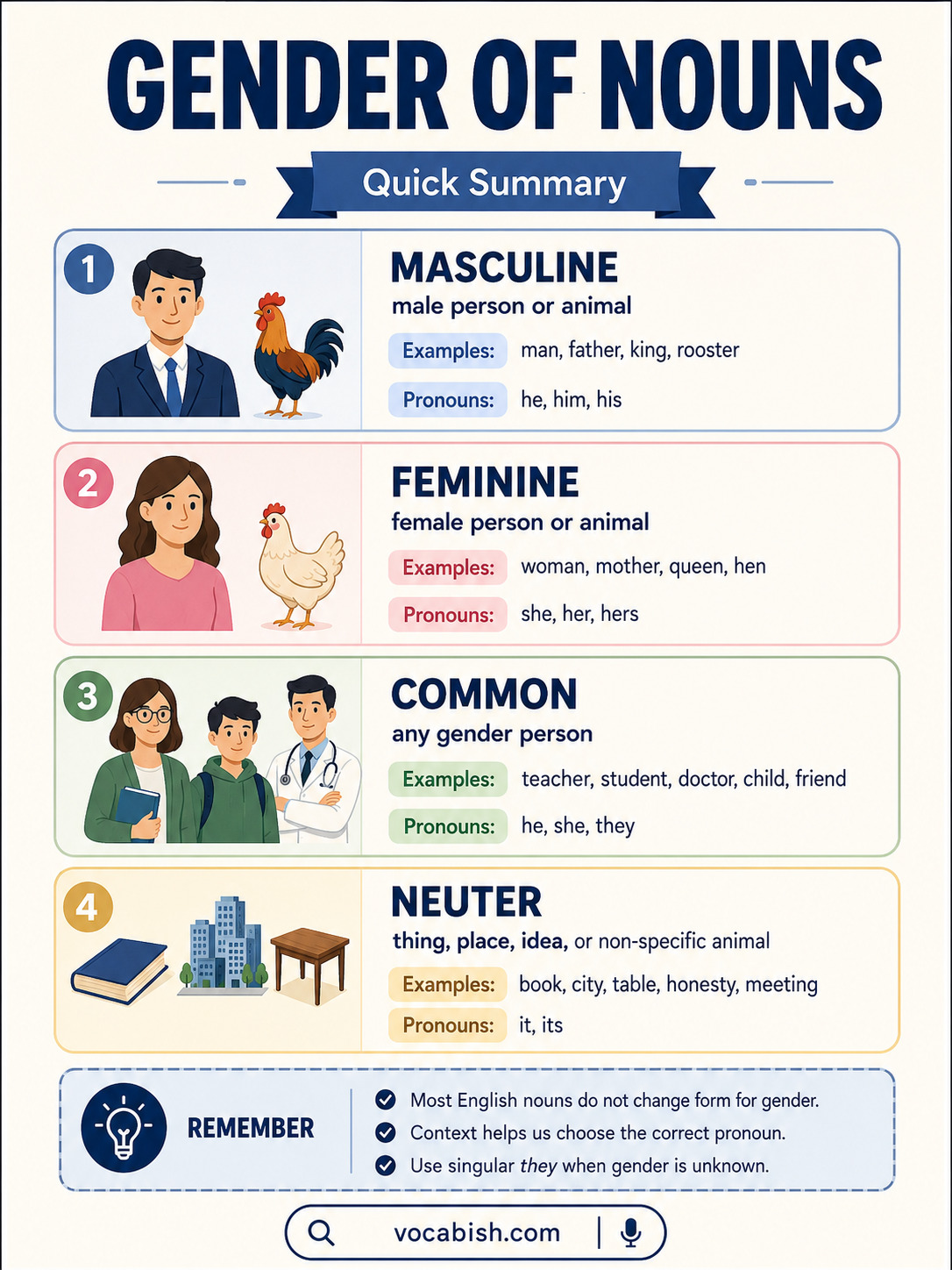
Short summary: English nouns are commonly grouped into four gender categories:
- Masculine: names a male person or animal
- Feminine: names a female person or animal
- Common: can name a person of any gender
- Neuter: names a thing, place, idea, or animal whose sex is not relevant
What Is Gender in English Nouns?
Gender tells us what kind of person, animal, object, or idea a noun represents. It can also help us choose the correct pronoun.
Gender type | Meaning | Examples | Usual pronouns |
|---|---|---|---|
Masculine | Refers to a male | father, boy, king | he, him, his |
Feminine | Refers to a female | mother, girl, queen | she, her, hers |
Common | Refers to any gender | teacher, child, friend | he, she, they |
Neuter | Refers to a thing or idea | book, city, honesty | it, its |
Unlike some languages, English does not normally change articles or adjectives according to noun gender.
We say:
- a good man
- a good woman
- a good teacher
- a good idea
The adjective good stays the same in every example.
Masculine Gender Nouns
A masculine gender noun names a male person or animal.
Common examples include:
- man
- boy
- father
- brother
- son
- husband
- uncle
- king
- prince
- rooster
Masculine nouns normally take the pronouns he, him, and his.
- My brother lives in Manchester. He works at a hospital.
- The king entered the hall. Everyone greeted him.
- The boy forgot his schoolbag.
A job title is not automatically masculine. Words such as teacher, doctor, and manager may refer to people of any gender.
Feminine Gender Nouns
A feminine gender noun names a female person or animal.
Examples include:
- woman
- girl
- mother
- sister
- daughter
- wife
- aunt
- queen
- princess
- hen
Feminine nouns usually take the pronouns she, her, and hers.
- My aunt owns a small bakery. She opens it every morning.
- The queen spoke to the guests. They listened to her carefully.
- The girl found her missing notebook.
Some feminine nouns have special endings, such as -ess, but these forms are less common in modern professional language.
Common Gender Nouns
A common gender noun can refer to a male, female, or non-binary person. Its form does not change according to the person’s gender.
Examples include:
- teacher
- student
- doctor
- nurse
- artist
- parent
- child
- cousin
- friend
- neighbour
- manager
- engineer
The correct pronoun depends on the person being discussed.
- My teacher is Mr Harris. He teaches history.
- Our doctor is Dr Patel. She works nearby.
- A student left their notebook on the desk.
Singular they is useful when the person’s gender is unknown, unimportant, or non-binary.
- Every applicant should bring their identification.
- Ask the customer whether they need assistance.
Neuter Gender Nouns
A neuter gender noun usually names something without a natural male or female identity.
Neuter nouns include:
- objects: table, phone, bicycle
- places: school, village, country
- materials: gold, water, wood
- ideas: freedom, patience, happiness
- events: meeting, concert, storm
The pronouns it and its are normally used with neuter nouns.
- The phone is new, but its screen is already damaged.
- London is famous for its historic buildings.
- The storm ended as quickly as it began.
Animals may also be treated as neuter when their sex is unknown or not important.
- A bird landed on the wall. It stayed there for several minutes.
When an animal’s sex is known, especially when it is a pet, he or she is more natural.
- Our cat is called Luna. She sleeps beside the window.
Masculine and Feminine Noun Pairs
Some nouns have separate forms for males and females. These pairs are especially common in family relationships, animals, and traditional titles.
Family Members
Masculine | Feminine |
|---|---|
man | woman |
boy | girl |
father | mother |
brother | sister |
son | daughter |
husband | wife |
uncle | aunt |
nephew | niece |
grandfather | grandmother |
grandson | granddaughter |
Some family nouns are already gender-neutral:
- parent
- child
- sibling
- spouse
- cousin
- grandparent
Related Resources: Masculine and Feminine of Family Members
Professions
Many traditional profession names had separate masculine and feminine forms. Modern English often uses one neutral term for everyone.
Traditional masculine | Traditional feminine | Modern neutral term |
|---|---|---|
actor | actress | actor |
waiter | waitress | server |
policeman | policewoman | police officer |
chairman | chairwoman | chair or chairperson |
steward | stewardess | flight attendant |
salesman | saleswoman | salesperson |
businessman | businesswoman | businessperson |
headmaster | headmistress | headteacher |
Some traditional forms remain grammatically correct, but neutral titles are usually clearer when gender is not relevant.
Here’s a complete guide: Masculine and Feminine of Jobs and Professions
Animals
Certain animals have different names for males and females.
Animal | Male | Female |
|---|---|---|
Cattle | bull | cow |
Horse | stallion | mare |
Chicken | rooster | hen |
Sheep | ram | ewe |
Deer | buck | doe |
Pig | boar | sow |
Goose | gander | goose |
Duck | drake | duck |
Lion | lion | lioness |
Tiger | tiger | tigress |
In everyday conversation, speakers often use the general animal name unless the animal’s sex matters.
- We saw three deer in the field.
- The farmer owns several horses.
You May Also Like: Masculine and Feminine of Birds
Royal and Social Titles
Royal and traditional social titles often have separate gender forms.
Masculine | Feminine |
|---|---|
king | queen |
prince | princess |
emperor | empress |
duke | duchess |
lord | lady |
baron | baroness |
widower | widow |
bridegroom | bride |
monk | nun |
host | hostess |
Some titles, including host and actor, are increasingly used for people of any gender.
Here’s a complete guide: 100 Examples of Masculine and Feminine Words
Gender-Neutral Nouns in Modern English
Gender-neutral nouns do not identify a person as male or female. They are useful when gender is unknown, unnecessary, or unrelated to the message.
Gendered expression | Gender-neutral alternative |
|---|---|
policeman | police officer |
fireman | firefighter |
chairman | chair or chairperson |
salesman | salesperson |
businessman | businessperson |
mankind | humankind or humanity |
manpower | workforce or staff |
housewife | homemaker |
mailman | postal worker |
repairman | technician |
Gender-neutral language avoids unnecessary assumptions.
Instead of:
- A doctor should listen to his patients.
Write:
- A doctor should listen to their patients.
- Doctors should listen to their patients.
The plural version is often the simplest solution.
Gendered Nouns vs Natural Gender
English mainly follows natural gender, not grammatical gender.
Feature | Gendered noun | Natural gender |
|---|---|---|
Meaning | The noun itself identifies gender | Gender depends on the actual person or animal |
Example | father, mother, king, queen | teacher, doctor, neighbour |
Noun form | Usually different for males and females | Usually remains unchanged |
Pronoun choice | Often predictable from the noun | Depends on the person being discussed |
For example, mother is clearly feminine and father is clearly masculine. The noun teacher has no fixed gender.
- The teacher said he would return tomorrow.
- The teacher said she would return tomorrow.
- The teacher said they would return tomorrow.
Objects such as tables, books, and houses do not receive masculine or feminine gender in standard English.
Pronouns Used with Gender Nouns
Noun gender | Subject pronoun | Object pronoun | Possessive adjective | Possessive pronoun |
|---|---|---|---|---|
Masculine | he | him | his | his |
Feminine | she | her | her | hers |
Common | he, she, they | him, her, them | his, her, their | his, hers, theirs |
Neuter | it | it | its | — |
Examples:
- The prince thanked the crowd. He waved to them.
- My sister found her keys. The blue bag is hers.
- A passenger left their coat on the train.
- The machine stopped because its motor overheated.
Do not use it for an adult person. Use the person’s known pronoun or singular they.
Common Gender Noun Mistakes
- Assuming every profession is masculine
Incorrect: Every engineer must bring his equipment.
Better: Every engineer must bring their equipment. - Using “it” for a person
Incorrect: The customer said it needed help.
Correct: The customer said they needed help. - Using an outdated gendered job title unnecessarily
Less inclusive: We need a new salesman.
Better: We need a new salesperson. - Confusing common and neuter nouns
Teacher is common gender because it names a person.
Classroom is neuter because it names a place. - Changing pronouns without a reason
Incorrect: Maria said she had finished their report.
Correct: Maria said she had finished her report. - Using “he or she” repeatedly
Awkward: Each visitor must show his or her ticket.
Natural: Each visitor must show their ticket.
Practice Exercise
Identify each noun as masculine, feminine, common, or neuter.
- brother
- queen
- pilot
- river
- niece
- child
- bicycle
- husband
Complete or correct the following:
- Write the feminine form of ram.
- Write the masculine form of mare.
- Replace policeman with a gender-neutral noun.
- A doctor should check ___ schedule before leaving.
- The table has lost ___ leg.
- Replace chairman with a gender-neutral title.
Answers
- Masculine
- Feminine
- Common
- Neuter
- Feminine
- Common
- Neuter
- Masculine
- Ewe
- Stallion
- Police officer
- Their
- Its
- Chair or chairperson
FAQs About Gender of Nouns
Gender of nouns shows whether a noun refers to a male, female, person of any gender, or a non-living thing.
English mainly uses natural gender, meaning gender usually depends on the person or animal named, not the noun’s grammatical form.
Common gender nouns can refer to males, females, or non-binary people. Common examples include teacher, student, doctor, neighbour, cousin, and friend.
Neuter gender nouns name objects, places, materials, ideas, and many animals when their sex is unknown, irrelevant, or not being discussed.
Use singular they when a person’s gender is unknown, irrelevant, non-binary, or when you want to avoid an unnecessary assumption.
Gender-neutral nouns are usually preferred because they include everyone and avoid suggesting that a particular job or role belongs to one gender.
Animals may take he or she when their sex is known. Use it when sex is unknown or the animal is discussed generally.
Summary on Gender of Nouns
- Masculine nouns refer to males, while feminine nouns refer to females.
- Common gender nouns can describe people of any gender.
- Neuter nouns usually name objects, places, materials, events, and ideas.
- English mostly uses natural gender rather than grammatical gender.
- Singular they is correct when a person’s gender is unknown or irrelevant.
- Modern English often prefers neutral terms such as firefighter, police officer, and salesperson.
You May Also Like