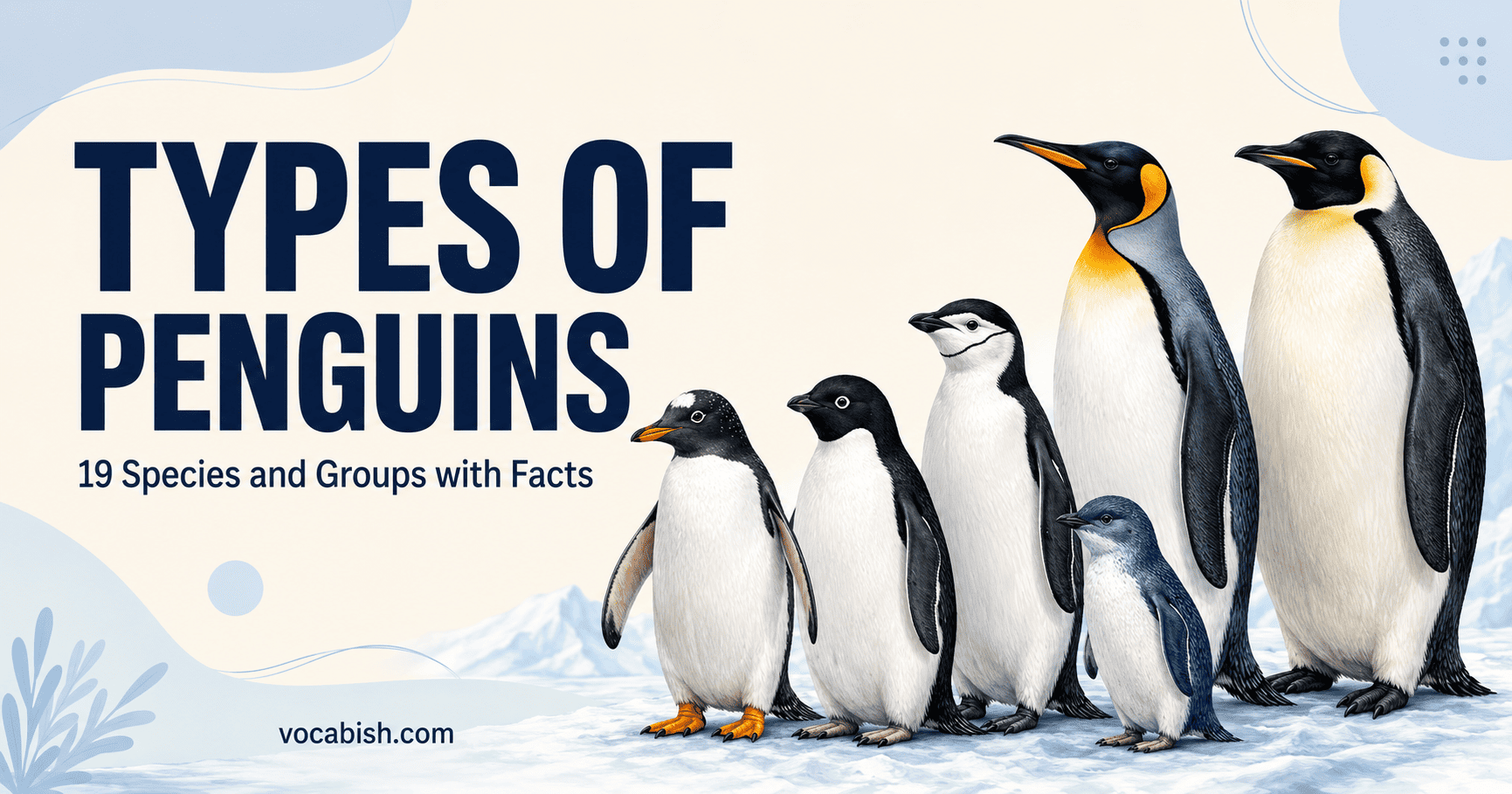

Types of penguins include the enormous Emperor Penguin, orange-marked King Penguin, tiny Little Penguin, equatorial Galápagos Penguin and several yellow-crested species. A current unified bird taxonomy recognises 19 living penguin species, divided among six scientific genera.
Some references still list 18 species because they combine the Eastern Rockhopper Penguin with the Southern Rockhopper Penguin. In this blog post, you will learn the accepted penguin names, major groups, habitats, physical features, and practical identification differences through pictures.
What Are Penguins?
Penguins are aquatic, flightless seabirds belonging to the order Sphenisciformes and family Spheniscidae. Their wings have developed into strong flippers, while streamlined bodies, dense feathers, and powerful feet help them move efficiently through water.
In this context, “types of penguins” refers to scientifically recognised species, not breeds. These species are classified using physical characteristics, geographical distribution, behaviour, genetics, and evolutionary relationships.
The 19 living species are organised into six genera:
- Aptenodytes
- Pygoscelis
- Eudyptula
- Spheniscus
- Megadyptes
- Eudyptes
Terms such as “large penguins,” “brush-tailed penguins,” “banded penguins,” and “crested penguins” are useful descriptive group names. However, the scientific genus remains the formal classification.
What to Know About the Types of Penguins
- A current unified taxonomy recognises 19 living penguin species.
- The species are divided among six scientific genera.
- Some older classifications recognise only 18 species.
- Penguins inhabit Antarctica, temperate coasts, forests and equatorial islands.
- Head markings, chest bands, crests and bills support visual identification.
- Geographical range is essential when comparing similar crested or banded species.
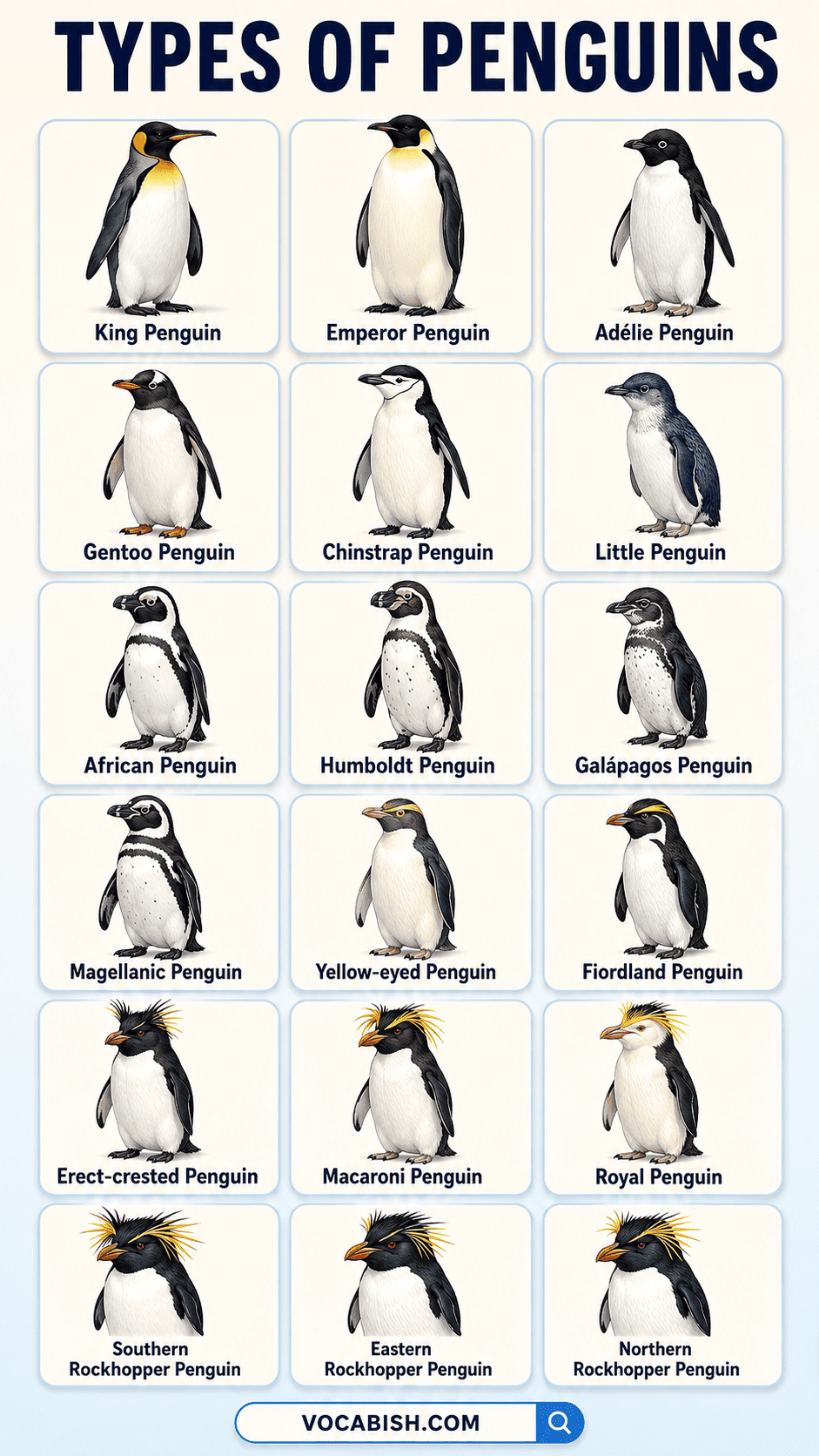
Complete List of Types of Penguins
- King Penguin
- Emperor Penguin
- Adélie Penguin
- Gentoo Penguin
- Chinstrap Penguin
- Little Penguin
- African Penguin
- Humboldt Penguin
- Galápagos Penguin
- Magellanic Penguin
- Yellow-eyed Penguin
- Fiordland Penguin
- Erect-crested Penguin
- Macaroni Penguin
- Royal Penguin
- Southern Rockhopper Penguin
- Eastern Rockhopper Penguin
- Northern Rockhopper Penguin
- Snares Penguin
Main Classification of Penguin Species
Penguins are grouped into six genera based on shared anatomy, appearance, geographical range, and evolutionary history. Some groups contain several closely related species, while others contain only one living member.
Large Penguins: Genus Aptenodytes
This genus contains the two largest living penguins. Both have long bills, colourful neck markings, and more upright bodies than most other species.
- King Penguin (Aptenodytes patagonicus): Second-largest penguin with bright orange ear patches and a long bill.
- Emperor Penguin (Aptenodytes forsteri): Largest living penguin, breeding on Antarctic sea ice during winter.
King Penguins mainly breed on subantarctic islands. Emperor Penguins live farther south and depend heavily on Antarctic sea-ice environments.
Brush-Tailed Penguins: Genus Pygoscelis
Brush-tailed penguins have relatively long, stiff tail feathers. They are strongly associated with Antarctica, the Antarctic Peninsula, and nearby islands.
- Adélie Penguin (Pygoscelis adeliae): Compact Antarctic species with a black head and white eye-ring.
- Gentoo Penguin (Pygoscelis papua): Large brush-tailed penguin with white head patches and an orange bill.
- Chinstrap Penguin (Pygoscelis antarcticus): Medium-sized Antarctic penguin recognised by its narrow black chin band.
Their head markings provide the easiest identification clues. Adélies have white eye-rings, Gentoos have white head patches, and Chinstraps have a dark line beneath the face.
Little Penguins: Genus Eudyptula
This genus contains the smallest living penguin species. Its members have blue-grey upperparts rather than the darker black colouring seen in many other penguins.
- Little Penguin (Eudyptula minor): Smallest penguin species, showing blue-grey upperparts across Australia and New Zealand.
The little penguin is also called the little blue penguin, blue penguin, fairy penguin, or kororā. These are regional common names rather than separate species.
Banded Penguins: Genus Spheniscus
Banded penguins generally have black facial markings, exposed pink skin, and one or two dark bands across the chest. They inhabit warmer coastal regions than most Antarctic penguins.
- African Penguin (Spheniscus demersus): Southern African coastal penguin with pink eye patches and one chest band.
- Humboldt Penguin (Spheniscus humboldti): Peru–Chile coastal penguin with pink facial skin and one chest band.
- Galápagos Penguin (Spheniscus mendiculus): Small equatorial penguin found along cool-current shores of the Galápagos Islands.
- Magellanic Penguin (Spheniscus magellanicus): South American burrow-nester recognised by two black chest bands and pale face.
These species can appear similar, so geographical range is especially helpful. Their chest bands, facial patterns, and areas of exposed pink skin also support identification.
Yellow-Eyed Penguins: Genus Megadyptes
The yellow-eyed penguin is the only living member of this genus. It differs clearly from other penguins through its pale head markings and yellow eyes.
- Yellow-eyed Penguin (Megadyptes antipodes): A New Zealand penguin with yellow eyes, a pale headband, and secluded nesting habits.
Unlike highly social colonial species, yellow-eyed penguins often nest separately or in loosely arranged groups among coastal vegetation.
Crested Penguins: Genus Eudyptes
Crested penguins have noticeable yellow or orange feathers above their eyes. Crest shape, face colour, bill structure, and breeding location help separate the species.
- Fiordland Penguin (Eudyptes pachyrhynchus): Rainforest-nesting New Zealand penguin with broad yellow crests and white cheek stripes.
- Erect-crested Penguin (Eudyptes sclateri): A remote island penguin bearing stiff, upright yellow eyebrow plumes above red eyes.
- Macaroni Penguin (Eudyptes chrysolophus): Widespread subantarctic penguin with orange-yellow plumes meeting above its red bill.
- Royal Penguin (Eudyptes schlegeli): Macquarie Island breeder resembling macaroni penguins but usually showing a white face.
- Southern Rockhopper Penguin (Eudyptes chrysocome): Small crested penguin breeding around southern South America and nearby islands.
- Eastern Rockhopper Penguin (Eudyptes filholi): A crested penguin breeding across southern Indian and Pacific Ocean islands.
- Northern Rockhopper Penguin (Eudyptes moseleyi): Long-plumed rockhopper breeding on temperate South Atlantic and Indian Ocean islands.
- Snares Penguin (Eudyptes robustus): An endemic New Zealand island bird with thick yellow crests and pink bill-base skin.
Crested species often look alike in photographs. Their breeding islands, crest length, facial colouring and bill details are frequently more useful than overall body colour.
Important Differences Between Similar Penguins
Similar Penguins | Key Identification Feature | Main Habitat or Range | Main Difference |
|---|---|---|---|
Emperor and King | Yellow-orange neck markings | Antarctica and subantarctic islands | Emperors are larger and breed on sea ice |
Adélie and Chinstrap | Eye-ring or chin band | Antarctica and nearby islands | Chinstrap has a black line below its face |
Gentoo and Chinstrap | White head patch or chin line | Antarctic and subantarctic regions | Gentoo has an orange bill and white head patches |
Macaroni and Royal | Dark or pale face | Subantarctic islands and Macquarie Island | Royal usually has a noticeably paler face |
African and Humboldt | Pink facial skin and chest band | Africa or western South America | Geographical range provides the clearest distinction |
Rockhopper species | Yellow crests and red eyes | Different Southern Ocean islands | Distribution and crest length help separate them |
How to Identify Different Types of Penguins
- Examine the head: Look for eye-rings, white patches, chin bands or coloured crests.
- Count the chest bands: Magellanic Penguins usually show two prominent dark bands.
- Check bill colour: Orange, red, black and pink areas support identification.
- Compare body size: Emperor and King Penguins are considerably larger than others.
- Consider the location: Many similar species occupy completely different geographical ranges.
- Allow for age: Juveniles may lack the clear markings seen in adults.
Common Misconceptions About Penguin Types
- Penguin species are not breeds: Breeds are usually human-developed domestic animal populations.
- Not every penguin lives in Antarctica: Most species breed outside continental Antarctica.
- Puffins are not penguins: Puffins are flying seabirds from the Northern Hemisphere.
- Little blue penguins are not always separate: The name usually refers to Little Penguins.
- Rockhopper totals vary: Some classifications combine Eastern and Southern Rockhopper Penguins.
- Shared habitats do not prove close relationships: Several genera may occupy similar regions.
Penguins live in more varied environments than many people expect. Depending on the species, they may breed on sea ice, rocky islands, beaches, coastal forests, dry shorelines, or equatorial volcanic islands.
Summary of the Main Penguin Groups
Scientific Genus | Descriptive Group | Species Count | Best Known For |
|---|---|---|---|
Aptenodytes | Large penguins | 2 | Large bodies and colourful neck markings |
Pygoscelis | Brush-tailed penguins | 3 | Stiff tails and Antarctic distribution |
Eudyptula | Little penguins | 1 | Small size and blue-grey plumage |
Spheniscus | Banded penguins | 4 | Chest bands and exposed pink skin |
Megadyptes | Yellow-eyed penguins | 1 | Yellow eyes and pale head markings |
Eudyptes | Crested penguins | 8 | Yellow or orange eyebrow feathers |
FAQs About Types of Penguins
A current unified bird classification recognises 19 living penguin species across six genera. Some references list 18 because they combine the Eastern Rockhopper Penguin with the Southern Rockhopper Penguin.
Penguin types are scientifically recognised species rather than breeds. Breeds are generally developed through controlled human selection, while penguin species evolved naturally as separate wild populations and lineages.
No, most penguin species do not breed on continental Antarctica. Penguins also inhabit South America, southern Africa, Australia, New Zealand, subantarctic islands and the equatorial Galápagos Islands.
The Emperor Penguin is the largest living penguin species. It is taller and heavier than every other penguin, with the closely related King Penguin ranking as the second-largest species.
The Little Penguin is the smallest living penguin. It has blue-grey upperparts and occurs around Australia and New Zealand, where several regional names are used for the species.
The Galápagos Penguin lives closest to the equator. Cold, nutrient-rich ocean currents help it survive around the tropical Galápagos Islands, including locations lying slightly north of the equatorial line.
A Chinstrap Penguin has a narrow black line running beneath its white face. This marking resembles a helmet strap and separates it from Adélie and Gentoo Penguins.
Emperor Penguins are larger and breed on Antarctic sea ice. King Penguins are smaller, show brighter orange markings and mainly breed on ice-free subantarctic islands farther north.
No, puffins are not penguins. Puffins are flying Northern Hemisphere seabirds belonging to the auk family, while penguins are flightless Southern Hemisphere seabirds adapted for underwater swimming.
Conclusion
The 19 recognised types of penguins belong to six scientific genera, each defined by shared physical and evolutionary characteristics. Emperor and King Penguins form the large-penguin group, while Adélie, Gentoo and Chinstrap Penguins belong to the brush-tailed genus. Other groups include Little, banded, Yellow-eyed and crested penguins.
Learning to compare body size, head markings, chest bands, bill colour, crest shape and geographical range makes penguin identification easier. It also explains why closely related species, particularly rockhoppers, may be classified differently. Understanding these distinctions provides a clearer picture of penguin diversity across the Southern Hemisphere.
You May Also Like