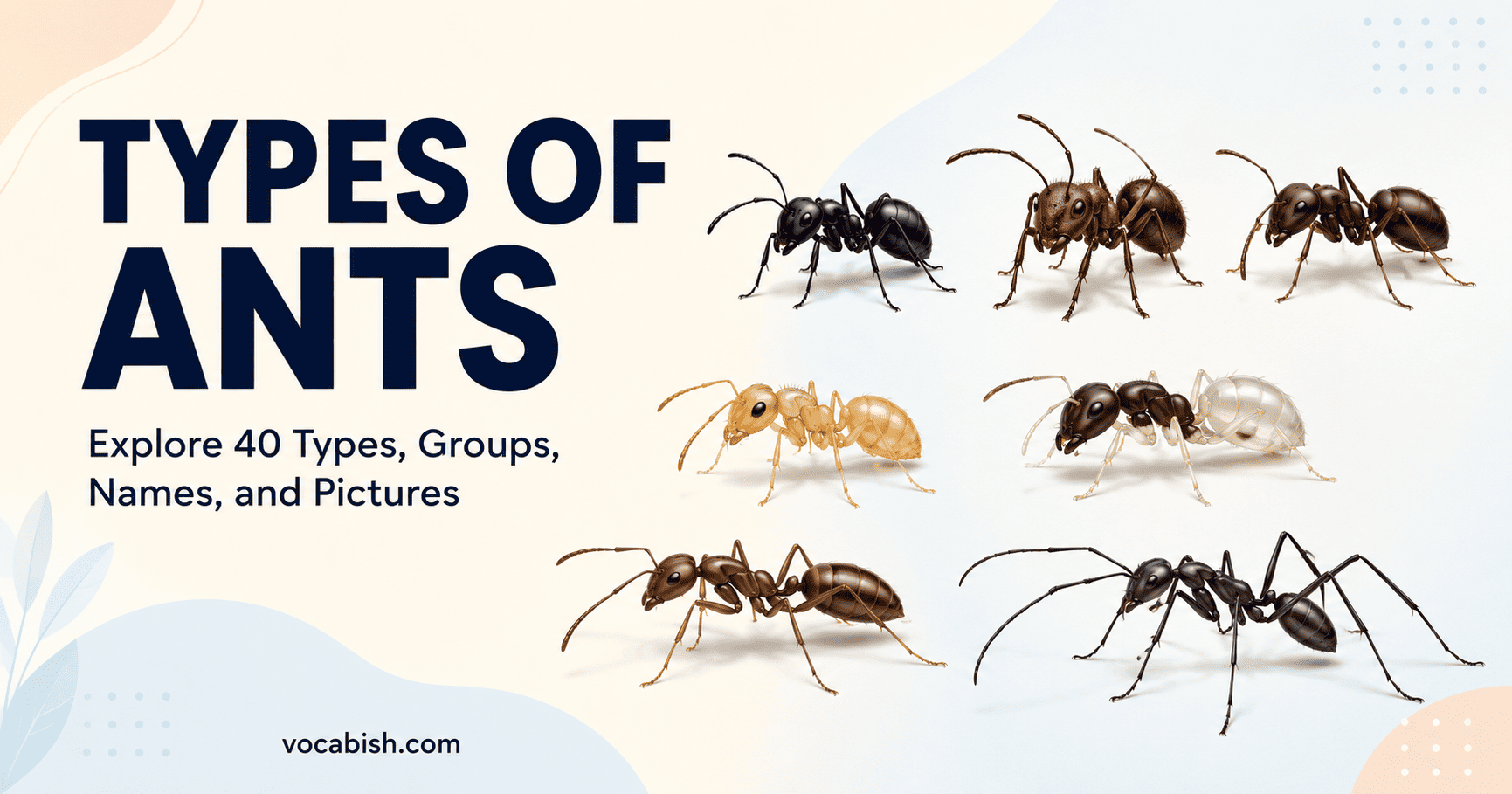

Ants are social insects found in forests, deserts, grasslands, gardens, buildings, and agricultural areas worldwide. Common types of ants include black garden ants, carpenter ants, fire ants, leafcutter ants, weaver ants, army ants, and bullet ants.
In this blog post, you will learn about 40 common ant species and groups, their defining characteristics, nesting habits, behaviours, habitats, and important differences. The types are organised into household ants, ecological specialists, stinging ants, predators, and raiding ants.
What Are Ants?
Ants are social insects belonging to the family Formicidae and the order Hymenoptera, which also includes bees and wasps. Most ants live in organised colonies containing queens, workers, developing young, and seasonal reproductive males.
The word “type” may describe a single species, an entire genus, a related species group, or ants sharing similar behaviour. Scientists recognise more than 14,000 described ant species worldwide.
Queens, workers, soldiers, and males are colony castes rather than separate ant species. Each caste performs particular reproductive, defensive, nesting, or food-gathering roles.
Complete List of 40 Types of Ants
Black Garden Ant | Pavement Ant | Odorous House Ant |
Pharaoh Ant | Ghost Ant | Argentine Ant |
Black Crazy Ant | Yellow Crazy Ant | Little Black Ant |
Big-Headed Ant | White-Footed Ant | Acrobat Ant |
Thief Ant | Citronella Ant | Carpenter Ant |
Leafcutter Ant | Weaver Ant | Turtle Ant |
Acacia Ant | Thatch Ant | Wood Ant |
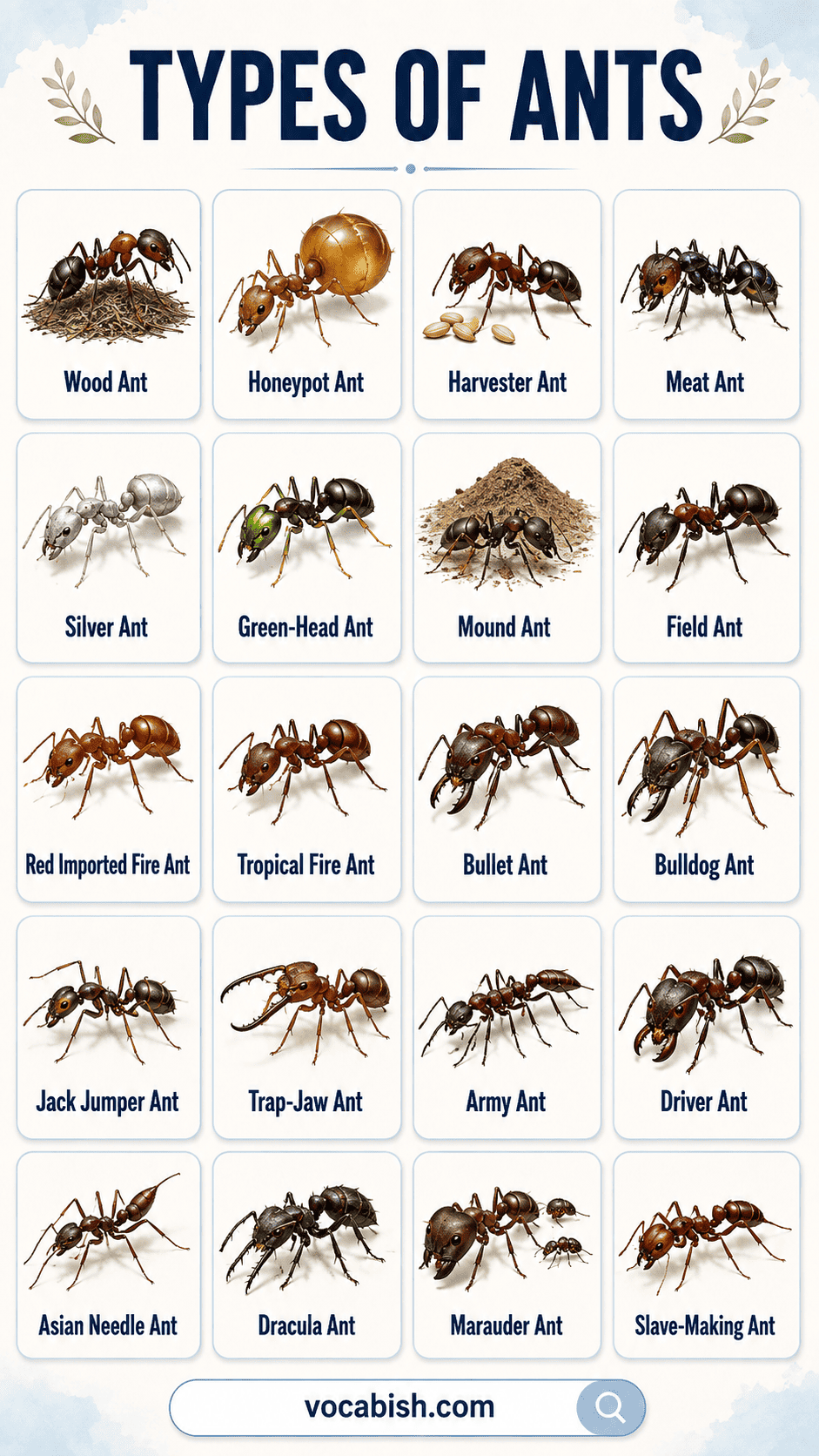
Honeypot Ant | Harvester Ant | Meat Ant |
Silver Ant | Green-Head Ant | Mound Ant |
Field Ant | Red Imported Fire Ant | Tropical Fire Ant |
Bullet Ant | Bulldog Ant | Jack Jumper Ant |
Trap-Jaw Ant | Army Ant | Driver Ant |
Asian Needle Ant | Dracula Ant | Marauder Ant |
Slave-Making Ant |
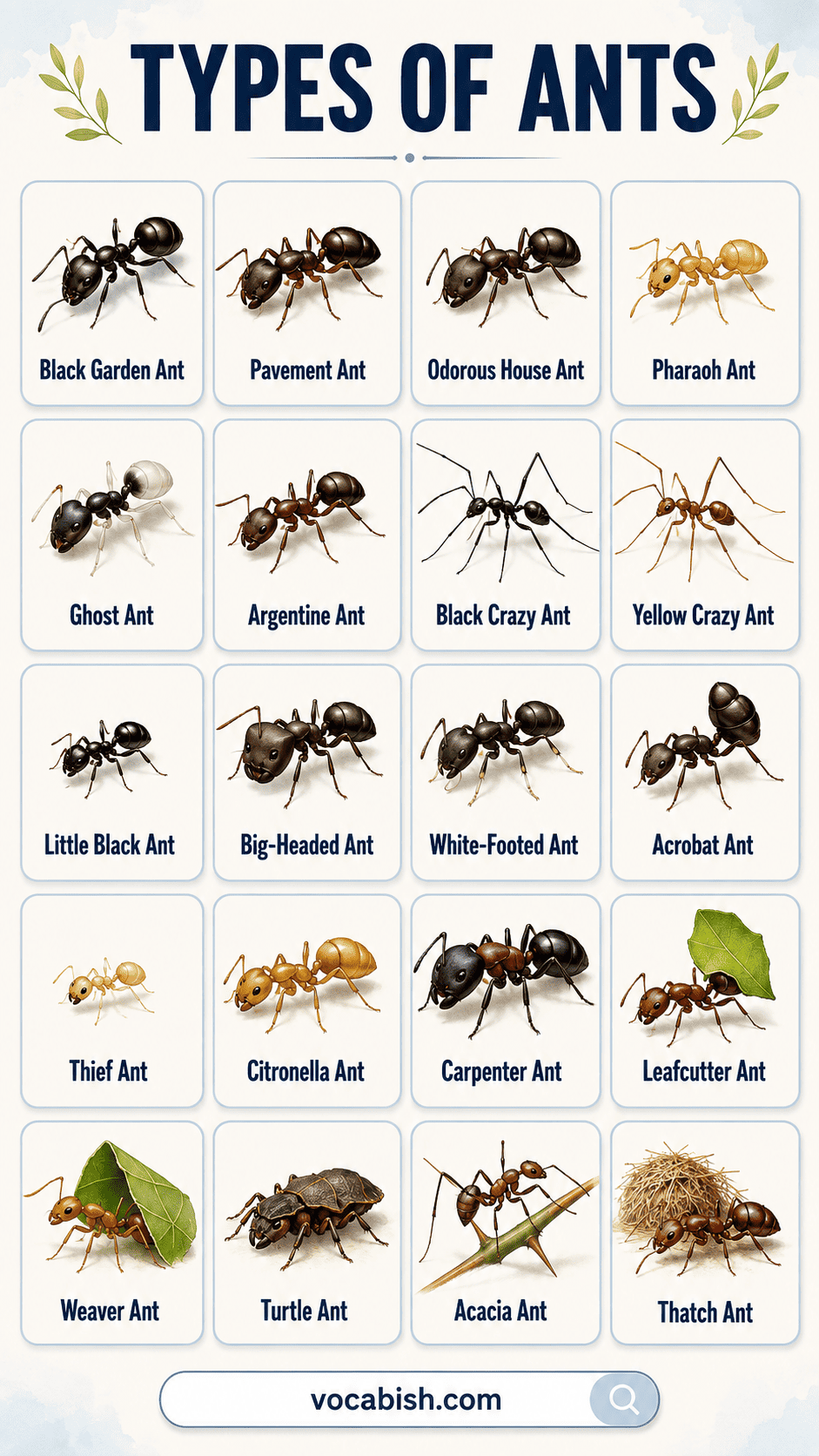
40 Types of Ants: Explained
Ants can be organised according to their habitat, nesting style, diet, defence, hunting behaviour, and relationship with humans or plants. Some categories overlap because one ant may possess several specialised traits.
Household and Garden Ants
These ants frequently occur around buildings, gardens, pavements, walls, kitchens, lawns, and other human-modified environments.
- Black Garden Ant (Lasius niger): Dark workers commonly nest outdoors and enter buildings searching for sugary foods.
- Pavement Ant (Tetramorium species): Small brown ants build colonies beneath paths, stones, foundations, and pavements.
- Odorous House Ant (Tapinoma sessile): Crushed workers release a coconut-like smell and form persistent indoor trails.
- Pharaoh Ant (Monomorium pharaonis): Tiny yellow ants establish warm indoor colonies through frequent colony budding.
- Ghost Ant (Tapinoma melanocephalum): Pale legs and abdomens make these tiny household ants difficult to notice.
- Argentine Ant (Linepithema humile): Invasive brown workers form enormous connected colonies and overwhelm native ants.
- Black Crazy Ant (Paratrechina longicornis): Long-legged dark ants move unpredictably and forage rapidly across exposed surfaces.
- Yellow Crazy Ant (Anoplolepis gracilipes): Slender yellow-brown ants move frantically and spray defensive formic acid.
- Little Black Ant (Monomorium minimum): Minute shiny workers nest in sheltered cavities and follow visible food trails.
- Big-Headed Ant (Pheidole megacephala): Major workers possess enlarged heads used for defence and processing food.
- White-Footed Ant (Technomyrmex difficilis): Dark workers have pale feet and commonly trail around buildings and trees.
- Acrobat Ant (Crematogaster species): Workers raise their heart-shaped abdomens overhead when disturbed or defending nests.
- Thief Ant (Solenopsis molesta): Extremely small yellow ants nest near other colonies and steal brood.
- Citronella Ant (Lasius species): Yellow subterranean ants release a lemony smell and tend root-feeding insects.
Nest-Building and Ecological Specialists
These ants are recognised by specialised nests, food-storage systems, plant relationships, farming behaviour, seed collection, or environmental adaptations.
- Carpenter Ant (Camponotus species): Large workers excavate damp wood for nesting but never consume timber.
- Leafcutter Ant (Atta and Acromyrmex): Workers harvest vegetation to cultivate fungus within extensive underground nest chambers.
- Weaver Ant (Oecophylla species): Arboreal workers pull leaves together and bind them using larval silk.
- Turtle Ant (Cephalotes species): Flattened tree-dwelling ants glide between branches and block narrow nest entrances.
- Acacia Ant (Pseudomyrmex species): Thorn-dwelling ants protect host trees while receiving food and secure shelter.
- Thatch Ant (Formica species): Workers construct prominent plant-material mounds in sunny woodland and grassland habitats.
- Wood Ant (Formica rufa group): Large forest ants build mound nests and spray defensive formic acid.
- Honeypot Ant (Myrmecocystus and related genera): Specialised workers store liquid food inside greatly expanded, swollen abdomens.
- Harvester Ant (Pogonomyrmex, Messor, and related genera): Seed-collecting workers build ground nests and store grains for later consumption.
- Meat Ant (Iridomyrmex purpureus group): Australian workers forage widely, defend territories, and build conspicuous gravel-covered nests.
- Silver Ant (Cataglyphis bombycina): Reflective body hairs help desert workers tolerate extreme daytime temperatures.
- Green-Head Ant (Rhytidoponera metallica): Metallic Australian workers hunt on the ground and deliver painful stings.
- Mound Ant (Formica exsectoides): Field-dwelling ants construct conspicuous soil mounds in warm, open locations.
- Field Ant (Formica species): Medium-to-large outdoor ants build soil nests and rarely colonise buildings.
Stinging, Predatory, and Raiding Ants
These ants are known for powerful stings, specialised jaws, organised hunting, temporary nests, collective raids, or aggressive colony defence.
- Red Imported Fire Ant (Solenopsis invicta): Aggressive reddish workers build mounds and repeatedly sting nearby animals or people.
- Tropical Fire Ant (Solenopsis geminata): Reddish-brown invasive workers nest in soil and defend colonies with stings.
- Bullet Ant (Paraponera clavata): Large rainforest workers possess an exceptionally painful defensive sting when threatened.
- Bulldog Ant (Myrmecia species): Large sharp-eyed Australian ants hunt individually using powerful mandibles and stings.
- Jack Jumper Ant (Myrmecia pilosula group): Agile Australian ants jump when threatened and deliver venomous defensive stings.
- Trap-Jaw Ant (Odontomachus and related genera): Long mandibles snap rapidly for hunting, defence, and escape movements.
- Army Ant: Nomadic colonies conduct coordinated swarm raids rather than maintaining permanent nests.
- Driver Ant (Dorylus species): Large African army ants form predatory columns guarded by powerful soldiers.
- Asian Needle Ant (Brachyponera chinensis): Dark invasive ants prefer moist nesting sites and can sting painfully.
- Dracula Ant: Predatory adults feed by drinking small amounts of haemolymph from larvae.
- Marauder Ant (Carebara diversa and relatives): Polymorphic workers raid collectively while oversized soldiers process large captured prey.
- Slave-Making Ant (Polyergus and related genera): Raiders steal brood from neighbouring species, creating dependent mixed-colony workforces.
Important Differences Between Ant Classifications
Classification | Meaning | Example | Main Difference |
|---|---|---|---|
Species | One formally recognised ant species | Bullet ant | Most precise scientific classification |
Genus-based group | Several related species within one genus | Carpenter ants | Includes multiple separate species |
Species group | Closely related species sharing similar features | Jack jumper ants | Members may be difficult to separate |
Behavioural group | Ants sharing a specialised lifestyle | Army ants | Defined mainly by behaviour |
Ecological group | Ants sharing habitat or feeding strategies | Harvester ants | May include unrelated genera |
Caste | A role within an ant colony | Queen or worker | Not a separate ant type |
Informal name | A regional or descriptive common name | Sugar ant | Meaning may vary geographically |
Different Types of Ants: Compared
Ant Type | Main Habitat | Defining Feature | Typical Nest |
|---|---|---|---|
Carpenter Ant | Forests and buildings | Excavates damaged or damp wood | Wooden galleries |
Leafcutter Ant | Tropical and subtropical areas | Cultivates fungus using plant material | Large underground chambers |
Weaver Ant | Trees and shrubs | Joins leaves using larval silk | Folded leaf nests |
Harvester Ant | Dry grasslands and deserts | Collects and stores seeds | Underground granaries |
Fire Ant | Open soil and disturbed land | Aggressive colony defence | Visible soil mounds |
Army Ant | Tropical forests | Conducts coordinated group raids | Temporary living nests |
Honeypot Ant | Dry environments | Stores liquid inside specialised workers | Underground chambers |
Trap-Jaw Ant | Tropical and subtropical habitats | Possesses rapidly closing mandibles | Soil or rotting wood |
How to Identify Different Types of Ants
- Examine whether the narrow waist contains one node or two.
- Look for elbowed antennae, which distinguish ants from many similar insects.
- Compare body size, colour, hairs, spines, mandibles, and head proportions.
- Observe whether workers are similar-sized or divided into minor and major forms.
- Check whether the colony nests in soil, wood, walls, leaves, or mounds.
- Record trails, movement speed, odour, active time, food preference, and aggression.
Colour alone cannot confirm an ant species. Several unrelated species may appear black, brown, yellow, or red, while workers from one colony can differ considerably in size.
Accurate identification may require clear close-up photographs, geographical location, worker specimens, and examination under magnification.
Terms and Confusions About Types of Ants
- Ants are not termites: Ants have elbowed antennae and narrow waists, while termites have broader waists and straighter antennae.
- Flying ants are not separate species: They are winged queens and males leaving established colonies to reproduce.
- Carpenter ants do not eat wood: They excavate wood to create protected nesting galleries.
- Not every red ant is a fire ant: Many unrelated ant species have reddish bodies.
- Army ants and driver ants are not identical terms: Driver ants are particular members of the broader army-ant group.
- Queens and soldiers are not separate species: They are specialised castes within the same colony.
- Velvet ants are not true ants: They are wingless female wasps with ant-like bodies.
- Common names vary between regions: Names such as sugar ant may describe different species.
Summary of the Main Ant Types
Category | Key Characteristic | Common Examples | Best Known For |
|---|---|---|---|
Household ants | Regularly enter buildings | Pharaoh, ghost, odorous house | Indoor food trails |
Garden ants | Common in soil and lawns | Black garden, pavement, field | Outdoor nesting |
Wood-nesting ants | Excavate or occupy wood | Carpenter, acrobat | Wooden nest galleries |
Plant-associated ants | Live in or protect vegetation | Weaver, acacia, turtle | Relationships with trees |
Fungus-growing ants | Cultivate fungus for food | Leafcutter ants | Underground fungus gardens |
Seed-collecting ants | Gather and store seeds | Harvester ants | Underground grain storage |
Desert ants | Possess heat and drought adaptations | Silver, honeypot | Survival in dry habitats |
Mound-building ants | Construct visible raised nests | Wood, thatch, fire ants | Large surface mounds |
Stinging ants | Defend colonies using venom | Fire, bullet, bulldog | Painful defensive stings |
Raiding ants | Hunt or capture brood collectively | Army, driver, slave-making | Organised colony raids |
FAQs About Types of Ants
Scientists recognise more than 14,000 described ant species worldwide. The exact total continues changing because new species are discovered, existing species are reclassified, and some difficult groups require further taxonomic research.
Common practical groups include household ants, wood-nesting ants, plant-associated ants, seed collectors, fungus growers, mound builders, stinging ants, predators, and raiders. These categories describe behaviour or habitat rather than formal ranks.
There is no single most common ant worldwide. Black garden ants are familiar across much of Europe, while pavement, Argentine, odorous house, and fire ants are common in other regions.
Begin with body size, colour, waist nodes, antennae, thoracic shape, hairs, spines, and mandibles. Close photographs, nest location, trail behaviour, odour, and local distribution provide additional evidence for accurate identification.
No, carpenter ants and termites are different insects. Carpenter ants excavate wood for nesting without eating it, whereas termites consume cellulose and have straighter antennae, broader waists, and differently proportioned wings.
Fire ants, bullet ants, bulldog ants, jack jumpers, Asian needle ants, and several other groups can sting. Reactions vary, and anyone experiencing breathing difficulty or severe swelling needs urgent medical assistance.
No, red colouring does not prove an ant is a fire ant. Many harvester, field, wood, acrobat, and bulldog ants appear reddish, so body structure, behaviour, nest form, and location matter.
Army ants form a broad behavioural and evolutionary group known for collective raids and temporary nesting. Driver ants are particular African and Asian army ants, mainly belonging to the genus Dorylus.
What To Know About Types of Ants
- More than 14,000 described ant species are scientifically recognised.
- Ant names may represent species, genera, related groups, or behaviours.
- Household, nesting, ecological, stinging, and raiding categories can overlap.
- Antennae, waist nodes, mandibles, nesting sites, and behaviour support identification.
- Queens, workers, soldiers, and males are colony castes, not species.
- Colour alone is not reliable enough for accurate ant identification.
Conclusion
The many types of ants differ in body structure, habitat, diet, nesting behaviour, colony organisation, and defensive abilities. Household ants commonly search buildings for food, while carpenter, weaver, leafcutter, harvester, and honeypot ants possess specialised nesting or feeding strategies. Fire ants, bullet ants, bulldog ants, and Asian needle ants are known for defensive stings, whereas army, driver, and marauder ants conduct organised raids.
Understanding these differences makes ants easier to recognise and compare. Examining the waist, antennae, mandibles, worker sizes, nest location, and movement patterns provides more dependable identification than relying only on body colour.
You May Also Like