

Freshwater habitats support far more animal life than fish alone. Freshwater animal names include fish, amphibians, reptiles, mammals, insects, crustaceans, mollusks, and other creatures found in rivers, lakes, ponds, streams, springs, and wetlands. Some spend their entire lives in fresh water, while others depend on it for feeding, breeding, or part of their life cycle. The sections below cover the major freshwater animal groups and a wide range of useful English names.
Explore more animals with their starting letter:
A | B | C | D | E | F | G | H | I | J | K | L | M | N | O | P | Q | R | S | T | V | W | YCommon Freshwater Animal Names with Pictures
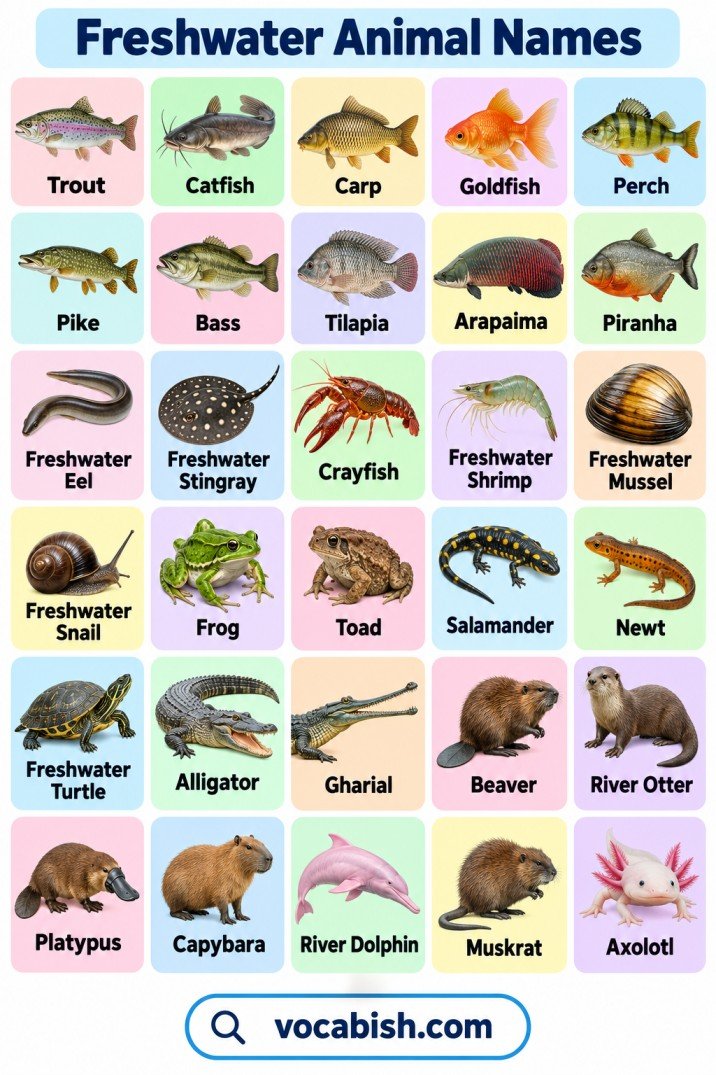
These are some of the most familiar animals associated with rivers, lakes, ponds, streams, and wetlands. Learning them first gives you a useful base for understanding freshwater wildlife vocabulary.
Trout
Trout are freshwater fish commonly found in cool, clean rivers, streams, and lakes. They feed on insects, small fish, and other aquatic animals. Rainbow trout and brown trout are two well-known types. Trout are strong swimmers and usually prefer water with plenty of oxygen.
Catfish
Catfish are named for the whisker-like structures called barbels around their mouths. Many species live in rivers, lakes, ponds, and reservoirs. They often search for food near the bottom. Catfish range from very small species to extremely large river fish.
Carp
Carp are sturdy freshwater fish found in lakes, ponds, canals, and slow-moving rivers. They usually eat plants, insects, worms, and other small organisms. Common carp can survive in many different water conditions.
Goldfish
Goldfish are freshwater fish originally developed from wild carp in East Asia. They are now among the world’s best-known aquarium and pond fish. Goldfish come in many colours, shapes, and fin types. They can grow much larger than many people expect when given enough space.
Perch
Perch are freshwater fish with noticeable spiny dorsal fins. They live in lakes, rivers, and reservoirs and usually feed on insects, crustaceans, and smaller fish. The yellow perch is a familiar North American species. Perch often gather in groups called schools.
Pike
Pike are long-bodied predatory fish with large mouths and sharp teeth. They usually hide among aquatic plants before attacking smaller fish. Northern pike live across parts of Europe, Asia, and North America. Their streamlined bodies help them accelerate quickly through the water.
Bass
Several popular freshwater fish are known as bass. Largemouth bass and smallmouth bass are common examples in North America. They are predators that eat fish, frogs, insects, and crayfish. Largemouth bass are especially recognizable by their wide mouths.
Tilapia
Tilapia is a common name for several freshwater fish from the cichlid family. Many species live naturally in warm rivers and lakes. Tilapia mainly eat plants, algae, and small aquatic organisms. They are also widely raised in fish farms.
Salmon
Salmon have an unusual life cycle because many species live in both fresh water and the ocean. They are generally born in rivers, migrate to the sea, and later return to fresh water to reproduce. Young salmon may remain in streams for months or years. This movement between fresh and salt water is called anadromous migration.
Sturgeon
Sturgeons are ancient-looking fish with rows of hard plates called scutes along their bodies. Many species live in large rivers and lakes, although some migrate between rivers and seas. They feed mainly near the bottom. Several sturgeon species can grow to impressive sizes.
Piranha
Piranhas are freshwater fish native to rivers and lakes in South America. They have strong jaws and sharp teeth, but their diets vary by species. Some eat fish and other animals, while others also consume plants, seeds, or fruit. They are closely related to pacus.
Arapaima
The arapaima is one of the largest freshwater fish in the world. It lives mainly in the Amazon River basin of South America. Arapaima can breathe air using a specialized organ, so they regularly come to the surface. Their ability to breathe air helps them survive in water with low oxygen levels.
Freshwater Stingray
Freshwater stingrays are flat-bodied rays that live in South American river systems. Their eyes are on top of the body, while the mouth lies underneath. They often rest on sandy or muddy river bottoms. Like many marine rays, they have a defensive spine on the tail.
Freshwater Eel
Freshwater eels have long, snake-like bodies and live in rivers, streams, and lakes. Species in the genus Anguilla spend much of their lives in fresh water but migrate to the ocean to reproduce. This life cycle is called catadromous migration. Eels feed on insects, crustaceans, worms, and fish.
Crayfish
Crayfish are freshwater crustaceans that resemble small lobsters. They live under rocks, logs, plants, and other shelters in streams, ponds, and lakes. Their front pair of legs usually carries strong claws. Crayfish eat plants, insects, dead material, and small aquatic animals.
Freshwater Shrimp
Freshwater shrimp are small crustaceans found in rivers, streams, ponds, lakes, and wetlands. Many species feed on algae and tiny pieces of organic matter. They help recycle nutrients within aquatic ecosystems. Some species are also popular in freshwater aquariums.
Freshwater Mussel
Freshwater mussels are mollusks protected by two hard shells. Most live partly buried in river or lake bottoms. They feed by filtering tiny particles from the water. Many species have larvae that temporarily attach to fish before developing into young mussels.
Freshwater Snail
Freshwater snails are mollusks found on rocks, plants, mud, and other submerged surfaces. Many feed on algae and decaying organic matter. Their shells protect their soft bodies. Some species breathe through gills, while others use lung-like structures.
Frog
Most frogs depend on fresh water for reproduction. Their eggs usually hatch into aquatic larvae called tadpoles. Tadpoles gradually develop legs and transform into adult frogs. Many adults live around ponds, lakes, streams, marshes, and wet forests.
Salamander
Many salamanders live in or close to freshwater habitats. Some species remain aquatic throughout life, while others return to water mainly for breeding. Their larvae commonly have visible external gills. Salamanders usually eat insects, worms, crustaceans, and other small animals.
Freshwater Turtle
Freshwater turtles live in ponds, lakes, rivers, marshes, and slow-moving waterways. They often rest on logs or rocks to warm themselves in sunlight. Different species eat plants, insects, fish, snails, or other animals. Snapping turtles and softshell turtles are familiar examples.
Alligator
Alligators are large reptiles commonly associated with freshwater wetlands, rivers, ponds, lakes, and swamps. American alligators occur naturally in the southeastern United States. They eat fish, turtles, birds, mammals, and other available prey. Their powerful tails help them move efficiently through water.
River Otter
River otters are semi-aquatic mammals adapted for swimming and hunting in water. They have streamlined bodies, strong tails, and webbed feet. Their diet includes fish, frogs, crayfish, and other aquatic animals. Different river otter species occur in North America, South America, Europe, and Asia.
Beaver
Beavers are semi-aquatic rodents well known for building dams and lodges. They live around rivers, streams, ponds, and lakes. Their broad, flat tails help with swimming and balance. Beavers mainly eat bark, leaves, twigs, and aquatic vegetation.
Platypus
The platypus is a semi-aquatic mammal native to eastern Australia and Tasmania. It searches freshwater streams and rivers for insect larvae, worms, and small crustaceans. It has webbed feet and a broad, sensitive bill. Unlike most mammals, the platypus lays eggs.
River Dolphin
River dolphins are aquatic mammals adapted to life in large freshwater river systems. Examples include the Amazon river dolphin, Ganges river dolphin, and Indus river dolphin. They use echolocation to navigate and locate prey. Their diet consists mainly of fish and other aquatic animals.
Hippopotamus
The hippopotamus spends much of the day in rivers, lakes, and other freshwater habitats in sub-Saharan Africa. Water helps protect its skin from heat and strong sunlight. Hippos normally leave the water to feed on land, especially at night. Their diet consists mainly of grasses.

Freshwater Fish Names
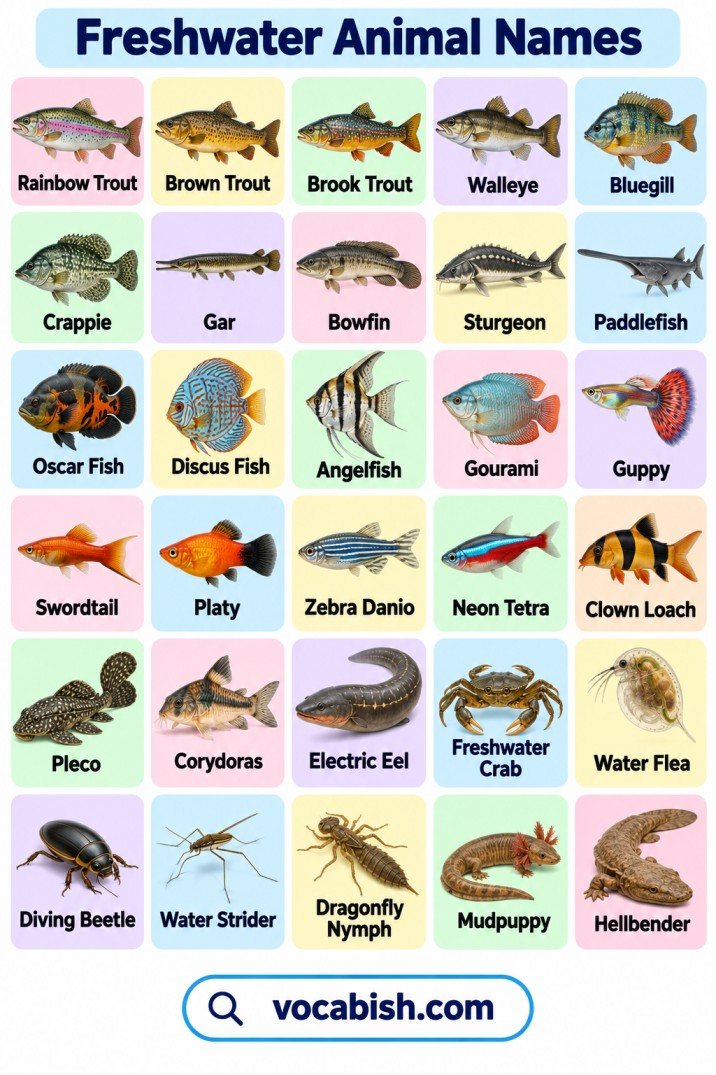
Fishes from the freshwater form one of the largest and most varied groups of animals in inland waters. These names include river fish, lake fish, aquarium species, and migratory species that spend important life stages in fresh water.
- Rainbow Trout
- Brown Trout
- Brook Trout
- Lake Trout
- Cutthroat Trout
- Common Carp
- Grass Carp
- Crucian Carp
- Goldfish
- Koi
- Channel Catfish
- Blue Catfish
- Flathead Catfish
- Wels Catfish
- Yellow Perch
- European Perch
- Largemouth Bass
- Smallmouth Bass
- Striped Bass
- Peacock Bass
- Northern Pike
- Muskellunge
- Walleye
- Sauger
- Black Crappie
- White Crappie
- Bluegill
- Pumpkinseed
- Green Sunfish
- Bowfin
- Alligator Gar
- Longnose Gar
- Paddlefish
- Lake Sturgeon
- Beluga Sturgeon
- Atlantic Salmon
- Chinook Salmon
- Sockeye Salmon
- Coho Salmon
- Arctic Char
- European Eel
- American Eel
- Arapaima
- Red-Bellied Piranha
- Pacu
- Silver Arowana
- Freshwater Angelfish
- Discus
- Oscar
- Guppy
- Platy
- Swordtail
- Zebra Danio
- Neon Tetra
- Cardinal Tetra
- Tiger Barb
- Clown Loach
- Kuhli Loach
- Siamese Fighting Fish
- Dwarf Gourami
- Giant Gourami
- Common Pleco
- Corydoras
- Freshwater Stingray
- Electric Eel
- Electric Catfish
- Nile Tilapia
- Mozambique Tilapia
- Nile Perch
- Mahseer
- Rohu
- Mrigal
- Hilsa
- Snakehead
- Mudfish
- Goby
- Minnow
- Stickleback
Here’s a complete guide on: 250+ Different Types of Fish
Freshwater Mammals
Several mammals live permanently in freshwater environments or spend a large part of their lives in rivers, lakes, marshes, and wetlands.
- Beaver
- North American River Otter
- Eurasian Otter
- Giant Otter
- Smooth-Coated Otter
- Muskrat
- Water Vole
- Capybara
- Nutria
- Platypus
- Hippopotamus
- Pygmy Hippopotamus
- Amazon River Dolphin
- Ganges River Dolphin
- Indus River Dolphin
- La Plata Dolphin
- Amazonian Manatee
- Russian Desman
- Pyrenean Desman
- Water Opossum
Related Resources: Mammals Name with Pictures
Freshwater Reptiles
Freshwater reptiles include turtles, crocodilians, snakes, and other species closely associated with rivers, lakes, swamps, and wetlands.
- American Alligator
- Chinese Alligator
- Freshwater Crocodile
- Nile Crocodile
- Gharial
- Spectacled Caiman
- Black Caiman
- Common Snapping Turtle
- Alligator Snapping Turtle
- Painted Turtle
- Red-Eared Slider
- Yellow-Bellied Slider
- Map Turtle
- Musk Turtle
- Mud Turtle
- Softshell Turtle
- Pig-Nosed Turtle
- Mata Mata
- Fly River Turtle
- Northern Water Snake
- Dice Snake
- Anaconda
- Water Monitor
Read more about the different types and names of reptiles with pictures.
Freshwater Amphibians
Fresh water is especially important for amphibians because many species lay their eggs and complete their larval stage in water.
- Common Frog
- Bullfrog
- Green Frog
- Leopard Frog
- Marsh Frog
- Pool Frog
- Tree Frog
- Glass Frog
- African Clawed Frog
- Surinam Toad
- Fire-Bellied Toad
- Common Toad
- Cane Toad
- Axolotl
- Tiger Salamander
- Spotted Salamander
- Fire Salamander
- Mudpuppy
- Hellbender
- Olm
- Alpine Newt
- Great Crested Newt
- Smooth Newt
- Caecilian
You may also like: Amphibians Name in English
Freshwater Crustaceans
Freshwater crustaceans range from large crayfish and prawns to tiny animals that form an important part of aquatic food webs.
- Crayfish
- Freshwater Prawn
- Freshwater Shrimp
- Ghost Shrimp
- Amano Shrimp
- Cherry Shrimp
- Bamboo Shrimp
- Vampire Shrimp
- Freshwater Crab
- Thai Micro Crab
- Water Flea
- Seed Shrimp
- Copepod
- Scud
- Freshwater Isopod
Here’s a complete guide on: Crustaceans with Names and Pictures
Freshwater Mollusks
Rivers, lakes, ponds, streams, and wetlands support many freshwater snails, mussels, and clams.
- Freshwater Mussel
- Pearl Mussel
- Zebra Mussel
- Quagga Mussel
- Swan Mussel
- Duck Mussel
- Freshwater Clam
- Asian Clam
- Pea Clam
- Pond Snail
- Ramshorn Snail
- Mystery Snail
- Apple Snail
- Nerite Snail
- Bladder Snail
- Trumpet Snail
- Freshwater Limpet
Read more about the names of Mollusks with their pictures.
Freshwater Insects and Other Aquatic Invertebrates
Many small animals spend all or part of their lives underwater. Some become flying adults after completing their aquatic juvenile stage.
- Dragonfly Nymph
- Damselfly Nymph
- Mayfly Nymph
- Stonefly Nymph
- Caddisfly Larva
- Mosquito Larva
- Water Strider
- Water Boatman
- Backswimmer
- Giant Water Bug
- Diving Beetle
- Whirligig Beetle
- Water Scorpion
- Dobsonfly Larva
- Midge Larva
- Freshwater Leech
- Tubifex Worm
- Freshwater Planarian
- Hydra
- Freshwater Sponge
- Freshwater Jellyfish
- Freshwater Bryozoan
- Horsehair Worm
- Rotifer
- Tardigrade
Explore more about Invertebrates Animal with their pictures.
Freshwater Birds
Many birds depend heavily on inland water for feeding, nesting, resting, or breeding.
- Mallard
- Mandarin Duck
- Wood Duck
- Muscovy Duck
- Canada Goose
- Greylag Goose
- Mute Swan
- Whooper Swan
- Kingfisher
- Great Blue Heron
- Grey Heron
- Great Egret
- Little Egret
- Cattle Egret
- Moorhen
- Coot
- Purple Swamphen
- Grebe
- Bittern
- Spoonbill
- Ibis
- Stork
- Jacana
- Dipper
- Osprey
- Cormorant
- Pelican
Herer’s the complete list and types of birds with their pictures.
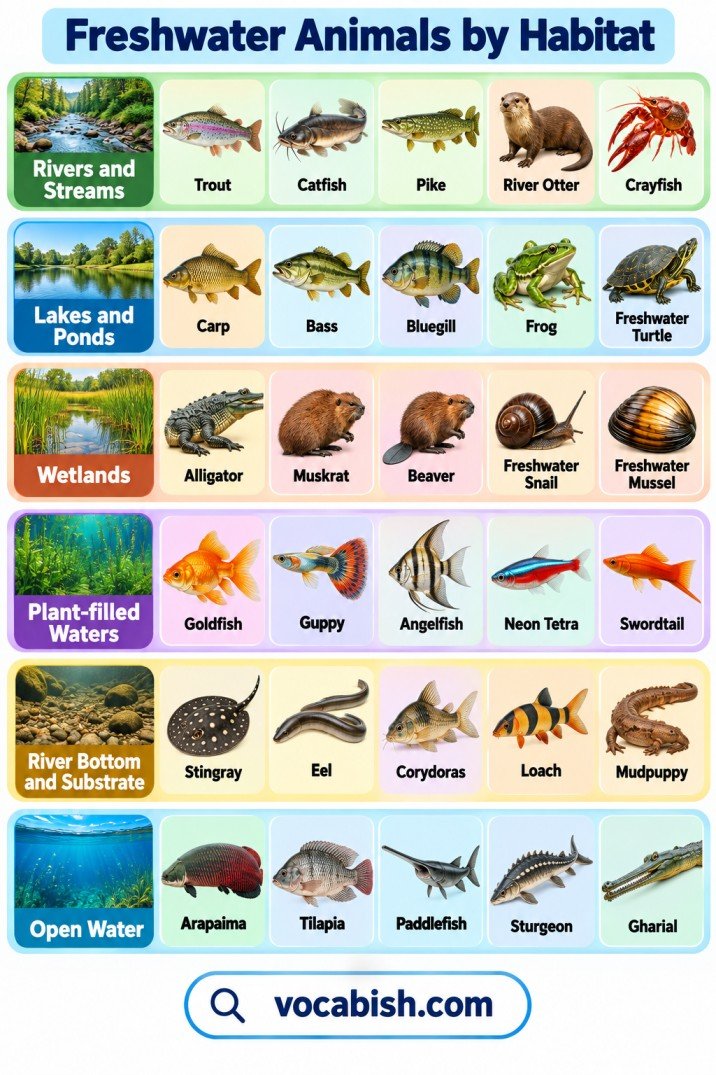
Freshwater Animals by Habitat
Freshwater habitats differ in water movement, depth, temperature, vegetation, and oxygen levels. Some animals can use several habitats, so the groups below are useful habitat examples rather than strict biological divisions.
River Animals
- River Dolphin
- River Otter
- Trout
- Salmon
- Catfish
- Sturgeon
- Mahseer
- Freshwater Eel
- Freshwater Stingray
- Crayfish
- Freshwater Mussel
- Gharial
- Kingfisher
Lake Animals
- Lake Trout
- Perch
- Pike
- Walleye
- Carp
- Bass
- Catfish
- Freshwater Snail
- Freshwater Mussel
- Beaver
- Grebe
- Swan
Pond Animals
- Goldfish
- Carp
- Frog
- Toad
- Newt
- Salamander
- Pond Snail
- Water Flea
- Dragonfly Nymph
- Water Strider
- Diving Beetle
- Duck
Stream Animals
- Brook Trout
- Minnow
- Crayfish
- Stonefly Nymph
- Mayfly Nymph
- Caddisfly Larva
- Salamander
- Freshwater Shrimp
- River Otter
- Dipper
Wetland and Marsh Animals
- Alligator
- Caiman
- Frog
- Turtle
- Muskrat
- Capybara
- Hippopotamus
- Moorhen
- Coot
- Heron
- Egret
- Dragonfly
Difference between Freshwater, Marine, and Brackish Animals
The main difference between these groups is the amount of salt in their normal aquatic habitat.
Water Type | Meaning | Common Habitats | Animal Examples |
|---|---|---|---|
Freshwater | Water with very little dissolved salt | Rivers, lakes, ponds, streams | Trout, carp, frog, beaver |
Marine | Salt water | Oceans and seas | Tuna, shark, octopus, sea turtle |
Brackish | Mixture of fresh and salt water | Estuaries, lagoons, mangroves | Mudskipper, some gobies, some mollusks |
Some animals move between these environments. Salmon migrate from rivers to the ocean and later return to fresh water, while freshwater eels generally make the opposite journey to reproduce.
Difference Between Freshwater and Saltwater Animals
Freshwater and saltwater animals mainly differ in the amount of salt in their habitat and the way their bodies control water and minerals. The table below covers the most important practical differences.
Feature | Freshwater Animals | Saltwater Animals |
|---|---|---|
Habitat | Rivers, lakes, ponds, and streams | Oceans, seas, and coral reefs |
Salt Level | Live in water with very little salt | Live in water with high salt content |
Water Balance | Their bodies take in water easily | Their bodies lose water more easily |
Salt Balance | Need to retain important salts | Need to remove excess salt |
Fish Drinking | Most freshwater fish drink little water | Many saltwater fish drink seawater |
Urine | Usually produce more dilute urine | Usually produce less urine to save water |
Common Examples | Trout, carp, catfish, frog, crayfish | Shark, tuna, octopus, lobster, sea turtle |
Main Adaptation | Adapted to low-salinity water | Adapted to high-salinity water |
Habitat Change | Most cannot survive long in seawater | Most cannot survive long in freshwater |
How to Use These Freshwater Animal Names
Start with familiar animals such as trout, frog, turtle, catfish, beaver, and crayfish. Match each name with a clear picture and then place it into a group such as fish, mammal, reptile, amphibian, or invertebrate.
After learning individual names, practise them by habitat. For example, connect trout with a stream, beaver with a river or pond, and alligator with a freshwater wetland.
Fun Facts About Freshwater Animals
- Some freshwater fish can breathe air. Arapaima rise to the surface regularly and use a specialized organ to take oxygen directly from the air.
- Electric eels can produce powerful electric shocks. They use electricity for hunting, defense, navigation, and sensing nearby objects in dark or muddy water.
- Freshwater mussels help clean the water. They are filter feeders that remove tiny particles from rivers and lakes as water passes through their bodies.
- River dolphins use echolocation to find their way. This ability is especially useful in muddy rivers where underwater visibility can be very poor.
- Beavers can change an entire freshwater habitat. By building dams, they create ponds and wetlands that provide shelter and food for many other species.
- Some freshwater animals migrate between rivers and oceans. Salmon travel from freshwater to the sea and return to rivers to reproduce, while freshwater eels generally make the opposite journey.
- Axolotls can regrow lost body parts. These unusual freshwater salamanders can regenerate limbs and repair parts of organs, including portions of the heart and spinal cord.
- Freshwater stingrays live far from the ocean. Several species spend their entire lives in South American rivers, including parts of the Amazon and Paraná river systems.
Practice: Test Your Freshwater Animal Vocabulary
Match each animal with the correct clue.
- Beaver
- Trout
- Frog
- Crayfish
- River Dolphin
- Freshwater Mussel
- Alligator
- Platypus
A. A freshwater crustacean with strong claws
B. A fish that often lives in cool, oxygen-rich water
C. A reptile found in freshwater wetlands
D. A mammal famous for building dams
E. A shell-bearing animal that filters food from water
F. An egg-laying semi-aquatic mammal
G. An amphibian whose young are called tadpoles
H. An aquatic mammal found in major river systems
Answers
- D
- B
- G
- A
- H
- E
- C
- F
FAQs
Freshwater animals are species that live permanently or partly in rivers, lakes, ponds, streams, springs, marshes, and other low-salt aquatic habitats.
Five familiar freshwater animals are trout, catfish, frog, crayfish, and beaver. They represent fish, amphibians, crustaceans, and semi-aquatic mammals.
Many trout, catfish, crayfish, freshwater mussels, snails, aquatic insects, and amphibians spend their entire lives or major life stages in freshwater habitats.
Yes. Most frogs depend on freshwater environments for breeding because their eggs and tadpoles usually develop in ponds, streams, wetlands, or other inland waters.
Some crocodile species regularly inhabit freshwater rivers, lakes, and wetlands. Other species can also enter brackish or saltwater environments, depending on the species.
Salmon use freshwater habitats for spawning and early development, but many species later migrate to the ocean before returning to rivers to reproduce.
Several fish compete for this distinction depending on measurement criteria. Giant freshwater stingrays, giant catfish, arapaima, and some sturgeons can reach exceptionally large sizes.
Small freshwater animals include water fleas, copepods, shrimp, snails, insect larvae, hydra, planarians, rotifers, amphipods, and many microscopic aquatic organisms.
Related Animal Vocabulary
- Marine Mammal Names
- Vertebrate Animal Names
- Invertebrate Animal Names
- Amphibian Names
- Fish Names in English
- Different Types of Saltwater Animals
Conclusion
Freshwater animal names cover far more than fish. Rivers, lakes, ponds, streams, and wetlands support mammals, reptiles, amphibians, crustaceans, mollusks, insects, birds, and many other forms of life. Learning the names by animal group and habitat makes the vocabulary easier to recognize, remember, and connect with pictures.