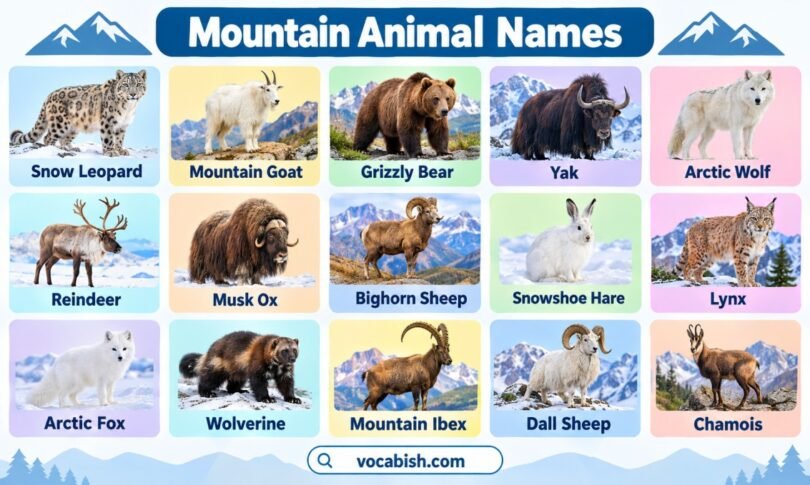

Mountain animal names in English include many species that live on high peaks, rocky slopes, alpine meadows, and mountain forests. You will find familiar names such as snow leopard, mountain goat, and golden eagle, along with less common animals like the markhor and Himalayan tahr. These animals have special features that help them survive cold weather, steep terrain, thin air, and limited food. This list covers mountain mammals, birds, reptiles, amphibians, and invertebrates, with useful names and short facts for English vocabulary and general knowledge.
Common Mountain Animal Names Explained with Pictures
Below are some of the most well-known mountain animal names, with short facts about each one.
Snow Leopard
High in the mountains of Central and South Asia, the snow leopard moves quietly across rocky slopes. Its thick fur keeps it warm, while its wide paws help it walk on snow. A long tail gives it balance on steep ground. Its spotted coat also helps it blend into rocks and snow while hunting wild sheep, goats, and other animals.
Mountain Goat
On the steep mountain cliffs of western North America, the mountain goat moves with surprising confidence. Its strong legs and sharp hooves give it a firm grip on rocky surfaces. A thick white coat protects it from freezing weather. It often lives high above the forest, where the terrain is difficult for many other animals to reach.
Bighorn Sheep
Rocky mountains across North America are home to the bighorn sheep. The males, known as rams, are easy to recognise because of their large curved horns. These animals are strong climbers and can move quickly along narrow slopes. Grasses, shrubs, and other plants make up much of their diet.
Ibex
An ibex looks a little like a wild goat, but several different species belong to this group. They are found in mountainous parts of Europe, Asia, and Africa. Their large horns curve backwards, and their split hooves help them stay steady on rocky ground. The Alpine ibex, Nubian ibex, and Siberian ibex are some well-known examples.
Markhor
The markhor is one of the most striking wild goats found in the mountains of Central and South Asia. Its long horns twist upward in a distinctive spiral shape. Despite its heavy appearance, it is an agile climber on steep rocky slopes. You can find this animal in mountain regions linked with the Himalayas and Hindu Kush.
Himalayan Tahr
The Himalayan tahr spends its days among the steep slopes and rocky areas of the Himalayas. Its reddish-brown coat becomes especially useful in cold weather. Strong legs and sturdy hooves make climbing easier on rough ground. Grasses, leaves, herbs, and other plants provide most of its food.
Chamois
In the European mountains, the chamois is known for its speed and sure-footed movement. It has short, hooked horns and strong legs that help it cross cliffs and steep slopes. Even loose rocky ground, called scree, does not easily stop it. Its usual food includes grasses, herbs, and other mountain plants.
Yak
The yak is closely connected with the high mountains and plateaus of Asia. Its long, thick hair protects it from bitter cold and strong winds. Yaks are also valued by people for milk, meat, fibre, and carrying heavy loads. Wild yaks are much larger than domestic ones and live mainly in remote parts of the Tibetan Plateau.
Takin
With its heavy body and short legs, the takin may look unusual at first. It lives in mountain forests and on rocky slopes in the eastern Himalayas and nearby areas. The animal can handle rough ground surprisingly well. Most of its food comes from grasses, leaves, shoots, and other vegetation.
Brown Bear
Brown bears are not found only in mountains, but many populations make their homes in mountain forests and valleys. They have strong bodies, powerful claws, and a varied diet. Depending on the region, they may eat plants, berries, insects, fish, and other animals. The grizzly bear is a type of brown bear native to North America.
Himalayan Brown Bear
The Himalayan brown bear lives in some of the high mountain areas of Central and South Asia. Its thick coat helps it deal with cold conditions, especially at higher elevations. Food can change with the season, so it may eat plants, insects, small animals, and other available foods. Harsh mountain conditions make finding food a regular challenge.
Puma
Known by several names, including mountain lion and cougar, the puma lives across much of the Americas. It is a powerful hunter that can climb, jump, and travel through difficult terrain. Deer are an important part of its diet, although it also catches smaller mammals. Mountains are one of its habitats, but it can also live in forests, deserts, and grasslands.
Andean Bear
Deep in the Andes of South America lives the Andean bear, also called the spectacled bear. It is the only bear species native to South America. Fruits and plants make up much of its diet, with insects and small animals added when available. These bears are good climbers and often use forested mountain areas.
Red Panda
The red panda lives in cool mountain forests of the eastern Himalayas and southwestern China. Its reddish fur, long ringed tail, and curved claws make it easy to recognise. Bamboo is its main food, although it also eats fruit, insects, and other small foods. Much of its time is spent resting or feeding in trees.
Himalayan Marmot
The Himalayan marmot is a large member of the squirrel family that lives at high elevations in Central and South Asia. Its thick fur helps it stay warm in cold mountain conditions. During winter, it spends a long period inside its underground burrow. When active, it feeds mainly on grasses, herbs, roots, and other plants.
Pika
Small and round, the pika lives among rocks, cliffs, and alpine meadows in many northern mountain regions. Although it looks somewhat like a tiny rabbit, it belongs to a different group of mammals. Its short ears and compact body help reduce heat loss in cold weather. Before winter arrives, pikas gather grasses and other plants to store for food.
Mountain Viscacha
The mountain viscacha is a rabbit-like rodent that lives high in the Andes. Its thick fur protects it from the cold, while its long bushy tail adds to its distinctive appearance. Rocky cliffs give it places to hide when predators approach. Much of its food consists of grasses, mosses, and other mountain vegetation.
Mountain Gorilla
Mountain gorillas live in the highland forests of central Africa, where the air is cool and the vegetation is dense. Their large bodies and thick dark fur help them cope with these conditions. A social group is usually led by a mature male known as a silverback. Leaves, stems, shoots, and other plant parts make up most of their diet.
Golden Eagle
Few mountain birds are as recognisable as the golden eagle. It has broad wings, sharp talons, and excellent eyesight for spotting prey from above. Warm air rising from valleys helps it soar without constant wingbeats. Depending on what is available, it may hunt mammals, birds, and reptiles.
Andean Condor
Gliding high above the Andes, the Andean condor is one of the world’s largest flying birds. Its huge wings allow it to travel long distances while using rising air currents. Unlike many hunting birds, it mainly feeds on carrion rather than chasing live prey. Its impressive size and wide wingspan make it a famous bird of the South American mountains.
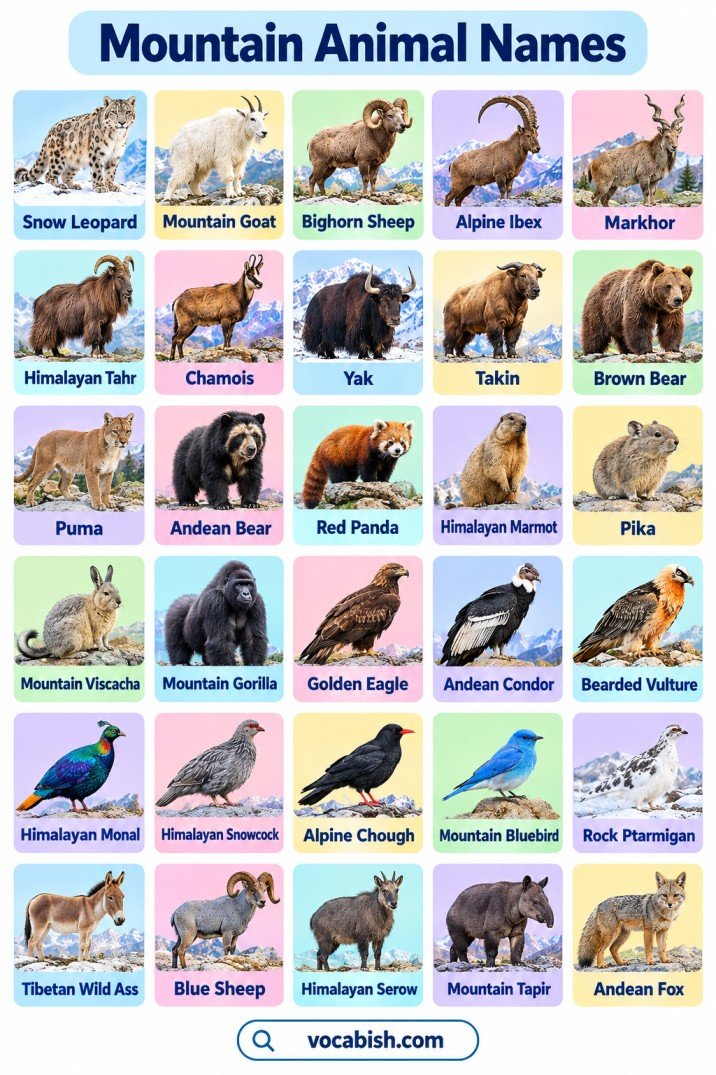
Mountain Mammals
Mammals make up a large part of mountain wildlife, with many species adapted to cold temperatures, steep ground, and high elevations. The names below cover common and well-known mountain mammals.
- Snow Leopard
- Mountain Goat
- Bighorn Sheep
- Alpine Ibex
- Nubian Ibex
- Siberian Ibex
- Markhor
- Himalayan Tahr
- Chamois
- Yak
- Takin
- Brown Bear
- Himalayan Brown Bear
- Grizzly Bear
- Puma
- Andean Bear
- Red Panda
- Himalayan Marmot
- Alpine Marmot
- Pika
- Mountain Viscacha
- Mountain Gorilla
- Argali
- Blue Sheep
- Himalayan Serow
- Mainland Serow
- Nilgiri Tahr
- Barbary Sheep
- Mountain Hare
- Dall Sheep
- Musk Deer
- Siberian Musk Deer
- Tibetan Wild Ass
Mountain Birds
Many birds are well suited to mountain habitats because they can fly across cliffs, valleys, and high slopes. This section includes familiar bird names associated with mountainous regions.
- Golden Eagle
- Bald Eagle
- Andean Condor
- Bearded Vulture
- Himalayan Monal
- Golden Pheasant
- Snowcock
- Himalayan Snowcock
- Tibetan Snowcock
- Rock Ptarmigan
- White-winged Snowfinch
- Wallcreeper
- Lammergeier
- Griffon Vulture
- Himalayan Griffon
- Bearded Vulture
- Alpine Chough
- Red-billed Chough
- Yellow-billed Chough
- Mountain Bluebird
- Mountain Hawk-Eagle
- Mountain Imperial Pigeon
- Himalayan Woodpecker
- Himalayan Buzzard
- Rufous-bellied Eagle
- Mountain Pipit
- Rock Thrush
- Himalayan Vulture
- Cinereous Vulture
- Snow Partridge
Mountain Reptiles
Reptiles found in mountain habitats include species that can cope with rocky ground, cooler temperatures, and changing conditions at different elevations. Here are their names.
- Himalayan Pit Viper
- Himalayan Green Pit Viper
- Mountain Keelback
- Himalayan Wolf Snake
- Common Kukri Snake
- Mountain Rat Snake
- Andean Lancehead
- Galápagos Lava Lizard
- Mountain Horned Lizard
- Rock Agama
- Himalayan Agama
- Tibetan Toad-headed Agama
- Armenian Viper
- Caspian Viper
- Alpine Long-nosed Viper
Mountain Amphibians
Mountain amphibians are mainly associated with cool and moist habitats such as mountain streams, forests, and alpine areas. The following names represent this group.
- Himalayan Newt
- Himalayan Salamander
- Mountain Salamander
- Alpine Newt
- Alpine Salamander
- Mountain Yellow-legged Frog
- Alpine Tree Frog
- Himalayan Frog
- Andes Frog
- Mountain Harlequin Frog
- Rock Frog
- Torrent Frog
- Cascades Frog
- Mountain Toad
- European Fire Salamander
Mountain Invertebrates
Invertebrates are also found throughout mountain environments, from rocky slopes and forests to alpine meadows. Below are names commonly linked with mountain habitats.
- Alpine Butterfly
- Apollo Butterfly
- Mountain Blue Butterfly
- Mountain Ringlet
- Alpine Moth
- Mountain Grasshopper
- Alpine Ladybird
- Mountain Bumblebee
- Alpine Bee
- Mountain Ant
- Rock Grasshopper
- Mountain Beetle
- Alpine Scarab Beetle
- Mountain Spider
- Alpine Spider
- Mountain Scorpion
- Rock Scorpion
- Mountain Snail
- Alpine Snail
- Mountain Slug
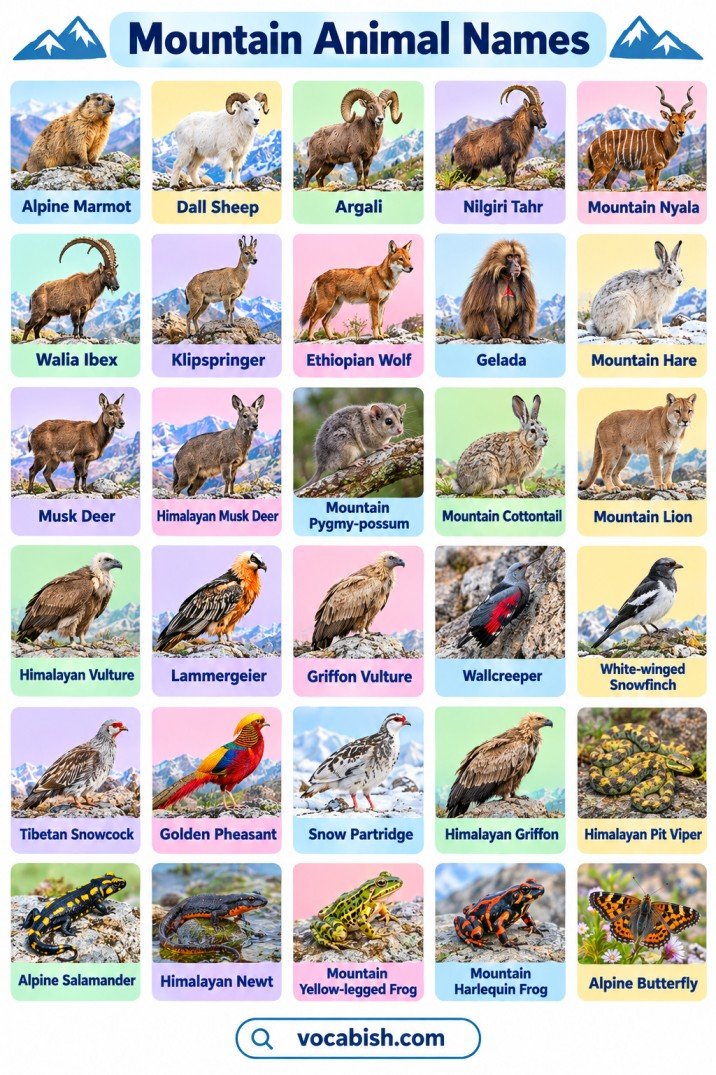
Mountain Animals by Region
Mountain wildlife varies from one part of the world to another because climate, elevation, and habitat differ by region. The names here are arranged according to major mountain regions.
Himalayan Mountain Animals
- Snow Leopard
- Yak
- Markhor
- Himalayan Tahr
- Takin
- Red Panda
- Himalayan Marmot
- Pika
- Himalayan Monal
- Himalayan Snowcock
- Himalayan Brown Bear
- Blue Sheep
- Himalayan Serow
Andes Mountain Animals
- Andean Condor
- Andean Bear
- Mountain Viscacha
- Vicuna
- Guanaco
- Puma
- Andean Fox
- Mountain Tapir
- Andean Cat
- Andean Goose
- Giant Coot
- Taruca
Rocky Mountain Animals
- Mountain Goat
- Bighorn Sheep
- Puma
- Grizzly Bear
- Mountain Lion
- Pika
- American Marmot
- Mountain Bluebird
- Golden Eagle
- Bighorn Ram
European Alpine Animals
- Alpine Ibex
- Chamois
- Alpine Marmot
- Golden Eagle
- Bearded Vulture
- Alpine Salamander
- Rock Ptarmigan
- Alpine Chough
- Mountain Hare
- European Snow Vole
African Mountain Animals
- Mountain Gorilla
- Ethiopian Wolf
- Gelada
- Walia Ibex
- Mountain Nyala
- Klipspringer
- African Buffalo
- Rüppell’s Vulture
- Lammergeier
- Cape Vulture
Australian Mountain Animals
- Mountain Pygmy-possum
- Swamp Wallaby
- Common Wombat
- Short-beaked Echidna
- Australian Raven
- Wedge-tailed Eagle
- Alpine Grasshopper
- Mountain Brush Wallaby
Mountain Animal Vocabulary
Word | Meaning |
|---|---|
Mountain | A high area of land with steep sides |
Alpine | Related to high mountains |
Summit | The highest point of a mountain |
Slope | A surface that rises or falls |
Cliff | A steep rock face |
Valley | Low land between hills or mountains |
Peak | The pointed or highest part of a mountain |
Hoof | The hard foot of animals such as goats and sheep |
Horn | A hard pointed growth on the head of some animals |
Fur | Soft hair covering the body of many mammals |
Predator | An animal that hunts other animals |
Prey | An animal hunted by another animal |
Habitat | The natural home of an animal |
Camouflage | Colours or patterns that help an animal hide |
Carrion | The dead body of an animal eaten by some animals |
Interesting Facts About Mountain Animals
- Snow leopards have huge paws that work like natural snowshoes, helping them walk across deep snow without sinking easily.
- Mountain goats can climb steep cliffs with the help of strong legs and hooves that grip small rocky surfaces.
- Yaks have unusually dense coats with long outer hair and a soft undercoat that helps them survive freezing mountain temperatures.
- Pikas prepare for winter early by collecting and drying grasses and other plants that they keep as food inside rocky shelters.
- Golden eagles use rising air currents to glide over mountain valleys while searching for prey, saving energy during long flights.
- Markhors have spiral-shaped horns that make them one of the most distinctive wild goats found in mountain regions.
- Mountain gorillas live in social groups and communicate through different sounds, body movements, and facial expressions.
- Andean condors can glide for long periods with very little wing movement by taking advantage of warm air rising from the mountains.
Commonly Confused Mountain Animal Names
- Puma, cougar, and mountain lion — These are different common names for the same species.
- Ibex and mountain goat — Both are wild goat-like animals, but they are not the same animal.
- Yak and musk ox — They look somewhat similar but belong to different animal groups.
- Pika and rabbit — A pika is related to rabbits and hares but is a separate group of mammals.
- Chamois and sheep — Chamois are goat-antelopes, not true sheep.
Practice Quiz for Mountain Animals
Choose the correct animal name for each question. Test your mountain animal vocabulary and see your score at the end.
Which animal is famous for its spotted coat and lives in high mountain regions of Asia?
FAQs
Mountain animals are species adapted to rocky slopes, cold temperatures, high elevations, and changing conditions found in mountainous habitats.
The snow leopard is one of the best-known mountain animals because it is strongly associated with high, rocky regions of Central Asia.
Snow leopards, yaks, markhors, Himalayan tahrs, takins, red pandas, marmots, pikas, and Himalayan monals live in Himalayan mountain habitats.
Bighorn sheep and several ibex species have large horns, while markhors are especially known for their long, twisted horns.
Mountain lion and puma are common names for the same species, which is also known as a cougar in North America.
Golden eagles, Andean condors, bearded vultures, Himalayan monals, snowcocks, choughs, and snowfinches are among mountain birds.
Yes. Brown bears, grizzly bears, and Himalayan brown bears can live in mountain forests, valleys, and high-altitude areas.
Snow leopard, mountain goat, yak, bighorn sheep, puma, golden eagle, and red panda are familiar mountain animal names for kids.
Conclusion
The Mountain Animals Name list includes mammals, birds, reptiles, amphibians, and invertebrates that live in or are strongly associated with mountain habitats. Common examples include the snow leopard, mountain goat, ibex, yak, markhor, puma, red panda, golden eagle, and Andean condor.