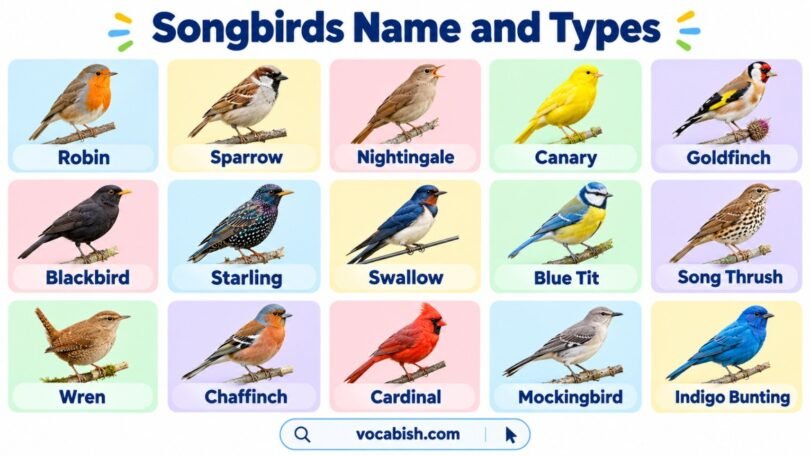

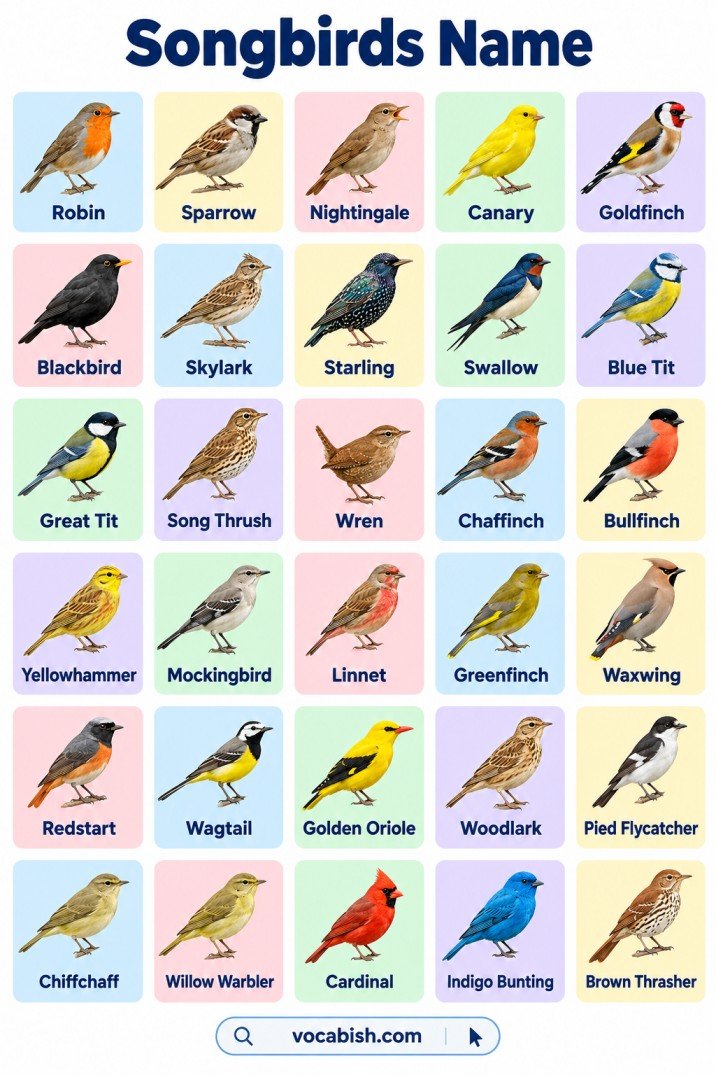
Songbirds Names in English include familiar birds such as robins, sparrows, nightingales, canaries, finches, and blackbirds. These birds belong to a large group of perching birds known for their vocal sounds, calls, and songs. Some sing sweet melodies, while others make short, repeated sounds. Learning their names with pictures helps you recognise different bird species, identify their colours, and build English bird vocabulary.
Here’s a complete guide on different types of birds with their names and pictures.
Common Songbirds Names in English with Pictures
Many common songbirds live in gardens, forests, parks, and open fields. Some have colourful feathers, while others are recognised by their voices. The following songbirds names include familiar species with important facts to help you identify them.
1. Robin
European robins have bright orange-red breasts and brown upper feathers. Their sweet, musical songs can be heard throughout much of the year. They feed on insects, worms, and berries.
2. Sparrow
House sparrows are small brown and grey birds commonly found near homes and gardens. They eat seeds, grains, and insects. These social birds often gather in noisy flocks.
3. Nightingale
Nightingales are famous for their powerful, varied songs, which males sometimes sing at night. Their plain brown feathers help them blend into thick bushes. They mainly feed on insects and other small invertebrates.
4. Canary
Canaries are popular for their pleasant, musical singing. Domestic varieties often have bright yellow, orange, or white feathers. Wild Atlantic canaries have greenish-yellow plumage with darker streaks.
5. Goldfinch
European goldfinches have red faces, black-and-white heads, and yellow wing patches. They use their pointed beaks to remove seeds from plants such as thistles. Their calls are light and twittering.
6. Blackbird
Male common blackbirds have glossy black feathers and bright yellow-orange bills. Their rich, flute-like songs are often heard in gardens during spring. Females have brown plumage and usually darker bills.
7. Skylark
Skylarks are brown, streaked birds that live in open fields and grasslands. Males sing continuously while flying high above the ground. They build their nests among grasses and low vegetation.
8. Starling
European starlings have dark, glossy feathers that shine with green and purple colours. They can imitate other birds and environmental sounds. Large flocks sometimes create impressive moving patterns in the sky.
9. Swallow
Barn swallows have blue upper feathers, reddish throats, and long, forked tails. They catch flying insects while moving quickly through the air. Their cup-shaped nests are made from mud and usually attached to buildings or other structures.
10. Blue Tit
Blue tits are small birds with blue heads, yellow breasts, and white cheeks. They search tree branches for caterpillars and other insects. These active birds often visit garden feeders and use nesting boxes.
11. Great Tit
Great tits have yellow underparts, black heads, and white cheek patches. A dark stripe runs down the centre of their bellies. Their loud, repeated songs are common in gardens and woodlands.
12. Song Thrush
Song thrushes have brown upper feathers and pale breasts covered with dark spots. They repeat musical phrases several times while singing. They also break snail shells against stones to reach the soft bodies inside.
13. Wren
Eurasian wrens are tiny brown birds with short tails that often point upward. Despite their small size, they produce surprisingly loud and complex songs. They usually hide among bushes, roots, and dense vegetation.
14. Chaffinch
Male chaffinches have pinkish breasts, blue-grey heads, and white wing markings. Their songs contain quick notes followed by a distinctive ending. They commonly search the ground for seeds and small insects.
15. Bullfinch
Male Eurasian bullfinches have pinkish-red breasts, black caps, and grey backs. Their thick, rounded beaks are suited to eating seeds and buds. They often remain hidden among trees and shrubs.
16. Yellowhammer
Male yellowhammers have bright yellow heads and streaked brown backs. Their repeated songs are commonly heard across farmland and open countryside. They feed on seeds and insects and nest close to the ground.
17. Mockingbird
Northern mockingbirds are grey birds with long tails and white wing patches. They can copy the songs of many other birds and sometimes sing at night. They strongly defend their nesting territories against intruders.
18. Linnet
Common linnets are small finches with brown, streaked feathers. Breeding males develop reddish patches on their foreheads and breasts. They eat mainly seeds and often form flocks outside the breeding season.
19. Greenfinch
European greenfinches have olive-green feathers with bright yellow patches on their wings and tails. Their strong beaks help them crack open hard seeds. Males sometimes perform fluttering display flights while singing.
20. Waxwing
Waxwings have silky feathers, pointed crests, and distinctive markings on their wings. They often travel in flocks searching for berries and fruits. Their soft, high-pitched calls can be heard while they feed or fly together.
21. Redstart
Common redstarts are small birds recognised by their bright orange-red tails. Males have grey upperparts, black faces, and orange underparts during the breeding season. They catch insects and frequently flick their tails while perched.
22. Wagtail
White wagtails have black, white, and grey feathers with long, slender tails. They repeatedly move their tails up and down while walking. These birds search for small insects on open ground and near water.
23. Golden Oriole
Male Eurasian golden orioles have bright yellow bodies and contrasting black wings. Their rich, flute-like songs can be heard from leafy trees. They mainly eat insects, caterpillars, and ripe fruits.
24. Woodlark
Woodlarks are small brown birds with streaked feathers and pale markings above their eyes. Their soft, flowing songs are often delivered during flight. They prefer open woodlands, grassy clearings, and areas with scattered trees.
25. Pied Flycatcher
Male European pied flycatchers often have black-and-white feathers during the breeding season, although some are browner. They catch flying insects in quick flights from branches. These birds commonly nest in tree holes and suitable nesting boxes.
26. Chiffchaff
Chiffchaffs are small, olive-brown birds with pale underparts and thin beaks. Their repeated two-note songs make them easier to recognise. They search leaves and branches for insects and other tiny invertebrates.
27. Willow Warbler
Willow warblers have greenish-brown upper feathers and pale yellowish underparts. Their gentle songs contain a series of descending notes. These small birds travel long distances between European breeding areas and African wintering grounds.
28. Cardinal
Male northern cardinals have brilliant red feathers, pointed crests, and thick orange-red bills. Females are mostly brown with reddish markings. Both males and females sing clear, whistling songs and feed on seeds, fruits, and insects.
29. Indigo Bunting
Male indigo buntings display brilliant blue feathers during the breeding season. Females have brown plumage that helps them remain less noticeable. Males often sing from exposed branches in fields and woodland edges.
30. Brown Thrasher
Brown thrashers have reddish-brown upper feathers, long tails, and pale underparts covered with dark spots. They are skilled singers that repeat many different musical phrases. Their long bills help them search fallen leaves for insects and other small animals.
List of Songbirds Names in English
Songbirds include thousands of species from the passerine group of birds. The following list contains additional songbird names commonly used in birdwatching and English vocabulary.
- American Robin
- Eastern Bluebird
- Western Bluebird
- Mountain Bluebird
- Eastern Meadowlark
- Western Meadowlark
- Baltimore Oriole
- Orchard Oriole
- Rose-breasted Grosbeak
- Evening Grosbeak
- Pine Grosbeak
- House Finch
- Purple Finch
- Cassin’s Finch
- American Goldfinch
- Lesser Goldfinch
- Pine Siskin
- Common Redpoll
- Hoary Redpoll
- Red Crossbill
- White-winged Crossbill
- Cedar Waxwing
- Hermit Thrush
- Wood Thrush
- Swainson’s Thrush
- Veery
- Gray Catbird
- American Pipit
- Tree Pipit
- Meadow Pipit
- Rock Pipit
- Common Whitethroat
- Lesser Whitethroat
- Garden Warbler
- Blackcap
- Sedge Warbler
- Reed Warbler
- Marsh Warbler
- Grasshopper Warbler
- Wood Warbler
- Dartford Warbler
- Cetti’s Warbler
- Icterine Warbler
- Melodious Warbler
- Firecrest
- Goldcrest
- Spotted Flycatcher
- Collared Flycatcher
- Red-breasted Flycatcher
- European Stonechat
- Whinchat
- Bluethroat
- Common Redpoll
- Brambling
- Hawfinch
- Corn Bunting
- Reed Bunting
- Snow Bunting
- Lapland Longspur
Different Types of Songbirds
Songbirds belong mainly to the suborder Passeri, also called oscine passerines. Scientists group them into many families based on their characteristics and evolutionary relationships.
Finches
- Zebra Finch
- Gouldian Finch
- Society Finch
- Java Sparrow
- European Serin
- Atlantic Canary
- Trumpeter Finch
- Desert Finch
- Crimson Finch
- Star Finch
- Double-barred Finch
- Owl Finch
- Strawberry Finch
- Cut-throat Finch
- Painted Finch
- Red-browed Finch
- Long-tailed Finch
- Blue-faced Parrotfinch
- Red-headed Finch
- Black-throated Finch
Warblers
- Yellow Warbler
- Magnolia Warbler
- Blackpoll Warbler
- Cape May Warbler
- Blackburnian Warbler
- Prairie Warbler
- Pine Warbler
- Palm Warbler
- Nashville Warbler
- Tennessee Warbler
- Wilson’s Warbler
- Canada Warbler
- Connecticut Warbler
- Mourning Warbler
- Kentucky Warbler
- Hooded Warbler
- Prothonotary Warbler
- Worm-eating Warbler
- Cerulean Warbler
- Golden-winged Warbler
Thrushes
- Mistle Thrush
- Fieldfare
- Redwing
- Ring Ouzel
- Varied Thrush
- Gray-cheeked Thrush
- Bicknell’s Thrush
- Eyebrowed Thrush
- Dusky Thrush
- White’s Thrush
- Orange-headed Thrush
- Blue Rock Thrush
- Chestnut-bellied Rock Thrush
- Siberian Thrush
- Rufous-bellied Thrush
Sparrows
- Eurasian Tree Sparrow
- American Tree Sparrow
- Song Sparrow
- White-throated Sparrow
- White-crowned Sparrow
- Chipping Sparrow
- Field Sparrow
- Savannah Sparrow
- Fox Sparrow
- Lincoln’s Sparrow
- Swamp Sparrow
- Vesper Sparrow
- Grasshopper Sparrow
- Seaside Sparrow
- Saltmarsh Sparrow
- Harris’s Sparrow
- Golden-crowned Sparrow
- Lark Sparrow
- Black-throated Sparrow
- Rufous-crowned Sparrow
Larks
- Crested Lark
- Horned Lark
- Greater Short-toed Lark
- Lesser Short-toed Lark
- Calandra Lark
- Bimaculated Lark
- Desert Lark
- Bar-tailed Lark
- Black-crowned Sparrow-Lark
- Ashy-crowned Sparrow-Lark
- Rufous-naped Lark
- Red-capped Lark
- Pink-billed Lark
- Sabota Lark
- Spike-heeled Lark
Tits and Chickadees
- Coal Tit
- Marsh Tit
- Willow Tit
- Crested Tit
- Long-tailed Tit
- Black-capped Chickadee
- Carolina Chickadee
- Mountain Chickadee
- Boreal Chickadee
- Chestnut-backed Chickadee
- Tufted Titmouse
- Oak Titmouse
- Juniper Titmouse
- Bridled Titmouse
- Varied Tit
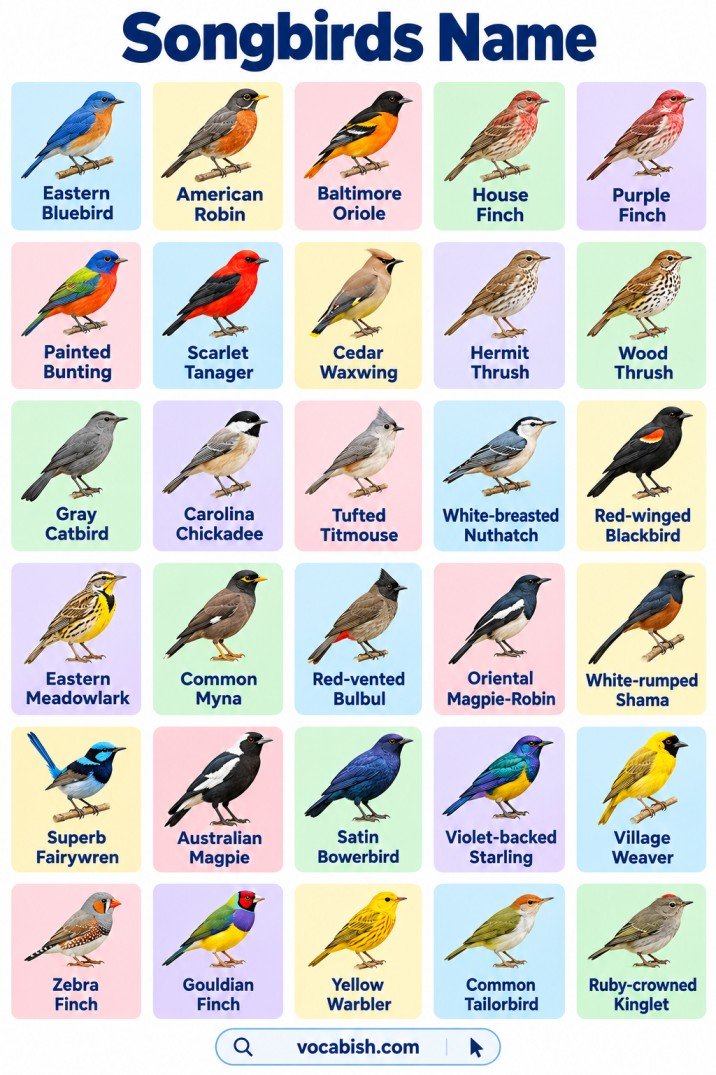
Songbirds Found in Gardens and Backyards
Many songbirds visit gardens and backyards to find food, water, and shelter. These birds often perch on trees, fences, and flowering plants.
- European Robin
- House Sparrow
- Eurasian Blackbird
- Common Starling
- Blue Tit
- Great Tit
- House Finch
- American Goldfinch
- Northern Cardinal
- Song Sparrow
- Chipping Sparrow
- White-breasted Nuthatch
- Carolina Wren
- House Wren
- American Robin
- Eastern Bluebird
- Gray Catbird
- Northern Mockingbird
- Dark-eyed Junco
- Red-winged Blackbird
- Common Grackle
- Brown-headed Cowbird
- Baltimore Oriole
- Cedar Waxwing
- European Greenfinch
Forest and Woodland Songbirds
Forests provide nesting places and food for many songbird species. Some live high in the tree canopy, while others search for insects near the forest floor.
- Wood Thrush
- Hermit Thrush
- Ovenbird
- Black-and-white Warbler
- Black-throated Green Warbler
- Black-throated Blue Warbler
- Chestnut-sided Warbler
- Bay-breasted Warbler
- Yellow-rumped Warbler
- Northern Parula
- American Redstart
- Scarlet Tanager
- Summer Tanager
- Western Tanager
- Red-eyed Vireo
- Blue-headed Vireo
- Warbling Vireo
- Yellow-throated Vireo
- Golden-crowned Kinglet
- Ruby-crowned Kinglet
- Brown Creeper
- Eurasian Treecreeper
- Spotted Nutcracker
- Eurasian Nuthatch
- Black-headed Oriole
Colourful Songbirds Names
Many songbirds have bright feathers in red, blue, yellow, green, and orange. These colours are especially noticeable in some adult males during the breeding season.
- Painted Bunting
- Rainbow Bunting
- Scarlet Tanager
- Flame-colored Tanager
- Paradise Tanager
- Green-headed Tanager
- Blue-gray Tanager
- Golden Tanager
- Silver-beaked Tanager
- Red-legged Honeycreeper
- Green Honeycreeper
- Purple Honeycreeper
- Blue Dacnis
- Scarlet-chested Sunbird
- Beautiful Sunbird
- Purple Sunbird
- Olive-backed Sunbird
- Crimson Sunbird
- Malachite Sunbird
- Splendid Fairywren
- Superb Fairywren
- Red-backed Fairywren
- Variegated Fairywren
- Vermilion Flycatcher
- Blue Grosbeak
- Lazuli Bunting
- Varied Bunting
- Red Siskin
- Yellow Cardinal
Small Songbirds Names
Small songbirds often move quickly through bushes, trees, and grasses. Their compact bodies help them search for insects, seeds, and other tiny foods.
- Goldcrest
- Firecrest
- Pygmy Nuthatch
- Brown-headed Nuthatch
- Winter Wren
- Pacific Wren
- Sedge Wren
- Marsh Wren
- Bewick’s Wren
- Blue-gray Gnatcatcher
- Black-tailed Gnatcatcher
- California Gnatcatcher
- Ruby-crowned Kinglet
- Golden-crowned Kinglet
- Bushtit
- Verdin
- Common Tailorbird
- Ashy Prinia
- Plain Prinia
- Zitting Cisticola
- Golden-headed Cisticola
- Common Waxbill
- Orange-cheeked Waxbill
- Violet-eared Waxbill
- Black-rumped Waxbill
Songbirds Known for Beautiful Singing
Some songbirds are recognised for their long melodies, repeated musical notes, and varied calls. Their songs are commonly heard during the breeding season.
- Common Nightingale
- Thrush Nightingale
- Common Blackbird
- Song Thrush
- Wood Thrush
- Hermit Thrush
- Eurasian Skylark
- Woodlark
- Northern Mockingbird
- Brown Thrasher
- Gray Catbird
- European Robin
- Common Canary
- European Goldfinch
- American Robin
- White-rumped Shama
- Oriental Magpie-Robin
- Common Hill Myna
- Common Tailorbird
- Eastern Meadowlark
- Western Meadowlark
- Carolina Wren
- Winter Wren
- Veery
- Marsh Warbler
Songbirds Names from Different Regions
Songbirds live on every continent except Antarctica. Their names and species vary across regions because of differences in climate, vegetation, and habitat.
European Songbirds
- European Robin
- Common Blackbird
- Song Thrush
- Common Nightingale
- Eurasian Skylark
- European Goldfinch
- Common Chaffinch
- Eurasian Bullfinch
- European Greenfinch
- Yellowhammer
- Common Linnet
- Eurasian Wren
- Blackcap
- Common Whitethroat
- Eurasian Golden Oriole
North American Songbirds
- Northern Cardinal
- American Robin
- Eastern Bluebird
- Western Bluebird
- Northern Mockingbird
- Song Sparrow
- American Goldfinch
- Indigo Bunting
- Painted Bunting
- Scarlet Tanager
- Baltimore Oriole
- Eastern Meadowlark
- Wood Thrush
- Carolina Wren
- Cedar Waxwing
Asian Songbirds
- Oriental Magpie-Robin
- Indian Robin
- Asian Koel
- Red-vented Bulbul
- Red-whiskered Bulbul
- Common Myna
- Bank Myna
- Common Hill Myna
- White-rumped Shama
- Asian Brown Flycatcher
- Tickell’s Blue Flycatcher
- Verditer Flycatcher
- Indian Golden Oriole
- Black-hooded Oriole
- Purple Sunbird
- Common Tailorbird
- Oriental White-eye
- Jungle Babbler
- Large Grey Babbler
- Rufous Treepie
African Songbirds
- African Paradise Flycatcher
- African Stonechat
- Cape Robin-Chat
- White-browed Robin-Chat
- Red-capped Robin-Chat
- Cape White-eye
- African Pied Wagtail
- Village Weaver
- Southern Masked Weaver
- Red-billed Quelea
- Violet-backed Starling
- Superb Starling
- Greater Blue-eared Starling
- Cape Glossy Starling
- Fork-tailed Drongo
- Fiscal Shrike
- Common Fiscal
- Southern Boubou
- Cape Bulbul
- African Golden Oriole
Australian Songbirds
- Australian Magpie
- Australian Raven
- Pied Butcherbird
- Grey Butcherbird
- Willie Wagtail
- Magpie-Lark
- Superb Fairywren
- Splendid Fairywren
- Red-backed Fairywren
- Eastern Whipbird
- Golden Whistler
- Rufous Whistler
- Grey Shrike-thrush
- Australian Golden Whistler
- Satin Bowerbird
- Regent Bowerbird
- Spotted Bowerbird
- Noisy Miner
- New Holland Honeyeater
- Eastern Spinebill
South American Songbirds
- Rufous-bellied Thrush
- Southern House Wren
- Great Kiskadee
- Tropical Kingbird
- Blue-gray Tanager
- Palm Tanager
- Sayaca Tanager
- Silver-beaked Tanager
- Bananaquit
- Saffron Finch
- Double-collared Seedeater
- Chestnut-bellied Seed Finch
- Red-crested Cardinal
- Yellow-billed Cardinal
- Blue-black Grassquit
- Shiny Cowbird
- Rufous Hornero
- Creamy-bellied Thrush
- White-lined Tanager
- Green-headed Tanager
Male and Female Songbirds
Male and female songbirds sometimes look different. Males of certain species have brighter feathers, while females have softer colours that help them blend into their surroundings.
Songbird | Male Appearance | Female Appearance |
|---|---|---|
Northern Cardinal | Bright red | Brown with red highlights |
Common Blackbird | Black with yellow bill | Dark brown |
Indigo Bunting | Bright blue | Brown |
Eurasian Bullfinch | Pinkish-red breast | Greyish-brown breast |
House Sparrow | Grey crown, black throat | Brown, plain throat |
Common Chaffinch | Pinkish breast, blue-grey head | Brownish-grey |
Painted Bunting | Blue, red, and green | Mostly green |
Baltimore Oriole | Orange and black | Yellow-orange and brownish |
Red-winged Blackbird | Black with red shoulder patches | Brown and heavily streaked |
Scarlet Tanager | Scarlet red and black | Yellow-green |
Songbirds and Their Sounds
Different songbirds make different vocal sounds. Some whistle, chirp, or trill, while others imitate sounds they hear around them.
Songbird | Typical Sound |
|---|---|
Sparrow | Chirping and chattering |
Nightingale | Musical whistles and trills |
Canary | Melodious warbling |
Robin | Clear whistles and musical phrases |
Blackbird | Rich, flute-like whistles |
Skylark | Continuous, flowing trills |
Goldfinch | Light, tinkling calls |
Starling | Whistles, clicks, and mimicry |
Wren | Loud, rapid trills |
Mockingbird | Varied songs and imitation |
Chiffchaff | Repeated two-note song |
Song Thrush | Repeated musical phrases |
Common Confusions About Songbirds
Some bird names and features can cause confusion when learning songbird vocabulary.
- Songbird vs singing bird: Not every bird that sings belongs to the scientific songbird group.
- Swallow vs swift: Swallows are songbirds, but swifts belong to a different bird order.
- Robin: European robins and American robins belong to different bird families.
- Sparrow: House sparrows and American sparrows belong to different families.
- Male vs female: Both sexes can sing, although singing behaviour varies by species.
Songbirds Name Quiz
Test your knowledge of songbird names, colours, calls, and characteristics. Choose the best answer for each question.
FAQs About Songbirds
Songbirds are birds belonging to the suborder Passeri. They have specialised vocal organs and include familiar species such as robins, finches, sparrows, and thrushes.
Common songbirds include robins, sparrows, blackbirds, finches, starlings, wrens, and tits. Their presence varies according to geographical region and natural habitat.
Nightingales are widely admired for their rich, varied songs. Song thrushes, canaries, and mockingbirds are also well known for musical singing.
No. Songbirds include many small species, but some small birds belong to other groups. Hummingbirds, for example, are not classified as songbirds.
Songbirds mainly sing to attract mates and defend territories. They also use calls to communicate danger, maintain contact, and identify other birds.
Songbirds belong to a particular evolutionary group of perching birds. Their vocal anatomy supports learned, often complex songs, although singing ability varies between species.
Yes, females of many songbird species sing. Their songs may help defend territories, communicate with mates, or support other social behaviours.
Common hill mynas, starlings, and some other songbirds can imitate human speech or environmental sounds. Their imitation abilities differ between species and individuals.
Conclusion
Learning Songbirds Names in English helps you recognise common birds, identify different species, and expand your nature vocabulary. From familiar robins and sparrows to colourful tanagers and musical nightingales, songbirds include a remarkable variety of birds. Use the pictures, names, categories, and practice questions to remember their appearance, sounds, and English names.