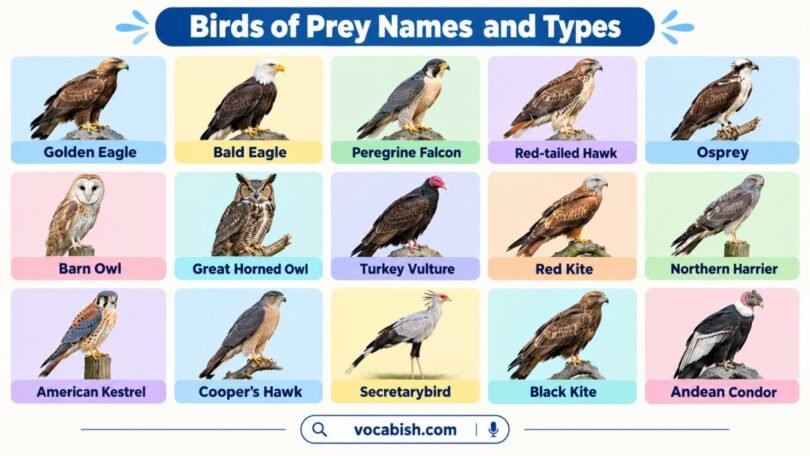

Birds of prey are hunting birds known for their sharp talons, hooked beaks, and powerful eyesight. Eagles, hawks, falcons, owls, and vultures are among the best-known examples. These birds, also called raptors, live in forests, mountains, grasslands, deserts, and wetlands around the world. Some catch small animals, fish, and insects, while others feed mainly on dead animals. Their sizes, hunting methods, and feeding habits differ by species. Learning their names and types helps you identify common birds of prey, recognise their physical features, and understand their important roles in nature.
Here’s the list of all types of birds with their names and pictures.
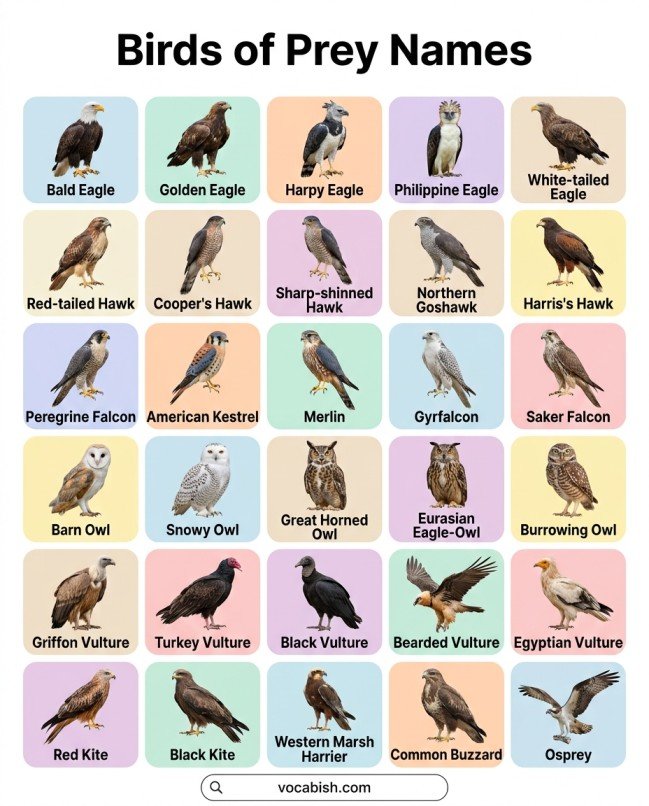
Common Birds of Prey Names with Pictures
The most familiar birds of prey include eagles, hawks, falcons, owls, vultures, and kites. These raptors differ in size, appearance, food, and hunting behaviour.
- Bald Eagle: Catches fish using strong, sharp gripping talons.
- Golden Eagle: Hunts rabbits and other animals in open country.
- Harpy Eagle: Hunts monkeys and sloths in tropical forests.
- White-tailed Eagle: Feeds mainly on fish, birds, and carrion.
- Philippine Eagle: Hunts mammals and birds in Philippine forests.
- Red-tailed Hawk: Hunts rodents from perches or while soaring.
- Cooper’s Hawk: Chases smaller birds through trees and gardens.
- Sharp-shinned Hawk: Catches small birds with quick, agile flights.
- Northern Goshawk: Hunts birds and mammals in wooded areas.
- Harris’s Hawk: Often hunts cooperatively in small family groups.
- Peregrine Falcon: Reaches extraordinary speeds when diving after birds.
- American Kestrel: Hunts insects and small animals in fields.
- Merlin: Pursues small birds with fast, powerful flight.
- Gyrfalcon: Hunts birds across cold Arctic tundra regions.
- Saker Falcon: Hunts birds and mammals across open grasslands.
- Barn Owl: Hunts small mammals using exceptionally sensitive hearing.
- Snowy Owl: Hunts lemmings and birds across Arctic tundra.
- Great Horned Owl: Hunts mammals and birds using powerful talons.
- Eurasian Eagle-Owl: Hunts various animals across forests and mountains.
- Burrowing Owl: Lives in underground burrows across open grasslands.
- Little Owl: Hunts insects and rodents across open habitats.
- Griffon Vulture: Soars over mountains searching for animal carcasses.
- Turkey Vulture: Locates dead animals using its keen smell.
- Black Vulture: Often searches for carcasses in social groups.
- Bearded Vulture: Eats bones and sometimes drops larger ones.
- Egyptian Vulture: Eats carrion and sometimes uses stone tools.
- Red Kite: Searches open countryside for carrion and prey.
- Black Kite: Eats small animals, scraps, and dead animals.
- Brahminy Kite: Hunts near rivers, wetlands, and coastal areas.
- Western Marsh Harrier: Hunts low over reedbeds and wet grasslands.
- Hen Harrier: Flies low over fields searching for prey.
- Common Buzzard: Hunts small mammals across fields and woodlands.
- Rough-legged Buzzard: Hunts rodents across tundra and open countryside.
- Osprey: Dives feet-first into water to catch fish.
- Secretarybird: Hunts snakes and other prey while walking.
Types of Birds of Prey
Birds of prey belong to several groups, including eagles, hawks, falcons, owls, and vultures. Most have hooked beaks and strong feet, although their feeding habits vary.
- Eagles
- Hawks
- Falcons
- Owls
- Vultures
- Kites
- Harriers
- Buzzards
- Ospreys
- Goshawks
- Sparrowhawks
- Kestrels
- Merlins
- Caracaras
- Serpent Eagles
- Snake Eagles
- Fish Eagles
- Hawk-Eagles
- Booted Eagles
- Harpy Eagles
- Sea Eagles
- Bat Hawks
- Honey Buzzards
- Chanting Goshawks
- Bateleurs
- Secretarybirds
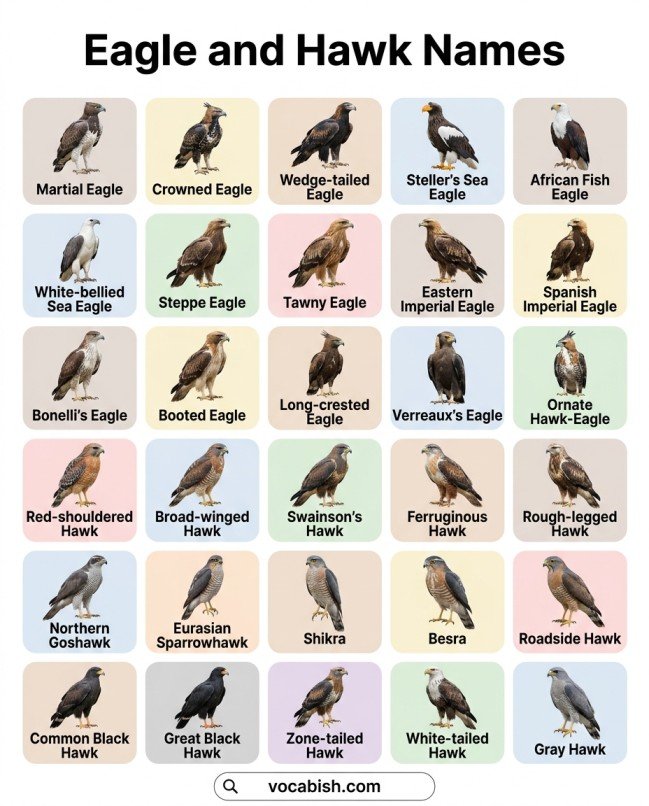
Eagle Names
Eagles are generally large, powerful raptors with strong feet and hooked beaks. Different species hunt mammals, birds, reptiles, and fish in habitats ranging from tropical forests to Arctic coastlines.
- Bald Eagle
- Golden Eagle
- Harpy Eagle
- Philippine Eagle
- Martial Eagle
- Crowned Eagle
- Wedge-tailed Eagle
- White-tailed Eagle
- Steller’s Sea Eagle
- African Fish Eagle
- White-bellied Sea Eagle
- Pallas’s Fish Eagle
- Lesser Fish Eagle
- Grey-headed Fish Eagle
- Steppe Eagle
- Tawny Eagle
- Eastern Imperial Eagle
- Spanish Imperial Eagle
- Bonelli’s Eagle
- Booted Eagle
- Little Eagle
- Wahlberg’s Eagle
- Long-crested Eagle
- Black Eagle
- Verreaux’s Eagle
- Mountain Hawk-Eagle
- Changeable Hawk-Eagle
- Ornate Hawk-Eagle
- Black-and-white Hawk-Eagle
- Javan Hawk-Eagle
- Sulawesi Hawk-Eagle
- Flores Hawk-Eagle
- Blyth’s Hawk-Eagle
- Crested Serpent Eagle
- Brown Snake Eagle
- Black-chested Snake Eagle
- Southern Banded Snake Eagle
- Short-toed Snake Eagle
- Bateleur
- Madagascar Fish Eagle
- Sanford’s Sea Eagle
Hawk Names
Hawks include woodland hunters and open-country raptors. The word hawk covers different groups depending on the region, so their names do not always indicate close relationships.
- Red-tailed Hawk
- Red-shouldered Hawk
- Broad-winged Hawk
- Swainson’s Hawk
- Ferruginous Hawk
- Rough-legged Hawk
- Harris’s Hawk
- Cooper’s Hawk
- Sharp-shinned Hawk
- Northern Goshawk
- Eurasian Sparrowhawk
- American Goshawk
- Besra
- Shikra
- Chinese Sparrowhawk
- Japanese Sparrowhawk
- Levant Sparrowhawk
- Tiny Hawk
- Semicollared Hawk
- Roadside Hawk
- Common Black Hawk
- Great Black Hawk
- Zone-tailed Hawk
- White-tailed Hawk
- Short-tailed Hawk
- Gray Hawk
- Crane Hawk
- Savanna Hawk
- Black-collared Hawk
- Black-faced Hawk
- White Hawk
- Mantled Hawk
- Black-and-white Hawk-Eagle
- Bat Hawk
- Rufous Crab Hawk
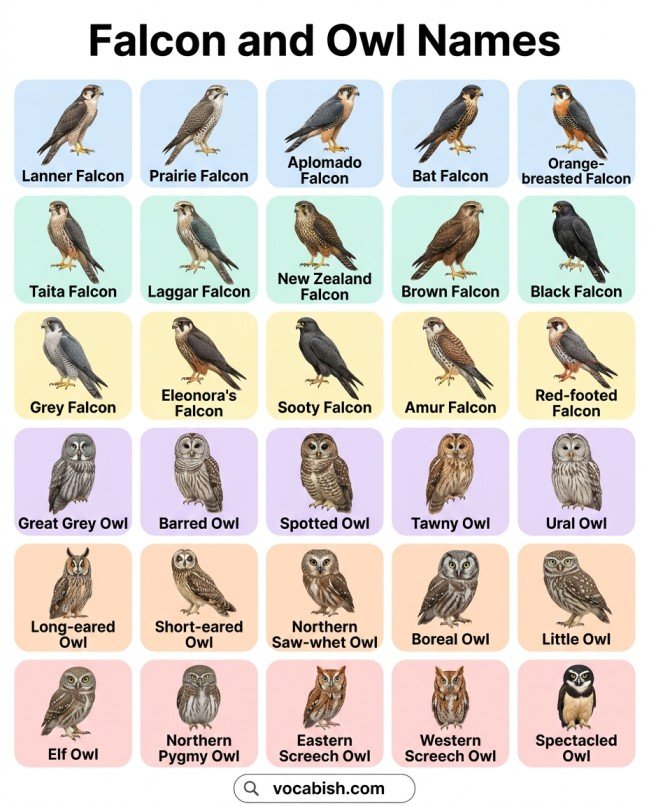
Falcon Names
Falcons are fast-flying birds of prey with pointed wings. Many catch other birds in flight, while smaller falcons also hunt insects, rodents, and reptiles.
- Peregrine Falcon
- Gyrfalcon
- Saker Falcon
- Lanner Falcon
- Prairie Falcon
- Aplomado Falcon
- Bat Falcon
- Orange-breasted Falcon
- Taita Falcon
- Barbary Falcon
- Laggar Falcon
- New Zealand Falcon
- Brown Falcon
- Black Falcon
- Grey Falcon
- Eleonora’s Falcon
- Sooty Falcon
- Amur Falcon
- Red-footed Falcon
- Lesser Kestrel
- Common Kestrel
- American Kestrel
- Greater Kestrel
- Fox Kestrel
- Dickinson’s Kestrel
- Seychelles Kestrel
- Mauritius Kestrel
- Madagascar Kestrel
- Merlin
- Eurasian Hobby
- African Hobby
- Australian Hobby
- Oriental Hobby
- Pied Falconet
- Black-thighed Falconet
- Collared Falconet
- White-rumped Falcon
- Pygmy Falcon
Owl Names
Owls are recognised by their forward-facing eyes, facial discs, and specialised feathers. Many hunt at night, although several species are active during daylight.
- Barn Owl
- Snowy Owl
- Great Horned Owl
- Eurasian Eagle-Owl
- Indian Eagle-Owl
- Spotted Eagle-Owl
- Verreaux’s Eagle-Owl
- Pharaoh Eagle-Owl
- Blakiston’s Fish Owl
- Brown Fish Owl
- Tawny Fish Owl
- Buffy Fish Owl
- Great Grey Owl
- Barred Owl
- Spotted Owl
- Tawny Owl
- Ural Owl
- Himalayan Owl
- Long-eared Owl
- Short-eared Owl
- Northern Saw-whet Owl
- Boreal Owl
- Little Owl
- Burrowing Owl
- Elf Owl
- Ferruginous Pygmy Owl
- Northern Pygmy Owl
- Eurasian Pygmy Owl
- Collared Scops Owl
- Eurasian Scops Owl
- Oriental Scops Owl
- Indian Scops Owl
- Eastern Screech Owl
- Western Screech Owl
- Whiskered Screech Owl
- Flammulated Owl
- Northern Hawk-Owl
- Powerful Owl
- Barking Owl
- Southern Boobook
- Morepork
- Spectacled Owl
- Crested Owl
- Mottled Owl
- African Wood Owl
- Pearl-spotted Owlet
- Spotted Owlet
- Jungle Owlet
- Forest Owlet
- Eastern Grass Owl
- African Grass Owl
- Masked Owl
- Sooty Owl
- Oriental Bay Owl
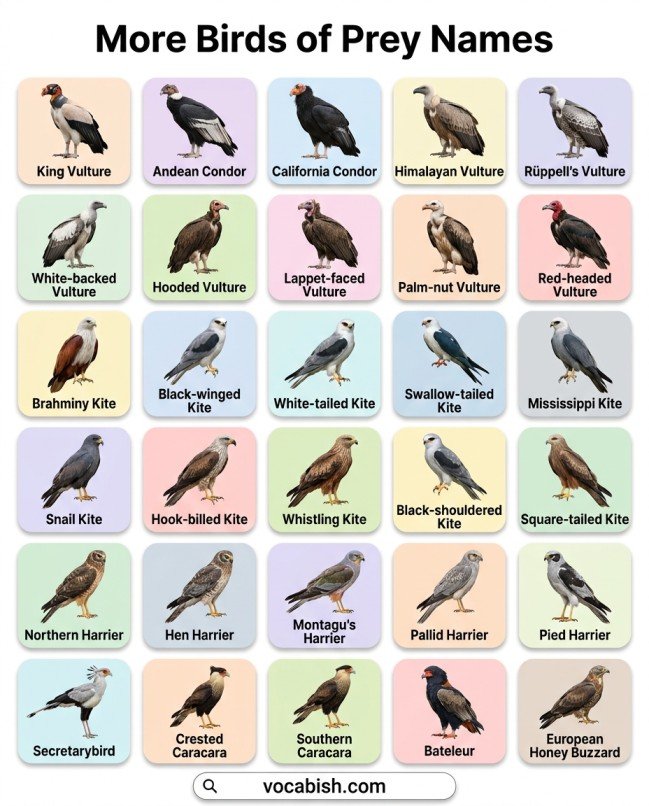
Vulture Names
Vultures mainly eat carrion, which means the remains of dead animals. Old World vultures and New World vultures belong to different evolutionary groups.
- Turkey Vulture
- Black Vulture
- King Vulture
- Andean Condor
- California Condor
- Lesser Yellow-headed Vulture
- Greater Yellow-headed Vulture
- Griffon Vulture
- Himalayan Vulture
- Eurasian Black Vulture
- Rüppell’s Vulture
- White-backed Vulture
- White-rumped Vulture
- Indian Vulture
- Slender-billed Vulture
- Cape Vulture
- Egyptian Vulture
- Bearded Vulture
- Red-headed Vulture
- White-headed Vulture
- Hooded Vulture
- Lappet-faced Vulture
- Palm-nut Vulture
Kite Names
Kites are generally medium-sized raptors, often recognised by their long wings and graceful soaring flight. Some hunt live animals, while others also eat carrion.
- Red Kite
- Black Kite
- Brahminy Kite
- Black-winged Kite
- White-tailed Kite
- Black-shouldered Kite
- Letter-winged Kite
- Swallow-tailed Kite
- Mississippi Kite
- Plumbeous Kite
- Snail Kite
- Slender-billed Kite
- Hook-billed Kite
- Double-toothed Kite
- Square-tailed Kite
- Black-eared Kite
- Yellow-billed Kite
- Whistling Kite
- Black-breasted Buzzard
- Grey-headed Kite
- Pearl Kite
- White-collared Kite
- Cuban Kite
Harrier Names
Harriers usually search for prey while flying low over open ground. Their long wings and tails help them move across grasslands, marshes, and agricultural fields.
- Hen Harrier
- Northern Harrier
- Western Marsh Harrier
- Eastern Marsh Harrier
- African Marsh Harrier
- Australasian Swamp Harrier
- Montagu’s Harrier
- Pallid Harrier
- Pied Harrier
- Black Harrier
- Cinereous Harrier
- Long-winged Harrier
- Spotted Harrier
- Papuan Harrier
- Réunion Harrier
- Madagascar Harrier
- Western Marsh Harrier
- Eastern Marsh Harrier
Buzzard Names
Buzzards are mostly broad-winged birds that hunt small animals or search for food from elevated positions. In North America, many similar raptors are called hawks.
- Common Buzzard
- Rough-legged Buzzard
- European Honey Buzzard
- Oriental Honey Buzzard
- Crested Honey Buzzard
- Long-legged Buzzard
- Upland Buzzard
- Himalayan Buzzard
- Mountain Buzzard
- Forest Buzzard
- Jackal Buzzard
- Augur Buzzard
- Archer’s Buzzard
- Red-necked Buzzard
- Lizard Buzzard
- Grasshopper Buzzard
- White-eyed Buzzard
- Grey-faced Buzzard
- Galapagos Hawk
- Black-chested Buzzard-Eagle
- Black-breasted Buzzard
- Madagascar Buzzard
- Socotra Buzzard
- Swainson’s Hawk
- Ferruginous Hawk
Osprey and Fish-Eating Raptors
Several birds of prey specialise in catching fish from rivers, lakes, and coastal waters. The osprey belongs to its own family and has feet adapted for gripping slippery fish.
- Osprey
- African Fish Eagle
- Bald Eagle
- Steller’s Sea Eagle
- White-tailed Eagle
- White-bellied Sea Eagle
- Pallas’s Fish Eagle
- Lesser Fish Eagle
- Grey-headed Fish Eagle
- Madagascar Fish Eagle
- Sanford’s Sea Eagle
- Blakiston’s Fish Owl
- Brown Fish Owl
- Tawny Fish Owl
- Buffy Fish Owl
- Brahminy Kite
- Black-collared Hawk
Other Birds of Prey Names
Some raptors have distinctive body shapes, feeding habits, or names that do not fit the familiar eagle, hawk, or falcon labels. These include caracaras, serpent-eagles, and specialised hunters.
- Secretarybird
- Crested Caracara
- Southern Caracara
- Yellow-headed Caracara
- Chimango Caracara
- Mountain Caracara
- Striated Caracara
- Black Caracara
- Red-throated Caracara
- Northern Crested Caracara
- Laughing Falcon
- Collared Forest Falcon
- Barred Forest Falcon
- Slaty-backed Forest Falcon
- Plumbeous Forest Falcon
- Bateleur
- Crested Serpent Eagle
- Short-toed Snake Eagle
- Brown Snake Eagle
- Black-chested Snake Eagle
- Southern Banded Snake Eagle
- Western Banded Snake Eagle
- Madagascar Serpent Eagle
- Bat Hawk
- Palm-nut Vulture
- Bearded Vulture
- European Honey Buzzard
- Oriental Honey Buzzard
Birds of Prey by Habitat
Raptors live on every continent, including Antarctica’s surrounding marine regions only as occasional visitors rather than established breeding land raptors. Their habitats influence where they nest and how they find food.
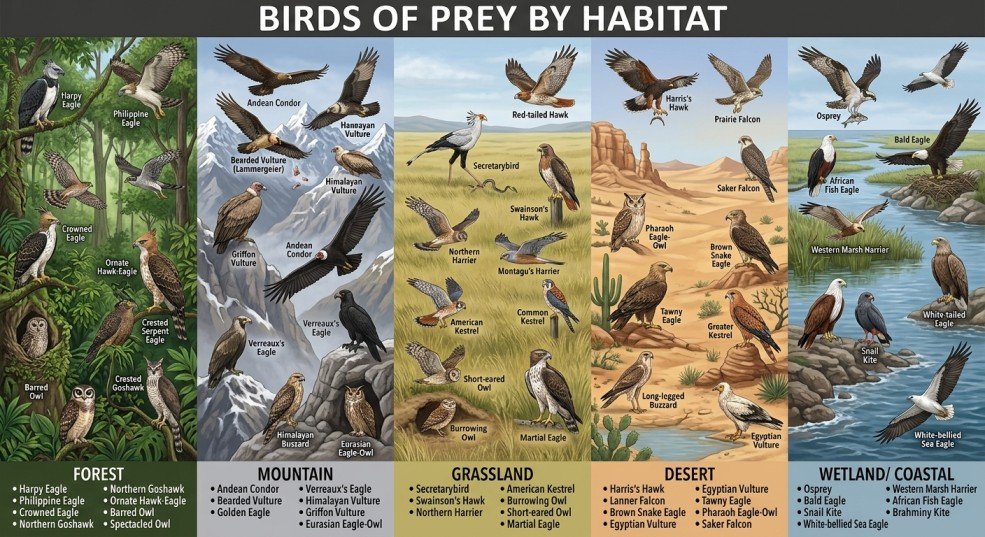
Forest Birds of Prey
- Harpy Eagle
- Philippine Eagle
- Northern Goshawk
- Cooper’s Hawk
- Crowned Eagle
- Ornate Hawk-Eagle
- Crested Serpent Eagle
- Barred Owl
- Spectacled Owl
- Crested Goshawk
Mountain Birds of Prey
- Golden Eagle
- Bearded Vulture
- Himalayan Vulture
- Griffon Vulture
- Andean Condor
- Verreaux’s Eagle
- Lammergeier
- Gyrfalcon
- Himalayan Buzzard
- Eurasian Eagle-Owl
Grassland Birds of Prey
- Secretarybird
- Red-tailed Hawk
- Swainson’s Hawk
- Northern Harrier
- Montagu’s Harrier
- American Kestrel
- Common Kestrel
- Short-eared Owl
- Burrowing Owl
- Martial Eagle
Desert Birds of Prey
- Harris’s Hawk
- Prairie Falcon
- Lanner Falcon
- Saker Falcon
- Pharaoh Eagle-Owl
- Brown Snake Eagle
- Tawny Eagle
- Greater Kestrel
- Long-legged Buzzard
- Egyptian Vulture
Wetland and Coastal Birds of Prey
- Osprey
- Bald Eagle
- African Fish Eagle
- White-tailed Eagle
- Western Marsh Harrier
- Eastern Marsh Harrier
- Brahminy Kite
- Snail Kite
- Black-collared Hawk
- White-bellied Sea Eagle
Diurnal and Nocturnal Birds of Prey
Birds of prey can also be grouped by their active hours. Diurnal raptors mainly hunt during daylight, while nocturnal species are most active at night.
Diurnal Birds of Prey
- Bald Eagle
- Golden Eagle
- Peregrine Falcon
- Red-tailed Hawk
- Cooper’s Hawk
- American Kestrel
- Osprey
- Red Kite
- Griffon Vulture
- Secretarybird
- Northern Harrier
- Common Buzzard
Nocturnal Birds of Prey
- Barn Owl
- Great Horned Owl
- Tawny Owl
- Barred Owl
- Eurasian Eagle-Owl
- Eastern Screech Owl
- Western Screech Owl
- Long-eared Owl
- Northern Saw-whet Owl
- Boreal Owl
- Spectacled Owl
- Spotted Owl
Birds of Prey Active During Day and Night
- Snowy Owl
- Burrowing Owl
- Short-eared Owl
- Northern Hawk-Owl
- Little Owl
- Great Grey Owl
Interesting Facts About Birds of Prey
Birds of prey have specialised hunting abilities, but not every species hunts in the same way. Their vision, flight, feet, and feeding habits reflect the animals they eat.
- Fastest diving bird: The peregrine falcon can exceed 320 km/h during a hunting dive.
- Largest living eagle by mass: The Steller’s sea eagle is among the heaviest eagle species.
- Powerful forest hunter: The harpy eagle has exceptionally large talons for gripping prey.
- Specialised fish hunter: The osprey catches fish with its feet and carries them head-first.
- Largest living owl by length: Blakiston’s fish owl is among the largest owl species.
- Exceptional hearing: Barn owls can locate small mammals using sound in darkness.
- Bone-eating raptor: The bearded vulture gets much of its food from animal bones.
- Ground-hunting bird: The secretarybird walks across grasslands to hunt snakes and other animals.
- Cooperative hunter: Harris’s hawks sometimes hunt together to capture prey.
- Natural scavengers: Vultures help remove dead animals from the environment.
Difference Between Common Birds of Prey
The easiest way to distinguish common raptors is to compare their wings, feet, food, and hunting behaviour. These features are useful for identifying birds in photographs or outdoors.
Bird Group | Common Features | Typical Food |
|---|---|---|
Eagles | Large body, strong talons | Fish, mammals, birds |
Hawks | Agile flight, sharp talons | Rodents, small birds |
Falcons | Pointed wings, fast flight | Birds, insects, mammals |
Owls | Facial discs, quiet flight | Rodents, birds, insects |
Vultures | Soaring wings, scavenging habits | Dead animals |
Kites | Long wings, often forked tails | Small animals, carrion |
Harriers | Long wings, low hunting flight | Rodents, birds |
Buzzards | Broad wings, soaring flight | Small mammals, reptiles |
Ospreys | Fish-gripping feet, long wings | Fish |
Secretarybirds | Long legs, ground hunting | Snakes, insects, rodents |
Common Confusions About Birds of Prey
Some raptor names overlap, and several everyday names do not match scientific groupings.
- Hawk vs. falcon: Hawks and falcons belong to different bird families.
- Buzzard vs. vulture: In North America, people sometimes call vultures buzzards.
- Eagle vs. osprey: An osprey is a separate type of fish-eating raptor.
- Owl activity: Not every owl hunts only at night.
- Vulture feeding: Vultures are birds of prey, although most mainly eat carrion.
FAQs About Birds of Prey
Birds of prey are raptors that hunt animals or feed on carrion. They generally have hooked beaks, sharp talons, and specialised eyesight.
The main groups include eagles, hawks, falcons, owls, vultures, kites, harriers, buzzards, and ospreys. They differ in appearance and feeding habits.
The Andean condor has one of the largest wingspans among living raptors, reaching approximately 3.3 metres. Large eagles can be heavier.
The peregrine falcon is the fastest bird during a dive, reaching speeds above 320 kilometres per hour when hunting birds in flight.
Yes. Owls are birds of prey that hunt animals using their sharp talons, hooked beaks, and excellent hearing or eyesight.
Eagles are generally larger and more powerful than hawks, but their sizes overlap. Both groups contain skilled hunters with sharp talons.
Yes. Raptors eat animal-based food, including mammals, birds, fish, insects, and carrion. Different species have different diets and feeding methods.
Raptors help control populations of rodents and other animals. Scavenging species also remove carcasses, supporting healthy ecosystems and natural food chains.
Conclusion
Birds of prey include eagles, hawks, falcons, owls, vultures, kites, harriers, buzzards, ospreys, and several specialised raptors. Their names reflect a wide variety of sizes, habitats, hunting methods, and feeding habits. Recognising their wings, talons, beaks, and behaviour makes it easier to identify these birds and understand their roles in nature.