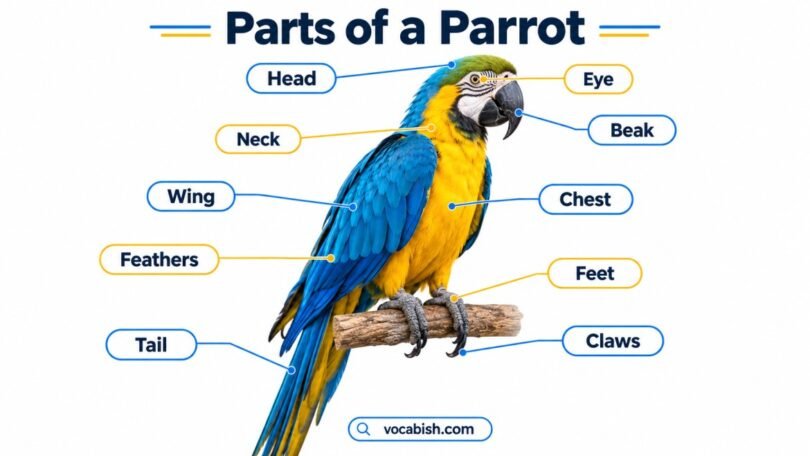

Parts of a Parrot include the head, beak, eyes, neck, wings, feathers, tail, legs, feet, toes, and claws. Each body part has a different function that helps the bird eat, fly, climb, balance, or explore its surroundings. Parrots are especially known for their strong, curved beaks and feet that can grip branches and hold food.
Learning parrot body parts names helps you identify these features and describe them correctly. This article explains the external anatomy of a parrot with easy meanings, a labeled diagram reference, examples, and vocabulary activities.
Common Parts of a Parrot and Their Names
A parrot has several external body parts that are easy to recognize. Some help it move and find food, while others protect its body or support everyday activities.
Here are 17 common parts of a parrot with their names and short meanings.
- Head: The upper body region containing the brain and eyes.
- Crown: The highest part of the parrot’s head.
- Eye: Helps the parrot see objects and movement.
- Beak: A hard, curved structure used for eating and gripping.
- Nostril: A small opening through which the parrot breathes.
- Neck: Connects the head to the main body.
- Body: The main region containing important internal organs.
- Chest: The front region below the neck.
- Back: The upper rear surface of the body.
- Belly: The lower front region of the body.
- Wing: A feather-covered limb mainly used for flying.
- Feathers: Lightweight coverings that protect and insulate the body.
- Tail: The rear structure that supports balance and steering.
- Leg: Supports the body during standing and movement.
- Foot: Helps the parrot perch and grip objects.
- Toes: Flexible digits used for holding and climbing.
- Claws: Curved, hard tips that help grip surfaces.
These are the main vocabulary words learners should recognize before studying more detailed parrot anatomy.
Parts of a Parrot with a Labeled Diagram
A labeled parrot anatomy diagram helps you identify where each body part is located. The head contains the eyes and beak, the wings extend from the sides of the body, and the tail projects from the rear.
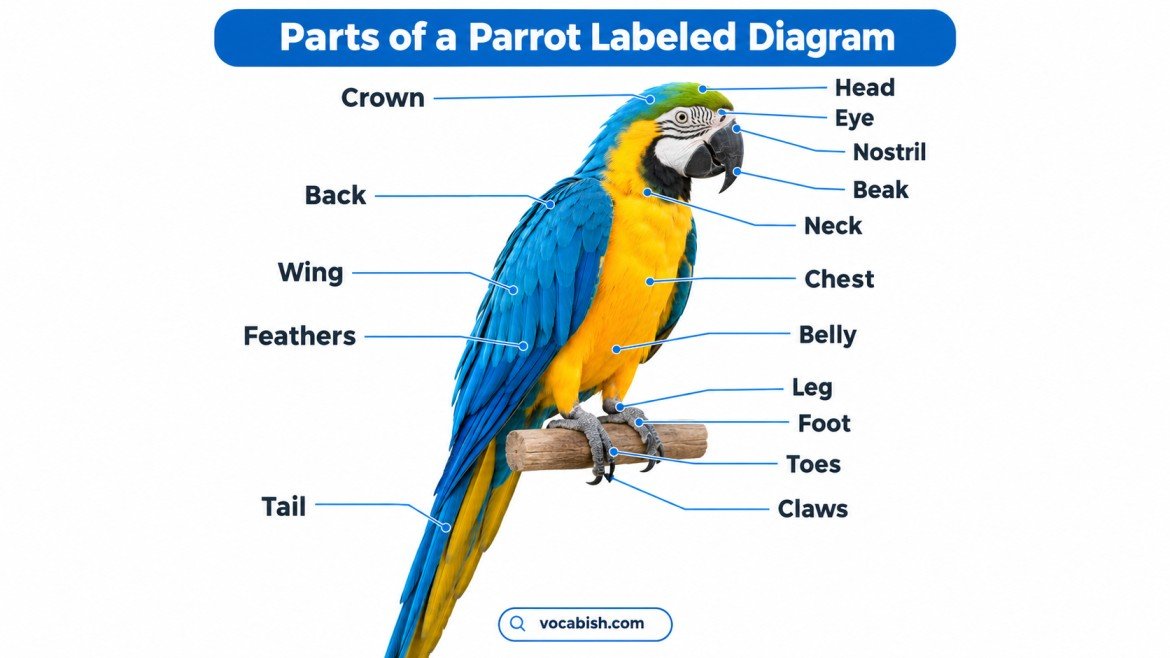
When studying the diagram, look for these main regions:
Body Region | Parts to Identify | Location |
|---|---|---|
Head | Crown, eye, beak, nostril | Top and front |
Neck | Neck | Between head and body |
Main body | Chest, back, belly | Middle of the bird |
Wings | Wings and flight feathers | Both sides of the body |
Tail | Tail feathers | Rear of the body |
Legs and feet | Legs, toes, claws | Lower body |
The beak and feet are especially useful for recognizing a parrot. Its curved beak can break and handle food, while its toes allow it to hold branches securely.
Parts of a Parrot’s Head
A parrot’s head contains several structures used for seeing, hearing, breathing, and eating. The beak is usually the most noticeable feature, while smaller parts such as the nostrils and ears can be harder to identify.
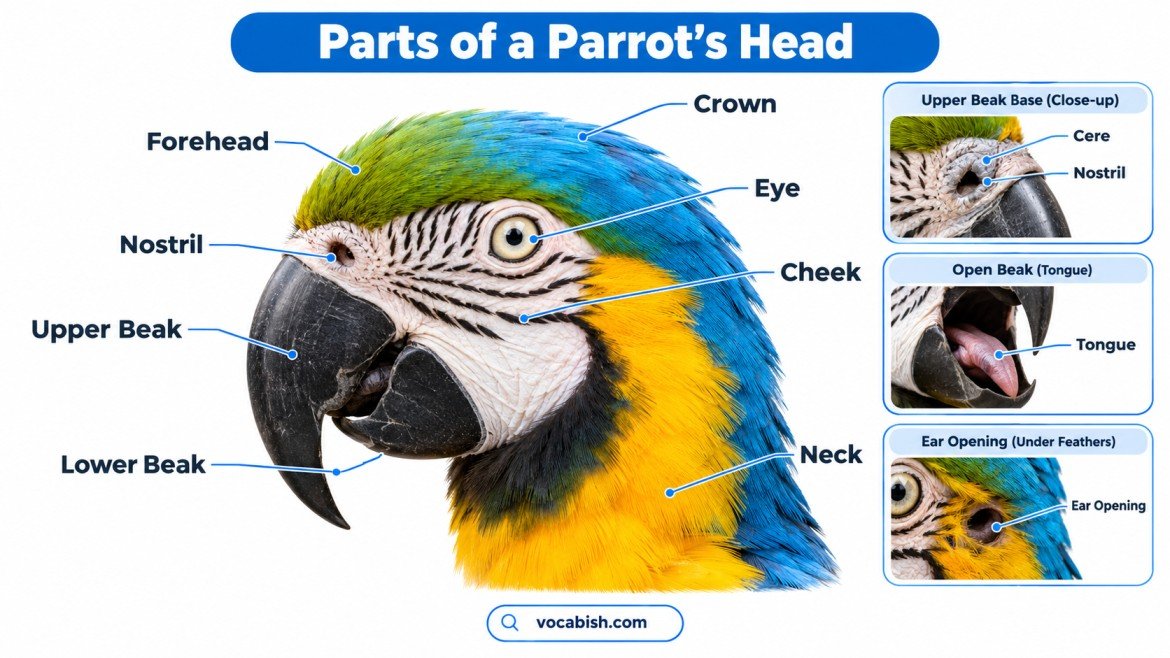
Beak, Cere, and Nostrils
Beak: A parrot’s beak is strong and curves downward at the tip. It has an upper part and a lower part that work together when the bird eats, holds objects, or climbs. Many parrots can crack hard seeds and nuts with their beaks.
Cere: The cere is an area of skin near the base of the upper beak. It is noticeable in some parrots but less obvious in others. The nostrils are commonly located in or near this area.
Nostrils: Nostrils are small openings that allow air to enter the respiratory system. The scientific word for nostrils is nares.
The beak is also called a bill. Both words are correct, although beak is especially common when describing parrots.
Eyes, Ears, and Tongue
Eyes: Parrots have eyes on the sides of their heads. They use their vision to find food, notice movement, and recognize objects around them.
Ears: A parrot has ear openings on the sides of its head, behind and slightly below the eyes. Feathers normally cover these openings, so they are difficult to see.
Tongue: The tongue is inside the beak. It helps the parrot move food, taste it, and handle small objects. Many parrots have thick, muscular tongues that work closely with their beaks.
Body, Neck, Chest, Back, and Belly
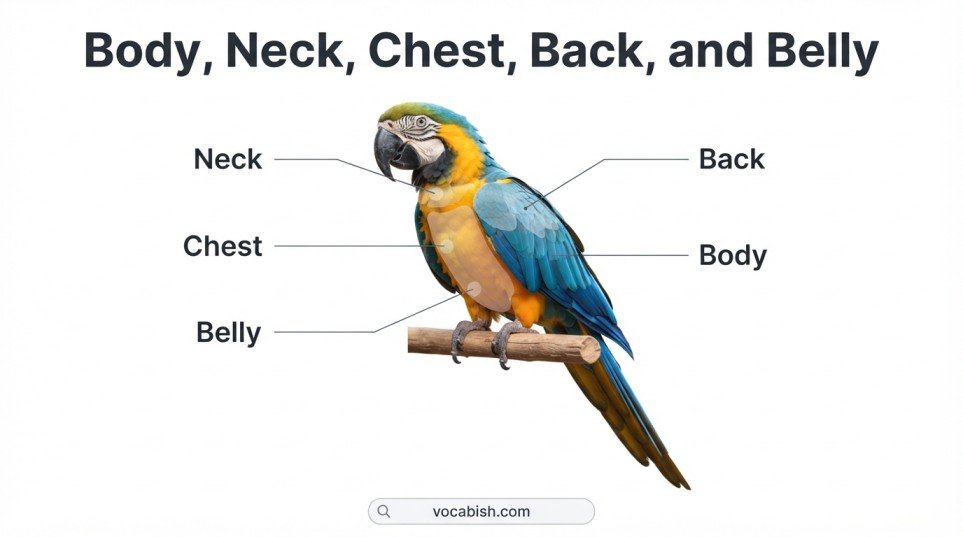
The main body of a parrot supports its wings and legs and contains its internal organs. The neck connects the head to the body, allowing the bird to turn its head and reach different areas.
Body Part | Location | Main Function |
|---|---|---|
Neck | Between head and body | Supports head movement |
Chest | Front of the body | Covers the breast region and flight muscles |
Back | Upper rear body | Supports the wings and surrounding structures |
Belly | Lower front body | Covers part of the abdominal region |
Body | Main central region | Houses and protects internal organs |
The chest and belly are different regions. The chest lies higher, while the belly is farther down toward the tail.
For example, a learner might say, “The parrot has yellow feathers on its chest” or “The feathers on its belly are green.”
Wings of a Parrot and Their Parts
Parrots have two wings attached to the sides of their bodies. Most parrots use them for flight, although some species, such as the kākāpō, cannot fly.
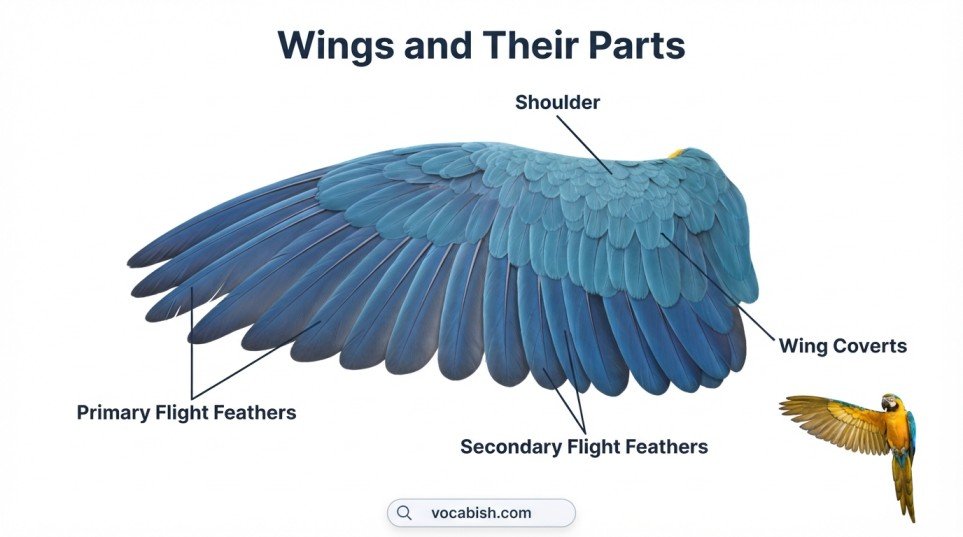
A wing contains bones, muscles, skin, and feathers. The long flight feathers are especially important because they help produce lift and control movement through the air.
Wing Part | Meaning | Function |
|---|---|---|
Shoulder | Area where the wing joins the body | Allows wing movement |
Primary feathers | Long feathers on the outer wing | Help produce forward movement and control |
Secondary feathers | Flight feathers along the inner wing | Help produce lift |
Wing coverts | Smaller feathers covering wing bases | Smooth and protect the wing surface |
Primary and secondary feathers are both flight feathers, but they occupy different positions on the wing.
During flight, the parrot moves its wings up and down. The shape and arrangement of the feathers help the bird move through the air.
Parrot Feathers and Their Types
Feathers cover much of a parrot’s body. They help protect its skin, maintain body temperature, and support flight. Feather colors and patterns vary greatly among parrot species.
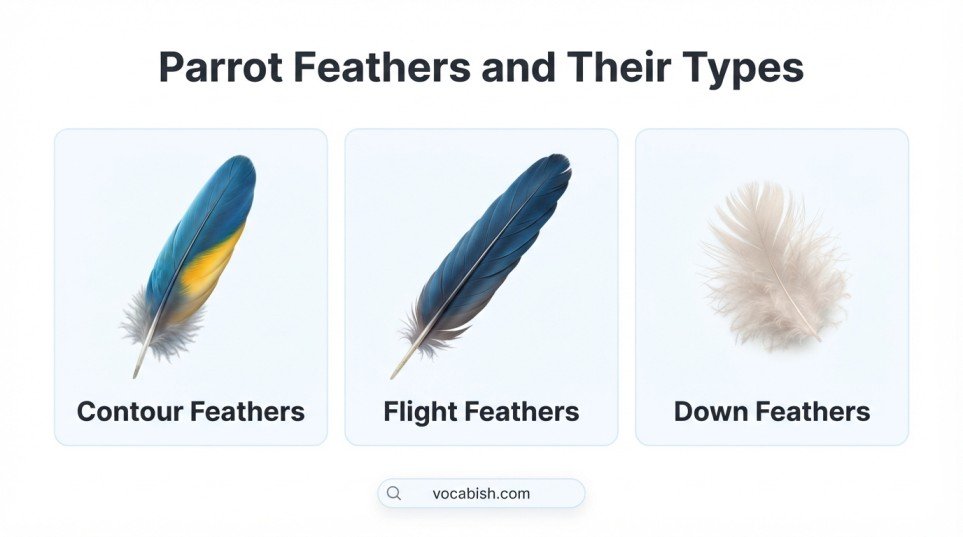
Three important feather types are:
Feather Type | Description | Main Function |
|---|---|---|
Contour feathers | Feathers forming the outer body covering | Give the body shape and protection |
Flight feathers | Long, strong feathers on wings and tail | Support flying, steering, and control |
Down feathers | Soft, fluffy feathers beneath outer feathers | Help keep the bird warm |
Parrots also replace old or damaged feathers through a natural process called molting.
A feather is not the same as a wing. Feathers cover the wings and other body regions, while a wing is an entire limb.
Tail and Tail Feathers of a Parrot
A parrot’s tail extends from the rear of its body. It consists of several structures, including long tail feathers that help the bird control its movements.
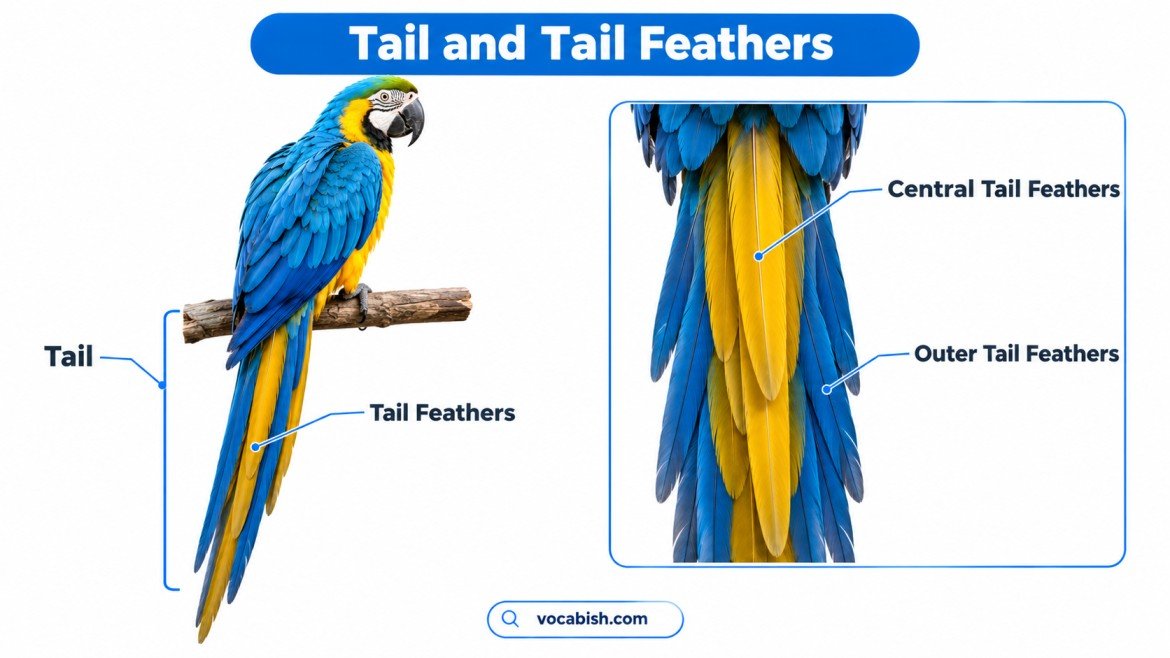
Tail feathers can spread apart or move together during flight.
Their main functions include:
- Steering: Helping the bird change direction in the air.
- Balance: Supporting stability during movement and landing.
- Braking: Helping the bird slow down before landing.
Parrot tails differ in appearance. Macaws often have long, pointed tails, while African grey parrots have much shorter tails.
The word tail refers to the whole rear structure, while tail feathers refers specifically to the feathers growing from that region.
Legs, Feet, Toes, and Claws of a Parrot
Parrots have two legs and two feet. Their feet are especially good at gripping branches, climbing, and holding food.
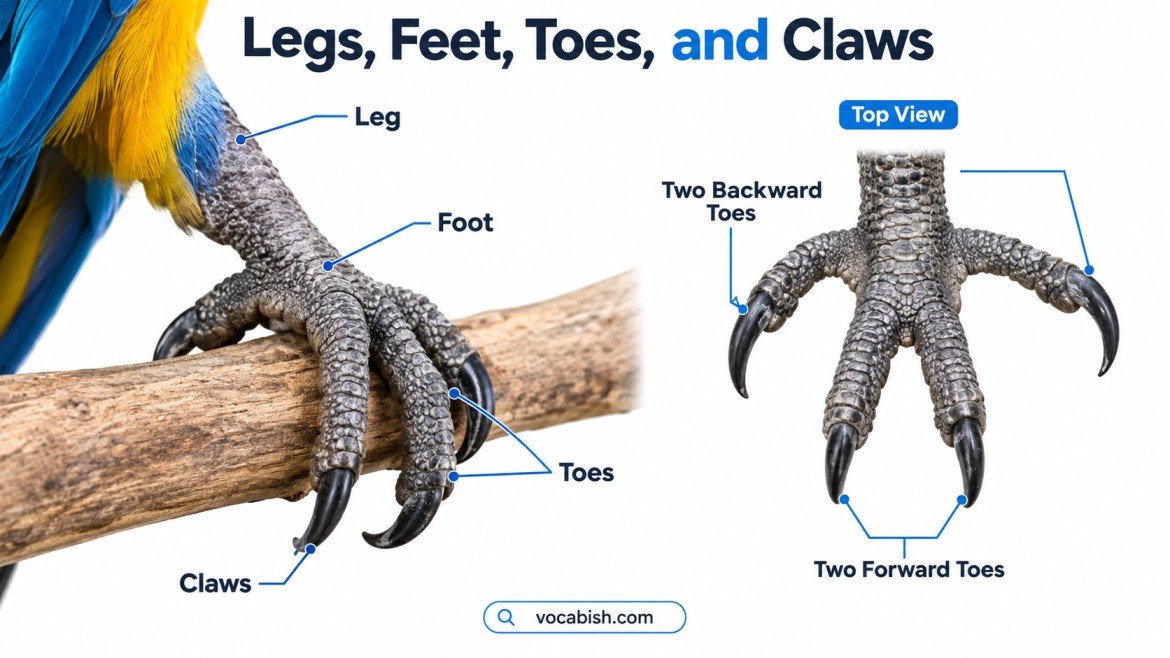
Most parrots have four toes on each foot. Two point forward and two point backward. This arrangement is called zygodactyl, pronounced approximately zy-go-DAK-til.
Part | Description | Function |
|---|---|---|
Leg | Limb connecting the body to the foot | Supports standing and walking |
Foot | Lower gripping structure | Holds branches and objects |
Toes | Four flexible digits on each foot | Grip, climb, and handle food |
Claws | Curved tips at the ends of toes | Provide a secure grip |
A parrot can often hold a piece of fruit in one foot while standing on the other. Its strong toes also help it climb branches and cage surfaces.
The claws are part of the toes, not separate toes themselves.
How Parrots Use Their Body Parts
Parrots use different body parts together to perform everyday activities. Their beaks, feet, wings, and tails are particularly important for feeding and movement.
Body Part | Main Function | Everyday Example |
|---|---|---|
Beak | Breaking and handling food | A parrot cracks a seed. |
Tongue | Moving food inside the mouth | It moves food with its tongue. |
Eyes | Seeing nearby objects | It notices a piece of fruit. |
Ears | Detecting sounds | It hears another bird calling. |
Wings | Flying | It flies between branches. |
Tail | Steering and balancing | It changes direction in flight. |
Feet | Gripping objects | It holds a branch. |
Claws | Maintaining a firm grip | Its claws grip the perch. |
Neck | Moving the head | It turns to look behind itself. |
Feathers | Insulation and protection | Its feathers help retain warmth. |
These examples show how parrot anatomy relates to actions that you can observe and describe in English.
Commonly Confused Parrot Body Parts
Some parrot body-part words have similar meanings, but they do not always refer to the same structure.
- Beak vs. Bill: Both names refer to the same mouth structure. Bill is another common word for beak.
- Wing vs. Feather: A wing is a limb used for flight. A feather is one of the structures covering it.
- Foot vs. Claw: The foot includes the toes. A claw is the curved tip of a toe.
- Nostril vs. Cere: A nostril is a breathing opening. The cere is an area of skin near the beak’s base.
- Tail vs. Tail Feather: The tail is the complete rear structure. Tail feathers are individual feathers within it.
Remember that feet is the plural form of foot, and feathers is the plural form of feather.
Parrot Body Parts in English Sentences
Using body-part words in sentences helps you remember their meanings and practise natural English.
- The parrot has a strong, curved beak.
- Its eyes help it notice movement.
- The green feathers cover most of its body.
- The parrot spreads its wings before flying.
- Its long tail helps it steer in the air.
- The parrot uses its feet to hold a branch.
- Its sharp claws grip the wooden perch.
- The bird turns its head to look around.
- A parrot uses its tongue to move food.
- The bird has bright yellow feathers on its chest.
Notice how its shows that a body part belongs to the parrot. For example, “The parrot opens its wings” is a natural way to describe the bird’s movement.
FAQs About Parrot Body Parts
The main external parts include the head, beak, eyes, neck, body, wings, feathers, tail, legs, feet, toes, and claws.
A parrot uses its curved beak to break food, hold objects, explore surfaces, and help itself climb branches or other structures.
A parrot normally has four toes on each foot. Two point forward and two point backward, providing a strong grip on branches.
The cere is an area of skin near the upper beak’s base. It surrounds or lies close to the nostrils in many parrots.
A parrot’s ear openings are on the sides of its head, behind and below the eyes. Feathers usually hide these openings.
Wings are the bird’s flight limbs, while feathers are lightweight structures covering its body. Flight feathers help the wings produce lift and control movement.
A parrot spreads and adjusts its tail feathers to help steer, maintain balance, and slow down when preparing to land.
Conclusion
Learning the parts of a parrot helps you recognize important bird anatomy and describe how parrots move, eat, and interact with their surroundings. The head, beak, wings, feathers, tail, and feet are the most useful body parts to identify first.
Study the labeled diagram, practise the vocabulary sentences, and review the differences between similar terms. These activities will help you use parrot body parts names correctly in everyday English.