Skip to content
  • Home
  • Privacy Policy
  • About Us
  • Contact Us
Vocabish Logo

Vocabish

Learn English as a Second Language

  • Home
  • Basic English Learning
  • Vocabulary
    • Adjectives
    • Synonyms
    • Antonyms
    • Confusing Words
  • Sentences
    • Examples
  • Privacy Policy
  • Contact Us
  • Toggle search form

Parts of a Fish and Their Functions with Diagram

Posted on January 8, 2026February 4, 2026 By Muhammad Matloob No Comments on Parts of a Fish and Their Functions with Diagram

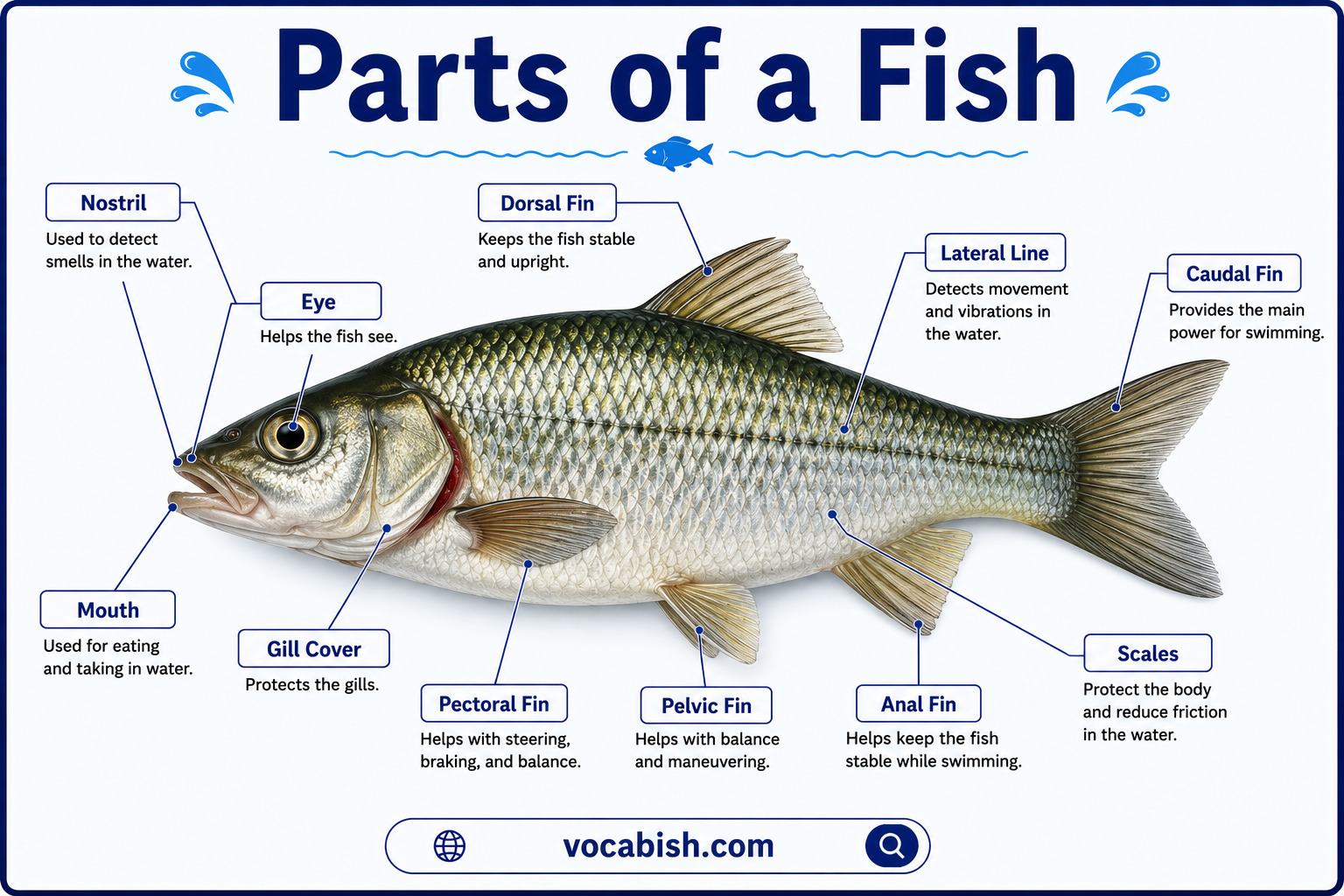
In this blog post, you will learn the main parts of a fish, both external and internal, and understand their functions. You will also see a clear diagram showing how each part works, including fins, gills, heart, stomach, and swim bladder. This helps students and beginners to easily master the names and uses of each part while improving their vocabulary.

Table of Contents

Toggle
  • What is a Fish?
  • External Parts of a Fish with Diagram
    • Fins
    • Gills
    • Eyes
    • Mouth
    • Scales
    • Lateral Line
  • Internal Parts of a Fish
    • Heart
    • Stomach
    • Intestines
    • Liver
    • Kidneys
    • Swim Bladder
  • Conclusion
  • Frequently Asked Questions

What is a Fish?

A fish is a cold-blooded animal that lives in water. Fish can breathe with gills, swim using fins, and have scales covering their body. They can be found in rivers, lakes, and oceans.

Read More: Different Types of Fish

External Parts of a Fish with Diagram

Fins

Dorsal Fin
Helps the fish stay stable while swimming.

Pectoral Fins
Used for steering and balance.

Pelvic Fins
Helps in direction control and stopping.

Anal Fin
Gives stability when swimming.

Caudal Fin (Tail)
Used for fast movement and propulsion.

Gills

Gills
Allow fish to breathe underwater by taking oxygen from water.

Eyes

Eyes
Help fish to see and detect movement in water.

Mouth

Mouth
Used for eating and sometimes breathing.

Scales

Scales
Protect the fish and reduce friction while swimming.

Lateral Line

Lateral Line
A sense organ that detects water movement and vibrations.
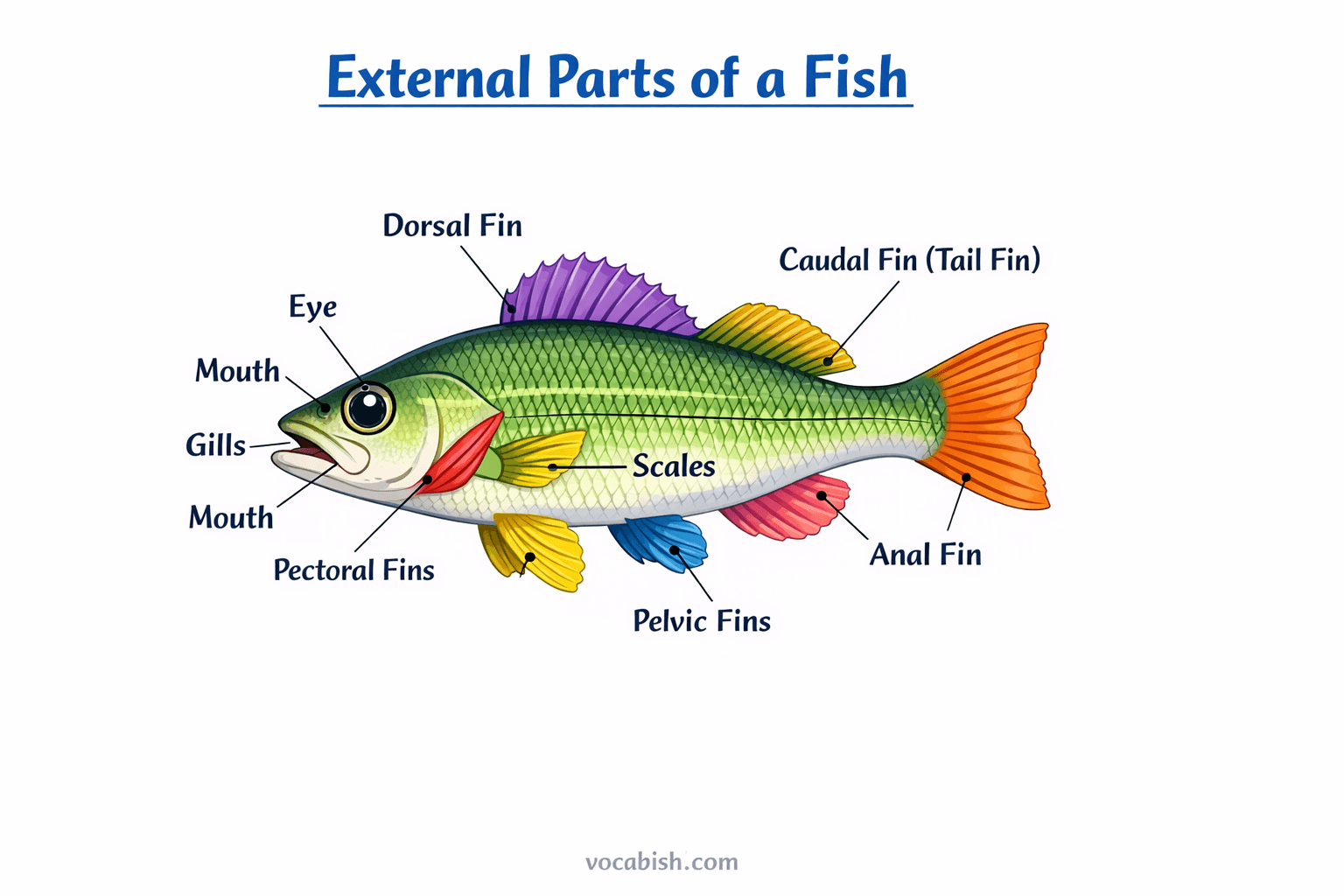
Fish External Parts Diagram
External Parts of a Fish

Internal Parts of a Fish

Heart

Heart
Pumps blood through the fish’s body.

Stomach

Stomach
Breaks down the food the fish eats.

Intestines

Intestines
Absorb nutrients from the food.

Liver

Liver
Produces enzymes to help digestion and stores energy.

Kidneys

Kidneys
Clean the fish’s blood and maintain water balance.

Swim Bladder

Swim Bladder
Helps the fish to float or sink in water easily.
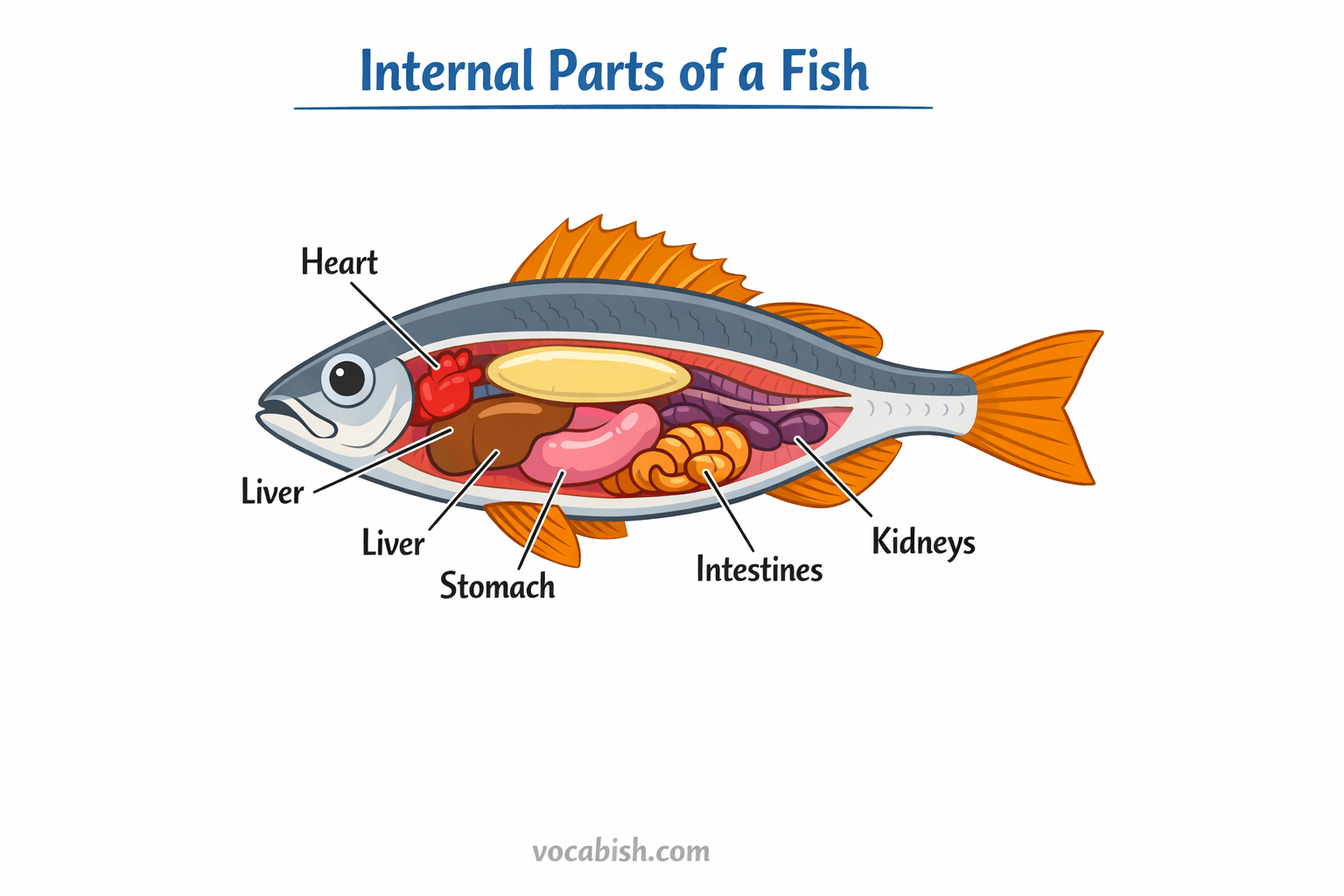
Internal Parts of a Fish with Functions
Internal Parts of a Fish

Conclusion

Understanding the parts of a fish and their functions is important for students and beginners. Knowing these parts helps you learn biology and nature in a simple way. Fish use their fins, gills, and other organs to survive, move, and eat in water.

Frequently Asked Questions

What are the main parts of a fish?
The main external parts of a fish are fins, gills, eyes, mouth, scales, and lateral line. Each part helps the fish move, breathe, see, and protect itself in water.

What is the function of a fish’s dorsal fin?
The dorsal fin helps the fish stay stable and balanced while swimming. It stops the fish from rolling over in water.

What do gills do in a fish?
Gills allow a fish to breathe underwater by taking oxygen from water and releasing carbon dioxide.

What are the internal parts of a fish?
The main internal parts include the heart, stomach, intestines, liver, kidneys, and swim bladder. These organs help the fish digest food, circulate blood, and control floating.

How does a fish swim using its fins?
Fins like pectoral, pelvic, anal, and caudal fins help the fish move forward, turn, stop, and maintain balance in water.

What is the purpose of the swim bladder in a fish?
The swim bladder allows the fish to float or sink easily without using its fins constantly, helping it save energy.

Read More

  • Parts of a Fishing Pole
  • Parts of a Fishing Reel
  • Parts of a Fishing Rod
Vocabulary

Post navigation

Previous Post: Parts of a Fishing Pole with Functions and Diagram
Next Post: Parts of an Egg and Their Functions with Diagram

Leave a Reply Cancel reply

Your email address will not be published. Required fields are marked *

  • Facebook
  • Pinterest

Recent Comments

  • OmarFaruk on 200+ Action Verbs List in English with Pictures
  • Alfred Kolekou on All Types of Jobs, Professions, Careers, and Occupations
  • Batu Dube Ukke on 10 Lines About A Day at the Park
  • Batu Dube Ukke on 10 Lines About A Day at the Park
  • ayantu on Modal Verbs Definition, Rules, and Examples

Recent Posts

  • 100 Collective Nouns for Animals in English with Pictures
  • List of Similes in English with Examples in Sentences
  • List of Homographs in English with Meanings
  • 100 Homonyms Meanings and Examples in English
  • 100 Best Homophones and Meaning with Examples

Most Popular Articles

  • Face Emoji Meanings — The Hidden Meanings Behind Emojis (4,421)
  • Unique Irregular Verbs List in English with Examples (4,163)
  • 500 Daily Used Normal vs Advanced English Words (4,042)
  • Heart Emoji Meanings : What Each Colour Heart Means (2,466)
  • Clothes and Fashion Vocabulary in English (2,453)
  • Emoji Meanings: Complete List of Emojis and Their Meanings (2,409)
  • 200+ Action Verbs List in English with Pictures (2,281)
  • 50 Basic Adjectives to Describe People in English (2,098)
  • 100 A to Z Difficult Words with Synonyms in English (1,466)

Our Topics

  • 12 Tenses (3)
  • Adjectives (44)
  • Antonyms (11)
  • Basic English Learning (5)
  • Confusing Words (35)
  • Examples (29)
  • Other Ways to Say (11)
  • Sentences (18)
  • Synonyms (37)
  • Vocabulary (137)
  • Worksheets (7)
  • Writing (14)

Copyright © 2026 Vocabish.

Powered by PressBook WordPress theme