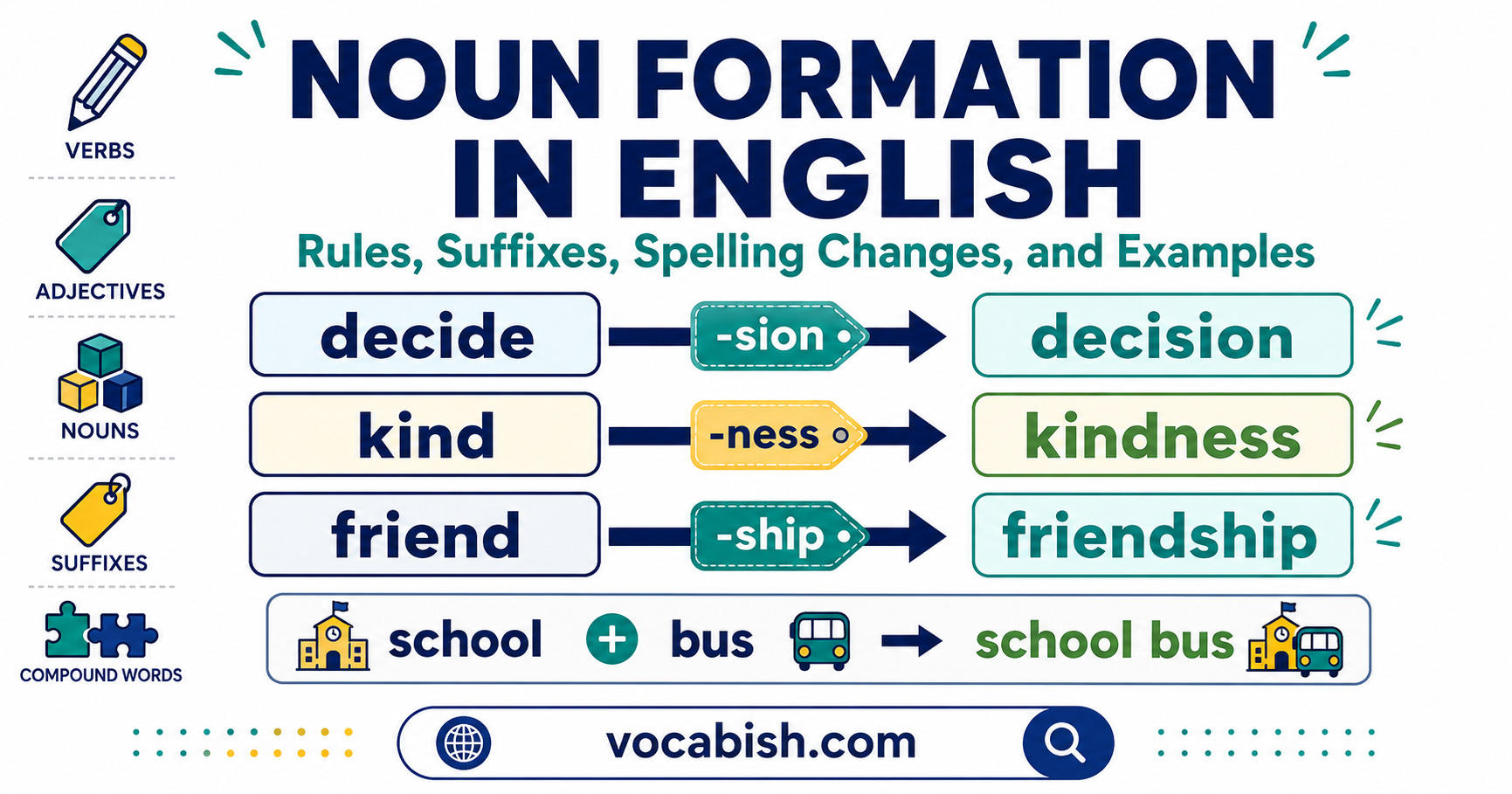

Noun formation in English is the process of creating nouns from verbs, adjectives, and other nouns. It helps learners understand how words such as “decide” become “decision” and “kind” becomes “kindness.”
English nouns are commonly formed by adding suffixes, combining words, or changing spelling. This guide explains the main rules, common noun-forming suffixes, spelling changes, and clear examples.
What Is Noun Formation?
Noun formation in English is the process of creating a noun from another word or combining existing words.
A noun may be formed from:
- A verb: decide → decision
- An adjective: kind → kindness
- Another noun: friend → friendship
- Two complete words: school + bus → school bus
Learning noun formation helps learners recognise word families and choose the correct form in sentences.
- They decided to leave.
- Their decision surprised us.
The verb “decided” describes an action, while the noun “decision” names the result of that action.
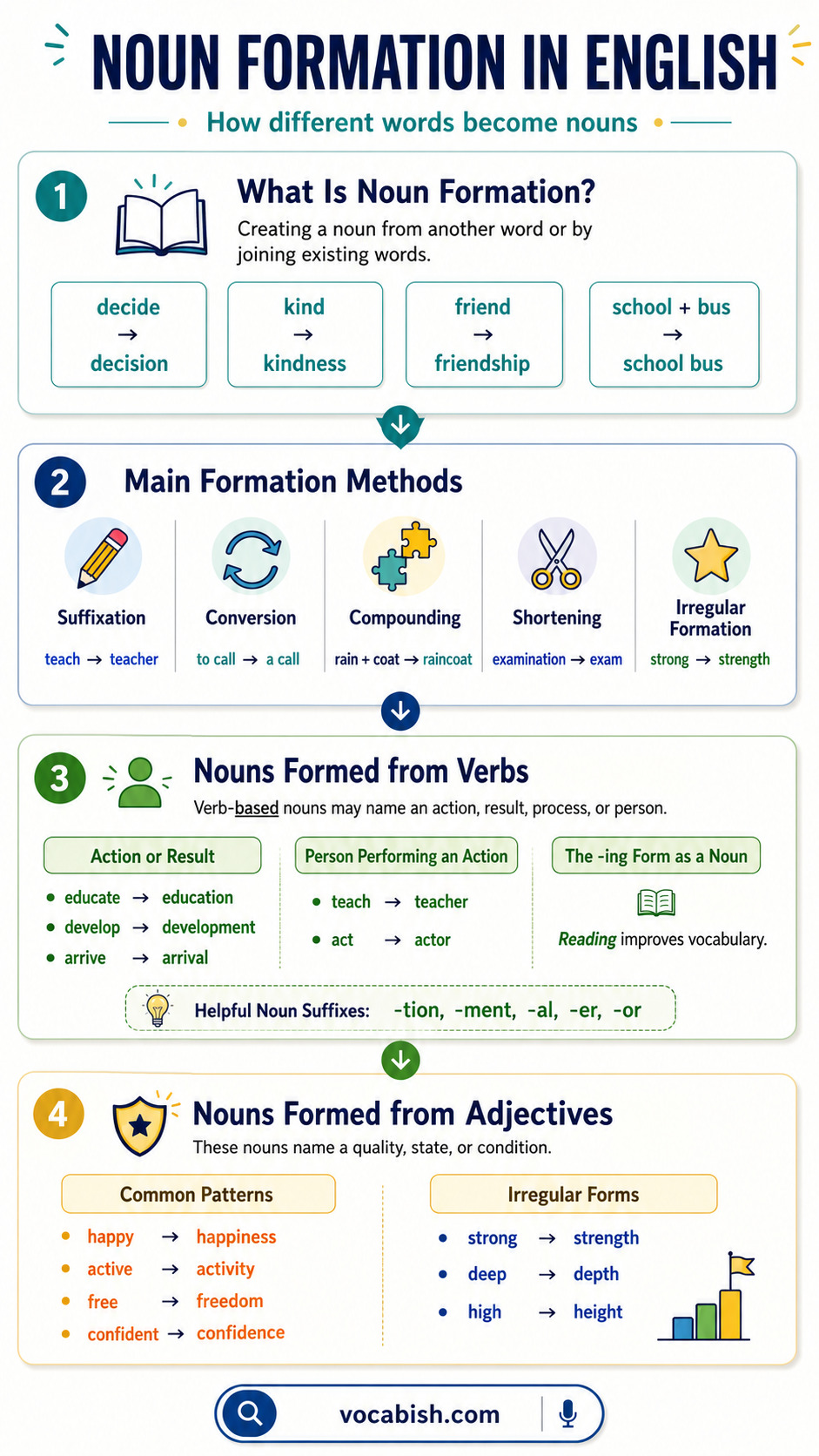
Main Ways Nouns Are Formed
English nouns are formed in several ways.
Method | How It Works | Examples |
|---|---|---|
Adding a suffix | An ending is added to a base word | teach → teacher |
Conversion | The word class changes without a new ending | to call → a call |
Compounding | Two words are joined | rain + coat → raincoat |
Shortening | A longer noun is reduced | examination → exam |
Irregular formation | The base word changes noticeably | strong → strength |
Suffixation is the most common method. However, not every suffix can be added to every word.
Nouns Formed from Verbs
Many nouns are formed by adding suffixes such as -tion, -ment, -al, -ance, -er, and -or to verbs.
Verb | Noun | Example |
|---|---|---|
educate | education | Education can improve lives. |
develop | development | The development took several years. |
arrive | arrival | We waited for their arrival. |
perform | performance | Her performance impressed everyone. |
refuse | refusal | His refusal caused a delay. |
teach | teacher | Our teacher explains grammar clearly. |
act | actor | The actor appeared on stage. |
choose | choice | You have a difficult choice. |
Some verb-based nouns name an action or process:
- discuss → discussion
- improve → improvement
- perform → performance
Others name the person who performs the action:
- write → writer
- direct → director
- employ → employer
The -ing form can also function as a noun:
- Reading improves vocabulary.
- Swimming is good exercise.
Related Resources: Nouns Formed From Verbs
Nouns Formed from Adjectives
Adjectives describe qualities. Their noun forms name the quality, state, or condition.
Adjective | Noun | Example |
|---|---|---|
happy | happiness | Happiness means different things to different people. |
kind | kindness | Her kindness made him feel welcome. |
able | ability | He has the ability to solve problems. |
active | activity | Physical activity supports good health. |
different | difference | I cannot see any difference. |
strong | strength | Regular training builds strength. |
wide | width | Measure the width of the table. |
free | freedom | Everyone values freedom. |
Common adjective-to-noun patterns include:
- -ness: dark → darkness
- -ity: possible → possibility
- -ence: confident → confidence
- -dom: free → freedom
Some forms are irregular and must be learned as complete words:
- poor → poverty
- long → length
- deep → depth
- high → height
You can read more about: Nouns Formed from Adjectives
Nouns Formed from Other Nouns
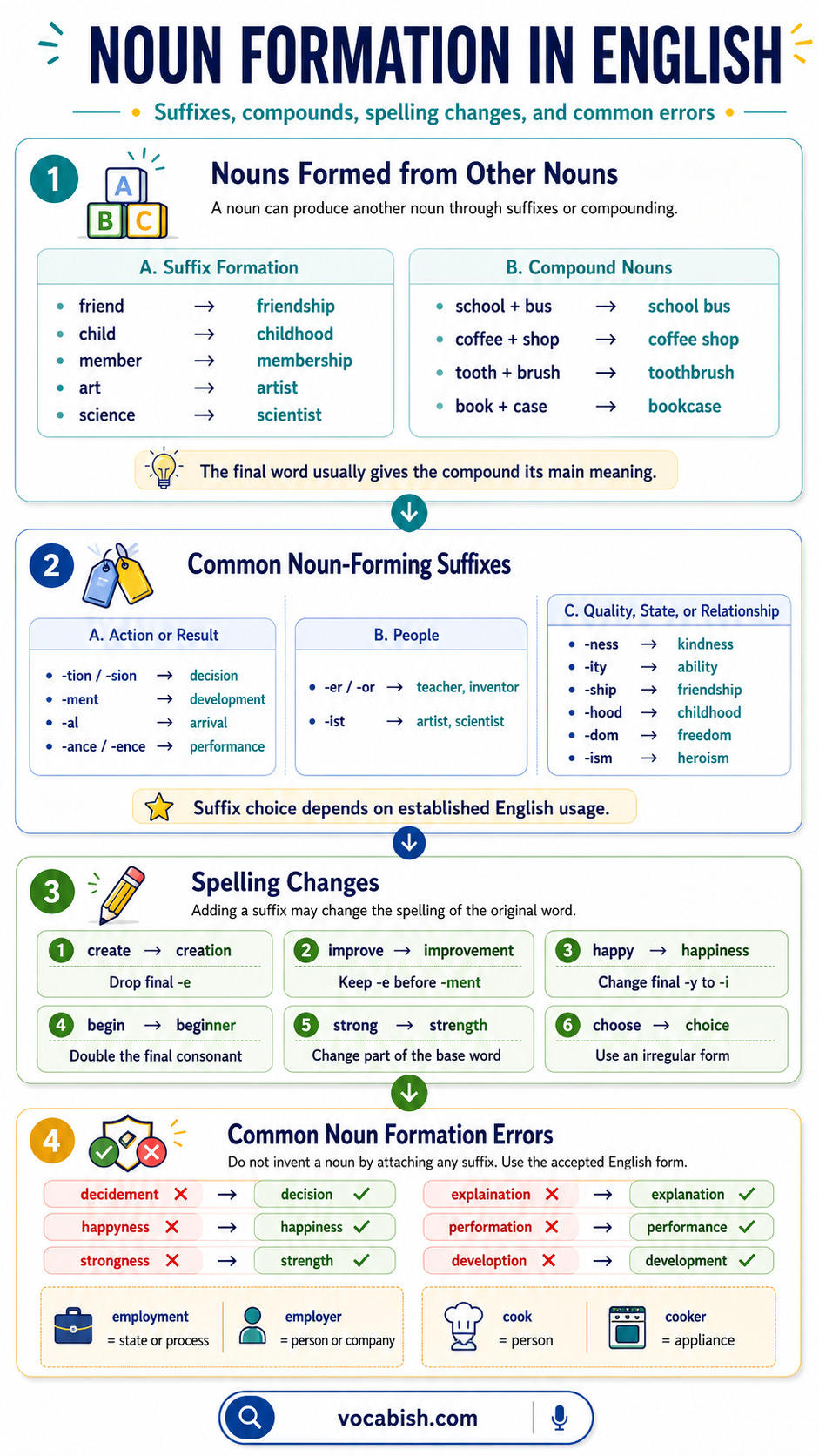
A noun can be changed into another noun by adding a suffix.
Base Noun | New Noun | Meaning |
|---|---|---|
friend | friendship | The relationship between friends |
child | childhood | The period of being a child |
member | membership | The state of being a member |
king | kingdom | An area ruled by a king |
hero | heroism | Brave or heroic behaviour |
art | artist | A person who creates art |
science | scientist | A person who studies science |
Nouns are also formed by combining two nouns:
- school + bus → school bus
- coffee + shop → coffee shop
- tooth + brush → toothbrush
- book + case → bookcase
- football + player → football player
In most compound nouns, the final word identifies the main person or thing. A coffee shop is a type of shop, not a type of coffee.
Here’s a detailed guide on: Nouns Formed from Nouns
Common Noun-Forming Suffixes
Suffix | Usual Meaning or Function | Examples |
|---|---|---|
-tion / -sion | Action, process, or result | creation, decision |
-ment | Action, process, or result | movement, agreement |
-al | Action or result | arrival, refusal |
-ance / -ence | State, action, or quality | performance, difference |
-er / -or | Person or thing performing an action | teacher, inventor |
-ness | Quality or state | kindness, darkness |
-ity | Quality, state, or condition | ability, activity |
-ship | Relationship, position, or status | friendship, leadership |
-hood | Period, state, or group | childhood, neighbourhood |
-dom | State, condition, or area | freedom, kingdom |
-ism | Belief, practice, or behaviour | heroism, tourism |
-ist | Person connected with an activity | artist, scientist |
The correct suffix usually depends on established English usage. For example:
- develop → development, not develoption
- decide → decision, not decidement
- kind → kindness, not kindity
Spelling Changes in Noun Formation
Adding a suffix sometimes changes the spelling of the base word.
Spelling Pattern | Examples |
|---|---|
Drop final -e before some suffixes | create → creation; combine → combination |
Keep final -e before -ment | achieve → achievement; improve → improvement |
Change final -y to -i | happy → happiness; lazy → laziness |
Double the final consonant in some words | begin → beginner; occur → occurrence |
Change part of the base word | strong → strength; wide → width |
Use an irregular form | choose → choice; speak → speech |
These patterns are helpful, but they do not apply to every word. Check a reliable dictionary when a noun form looks unfamiliar.
Common Noun Formation Errors
Incorrect Form | Correct Form | Reason |
|---|---|---|
decidement | decision | Decide forms its noun with -sion |
happyness | happiness | Final y changes to i |
strongness | strength | The standard noun form is irregular |
explaination | explanation | The correct spelling is explanation |
performation | performance | Perform takes -ance |
develoption | development | Develop takes -ment |
arriveance | arrival | Arrive takes -al |
Other common problems include:
- Confusing the action with the person:
- employment = the state or process of being employed
- employer = the person or company providing work
- Using the wrong person noun:
- cook can mean a person who prepares food.
- cooker normally means an appliance used for cooking.
- Assuming every word follows one fixed rule:
- teach → teacher
- act → actor
- science → scientist
You May Also Like: Nouns That Are Always Singular or Plural
Practice Exercise of Noun Formation
Complete each sentence with the correct noun form of the word in brackets.
- Her final ______ surprised the whole team. (decide)
- Thank you for your patience and ______. (kind)
- The company provides stable ______ for local workers. (employ)
- We waited at the airport for their ______. (arrive)
- Money does not always bring ______. (happy)
- His stage ______ was excellent. (perform)
- She has many happy memories of her ______. (child)
- Regular exercise can improve physical ______. (strong)
- Our new ______ makes grammar easy to understand. (teach)
- There is a clear ______ between the two answers. (differ)
Answers:
- decision
- kindness
- employment
- arrival
- happiness
- performance
- childhood
- strength
- teacher
- difference
FAQs About Noun Formation
Noun formation in English is the process of creating nouns from verbs, adjectives, other nouns, or complete words through suffixes and structural changes.
Common verb-to-noun suffixes include -tion, -ment, -al, -ance, -er, and -or, as in education, movement, arrival, performance, teacher, and actor.
Yes. English sometimes uses conversion, where a word changes function without changing form, as in to call and a call.
Spelling changes help the new noun follow standard English word patterns, such as happy becoming happiness or decide becoming decision.
No. Suffix choice depends on established usage, word history, and spelling patterns, so learners should check unfamiliar forms in a reliable dictionary.
Both often name people who perform actions, but their use depends on the base word: teacher, writer, actor, and inventor.
Learn common suffix patterns, notice nouns while reading, group related word families, and practise using each new noun in a complete sentence.
You May Also Like