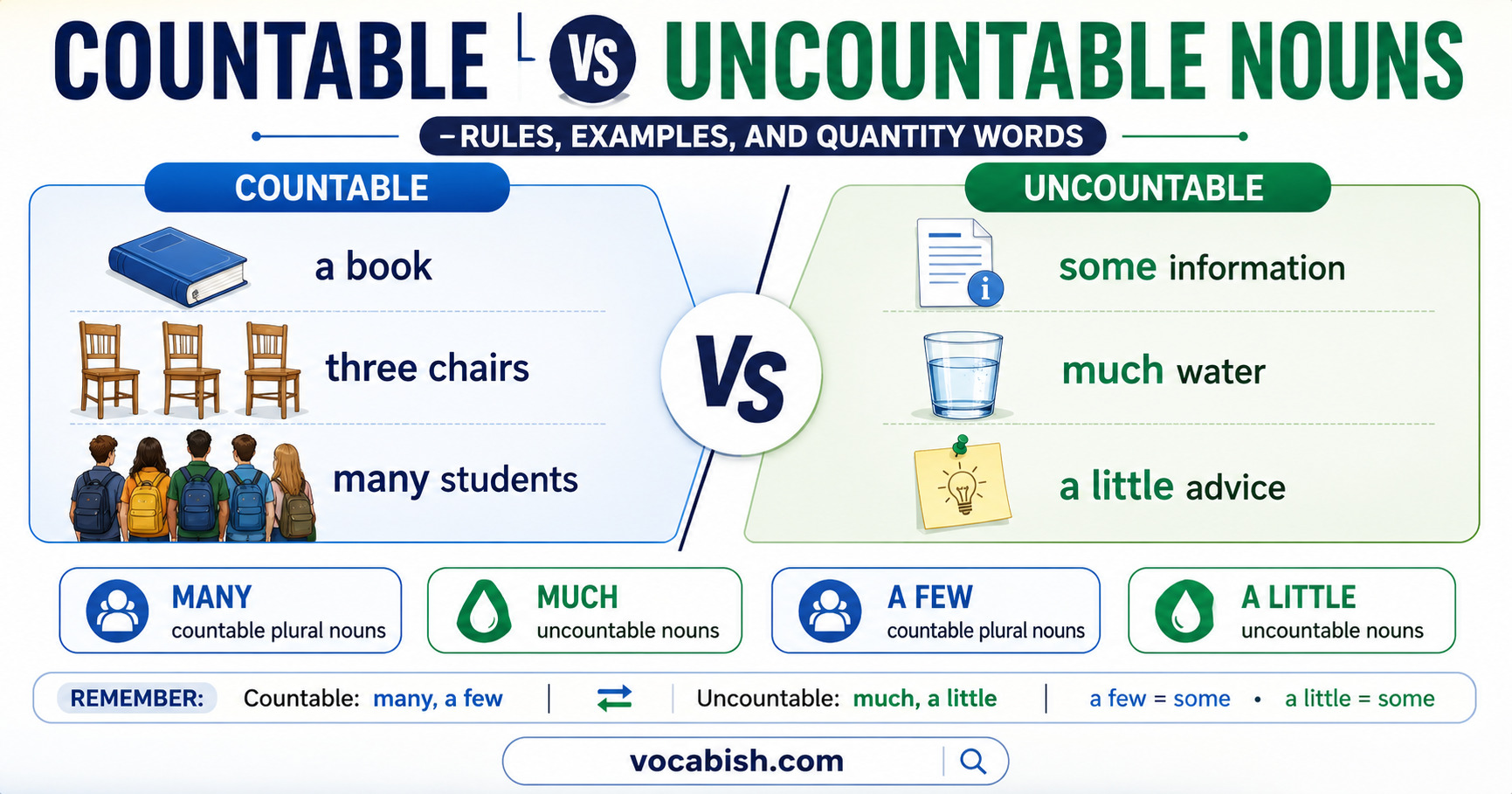

Countable vs uncountable nouns differ in how English treats number and quantity.
Countable nouns refer to separate people, objects, or ideas that we can count, while uncountable nouns describe substances, qualities, or general amounts that are not normally counted individually.
For example, we can say one book or three books, but we usually say some information, not three informations. This distinction affects plural forms, articles, quantifiers, and verb agreement.
The Main Difference
Countable nouns | Uncountable nouns |
|---|---|
Can be counted individually | Are treated as a mass, amount, or general idea |
Have singular and plural forms | Usually have no plural form |
Can follow a number | Do not normally follow a number directly |
Can use a or an in the singular | Cannot normally use a or an |
Examples: chair, student, idea | Examples: water, advice, furniture |
Compare:
- We bought three chairs.
- We bought some furniture.
- She gave me an idea.
- She gave me some advice.
A noun is not uncountable simply because it is difficult to count. The distinction depends on how English speakers normally understand and use it.
Singular and Plural Behaviour
Countable nouns have both singular and plural forms.
Singular | Plural |
|---|---|
one student | two students |
a child | several children |
an address | many addresses |
one box | five boxes |
A singular countable noun normally needs a determiner:
- a book
- the book
- my book
- this book
We do not usually say:
- Incorrect: I bought book.
- Correct: I bought a book.
Uncountable nouns usually remain singular in form and take a singular verb:
- The information is accurate.
- This furniture looks expensive.
- Her advice was helpful.
- The traffic has become worse.
Common uncountable nouns include:
- advice
- equipment
- furniture
- homework
- information
- knowledge
- luggage
- money
- progress
- research
- traffic
- work
These nouns do not normally take plural endings such as advices, furnitures, or informations.
Articles with Both Noun Types
Article choice depends on whether the noun is singular, plural, specific, or general.
Article use | Countable noun | Uncountable noun |
|---|---|---|
a/an | a ticket, an answer | Not normally used |
the | the ticket, the answers | the water, the information |
No article | Tickets are expensive. | Water is essential. |
some | some tickets | some water |
Use a or an only with singular countable nouns:
- a problem
- an opportunity
- a European country
- an honest person
Do not place a or an directly before an uncountable noun:
- Incorrect: an advice
- Correct: some advice
- Correct: a piece of advice
The definite article the can be used with either type when the meaning is specific:
- Please close the windows.
- Please drink the water on the table.
- I read the information you sent.
No article is needed when making a general statement:
- Dogs need regular exercise.
- Education can change lives.
- Rice is eaten in many countries.
Quantity Words Used with Countable and Uncountable Nouns
Different quantity words are used with countable and uncountable nouns.
Expression | Used with | Example |
|---|---|---|
many | plural countable nouns | many questions |
much | uncountable nouns | much time |
a few | plural countable nouns | a few mistakes |
few | plural countable nouns | few opportunities |
a little | uncountable nouns | a little patience |
little | uncountable nouns | little progress |
Use many with plural countable nouns:
- How many emails did you receive?
- There were not many people at the meeting.
Use much with uncountable nouns:
- How much money do we need?
- I do not have much experience.
In everyday positive statements, a lot of is often more natural than much:
- We have a lot of work today.
- She has a lot of friends.
The presence of a changes the meaning of few and little:
- A few students attended.
This means some students attended. - Few students attended.
This suggests that the number was disappointingly small. - We have a little time.
This means some time remains. - We have little time.
This means almost no time remains.
Measuring Uncountable Nouns
Uncountable nouns can be counted by adding a unit, container, measurement, or suitable quantity phrase.
Uncountable noun | Measurement expression |
|---|---|
advice | a piece of advice |
bread | a loaf of bread, two slices of bread |
furniture | an item of furniture |
information | a piece of information |
luggage | three pieces of luggage |
rice | a bowl of rice, a grain of rice |
water | a glass of water, two litres of water |
equipment | a piece of equipment |
work | a piece of work |
money | a sum of money |
Examples:
- The teacher gave us three pieces of advice.
- We ordered two bowls of rice.
- They bought five items of furniture.
- I need a piece of equipment for the repair.
- She saved a large sum of money.
The measurement word becomes countable, while the main noun stays uncountable:
- one piece of information
- four pieces of information
Nouns That Can Be Both
Some nouns can be countable or uncountable, but their meaning changes.
Noun | Uncountable meaning | Countable meaning |
|---|---|---|
chicken | meat | an individual bird |
coffee | the drink generally | a cup or serving |
experience | knowledge gained over time | a particular event |
glass | the material | a drinking container |
hair | hair collectively | an individual strand |
paper | the material | a newspaper, article, or academic work |
room | available space | an area inside a building |
time | time generally | a particular occasion |
Compare these examples:
- We ate chicken for dinner.
- There are six chickens on the farm.
- I drink coffee every morning.
- We ordered two coffees.
- She has teaching experience.
- Travelling alone was an unforgettable experience.
- There is not enough room in the car.
- The hotel has fifty rooms.
- I found a hair in my soup.
- Her hair is very long.
The surrounding meaning determines whether the noun is countable or uncountable.
Frequent Learner Errors
Incorrect | Correct |
|---|---|
an advice | some advice |
two advices | two pieces of advice |
many furniture | much furniture |
a new furniture | a new piece of furniture |
several information | several pieces of information |
much people | many people |
less students | fewer students |
fewer water | less water |
an equipment | a piece of equipment |
researches show | research shows |
Keep these points in mind:
- Use fewer with plural countable nouns: fewer cars, fewer errors.
- Use less with uncountable nouns: less traffic, less work.
- Use number with countable nouns: a large number of visitors.
- Use amount with uncountable nouns: a small amount of sugar.
- Do not add -s to standard uncountable nouns unless the meaning changes.
- Do not use a/an before an uncountable noun without a measuring expression.
Usage Practice
Choose the correct option.
- We received many / much applications for the position.
- Could you give me an advice / some advice?
- There is not many / much milk left.
- She bought three furnitures / pieces of furniture.
- I have had several interesting experiences / experience abroad.
- How many / much luggage are you taking?
- Only a few / a little employees attended the workshop.
- We still have a few / a little time before the train leaves.
Correct these sentences.
- He gave me two useful advices.
- There are less cars on the road today.
- I need an information about the course.
- Her researches are very detailed.
- We bought a bread from the bakery.
Answers:
- many
- some advice
- much
- pieces of furniture
- experiences
- much
- a few
- a little
Corrected sentences:
- He gave me two useful pieces of advice.
- There are fewer cars on the road today.
- I need some information about the course.
- Her research is very detailed.
- We bought a loaf of bread from the bakery.
FAQs
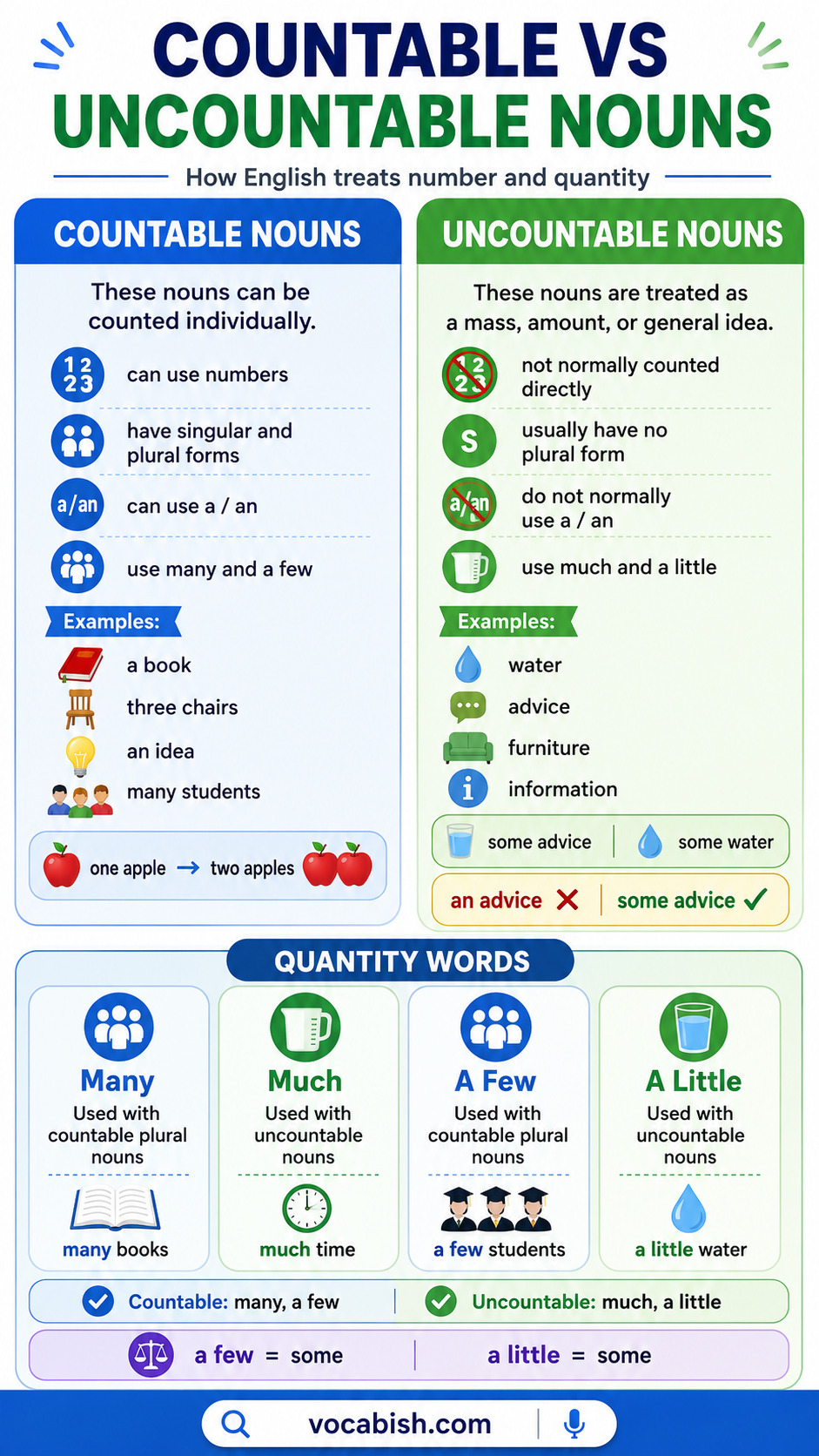
Countable nouns can be counted individually and usually have singular and plural forms, while uncountable nouns are treated as an undivided amount.
Use a or an only before a singular countable noun, such as a chair or an apple, never before an uncountable noun.
Some uncountable nouns become countable when they refer to types, servings, separate examples, or particular experiences rather than a general substance or idea.
Advice is uncountable in standard English, so say some advice, a piece of advice, or two useful pieces of advice.
Use many with plural countable nouns and much with uncountable nouns, especially in questions, negatives, and more formal positive statements.
Money is uncountable because English treats it as a general amount, although individual units such as rupees, coins, and notes are countable.
To check a noun, ask whether it can naturally take a number and a plural ending without changing its intended meaning.
Short Summary
Countable nouns have singular and plural forms and can be used with numbers, a/an, many, and a few. Uncountable nouns usually have one form and are used with much, a little, and measurement phrases. Some nouns belong to either group depending on their meaning, so always consider how the noun is being used in the sentence.
You May Also Like