
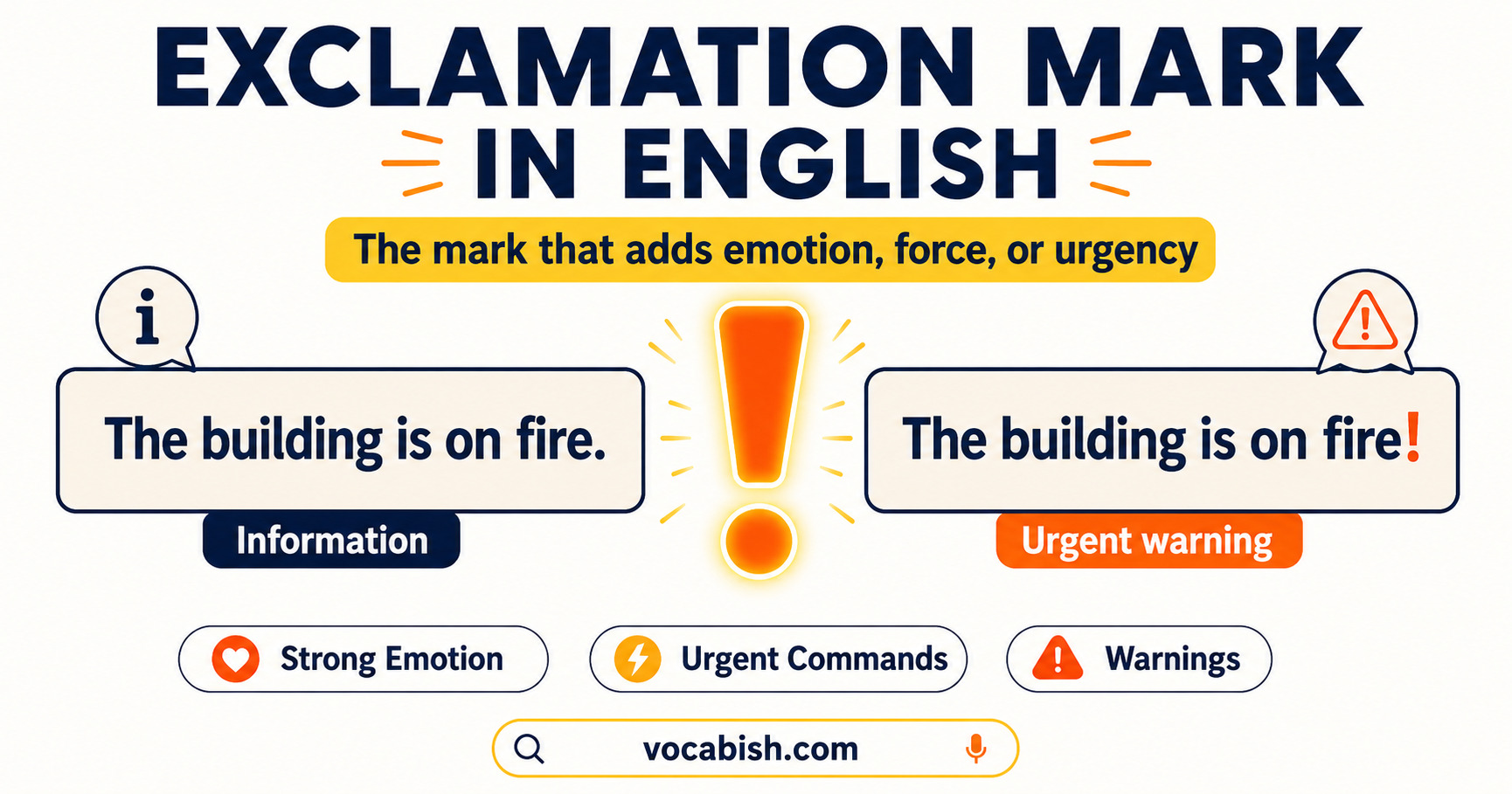

An exclamation mark (!) shows strong emotion, surprise, urgency, excitement, or a forceful command. It tells the reader that a word or sentence should be read with more intensity than an ordinary statement.
Compare “The building is on fire.” with “The building is on fire!” The first sentence simply gives information. The second sounds urgent and warns people that immediate action may be necessary. An exclamation mark can make writing more expressive, but it works best when the situation genuinely needs emphasis.
What an Exclamation Mark Expresses
An exclamation mark appears at the end of a word, phrase, or sentence that carries strong feeling or force.
Purpose | What It Communicates | Example |
|---|---|---|
Excitement | Happiness or enthusiasm | We won the match! |
Surprise | An unexpected reaction | You are here! |
Anger | Strong annoyance | Leave me alone! |
Fear | Alarm or danger | There is someone outside! |
Urgency | A need for immediate action | Call an ambulance! |
Admiration | Strong approval | What a beautiful painting! |
Pain | A sudden physical reaction | Ouch! |
Warning | A forceful caution | Watch out! |
The punctuation mark changes the tone, not the basic grammar:
- She passed the exam. — neutral information
- She passed the exam! — excitement or surprise
- You finished the entire project. — simple statement
- You finished the entire project! — admiration or disbelief
In American English, an exclamation mark is also called an exclamation point. Both names refer to the symbol !.
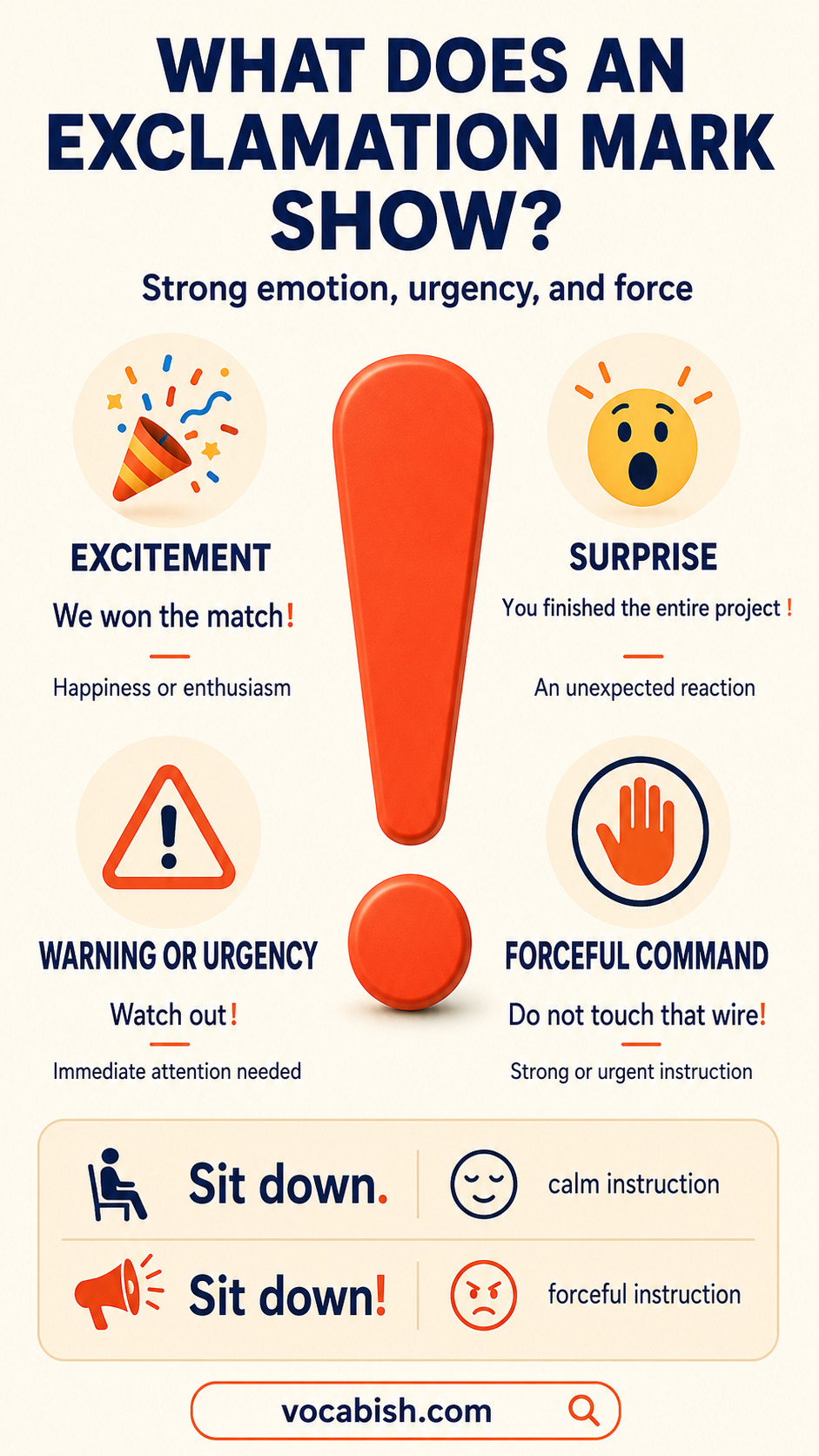
Strong Feelings and Commands
Expressing Strong Feelings
Use an exclamation mark when a sentence clearly communicates an intense emotion.
- I cannot believe we are finally here!
- That was an amazing performance!
- I am so happy for you!
- What a terrible mistake!
- This is the best news I have heard all week!
The emotion should already be present in the words. The punctuation simply strengthens it.
Compare:
Neutral Sentence | Emotional Sentence |
|---|---|
The view is beautiful. | What a beautiful view! |
I am pleased to see you. | I am so pleased to see you! |
The result is disappointing. | What a disappointing result! |
Giving Forceful Commands
A command normally ends with a full stop when it sounds calm or routine.
- Please close the window.
- Turn to page twenty.
- Leave the package at reception.
Use an exclamation mark when the command is urgent, emotional, or connected with danger.
- Stop!
- Get out of the road!
- Do not touch that wire!
- Run before the gate closes!
- Call the police immediately!
The difference depends on tone:
- Sit down. — calm instruction
- Sit down! — forceful order
- Please wait here. — polite request
- Wait here! — urgent command
An exclamation mark does not automatically make a command rude. Context, word choice, and the relationship between speakers also affect how it sounds.
Exclamations and Interjections
An exclamation is a word, phrase, or sentence that expresses a strong reaction.
- What a wonderful idea!
- How quickly the year has passed!
- That is unbelievable!
An interjection is a short word or expression used to show a sudden feeling.
Common interjections include:
- Wow! — surprise or admiration
- Ouch! — pain
- Hurray! — happiness or celebration
- Oh no! — worry or disappointment
- Hey! — attention, surprise, or protest
- Help! — urgent need
- Bravo! — approval
- Oops! — recognition of a small mistake
When an interjection carries strong emotion, place the exclamation mark directly after it.
- Wow! That building is enormous.
- Ouch! My ankle hurts.
- Oh no! I left my keys inside.
- Hurray! Our team has reached the final.
A mild interjection may use a comma instead:
- Well, I am not completely sure.
- Oh, I did not notice that.
- Yes, that seems reasonable.
Compare the difference:
Mild Reaction | Strong Reaction |
|---|---|
Oh, I forgot your book. | Oh no! I forgot your book! |
Well, that was unexpected. | Well! That was certainly unexpected! |
Hey, can I ask something? | Hey! Put that down! |
Exclamatory Sentences with “What” and “How”
Exclamatory sentences often begin with what or how, but they are not questions.
What + noun phrase
- What a beautiful garden!
- What an unusual story!
- What terrible weather!
- What kind people they are!
How + adjective or adverb
- How beautiful the garden looks!
- How carefully she speaks!
- How strange that sounds!
- How quickly they completed the work!
Do not add a question mark unless the sentence is actually asking for information.
- What a lovely dress! — exclamation
- What dress are you wearing? — question
- How beautifully she sings! — exclamation
- How does she sing so beautifully? — question
Exclamation Marks in Dialogue
Exclamation marks help readers understand a speaker’s emotion, volume, or urgency.
- “I found the missing documents!” Sara said.
- “Do not open that door!” the guard warned.
- “What a fantastic surprise!” Ali exclaimed.
- “Help!” the child shouted.
When an exclamation mark ends the spoken words, do not add a comma after it.
- Correct: “Get away from the edge!” he shouted.
- Incorrect: “Get away from the edge!,” he shouted.
The reporting clause usually begins with a lowercase letter because it remains part of the same sentence.
- “We have won!” she cried.
- “Watch out!” the driver yelled.
- “That is wonderful!” my mother said.
Use a capital letter when the words after the quotation begin a new sentence.
- “We have won!” She raised both arms in celebration.
- “Be careful!” The floor was still wet.
Exclamation Marks with Questions in Dialogue
Choose the punctuation that matches the sentence’s main purpose.
- “Where are you going?” — asks a direct question
- “Where are you going!” — sounds shocked or angry, but this form is uncommon in standard writing
- “How could you forget?” — emotional question that still requires an answer
- “What an awful decision!” — emotional statement, not a question
Avoid combining a question mark and an exclamation mark in formal writing.
- Informal: Are you serious?!
- Standard: Are you serious?
- Alternative: I cannot believe you are serious!
The symbol ‽ is called an interrobang. It combines a question mark and an exclamation mark, but it is rarely used in standard professional writing.