
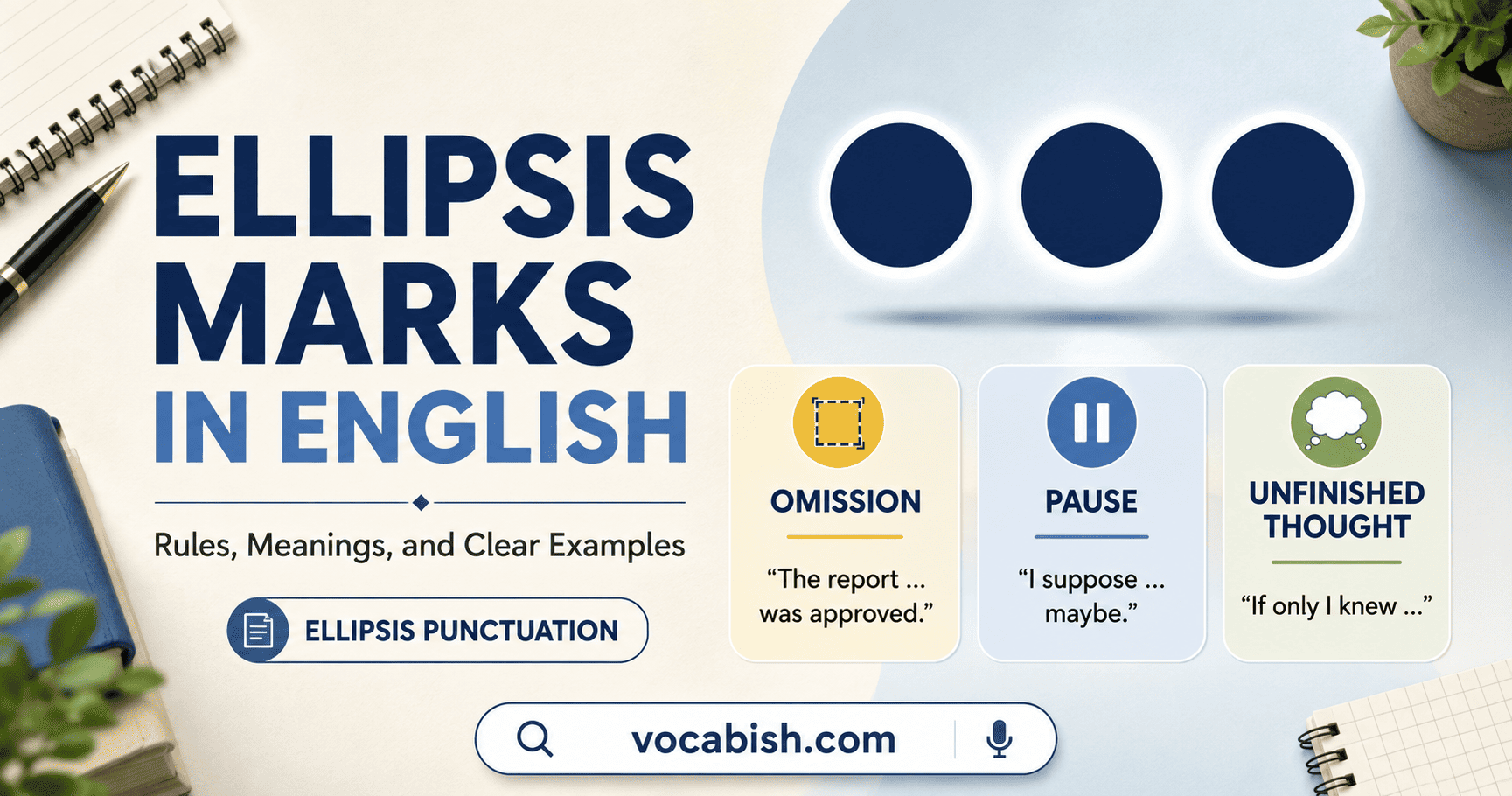

Ellipsis punctuation consists of three dots (…) used to show omitted words, a noticeable pause, or a thought that remains unfinished.
It tells the reader that something has been removed, delayed, or deliberately left unsaid.
The plural form of ellipsis is ellipses. Although an ellipsis looks simple, its meaning changes according to where and how it appears.
Use | What the ellipsis shows | Example |
|---|---|---|
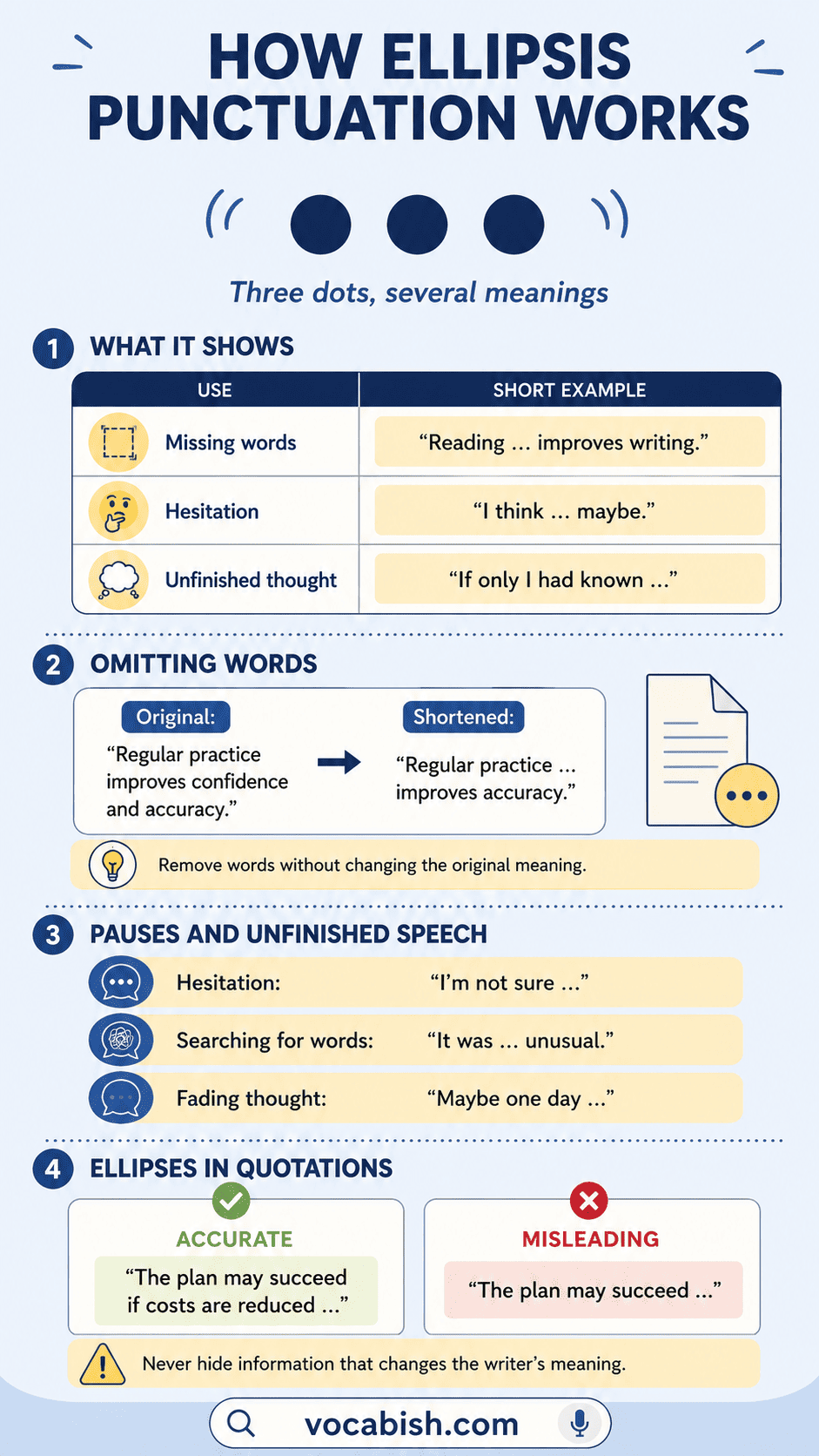
Omission | Words have been removed | The report states that “regular practice … improves accuracy.” |
Pause | The speaker hesitates or pauses | I thought we could … perhaps try again. |
Unfinished thought | The speaker stops before completing the idea | If only I had known … |
Trailing thought | The idea fades without a firm ending | Maybe one day … |
Showing Omitted Words
An ellipsis can replace words that have been removed from a sentence or passage. This use is common when shortening quotations.
Original sentence:
Regular reading helps learners develop vocabulary, improve comprehension, and become more confident writers.
Shortened quotation:
“Regular reading helps learners … become more confident writers.”
The ellipsis shows that the words develop vocabulary, improve comprehension, and were removed.
Follow these rules when omitting words:
- Keep the original meaning unchanged.
- Do not remove words that alter the writer’s argument.
- Make sure the shortened quotation remains grammatically understandable.
- Use an ellipsis only where words have actually been removed.
- Place quotation marks around the quoted material, not around the ellipsis alone.
Omission at the Beginning or End
An ellipsis is usually unnecessary at the beginning or end of a quotation because quotation marks already show that only part of the original text is being quoted.
Original:
After several months of careful preparation, the research team began the final stage of the experiment.
Usually preferred:
The researchers “began the final stage of the experiment.”
An opening ellipsis may be used when showing the omission is necessary for clarity:
“… the research team began the final stage of the experiment.”
This form is less common in ordinary writing. Follow the required style guide when preparing academic or published work.
Showing Pauses and Unfinished Thoughts
In dialogue and informal writing, an ellipsis can show hesitation, uncertainty, a long pause, or speech that gradually fades.
A Hesitant Pause
I’m not sure … perhaps we should ask someone else.
The speaker pauses because they are uncertain.
Difficulty Finding Words
The meeting was … well, it was not what I expected.
The ellipsis shows that the speaker is searching for the right expression.
An Unfinished Thought
I wanted to tell you that … never mind.
The first thought is abandoned before it is completed.
A Fading Voice
I thought everything would be different …
The thought trails away rather than ending firmly.
An ellipsis is not normally used when another person suddenly interrupts the speaker. An em dash is usually better for a sharp interruption.
Meaning | Better punctuation | Example |
|---|---|---|
Hesitation or fading speech | Ellipsis | “I suppose … we could wait.” |
Sudden interruption | Em dash | “I was about to explain—” |
Normal grammatical pause | Comma | “After lunch, we returned home.” |
Ellipses in Quotations
Ellipses are often used to shorten long quotations while keeping the relevant information.
Original quotation:
Students who review new vocabulary regularly and use it in meaningful sentences are more likely to remember it.
With an ellipsis:
“Students who review new vocabulary regularly … are more likely to remember it.”
The removed words are not needed for the writer’s immediate point.
Keep the Meaning Honest
Never use an ellipsis to create a meaning that the original speaker or writer did not intend.
Original:
The plan may succeed if the company improves staff training and reduces unnecessary spending.
Misleading version:
“The plan may succeed …”
This version hides the conditions and makes the statement sound more confident than it really is.
Accurate shortened version:
“The plan may succeed if the company improves staff training …”
Joining Parts of a Quotation
An ellipsis can connect two relevant parts of the same quotation:
“The new programme supports beginner learners … and provides advanced practice for experienced students.”
The remaining words must still read naturally and represent the source accurately.
Omitting One or More Sentences
An ellipsis may replace a complete sentence or several sentences within a quotation.
Original:
The museum opened in 1985. It was renovated twenty years later. Today, it welcomes thousands of visitors each month.
Shortened:
“The museum opened in 1985. … Today, it welcomes thousands of visitors each month.”
Some academic style guides use a period followed by an ellipsis when the omitted material comes after a complete sentence. Check the style required by your school, publisher, or organisation.
Ellipsis at the End of a Sentence
An ellipsis may appear at the end when a thought fades, remains incomplete, or is intentionally left open.
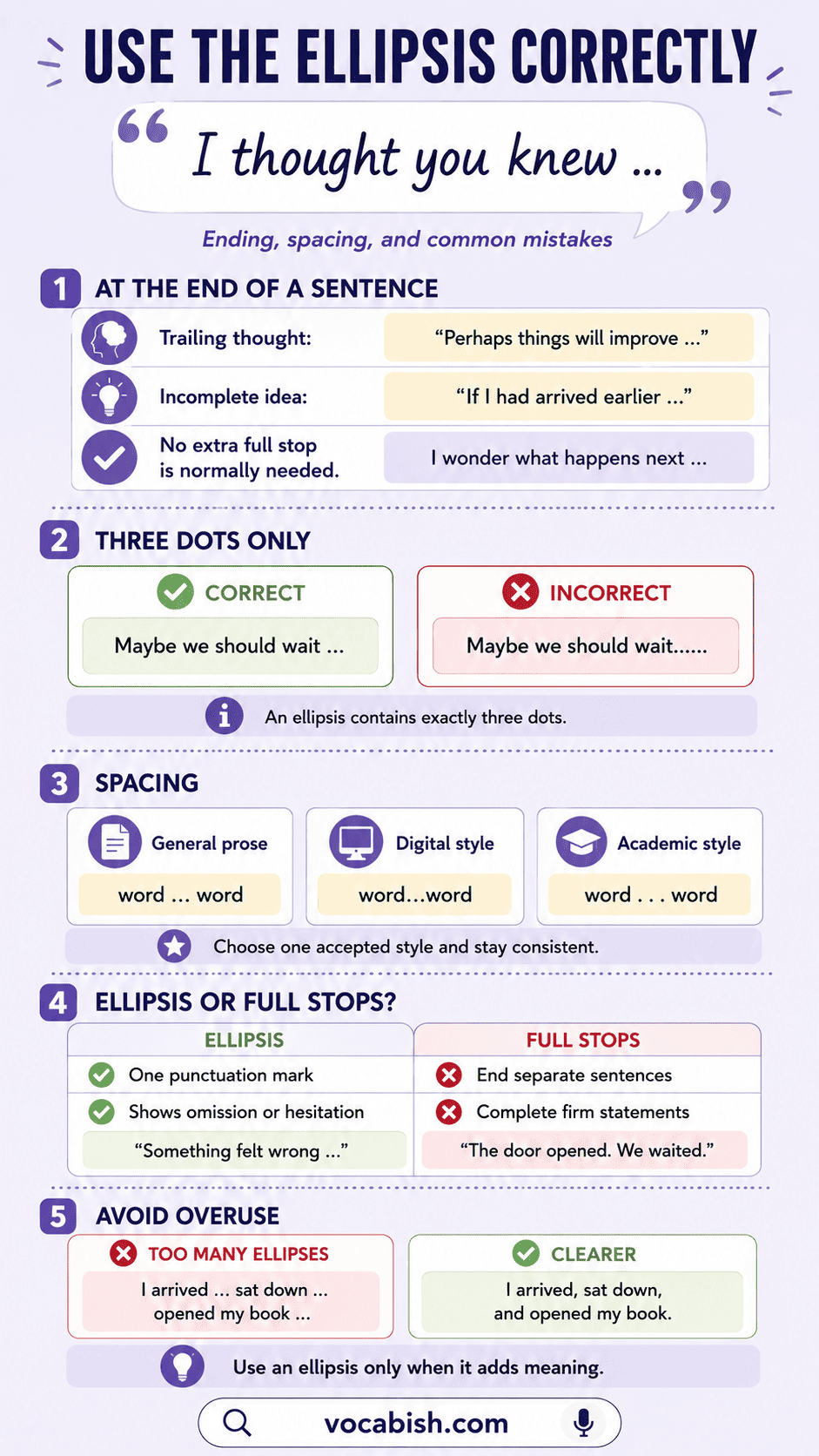
Perhaps things will improve …
If I had arrived a few minutes earlier …
She looked towards the empty doorway and whispered, “I remember when …”
These sentences do not end with a firm statement. The ellipsis creates a softer, unfinished effect.
Does an Ellipsis Need a Final Period?
The answer depends on its function.
Situation | Correct form | Explanation |
|---|---|---|
Thought trails away | I wonder what happened … | The ellipsis itself ends the sentence. |
Speech remains unfinished | If only we could … | No additional period is normally needed. |
Words omitted before sentence ends | “The results … were unexpected.” | The normal period appears later. |
Omission follows a complete quoted sentence | “The results were unexpected. …” | Some styles retain the sentence period before the ellipsis. |
In ordinary dialogue, three dots are enough when the speaker’s final thought trails away.
I believed you would understand …
Do not automatically type four dots whenever an ellipsis appears at the end. Four dots are mainly associated with specific quotation and editing conventions.
Spacing and Number of Dots
A standard ellipsis contains three dots, not two, four, or an unlimited row of periods.
Common Forms
Form | Example | Where it may appear |
|---|---|---|
Three closed dots | word…word | Informal messages and some digital writing |
Spaces around the ellipsis | word … word | General edited prose |
Spaced individual dots | word . . . word | Some academic style guides |
Single ellipsis character | word…word | Digital publishing and typesetting |
For clear general writing, place a space before and after an ellipsis when it appears between words:
The journey was long … but worth the effort.
When the ellipsis ends the sentence, no extra space is needed after it:
I thought you already knew …
Use Exactly Three Dots
Correct:
Maybe we should wait …
Incorrect:
Maybe we should wait..
Maybe we should wait……
Extra dots look careless and do not create a longer pause. The context, not the number of dots, controls the effect.
Spacing rules vary between style guides. The main requirement is consistency: choose one accepted style and use it throughout the document.
Ellipsis vs Three Full Stops
An ellipsis may be typed with three period marks, but it functions as one punctuation mark. It does not represent three separate sentence endings.
Ellipsis | Three separate full stops |
|---|---|
Represents one punctuation mark | Would suggest three independent sentence endings |
Shows omission, hesitation, or an unfinished thought | A full stop normally completes one statement |
Contains exactly three dots | Full stops belong to separate complete sentences |
Can also appear as the single character (…) | Usually typed as individual period marks |
Ellipsis:
There was something strange about the room …
Separate sentences with full stops:
The door opened. The lights flickered. Everyone became silent.
The first example contains one unfinished sentence. The second contains three complete sentences, each ending with its own full stop.
Common Overuse
Ellipses lose their effect when they appear too frequently. They can make writing seem uncertain, vague, or overly dramatic.
Avoid Ellipses After Every Sentence
Overused:
I went to the shop … but it was closed … so I returned home …
Better:
I went to the shop, but it was closed, so I returned home.
Do Not Replace Normal Commas
Incorrect:
After finishing the lesson … the students completed an exercise.
Correct:
After finishing the lesson, the students completed an exercise.
Do Not Use Them as Decoration
Weak:
Our new course is available now …
Clearer:
Our new course is available now.
Use an ellipsis only when it adds a real meaning:
- Words have been omitted.
- A speaker hesitates.
- A thought trails away.
- An idea remains deliberately unfinished.
Avoid using it simply because three dots look expressive.