
Question Mark in English: Rules and Examples

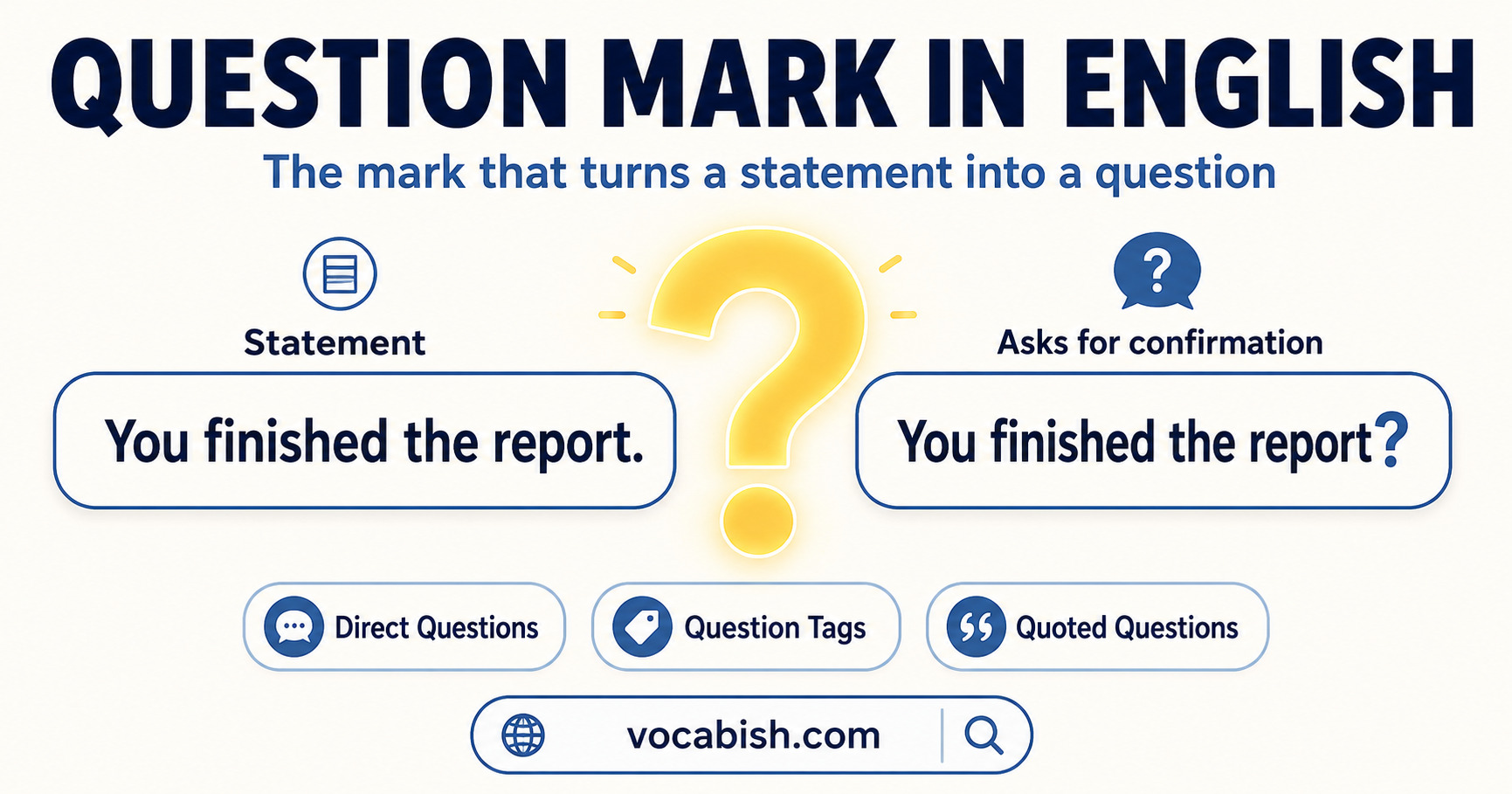
The main question mark rules are simple: place a question mark (?) at the end of a direct question, but not after an indirect question. This small punctuation mark immediately tells the reader that someone is asking for information, confirmation, permission, or a choice.

Compare these sentences:

  • You finished the report.
  • You finished the report?

The first sentence gives information. The second asks for confirmation. The words are identical, but the question mark changes the purpose and tone.

Direct Questions

A direct question asks something in the speaker’s or writer’s exact words. It normally ends with a question mark.

Questions beginning with a question word

Use a question mark after questions beginning with words such as who, what, when, where, why, which, and how.

  • Where does your brother work?
  • Why was the meeting cancelled?
  • Who left this package here?
  • How did you solve the problem?
  • Which colour would you prefer?

Yes-or-no questions

Questions that can be answered with yes or no also need a question mark.

  • Are you feeling better?
  • Did Sana receive the email?
  • Can we park here?
  • Has the train already left?
  • Will they attend the ceremony?

Questions offering a choice

An alternative question gives the listener two or more options.

  • Would you like tea or coffee?
  • Should we travel by bus or train?
  • Are you staying tonight or leaving early?

Use only one question mark at the end of the complete question.

Question type
Common pattern
Example
Information question
Question word + auxiliary + subject
Where are they staying?
Yes-or-no question
Auxiliary + subject + verb
Did you call her?
Choice question
Question + option + or + option
Is the bag black or blue?
Polite question
Modal verb + subject + verb
Could you open the window?
Short question
Question word or brief phrase
Why?
Rhetorical question
Question asked for effect
Who could forget that day?

Polite requests written as questions

A polite request needs a question mark when it has the grammatical form of a question.

  • Could you send me the details?
  • Would you mind closing the door?
  • May I borrow your dictionary?
  • Can you help me carry these boxes?

A command or request without question structure usually takes a full stop.

  • Please send me the details.
  • Kindly close the door.
  • Let me know when you arrive.

Short and incomplete questions

A question does not always need to be a complete sentence. Short questions still take a question mark when their meaning is clear from the context.

  • When?
  • Why not?
  • Any questions?
  • Another cup?
  • Ready to leave?

These forms are common in conversation, messages, interviews, and informal writing.

Rhetorical questions

A rhetorical question is asked for effect rather than to receive an actual answer. Because it still has the form of a direct question, it normally ends with a question mark.

  • Is money the only measure of success?
  • How could anyone ignore such clear evidence?
  • What difference would one more day make?
Question Mark Rules for Direct and Indirect Questions

Indirect Questions

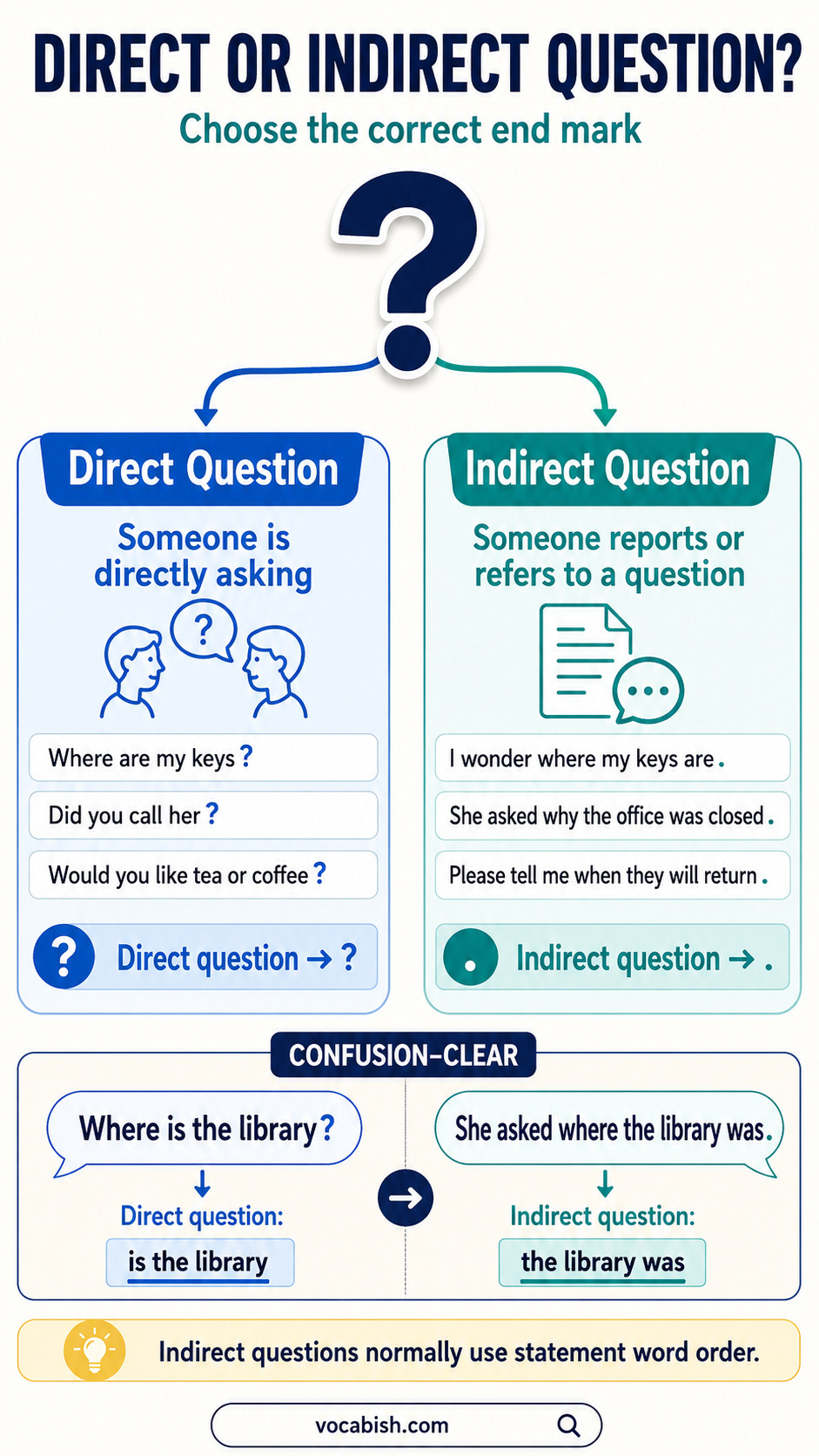
An indirect question reports or refers to a question without asking it directly. It usually ends with a full stop, not a question mark.

  • I wonder where Bilal lives.
  • She asked why the office was closed.
  • We do not know when the results will arrive.
  • He wanted to know whether I was available.
  • Please tell me what this word means.
Direct question
Indirect question
Where is the library?
She asked where the library was.
Why did Hina leave?
I wonder why Hina left.
Is the shop open?
He asked whether the shop was open.
What does this button do?
I do not know what this button does.
When will they return?
Please tell me when they will return.

Notice that an indirect question normally uses statement word order.

  • Correct: I wonder where she is.
  • Incorrect: I wonder where is she?
  • Correct: He asked what I wanted.
  • Incorrect: He asked what did I want?

However, a sentence containing an indirect question may still end with a question mark when the complete sentence is itself a direct question.

  • Could you tell me where the station is?
  • Do you know when the lesson begins?
  • Can you explain why the machine stopped?

Compare:

  • Please tell me where the station is.
  • Could you tell me where the station is?

The first is a request. The second is a direct question.

Question Marks with Tags

A tag question consists of a statement followed by a short question. Place a comma before the tag and a question mark at the end.

  • You know Ahmed, don’t you?
  • She has finished the assignment, hasn’t she?
  • They were not invited, were they?
  • The children can swim, can’t they?

A positive statement usually takes a negative tag.

  • Mariam is a doctor, isn’t she?
  • They will arrive soon, won’t they?
  • You remembered the tickets, didn’t you?

A negative statement usually takes a positive tag.

  • He is not angry, is he?
  • We have not met before, have we?
  • She cannot drive, can she?
Main statement
Tag
Complete sentence
You are ready
aren’t you
You are ready, aren’t you?
He arrived early
didn’t he
He arrived early, didn’t he?
They have left
haven’t they
They have left, haven’t they?
She is not coming
is she
She is not coming, is she?
We should wait
shouldn’t we
We should wait, shouldn’t we?

Imperatives can also be followed by question tags.

  • Close the gate, will you?
  • Pass me that folder, would you?
  • Do not be late, will you?
  • Let’s begin, shall we?

The question mark shows that the speaker expects confirmation, agreement, or a response.

Questions inside Quotations

The position of a question mark depends on which words form the question.

When the quoted words are a question

Place the question mark inside the closing quotation mark when the quotation itself is a direct question.

  • Ayesha asked, “Where are my glasses?”
  • “Are you ready?” the instructor said.
  • He whispered, “Can anyone hear us?”
  • She kept asking, “Why?”

When a reporting clause follows the quotation, do not add a comma after the question mark.

  • Correct: “Where are you going?” Hamza asked.
  • Incorrect: “Where are you going?,” Hamza asked.

The reporting clause begins with a lowercase letter unless it starts with a proper noun.

  • “Did you call me?” she asked.
  • “Did you call me?” Fatima asked.

When the whole sentence is a question

Place the question mark outside the quotation marks when the quoted words are not a question but the complete sentence is.

  • Did he really say, “I have lost the documents”?
  • Have you read the poem “The Road Not Taken”?
  • Why did she describe the plan as “completely safe”?

When both parts involve a question

Use one question mark when the quoted material is already a complete question. Do not add another question mark after the closing quotation mark.

  • Did she ask, “Where is the manager?”
  • Can you believe he said, “Why should I apologise?”
  • Were his exact words, “Are you leaving now?”
Situation
Position of question mark
Example
Quotation is a question
Inside quotation marks
She asked, “Are you busy?”
Whole sentence is a question
Outside quotation marks
Did she say, “I am busy”?
Both are questions
One mark inside
Did she ask, “Are you busy?”
Reporting clause follows
Inside; no comma added
“Are you busy?” he asked.

Question Marks with Other Punctuation

A question mark usually replaces the full stop that would otherwise end a sentence.

With a full stop

Do not place a full stop after a question mark.

  • Correct: Where are the keys?
  • Incorrect: Where are the keys?.
  • Incorrect: Where are the keys.?

The question mark already completes the sentence.

With commas

In quoted dialogue, a question mark replaces the comma before a reporting clause.

  • “Are you coming?” she asked.
  • “What happened?” the nurse said.

Do not write:

  • “Are you coming?,” she asked.

With exclamation marks

In formal and academic writing, choose the punctuation mark that best matches the sentence.

  • Are you serious?
  • Stop touching that!

The combination ?! or !? may appear in informal messages, comics, advertising, or creative dialogue to show surprise and questioning together.

  • You sold the car?!
  • How could you forget!?

Avoid repeated punctuation in formal writing.

  • Informal: What happened???
  • Formal: What happened?

With parentheses

Place the question mark inside parentheses when only the parenthetical words form a question.

  • The delivery arrived on Monday (or was it Tuesday?).
  • He agreed to the proposal (but did he understand it?).

Place the question mark outside when the entire sentence is a question.

  • Will you attend the meeting despite the delay?
  • Did she accept the offer after speaking to her manager?

A complete parenthetical question keeps its question mark inside.

  • The announcement surprised everyone. (Who had approved it?)

With abbreviations

A question mark may follow an abbreviation that already ends in a full stop. The two marks perform different jobs.

  • Is the appointment at 4 p.m.?
  • Did you speak to Prof. Ahmed?
  • Should the parcel arrive before 10 a.m.?

The full stop belongs to the abbreviation, while the question mark closes the complete question.

With an ellipsis

An ellipsis and a question mark may appear together when the ellipsis shows hesitation or omitted words and the sentence remains a question.

  • You really thought that would work…?
  • But why would she…?
  • Are you saying that he knew all along…?

This combination is more common in dialogue and creative writing than in formal prose.

Question Mark Uses and Examples

Common Mistakes

Incorrect
Correct
Reason
I wonder where is Ali?
I wonder where Ali is.
It is an indirect question with statement word order.
She asked why was I late?
She asked why I was late.
A reported question normally ends with a full stop.
Could you help me.
Could you help me?
The sentence has direct-question structure.
Where are you?.
Where are you?
A question mark does not need a full stop.
“Are you ready”? she asked.
“Are you ready?” she asked.
The quoted words form the question.
Did he say, “I am leaving?”
Did he say, “I am leaving”?
The whole sentence, not the quotation, is the question.
You finished the work, isn’t it?
You finished the work, didn’t you?
The tag must match the subject and auxiliary.
What happened???
What happened?
One question mark is enough in standard writing.

Other errors to avoid include:

  1. Adding a question mark simply because a sentence expresses uncertainty.
    • Unclear: Perhaps he has forgotten?
    • Standard: Perhaps he has forgotten.
    • Direct question: Has he forgotten?
  2. Forgetting the comma before a question tag.
    • Incorrect: It is cold isn’t it?
    • Correct: It is cold, isn’t it?
  3. Using question word order inside an indirect question.
    • Incorrect: Do you know where does she work?
    • Correct: Do you know where she works?
  4. Adding two question marks when a quoted question appears inside another question.
    • Incorrect: Did he ask, “Where is Sara?”?
    • Correct: Did he ask, “Where is Sara?”

Practice Exercise of Question Mark

Add a question mark or full stop where needed. Correct the word order or quotation punctuation when necessary.

  1. Where did you leave the keys
  2. I wonder where the keys are
  3. Could you tell me when the shop opens
  4. She asked, “Are you feeling better”
  5. Did he really say, “The meeting is cancelled”
  6. You are joining us, aren’t you
  7. I do not know whether Usman has arrived
  8. “Why are you laughing” Sara asked
  9. Is the appointment at 3 p.m.
  10. Let’s take a short break, shall we
  11. Do you know where does this road lead
  12. She wanted to know why was the door locked

Answers

  1. Where did you leave the keys?
  2. I wonder where the keys are.
  3. Could you tell me when the shop opens?
  4. She asked, “Are you feeling better?”
  5. Did he really say, “The meeting is cancelled”?
  6. You are joining us, aren’t you?
  7. I do not know whether Usman has arrived.
  8. “Why are you laughing?” Sara asked.
  9. Is the appointment at 3 p.m.?
  10. Let’s take a short break, shall we?
  11. Do you know where this road leads?
  12. She wanted to know why the door was locked.

Question Mark Punctuation PDF

FAQs About Question Mark

When should I use a question mark?

Use a question mark after a complete direct question, whether the question begins with a question word or an auxiliary verb.

Do indirect questions take a question mark?

No. An indirect question reports what someone asked, so it normally ends with a full stop rather than a question mark.

Where does a question mark go with quotation marks?

Place the question mark inside quotation marks when the quoted words form a question, and outside when only the full sentence is questioning.

Can I put a full stop after a question mark?

Do not add a full stop after a question mark because the question mark already closes and punctuates the sentence completely.

Does a tag question need a question mark?

Yes. A tag question normally ends with a question mark because the speaker is asking for confirmation, agreement, or a response.

Can a title end with a question mark?

Question marks may appear in titles when the title is a genuine question, but they should not be added only to attract attention.

Can I use an exclamation mark with a question mark?

The combination ?! is acceptable in informal messages or creative writing, but formal and academic writing should normally use one appropriate mark.

Short Summary

  1. Use a question mark after a direct question.
  2. End an indirect question with a full stop unless the complete sentence asks a direct question.
  3. Put a comma before a question tag and a question mark after it.
  4. Place the mark inside quotation marks when the quoted words are the question.
  5. Place it outside quotation marks when the complete sentence is the question.
  6. Do not add a full stop after a question mark.
  7. Avoid repeated marks such as ??? in formal writing.
  8. Apply question mark rules according to sentence structure, not simply the speaker’s tone.
Share or Save it for later:
Muhammad Matloob
Muhammad Matloob

Matloob is the founder of Vocabish, an educational website dedicated to helping students, teachers, and English learners improve their language skills. He creates practical learning resources on English grammar, vocabulary, phrasal verbs, confused words, speaking English, and worksheets. His goal is to make English learning simple, engaging, and accessible through clear explanations, real-life examples, and useful practice materials.

Articles: 534