
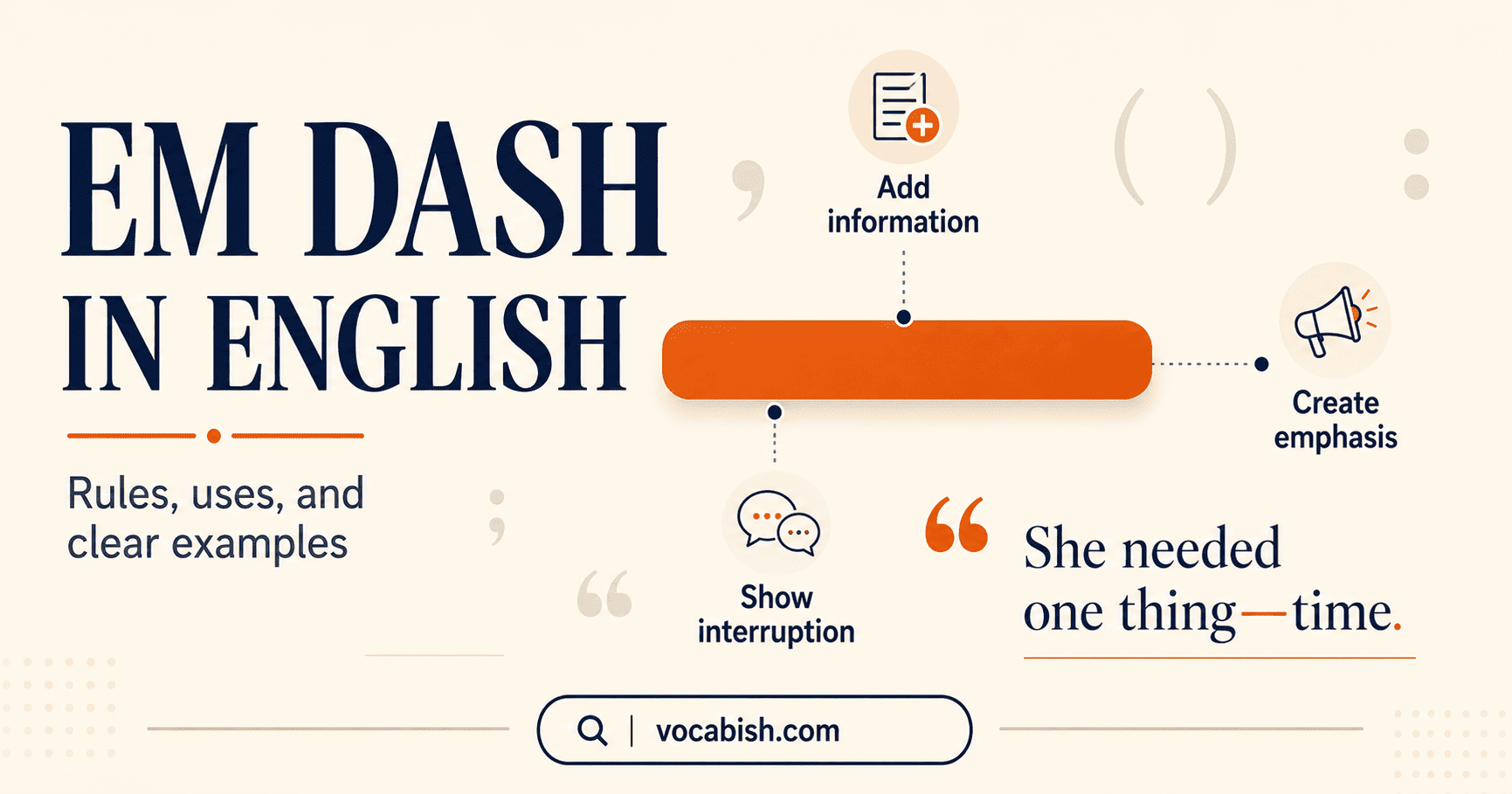

The em dash (—) is a long punctuation mark used to separate, interrupt, or emphasize information within a sentence. It is longer than both a hyphen (-) and an en dash (–).
Writers often use an em dash when a comma feels too weak, parentheses feel too quiet, or a colon feels too formal.
Compare:
- The journey was difficult, especially during winter.
- The journey was difficult—especially during winter.
The second sentence gives stronger emphasis to the final detail.
An em dash may appear:
- as a single dash before an important addition
- as a pair of dashes around inserted information
- at the point where someone is interrupted
- before an unexpected explanation or conclusion
Adding Extra Information
An em dash can introduce extra information at the end of a sentence. The added detail may explain, clarify, or comment on the main statement.
- She finally visited the city she had always dreamed about—Rome.
- Only one person knew the password—the manager.
- The team faced another problem—a shortage of trained workers.
- He brought everything we needed—food, water, blankets, and medicine.
The information before the em dash should usually form a complete thought.
- Correct: We reached our final destination—a quiet village near the border.
- Weak: We travelled to—a quiet village near the border.
The second sentence separates the verb from its complement unnecessarily.
A single em dash can also introduce a surprising final detail:
- Everyone expected Daniel to win—but he finished last.
- She opened the envelope—and found her own photograph inside.
- The missing keys were in the most obvious place—my pocket.
Showing an Interruption
In dialogue, an em dash shows that a speaker is suddenly interrupted or cuts off their own sentence.
- “I was going to tell you that—”
- “You had plenty of time,” Maria replied.
The first speaker does not complete the sentence because Maria interrupts.
More examples:
- “Please let me explain—”
- “There is nothing left to explain.”
- “When I entered the room, I saw—”
- “Wait. Was the window open?”
An em dash may also show an abrupt change in thought:
- I think we should call James—or perhaps we should handle this ourselves.
- The meeting begins at nine—no, I have just remembered—it begins at ten.
- She was planning to move to London—but that was before she received the new offer.
Do not use an ellipsis when the speech ends suddenly.
Punctuation | Main meaning | Example |
|---|---|---|
Em dash | Sudden interruption or sharp break | “I did not mean to—” |
Ellipsis | Fading, hesitation, or unfinished thought | “I thought perhaps we could…” |
Creating Emphasis
An em dash draws attention to the words that follow it. It creates a stronger pause than a comma.
- There was only one possible answer—no.
- She wanted one thing more than anything else—freedom.
- His greatest strength was not intelligence—it was patience.
- The final result surprised everyone—a complete victory.
The emphasized information may be:
- a single word
- The answer was obvious—leave.
- a phrase
- He feared only one outcome—losing his family’s trust.
- a list
- Three qualities made her successful—discipline, patience, and courage.
- a complete clause
- We soon discovered the truth—the building had never been empty.
An em dash can also place emphasis on inserted information:
- The new policy—despite its good intentions—created several practical problems.
- Her first novel—which took seven years to complete—became an international success.
- Our neighbour—the one who rarely speaks—offered to help us.
The sentence should still be grammatically complete when the inserted words are removed:
- The new policy created several practical problems.
- Her first novel became an international success.
- Our neighbour offered to help us.
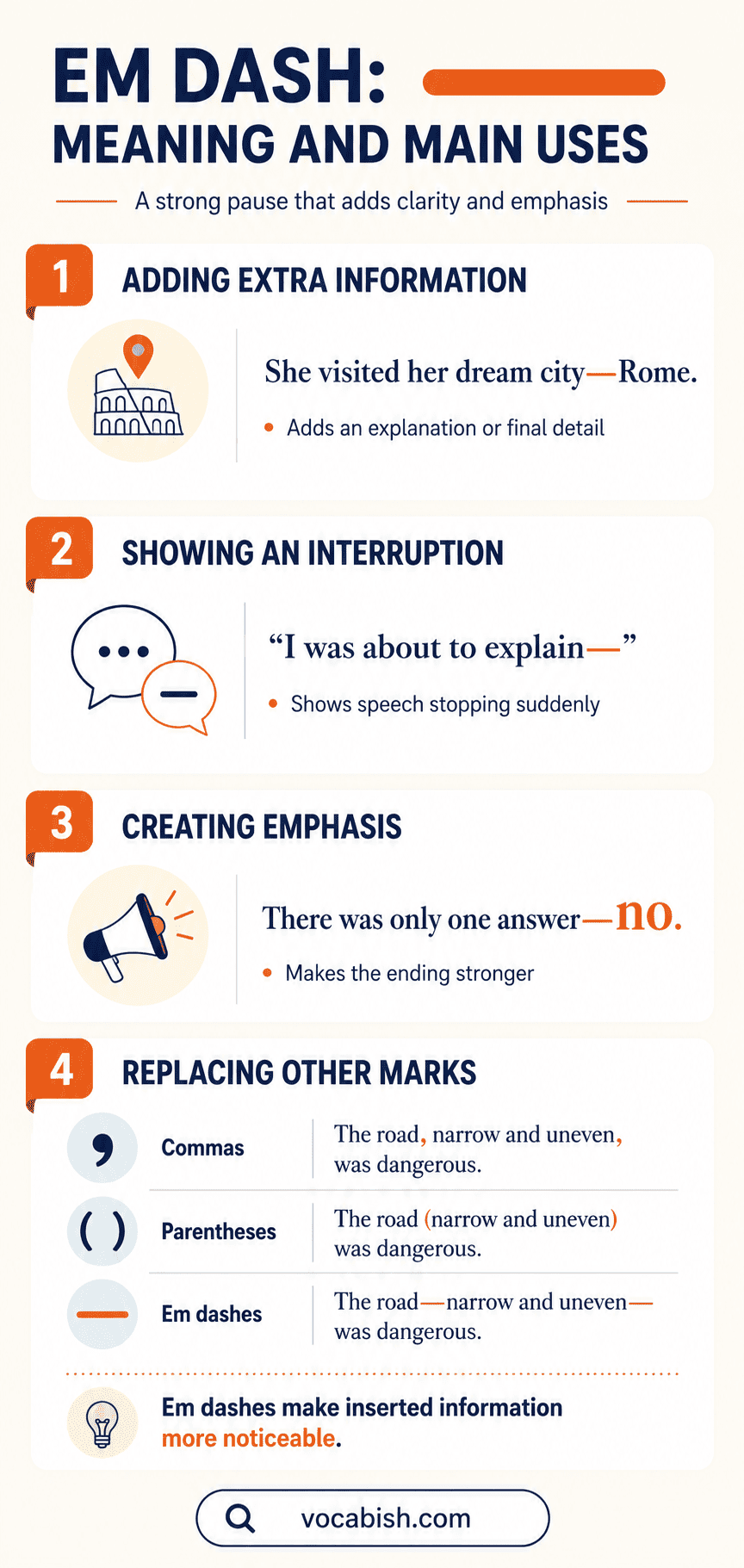
Replacing Commas or Parentheses
A pair of em dashes can separate additional information in the middle of a sentence.
- The old theatre—built more than a century ago—will reopen next month.
- My younger brother—usually the quietest person in the room—gave a long speech.
- The guests—tired, hungry, and slightly annoyed—waited in the entrance hall.
Commas, parentheses, and em dashes can sometimes contain the same information, but they create different levels of emphasis.
Punctuation | Effect | Example |
|---|---|---|
Commas | Smooth, neutral interruption | The director, who joined last year, approved the plan. |
Parentheses | Quiet or less important information | The director (who joined last year) approved the plan. |
Em dashes | Strong, noticeable interruption | The director—who joined last year—approved the plan. |
Use em dashes when the inserted detail deserves attention:
- The train—already two hours late—stopped again.
- His explanation—if it can be called an explanation—confused everyone.
- The repairs—far more expensive than expected—took six months.
Avoid mixing punctuation around the same inserted phrase.
- Incorrect: The train—already two hours late, stopped again.
- Correct: The train—already two hours late—stopped again.
Both em dashes are needed because the inserted information appears in the middle of the sentence.
Em Dash vs Colon
An em dash and a colon can both introduce explanations, examples, lists, or conclusions. However, they do not always create the same tone.
Feature | Em dash | Colon |
|---|---|---|
Tone | Expressive and conversational | Structured and formal |
Pause | Strong and dramatic | Controlled and expected |
Purpose | Emphasis, surprise, or interruption | Explanation, list, or result |
Common position | Middle or end of a sentence | Usually after a complete clause |
Example | She needed one thing—time. | She needed one thing: time. |
A colon tells readers that an explanation or list is coming:
- You need three documents: your passport, your application form, and your receipt.
- He had one clear goal: to finish the project before Friday.
An em dash makes the ending feel more forceful or unexpected:
- You need three documents—your passport, your application form, and your receipt.
- He had one clear goal—to finish the project before Friday.
A colon is usually better in formal instructions, definitions, and carefully organized lists.
- Please bring the following items: a notebook, a pen, and your identity card.
An em dash works well when the writer wants a stronger voice.
- I opened the cupboard and found exactly what I feared—nothing.
Spacing Conventions
Spacing around an em dash depends on the writing style being followed.
Style | Format | Example |
|---|---|---|
Common American style | No spaces | The decision—although unpopular—was final. |
Some British and publishing styles | Spaces on both sides | The decision — although unpopular — was final. |
Inconsistent spacing | Avoid | The decision —although unpopular— was final. |
Choose one style and use it consistently.
For general American English:
- Correct: The road—narrow and uneven—was difficult to follow.
- Avoid: The road — narrow and uneven — was difficult to follow.
For a publication that requires spaced em dashes:
- Correct: The road — narrow and uneven — was difficult to follow.
Do not place a space on only one side:
- Incorrect: The road— narrow and uneven—was difficult to follow.
- Incorrect: The road —narrow and uneven —was difficult to follow.
When writing for a school, company, publisher, or website, follow its preferred style guide.
Common Overuse
Em dashes are useful, but too many can make writing feel restless or disorganized.
- Overused: The manager—who arrived late—entered the office—without greeting anyone—and closed the door.
- Better: The manager, who arrived late, entered the office without greeting anyone and closed the door.
Use an em dash when it serves a clear purpose, not simply because the sentence is long.
Common Mistakes You Should Avoid
Common problems include:
- Using several em dashes in one sentence
- Overused: The house—old and damaged—stood beside the river—which flooded every winter—and needed repairs.
- Better: The old, damaged house stood beside a river that flooded every winter. It needed repairs.
- Using an em dash instead of every comma
- Overused: We bought bread—milk—eggs—and fruit.
- Correct: We bought bread, milk, eggs, and fruit.
- Separating essential sentence parts
- Incorrect: The teacher explained—the new rule.
- Correct: The teacher explained the new rule.
- Using only one dash around a middle interruption
- Incorrect: My sister—who lives in Lahore is visiting tomorrow.
- Correct: My sister—who lives in Lahore—is visiting tomorrow.
- Combining an em dash with unnecessary punctuation
- Incorrect: He gave one reason—: lack of time.
- Correct: He gave one reason—lack of time.
- Correct: He gave one reason: lack of time.
- Using em dashes in highly formal writing without considering tone
Academic, legal, and technical writing may prefer commas, parentheses, colons, or separate sentences when a neutral structure is needed.
Practice Exercise
Add an em dash or a pair of em dashes where appropriate.
- She had one final request more time.
- The main road damaged during the storm remains closed.
- “I can explain what happened”
- We discovered the cause of the noise a trapped bird.
- His new proposal although expensive could solve the problem.
- Everyone believed the task was impossible everyone except Sara.
- The package contained everything books, clothes, photographs, and letters.
- I wanted to speak to the manager but perhaps that would make matters worse.
Answers
- She had one final request—more time.
- The main road—damaged during the storm—remains closed.
- “I can explain what happened—”
- We discovered the cause of the noise—a trapped bird.
- His new proposal—although expensive—could solve the problem.
- Everyone believed the task was impossible—everyone except Sara.
- The package contained everything—books, clothes, photographs, and letters.
- I wanted to speak to the manager—but perhaps that would make matters worse.