

A colon (:) tells the reader that more information is coming. That information may be a list, an explanation, an example, or a quotation.
Think of the colon as a sign that says, “Look ahead—the next part develops this idea.”
We needed one thing: patience.
The first part, We needed one thing, is a complete clause. The word patience identifies that one thing.
In most sentence structures, the words before a colon should express a complete thought. Titles and numerical time expressions follow different rules, which we will examine later.
Introducing Lists
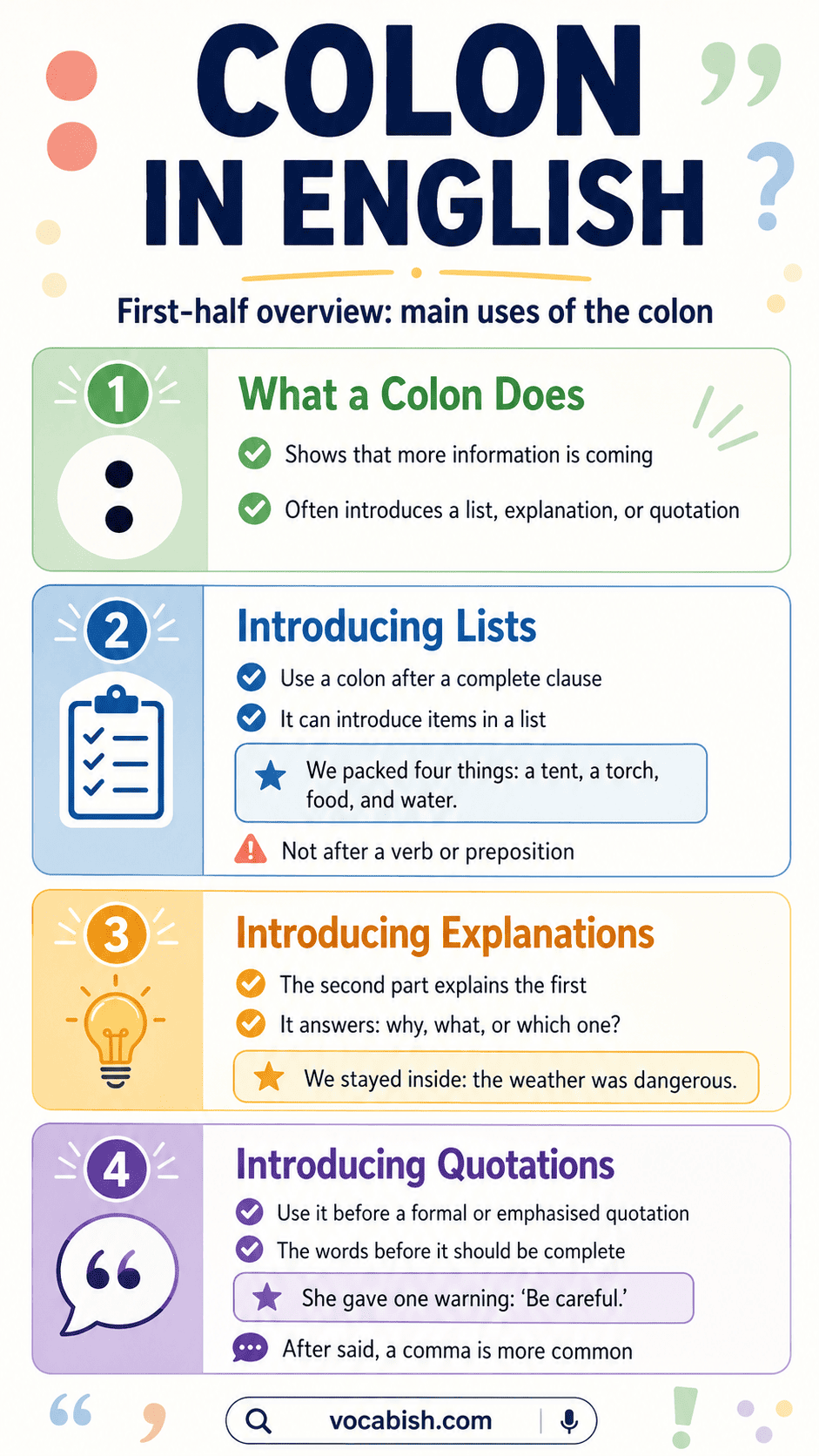
A colon can introduce a list when the introductory words form a complete clause.
The camping bag contained four items: a torch, a blanket, a water bottle, and a map.
The clause The camping bag contained four items could stand alone as a sentence. The colon then introduces the four items.
A list may appear:
- within the same sentence
- as a vertical list
- as a numbered set of instructions
Lists within sentences
Please bring the following documents: your passport, your application form, and two photographs.
Three students received awards: Zara, Bilal, and Hamza.
The recipe requires several spices: cumin, coriander, turmeric, and black pepper.
Use commas to separate simple items. When the listed items already contain commas, semicolons may make the divisions clearer:
The guests came from Lahore, Punjab; Quetta, Balochistan; and Peshawar, Khyber Pakhtunkhwa.
Vertical lists
A colon can introduce a vertical list after a complete clause:
You will need these materials:
- a notebook
- a pencil
- a ruler
- coloured markers
The listed items do not normally need full stops when they are single words or short phrases. Use full stops when each item is a complete sentence.
When not to use a colon before a list
Do not place a colon directly after a verb or preposition.
Incorrect | Correct | Reason |
|---|---|---|
My favourite fruits are: mangoes and oranges. | My favourite fruits are mangoes and oranges. | The colon separates are from its complement. |
The box contains: books, files, and photographs. | The box contains books, files, and photographs. | The colon separates contains from its object. |
We travelled through: Lahore, Multan, and Sukkur. | We travelled through Lahore, Multan, and Sukkur. | The colon follows the preposition through. |
The winners included: Sana, Ali, and Hira. | The winners included Sana, Ali, and Hira. | The colon separates included from its object. |
You can rewrite an incorrect introduction as a complete clause:
The box contains three kinds of items: books, files, and photographs.
Introducing Explanations
A colon can introduce information that explains, clarifies, or develops the statement before it.
Mariam could not attend the meeting: her flight had been cancelled.
The second clause explains why Mariam could not attend.
The room had one noticeable problem: it had no windows.
I finally understood his decision: he wanted to protect the team.
We changed our travel plans: the road was closed because of heavy rain.
The relationship between the two parts should be clear. The information after the colon should answer a natural question raised by the first part.
First clause raises a question | Information after the colon answers it |
|---|---|
She had one concern. What was it? | She had one concern: the cost. |
The plan failed. Why? | The plan failed: nobody had checked the figures. |
His message was clear. What was it? | His message was clear: we had to leave immediately. |
The explanation after a colon may be:
- one word: There was only one possible answer: no.
- a phrase: His greatest strength was obvious: calmness under pressure.
- a complete clause: We stayed indoors: the weather had become dangerous.
- more than one sentence: The situation had changed: The road was blocked. The buses had stopped running. We had to walk home.
A colon often creates a stronger pause than a comma. It also shows a closer explanatory connection than a full stop.
Compare:
We cancelled the picnic. It was raining.
These are two separate statements.
We cancelled the picnic: it was raining.
The second clause directly explains the first.
Introducing Quotations
A colon may introduce a formal, lengthy, or strongly emphasised quotation after a complete clause.
The principal ended the assembly with this reminder: “Your actions represent the whole school.”
The report reached a clear conclusion: “Further testing is required before the product can be approved.”
The guide offered one final warning: “Never leave the marked path after sunset.”
The quotation should directly support or explain the preceding clause.
A colon is especially useful when:
- the introductory clause is complete
- the quotation is long
- the quotation is formally presented
- the writer wants to give the quotation extra emphasis
Do not automatically use a colon after reporting verbs such as said, asked, replied, or explained. These verbs are normally followed by a comma when they introduce a quotation.
Structure | Example |
|---|---|
Reporting verb + comma | The teacher said, “Open your books.” |
Complete clause + colon | The teacher gave one instruction: “Open your books.” |
Quotation integrated into the sentence | The teacher told us to “open our books immediately.” |
Incorrect:
The teacher said: “Open your books.”
Better:
The teacher said, “Open your books.”
A colon may still be appropriate in a script, transcript, questionnaire, or interview format:
Interviewer: What inspired you to become a nurse?
Candidate: I wanted to work directly with patients.
Colons after Complete Clauses
In ordinary sentences, a colon should usually come after an independent clause—a group of words that could stand alone as a sentence.
Use this simple test:
- Read only the words before the colon.
- Ask whether they express a complete thought.
- If they do, the colon may be correct.
- If they do not, remove the colon or rewrite the introduction.
Correct complete clauses
The committee made its final decision: the event would be postponed.
Before the colon:
The committee made its final decision.
This is a complete sentence.
We visited three historical places: the fort, the museum, and the old mosque.
Before the colon:
We visited three historical places.
This is also complete.
Incomplete introductions
Incorrect:
The main reason for the delay was: a damaged engine.
The main reason for the delay was is incomplete because the verb was still needs a complement.
Correct:
The main reason for the delay was a damaged engine.
Or:
There was one main reason for the delay: a damaged engine.
Incorrect:
Our plans include: visiting the museum and walking through the old city.
Correct:
Our plans include visiting the museum and walking through the old city.
Or:
We have two plans: visiting the museum and walking through the old city.
Sentence | Colon needed? | Explanation |
|---|---|---|
She made one request: complete the work today. | Yes | The introductory clause is complete. |
Her request was: to complete the work today. | No | The colon separates was from its complement. |
We discussed three problems: cost, timing, and safety. | Yes | The clause before the list is complete. |
We discussed problems such as: cost and timing. | No | A colon should not normally follow such as. |
I know the truth: he never sent the message. | Yes | The second clause explains what the truth is. |
Titles, subtitles, labels, dialogue tags, and numerical time expressions do not require a complete clause before the colon.
Colons in Titles and Time
Titles and subtitles
A colon can separate a main title from its subtitle.
Learning English: A Practical Guide for Beginners
City Life: Stories from Modern Lahore
The Science of Sleep: Why Rest Matters
The main title introduces the general subject. The subtitle gives more specific information.
Do not normally place a full stop after a title or subtitle.
A colon may also divide a heading into a topic and a narrower section:
Punctuation Marks: The Colon
Chapter Four: Building Strong Sentences
Numerical time
Use a colon between the hour and minutes when writing time with numbers.
7:15 a.m.
12:30 p.m.
4:45 in the afternoon
21:20
Do not add spaces before or after the colon:
- Correct: 9:05 a.m.
- Incorrect: 9 : 05 a.m.
A colon is unnecessary when the time is written in words:
The class begins at nine thirty.
Not:
The class begins at nine colon thirty.
For an exact hour, styles differ:
- 8:00 a.m. clearly shows the minutes.
- 8 a.m. is shorter and equally correct in ordinary writing.