
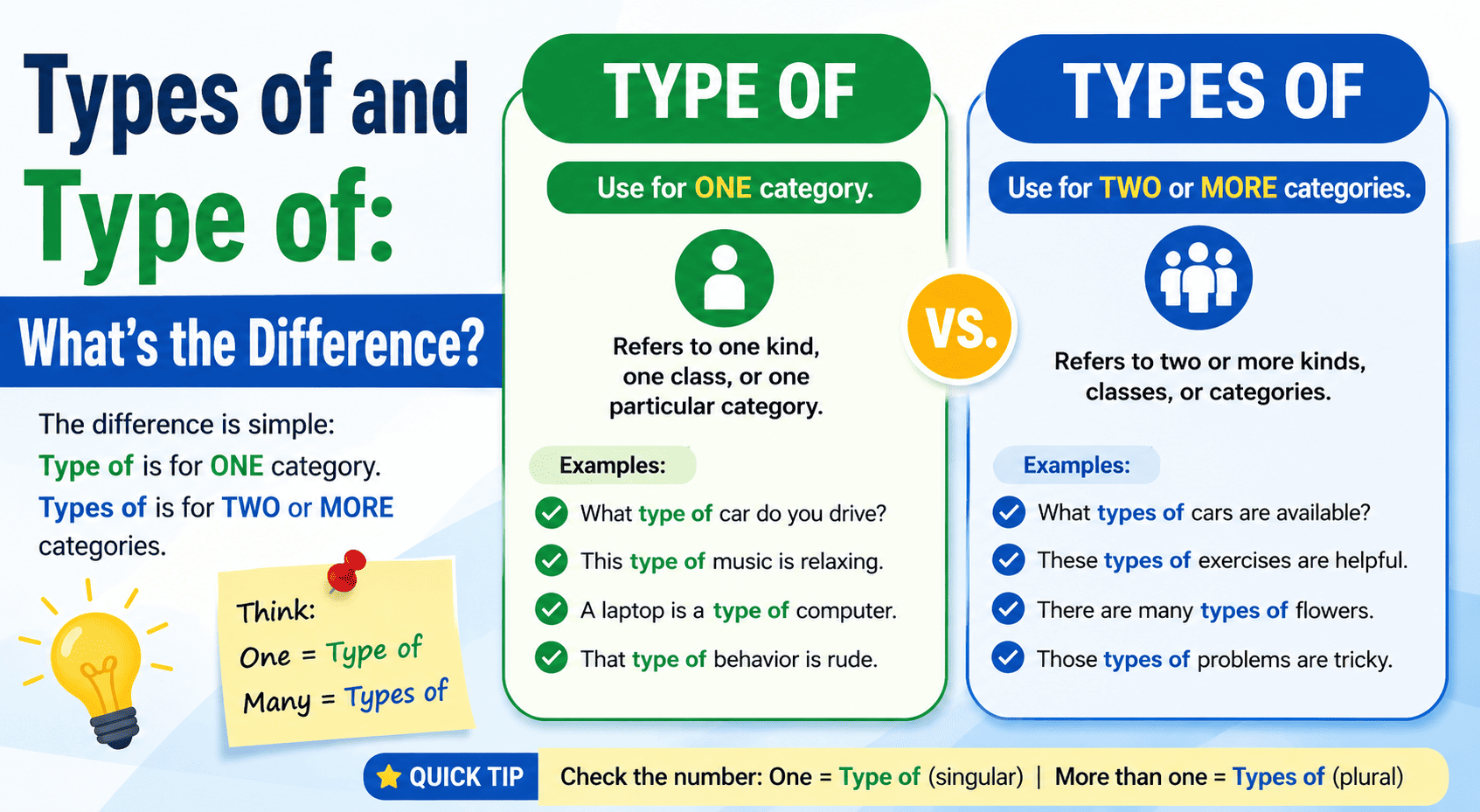

Should you say “this type of book” or “these types of books”? The phrases types of and type of look almost identical, but they do not always communicate the same meaning.
The main difference is number: type of usually refers to one category, while types of refers to two or more categories. However, choosing the correct phrase also depends on determiners, noun forms, context, and subject–verb agreement.
This article explains the difference with clear rules, comparison tables, questions, and everyday examples.
Quick Answer: Types of and Type of
The choice between these expressions mainly depends on whether you are discussing one category or several categories. The noun and determiner around the phrase must also match that meaning.
- Type of means one category, class, form, or variety.
- Types of means two or more categories, classes, forms, or varieties.
Expression | Meaning | Example |
|---|---|---|
a type of | one category | A rose is a type of flower. |
this type of | one category near or already mentioned | This type of exercise is useful. |
that type of | one category farther away or previously mentioned | I do not enjoy that type of music. |
types of | more than one category | We studied several types of rocks. |
these types of | multiple nearby or mentioned categories | These types of questions are common. |
those types of | multiple categories farther away | Those types of machines are expensive. |
A useful rule is:
Use type of for one category and types of for more than one category.
The Difference Between Types of and Type of
Both phrases classify something by placing it into a group. The key difference is whether the speaker is referring to a single group or multiple groups.
“Type of” refers to one category
Use the singular word type when you are talking about one particular class, form, style, or category.
- This is a new type of phone.
- What type of food do you prefer?
- A whale is a type of mammal.
- That type of behaviour can cause problems.
In each sentence, the speaker is interested in one general category.
“Types of” refers to several categories
Use the plural word types when discussing more than one class, form, style, or category.
- The shop sells many types of phones.
- We tried three types of food.
- Scientists study different types of mammals.
- These types of behaviour are difficult to change.
Here, the speaker refers to multiple categories rather than one.
How to Use “Type of”
The phrase type of often follows a singular determiner such as a, one, this, or that. It can be followed by a countable or uncountable noun.
Common patterns
Pattern | Example |
|---|---|
a type of + singular countable noun | This is a type of bird. |
one type of + singular countable noun | Only one type of plant grows here. |
this type of + noun | This type of car uses less fuel. |
that type of + noun | I have never used that type of software. |
what type of + noun | What type of job are you looking for? |
each type of + noun | Each type of material has different properties. |
With singular countable nouns
A singular countable noun often follows a type of when one category is being identified.
- A laptop is a type of computer.
- A violin is a type of musical instrument.
- A bungalow is a type of house.
- An eagle is a type of bird.
The noun after of names the larger group.
With uncountable nouns
Uncountable nouns do not normally take a plural ending, even after type of.
- This type of music is relaxing.
- What type of information do you need?
- That type of equipment is expensive.
- We do not provide this type of advice.
Do not write informations, equipments, or advices in these examples because those nouns are normally uncountable.
When asking about one general category
Use what type of when you expect one general answer or want someone to identify a category.
- What type of car do you drive?
- What type of work does she do?
- What type of exercise is best for you?
- What type of books do you enjoy?
Notice that what type of books is correct. The word type is singular because the question asks for one general category, while books is plural because it refers to books as a group.
How to Use “Types of”
Use types of when you want to name, compare, count, or discuss several categories. It commonly follows words such as many, several, different, various, these, and those.
Common patterns
Pattern | Example |
|---|---|
many types of + plural noun | There are many types of insects. |
several types of + plural noun | We tested several types of batteries. |
different types of + plural noun | Children enjoy different types of games. |
various types of + plural noun | The museum displays various types of art. |
these types of + plural noun | These types of mistakes are avoidable. |
those types of + plural noun | Those types of shoes are designed for running. |
what types of + plural noun | What types of films do you watch? |
With plural countable nouns
A plural countable noun usually follows types of.
- different types of animals
- several types of computers
- many types of flowers
- two types of questions
- various types of buildings
This pattern clearly shows that several categories exist within a larger group.
With uncountable nouns
An uncountable noun remains uncountable after types of.
- different types of music
- several types of information
- various types of equipment
- two types of rice
- many types of furniture
The word types becomes plural, but the uncountable noun does not.
When listing several categories
Use types of when the sentence names or implies more than one category.
- The course covers three types of writing: descriptive, narrative, and persuasive.
- We grow several types of vegetables, including carrots, onions, and potatoes.
- The library contains different types of books, such as novels, biographies, and dictionaries.
What Type of vs. What Types of
Both question forms are correct, but they set different expectations. What type of usually asks for one general category, while what types of invites several categories.
Question | Expected answer |
|---|---|
What type of music do you like? | One main category, such as jazz |
What types of music do you like? | Several categories, such as jazz, rock, and classical |
What type of job does he want? | One kind of job |
What types of jobs are available? | Several job categories |
What type of book is this? | One classification |
What types of books does the library have? | A list of classifications |
Use “what type of” for one main answer
- What type of phone do you use?
- What type of pet does she have?
- What type of problem are you facing?
- What type of accommodation do they need?
The speaker expects one main category, although the answer may contain additional details.
Use “what types of” for a list
- What types of phones does the company sell?
- What types of pets are allowed?
- What types of problems did you find?
- What types of accommodation are available?
These questions encourage the listener to mention several categories.
Choosing the Correct Determiner
Words such as this, that, these, and those must agree with type or types. Singular determiners go with type, while plural determiners go with types.
Correct | Incorrect |
|---|---|
this type of problem | this types of problem |
that type of machine | that types of machine |
these types of problems | these type of problems |
those types of machines | those type of machines |
Singular combinations
Use these expressions for one category:
- this type of
- that type of
- one type of
- each type of
- another type of
Examples:
- This type of lesson is easy to follow.
- That type of fabric dries quickly.
- Another type of treatment may be available.
- Each type of engine works differently.
Plural combinations
Use these expressions for more than one category:
- these types of
- those types of
- many types of
- several types of
- different types of
- various types of
Examples:
- These types of lessons help visual learners.
- Those types of fabrics require special care.
- Different types of engines use different fuels.
- Several types of treatment are being studied.
Singular and Plural Nouns After the Phrase
The noun following of does not depend only on type or types. It also depends on whether that noun is countable, uncountable, or being used as a category label.
The safest standard patterns
Meaning | Recommended pattern | Example |
|---|---|---|
One category of a countable thing | a type of + singular noun | a type of tree |
Several categories of countable things | types of + plural noun | types of trees |
One category of an uncountable thing | a type of + uncountable noun | a type of cheese |
Several categories of an uncountable thing | types of + uncountable noun | types of cheese |
Countable noun examples
- one type of bird
- two types of birds
- this type of question
- these types of questions
- another type of vehicle
- several types of vehicles
Uncountable noun examples
- one type of water
- several types of water
- this type of software
- different types of software
- a type of bread
- many types of bread
Some nouns, including fish, fruit, cheese, and bread, may be countable or uncountable depending on meaning. When they refer to varieties, their usual uncountable form often remains natural.
- The shop sells five types of cheese.
- We tasted several types of bread.
- The region produces different types of fruit.
Subject–Verb Agreement
The verb usually agrees with type or types, because that word is the grammatical head of the subject. A singular type takes a singular verb, while plural types takes a plural verb.
Singular subject
- This type of problem is common.
- That type of machine requires regular maintenance.
- One type of exercise helps improve balance.
- Each type of flower has a different shape.
Plural subject
- These types of problems are common.
- Those types of machines require regular maintenance.
- Different types of exercise help improve balance.
- Several types of flowers have a strong scent.
Compare:
- This type of question is difficult.
- These types of questions are difficult.
The noun nearest the verb may be plural, but the verb still agrees with type or types.
Common Mistakes and Their Corrections
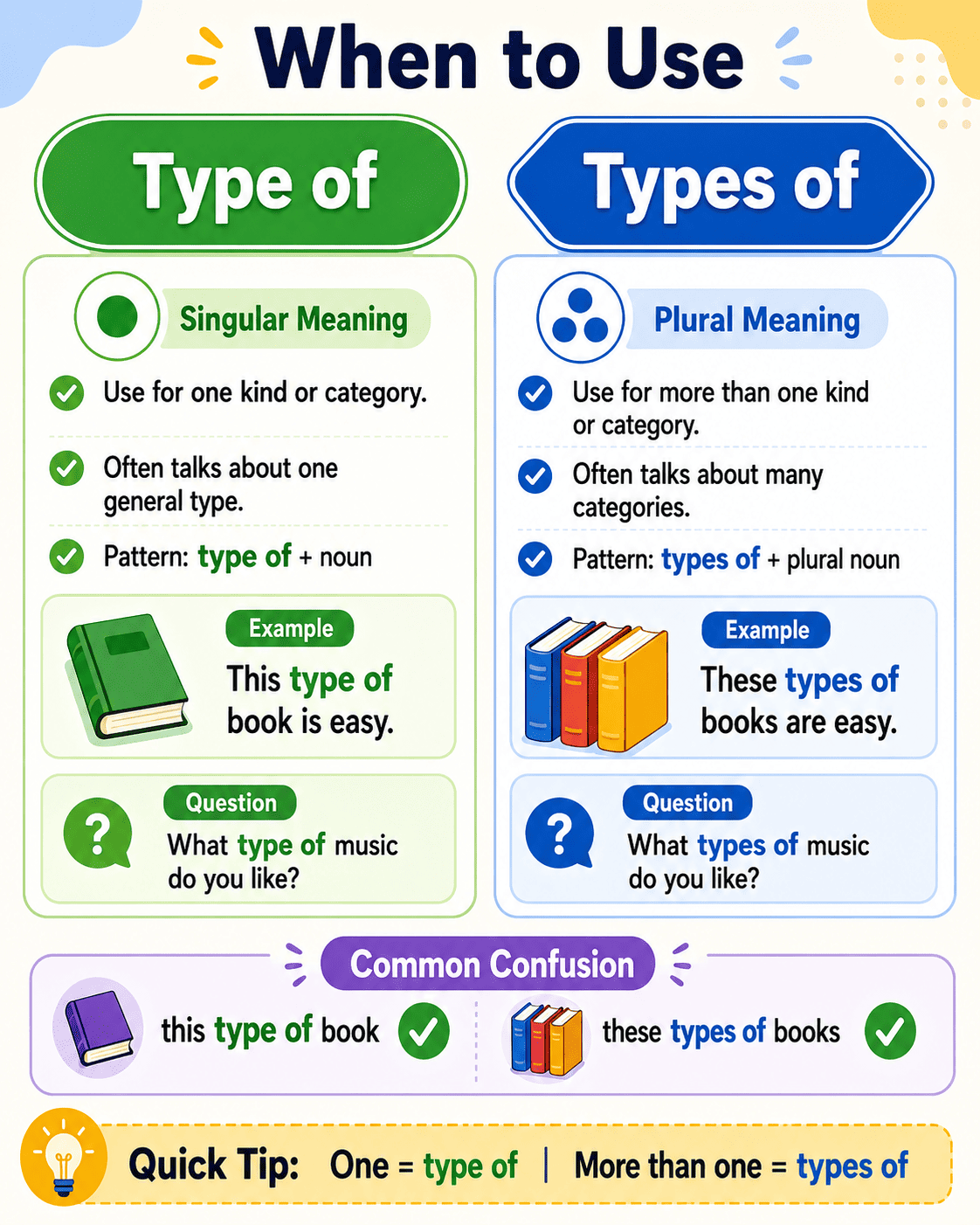
Most errors happen because the determiner, the word type, and the following noun do not agree. Checking whether you mean one category or several categories usually solves the problem.
1. Using “these type of”
Incorrect: These type of shoes are comfortable.
Correct: These types of shoes are comfortable.
These is plural, so it must modify the plural noun types.
2. Using “this types of”
Incorrect: This types of exercise improve strength.
Correct: This type of exercise improves strength.
This is singular and must be followed by type.
3. Using a singular countable noun after plural “types”
Less natural: We studied different types of animal.
Recommended: We studied different types of animals.
In modern everyday English, a plural countable noun is usually the clearest choice after types of.
4. Using a plural noun after “a type of”
Less natural: A tiger is a type of animals.
Correct: A tiger is a type of animal.
The phrase identifies one category within the larger group called animals.
5. Choosing the wrong verb
Incorrect: This type of mistake are common.
Correct: This type of mistake is common.
The singular subject type requires the singular verb is.
6. Using “different type” for multiple categories
Incorrect: The website offers different type of courses.
Correct: The website offers different types of courses.
The word different often signals that more than one category is being discussed.
Type of, Kind of, and Sort of
The nouns type, kind, and sort can all describe a category. In many sentences, they have similar meanings, although tone and usage may vary.
Expression | Typical use | Example |
|---|---|---|
type of | neutral and common in formal or technical classification | This is a type of metal. |
kind of | common in everyday speech | What kind of music do you like? |
sort of | common in informal British English | What sort of work does he do? |
These sentences have nearly the same meaning:
- What type of film is it?
- What kind of film is it?
- What sort of film is it?
Their plural forms work in the same way:
- different types of films
- different kinds of films
- different sorts of films
However, kind of and sort of can also mean “slightly” or “somewhat” in informal speech.
- I am kind of tired.
- The instructions were sort of confusing.
In those sentences, they do not refer to categories.
A Fast Way to Choose the Correct Form
You can choose between type of and types of by asking one question: “Am I talking about one category or more than one?”
Use this three-step check:
- Decide whether the meaning is singular or plural.
- Match the determiner with type or types.
- Check the noun and verb forms.
One category
- this type of book
- that type of music
- one type of machine
- what type of job
More than one category
- these types of books
- those types of music
- several types of machines
- what types of jobs
A useful memory pattern is:
This type is singular.
These types are plural.
Examples in Everyday Contexts
Seeing the phrases in complete situations makes their meanings easier to recognise. The following examples cover school, work, shopping, technology, and daily conversation.
At school
- What type of assignment did the teacher give you?
- We completed three types of assignments this week.
- This type of question appears in many examinations.
- These types of questions test reading skills.
At work
- What type of work do you do?
- The company offers different types of work.
- That type of meeting usually lasts an hour.
- Those types of meetings can be held online.
While shopping
- I am looking for a particular type of jacket.
- The store sells many types of jackets.
- This type of material feels soft.
- These types of materials are easy to wash.
When discussing technology
- What type of computer do you need?
- What types of computers does the company manufacture?
- This type of software is used for editing videos.
- Several types of software can perform that task.
When discussing food
- What type of food would you like?
- What types of food are served at the festival?
- This type of cheese has a mild flavour.
- The shop sells more than twenty types of cheese.
Mini Practice: Type of or Types of?
Choose the correct phrase in each sentence. Think about whether the sentence refers to one category or several.
- What ___ music helps you concentrate?
- The zoo protects several ___ endangered animals.
- This ___ question often confuses learners.
- What ___ books are available in the library?
- These ___ machines use very little electricity.
- A dolphin is a ___ mammal.
- That ___ behaviour is unacceptable.
- We discussed three ___ communication styles.
Answers
- type of
- types of
- type of
- types of
- types of
- type of
- type of
- types of
FAQs About Types of and Type of
“Type of” refers to one category, while “types of” refers to two or more categories, varieties, classes, forms, or groups.
In standard English, use “these types of things.” The plural determiner “these” must agree with the plural noun “types.”
Use “what type of” when expecting one general category. Use “what types of” when asking someone to identify several categories.
Yes. Phrases such as “what type of books” are grammatical when asking about one general category within a group of plural items.
Use “different types of” when discussing multiple categories. Use “a different type of” when referring to one alternative category.
The verb normally agrees with “type” or “types”: “This type is common,” but “These types are common.”
They often have similar meanings when classifying something. “Type” sounds neutral, while “kind” and “sort” are common in everyday conversation.
Yes. “Information” is uncountable, so it remains singular in form: “one type of information” and “several types of information.”
Conclusion
The difference between types of and type of becomes clear when you focus on number. Use type of for one category and types of for multiple categories.
Remember to match singular words such as this and that with type, and plural words such as these and those with types. Also check the following noun and verb: this type of problem is, but these types of problems are.
With this pattern in mind, you can use both expressions naturally and accurately in questions, descriptions, comparisons, and everyday conversations.
You May Also Like
