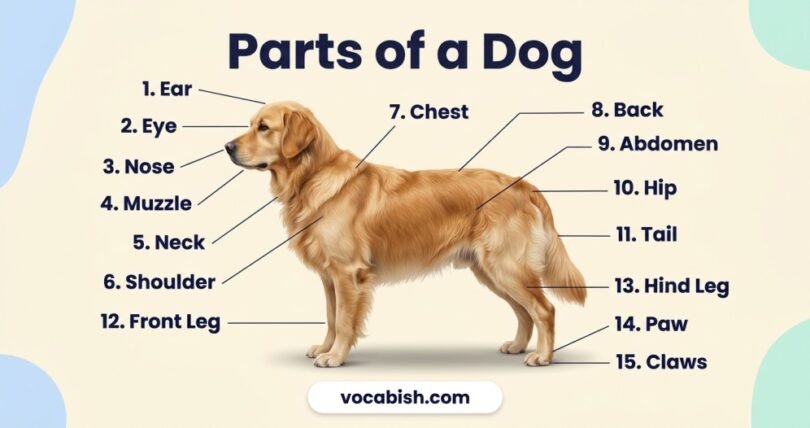

The parts of a dog include the head, ears, eyes, nose, muzzle, neck, chest, back, legs, paws, and tail. Each part has a specific function, such as helping the dog walk, run, eat, smell, hear, or maintain balance. A dog’s body also contains bones, muscles, joints, and internal organs that support movement and other vital activities.
Learning dog body parts in English helps students recognise different body structures and describe their functions correctly. This article covers external and internal dog anatomy, body part names with functions, and a labelled diagram to help you identify where each part is located.
Here’s a detail guide on different types of dogs and their names with images.
Parts of a Dog with Names and Functions
A dog’s body has several external parts that you can see and identify. Some parts help with movement, while others support hearing, smelling, eating, and balance.
The following table covers the main dog parts, their locations, and their functions.
Dog Part | Location | Function |
|---|---|---|
Head | Top of the neck | Holds the brain and major sense organs. |
Ears | Sides or top of the head | Detect sounds and help express emotions. |
Eyes | Front of the head | Provide vision and detect movement. |
Nose | Front of the muzzle | Detects smells and allows air to enter. |
Muzzle | Front of the face | Contains the nose, mouth, and jaws. |
Snout | Projecting part of the face | Houses the nose and mouth. |
Mouth | Below the nose | Takes in food and water. |
Lips | Around the mouth | Help contain food and saliva. |
Teeth | Inside the mouth | Bite, tear, and chew food. |
Tongue | Inside the mouth | Helps with tasting, drinking, and cooling. |
Gums | Around the teeth | Support and protect tooth roots. |
Whiskers | Around the muzzle and eyes | Sense nearby objects and contact. |
Cheeks | Sides of the face | Cover and support the sides of the mouth. |
Chin | Below the lower lip | Forms the front of the lower jaw. |
Jaw | Lower part of the head | Opens and closes the mouth for biting. |
Forehead | Above the eyes | Forms the upper front of the skull. |
Stop | Between forehead and muzzle | Marks the change in facial angle. |
Occiput | Back of the skull | Forms a bony area behind the head. |
Neck | Between head and shoulders | Supports and moves the head. |
Throat | Front of the neck | Contains passages for air and food. |
Shoulders | Upper front body | Connect the front legs to the trunk through muscles. |
Chest | Front of the torso | Protects the heart and lungs. |
Brisket | Lower part of the chest | Forms the underside of the chest. |
Withers | Top of the shoulders | Provide a reference point for measuring height. |
Back | Between shoulders and loin | Supports the body during movement. |
Loin | Between ribs and pelvis | Helps support and flex the lower back. |
Ribs | Around the chest | Protect the heart and lungs. |
Flank | Side between ribs and hip | Allows abdominal movement and flexibility. |
Abdomen | Under the torso | Contains major digestive organs. |
Belly | Lower abdominal surface | Covers the underside of the abdomen. |
Hip | Upper rear body | Connects the hind limbs to the pelvis. |
Croup | Upper rear back | Forms the area between loin and tail base. |
Rump | Rear upper body | Covers the hindquarters. |
Tail | Rear end of the body | Helps with balance and communication. |
Tail base | Where the tail begins | Connects the tail to the body. |
Forelegs | Front of the body | Support weight and control movement. |
Hind legs | Rear of the body | Provide propulsion during running and jumping. |
Elbows | Joints of the front legs | Allow the forelegs to bend. |
Wrists (carpi) | Above the front paws | Allow movement of the lower forelegs. |
Thighs | Upper hind legs | Provide power for movement. |
Stifles | Knee joints of hind legs | Allow the hind legs to bend and straighten. |
Hocks | Lower hind-leg joints | Help propel the dog forward. |
Paws | Ends of all four legs | Support walking, running, and gripping. |
Toes (digits) | Ends of the paws | Help with balance and movement. |
Claws | Tips of the toes | Provide traction and assist with digging. |
Paw pads | Undersides of the paws | Cushion steps and improve grip. |
Dewclaws | Inner side of some legs | May help grip objects and provide traction. |
Coat | Outer body covering | Helps protect skin and regulate temperature. |
Skin | Covers the body | Protects internal tissues and senses touch. |
Mammary glands | Along the underside | Produce milk in nursing females. |
Anus | Beneath the tail | Releases solid waste from the body. |
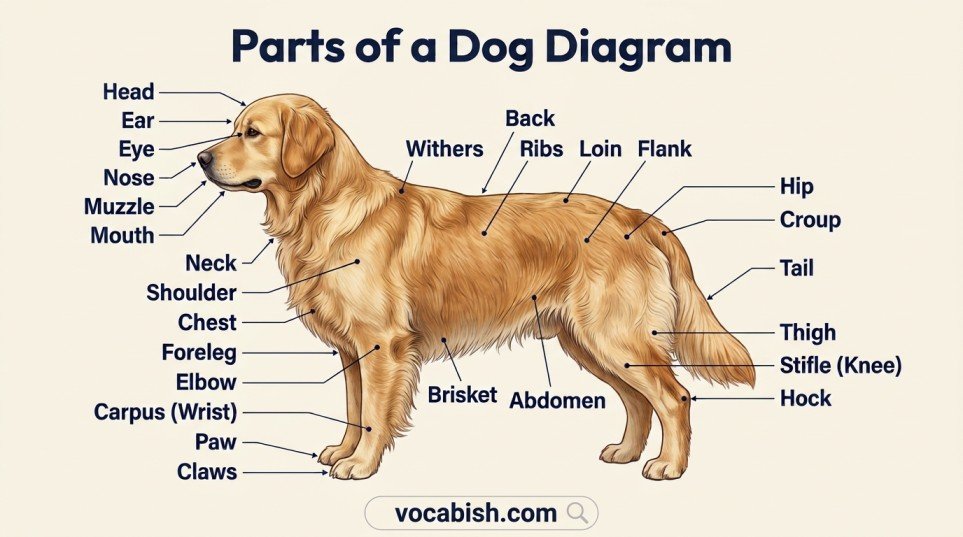
Parts of a Dog Diagram
A labelled dog diagram shows where different body parts are located. It helps English learners connect anatomical names with the correct areas of a dog’s body.
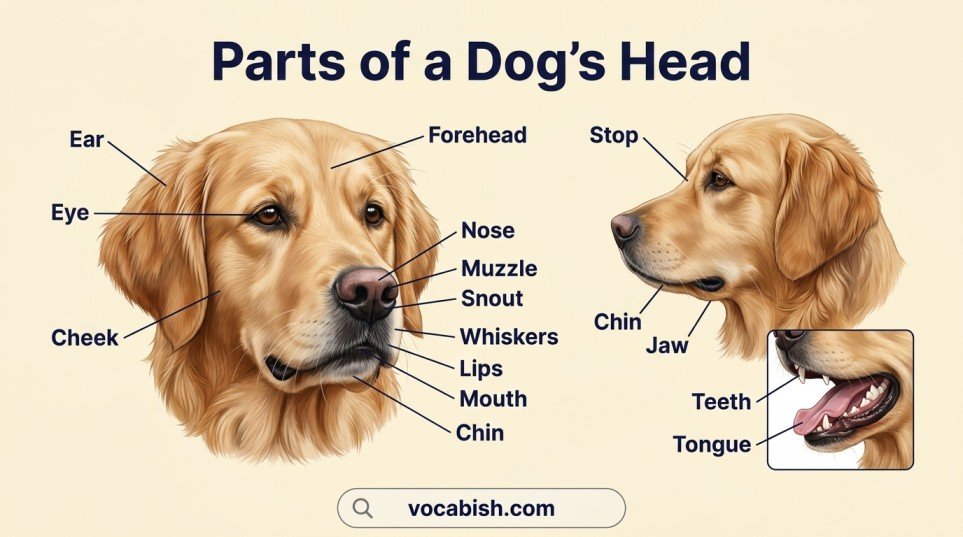
Parts of a Dog’s Head
The head contains several important sensory organs. Dogs use their eyes, ears, and nose to observe their surroundings, while their jaws, teeth, and tongue help them eat and drink.
These are the main parts of a dog’s head and their functions.
Head Part | Function | Example |
|---|---|---|
Ears | Detect sounds | A dog raises its ears when alert. |
Eyes | Detect light and movement | The dog watches a moving ball. |
Nose | Identifies different smells | The dog sniffs the ground. |
Muzzle | Contains the mouth and nose | Some dogs have short muzzles. |
Teeth | Bite and chew | The dog chews its food. |
Tongue | Helps with drinking and cooling | The dog pants with its tongue out. |
Whiskers | Detect nearby contact | Whiskers touch nearby objects. |
Jaw | Controls biting movements | The dog opens its jaw to yawn. |
Forehead | Forms the upper facial region | The dog’s forehead is broad. |
Cheeks | Cover the sides of the mouth | The dog’s cheeks are covered with fur. |
Types of Dog Teeth
Adult dogs normally have 42 permanent teeth. These teeth perform different jobs when a dog eats.
Tooth Type | Number in Adult Dogs | Function |
|---|---|---|
Incisors | 12 | Nip and scrape small pieces of food. |
Canines | 4 | Grip, puncture, and tear food. |
Premolars | 16 | Cut and crush food. |
Molars | 10 | Crush and grind food. |
Puppies normally develop 28 temporary teeth before their permanent teeth grow.
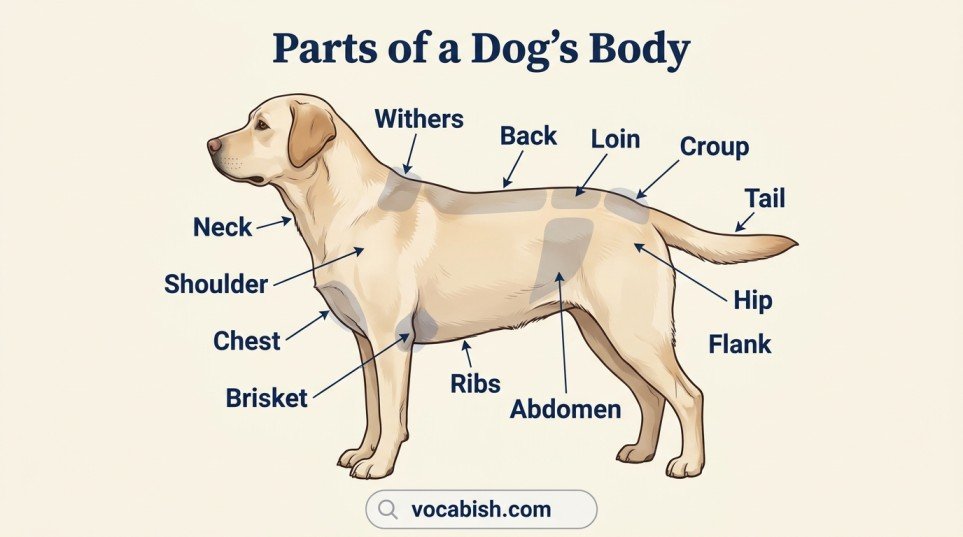
Parts of a Dog’s Body
The main body, also called the trunk or torso, contains the chest, back, abdomen, and hips. These areas support the skeleton, protect organs, and help the dog maintain its posture.
Understanding these names makes it easier to describe a dog’s shape and physical condition.
Body Part | Description |
|---|---|
Neck | Connects the head to the trunk. |
Withers | Highest area over the shoulder blades in a standing dog. |
Chest | Contains the heart, lungs, and rib cage. |
Brisket | Lower chest region between the front legs. |
Back | Upper body region behind the shoulders. |
Loin | Muscular lower-back region behind the ribs. |
Abdomen | Body cavity containing digestive and other organs. |
Flank | Side region between the last rib and hip. |
Croup | Upper rear region leading toward the tail. |
Hip | Region where the hind limb connects to the pelvis. |
Tail | Flexible extension of the spine used in movement and signalling. |
Why Do Dogs Have Tails?
A dog’s tail helps with balance during movement and provides signals during communication. Tail position and movement may express excitement, uncertainty, or fear.
However, tail wagging does not always mean happiness. A dog’s overall posture and facial expression help explain its behaviour.
Parts of a Dog’s Legs and Paws
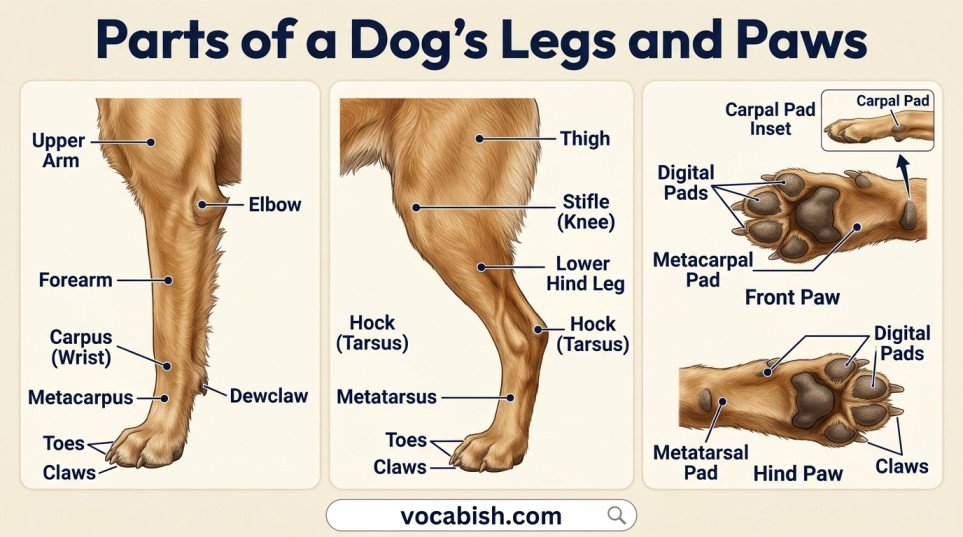
Dogs have four legs: two forelegs and two hind legs. The front legs mainly support and guide the body, while the hind legs generate much of the power needed for running and jumping.
Their paws contain toes, claws, and specialised pads that help them move across different surfaces.
Leg or Paw Part | Function |
|---|---|
Upper arm | Connects the shoulder to the elbow. |
Elbow | Allows bending of the front leg. |
Forearm | Connects the elbow to the wrist. |
Carpus | Forms the wrist joint of the front leg. |
Metacarpus | Supports the area between wrist and front toes. |
Thigh | Contains muscles that power the hind leg. |
Stifle | Functions as the dog’s knee joint. |
Lower hind leg | Connects the stifle to the hock. |
Hock | Functions similarly to the human ankle. |
Metatarsus | Supports the area between hock and hind toes. |
Toes | Help distribute weight and maintain balance. |
Claws | Improve traction and assist with digging. |
Digital pads | Cushion the individual toes. |
Metacarpal pad | Cushions the main weight-bearing area of a front paw. |
Metatarsal pad | Cushions the main weight-bearing area of a hind paw. |
Carpal pad | Helps provide traction during braking and movement. |
Dewclaw | May assist with gripping and stability. |
Front Paws vs. Hind Paws
Front and hind paws share many features, but their roles differ.
Front Paws | Hind Paws |
|---|---|
Carry more of the dog’s standing body weight. | Help generate forward propulsion. |
Help with steering and braking. | Support acceleration and jumping. |
Usually have five digits, including a dewclaw. | Usually have four main digits, sometimes with dewclaws. |
Include a carpal pad above the main paw pads. | Do not normally have a carpal pad. |
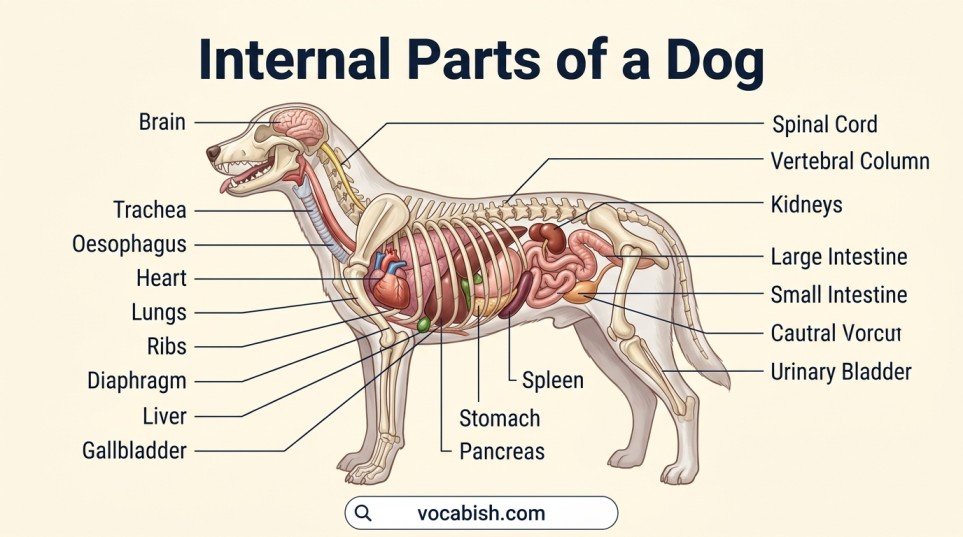
Internal Parts of a Dog
A dog’s internal anatomy includes organs that support breathing, digestion, circulation, movement, and reproduction. These organs work together to keep the animal alive and active.
The following table identifies important internal dog parts and their functions.
Internal Part | Function |
|---|---|
Brain | Controls movement, senses, behaviour, and body functions. |
Heart | Pumps blood throughout the body. |
Lungs | Exchange oxygen and carbon dioxide during breathing. |
Trachea | Carries air toward the lungs. |
Oesophagus | Moves swallowed food to the stomach. |
Stomach | Stores food and begins chemical digestion. |
Small intestine | Digests food and absorbs most nutrients. |
Large intestine | Absorbs water and forms faeces. |
Liver | Processes nutrients and produces bile. |
Gallbladder | Stores and releases bile. |
Pancreas | Produces digestive enzymes and blood-sugar hormones. |
Spleen | Filters blood and supports immune functions. |
Kidneys | Filter blood and produce urine. |
Urinary bladder | Stores urine before urination. |
Spinal cord | Carries nerve signals between brain and body. |
Vertebral column | Supports the body and protects the spinal cord. |
Ribs | Protect organs inside the chest. |
Diaphragm | Helps the lungs expand during breathing. |
Muscles | Produce movement and maintain posture. |
Joints | Allow movement between connected bones. |
Dog Body Parts and Their Functions
Different parts of a dog’s body work together during everyday activities. Walking, eating, breathing, and detecting sounds all involve several structures rather than one body part.
This table connects common dog activities with the parts responsible for them.
Activity | Main Body Parts | How They Help |
|---|---|---|
Smelling | Nose and olfactory receptors | Detect and identify scents. |
Hearing | Ears and auditory nerves | Receive and process sounds. |
Seeing | Eyes and optic nerves | Detect light, shapes, and movement. |
Eating | Teeth, jaws, and tongue | Bite, chew, and move food. |
Drinking | Tongue and mouth | Lap water and swallow it. |
Running | Legs, muscles, and joints | Produce coordinated movement. |
Jumping | Hind legs and hip muscles | Generate upward force. |
Balancing | Tail, muscles, and inner ears | Help maintain body position. |
Cooling | Respiratory system and tongue | Support heat loss through panting. |
Digestion | Stomach and intestines | Break down food and absorb nutrients. |
Breathing | Nose, trachea, lungs, and diaphragm | Move air and exchange gases. |
Communication | Tail, ears, eyes, and body posture | Express signals through movement and position. |
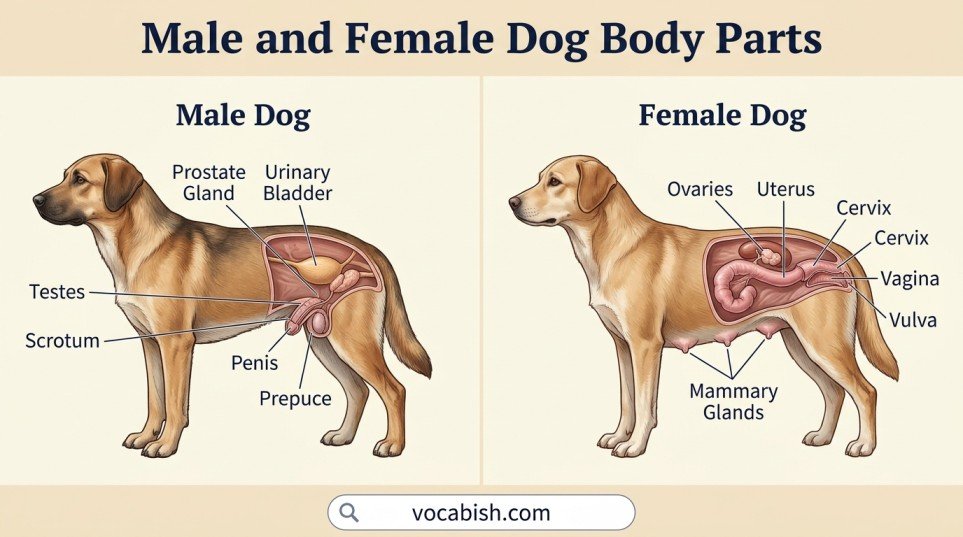
Male and Female Dog Body Parts
Male and female dogs share the same main external anatomy, including the head, legs, paws, chest, and tail. Their reproductive organs differ because they perform different biological functions.
Male Dog Part | Female Dog Part | Function |
|---|---|---|
Testes | Ovaries | Produce reproductive cells and hormones. |
Scrotum | Vulva | Scrotum holds the testes; vulva forms the external genital opening. |
Penis | Vagina | Penis delivers semen; vagina forms part of the reproductive tract. |
Prostate gland | Uterus | Prostate contributes fluid to semen; uterus supports pregnancy. |
Prepuce | Cervix | Prepuce covers the penis; cervix connects the vagina and uterus. |
Both male and female dogs have nipples and mammary tissue. Female dogs usually develop functional milk-producing mammary glands during nursing.
Common Dog Anatomy Terms
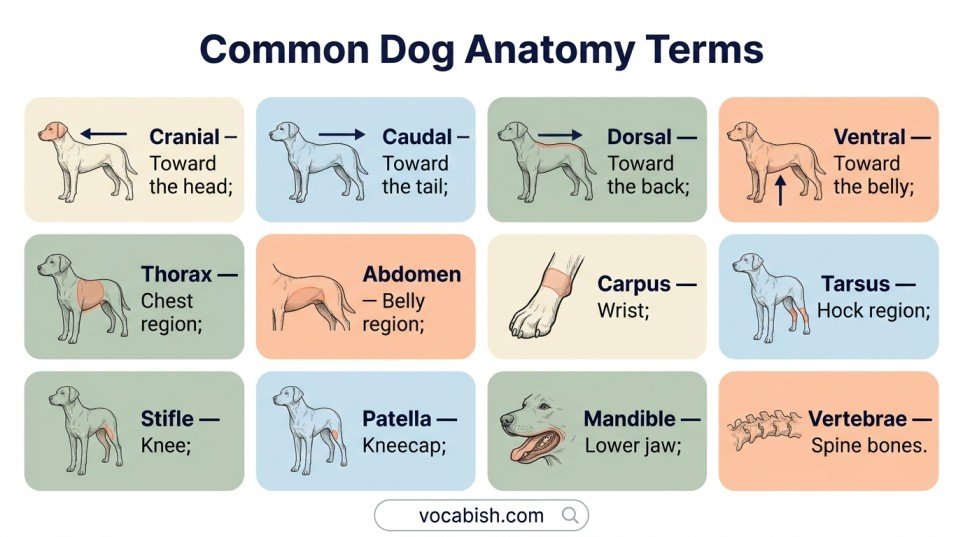
Some anatomical words are different from everyday English. Learning them helps students understand veterinary descriptions, animal science lessons, and dog body diagrams.
Anatomical Term | Everyday Meaning | Example |
|---|---|---|
Canine | Related to dogs | Canine anatomy describes a dog’s body. |
Cranial | Toward the head | The chest is cranial to the abdomen. |
Caudal | Toward the tail | The tail is caudal to the hips. |
Dorsal | Toward the back or upper surface | The spine lies along the dorsal body region. |
Ventral | Toward the belly or underside | The abdomen has a ventral surface. |
Thorax | Chest region | The thorax contains the lungs. |
Abdomen | Belly region | The stomach lies inside the abdomen. |
Carpus | Wrist | The carpus is above the front paw. |
Tarsus | Hock or ankle region | The tarsus is part of the hind limb. |
Stifle | Knee | The stifle bends during walking. |
Patella | Kneecap | The patella is part of the stifle joint. |
Mandible | Lower jaw | The mandible holds the lower teeth. |
Maxilla | Upper jaw bone | The maxilla supports upper teeth. |
Phalanges | Toe bones | Phalanges form the digits. |
Vertebrae | Bones of the spine | Vertebrae protect the spinal cord. |
Common Mistakes in Dog Body Part Names
Several dog anatomy terms are easy to confuse because they describe nearby areas or resemble human body parts.
- Muzzle vs. nose: The muzzle includes the nose and mouth region; the nose is one part of it.
- Hock vs. knee: The hock resembles an ankle, while the stifle is the knee.
- Paw vs. pad: A paw is the entire foot; a pad is a cushioning structure underneath.
- Fur vs. skin: Fur covers the body, while skin forms the protective tissue beneath it.
- Claw vs. toe: A claw grows from the end of a toe; they are not the same structure.
Frequently Asked Questions
The main parts include the head, neck, chest, back, abdomen, legs, paws, and tail. Each supports movement, protection, or sensory functions.
A dog’s face includes the eyes, ears, nose, muzzle, cheeks, lips, mouth, and whiskers. These structures support sensing, eating, and communication.
A dog’s knee is called the stifle. It is located on the hind leg and contains the patella, which is the kneecap.
A dog’s paw contains toes, claws, digital pads, and a main weight-bearing pad. Front paws also have a carpal pad.
The elbow is a front-leg joint, while the hock is a hind-leg joint. Both help dogs move, but their structures differ.
An adult dog typically has around 319 bones. The exact number can vary because tail length and anatomical differences affect the total.
Major internal organs include the brain, heart, lungs, liver, stomach, intestines, kidneys, spleen, and pancreas. They support vital body functions.
The inner ears, muscles, joints, eyes, and nervous system help maintain balance. The tail can also assist during turns and rapid movement.
Conclusion
Learning the parts of a dog helps English learners identify body structures and describe how they work. From the ears and muzzle to the legs, paws, and internal organs, each part has a particular role. A labelled dog anatomy diagram, along with the names and functions in these tables, can help students recognise these parts and use the correct English vocabulary.