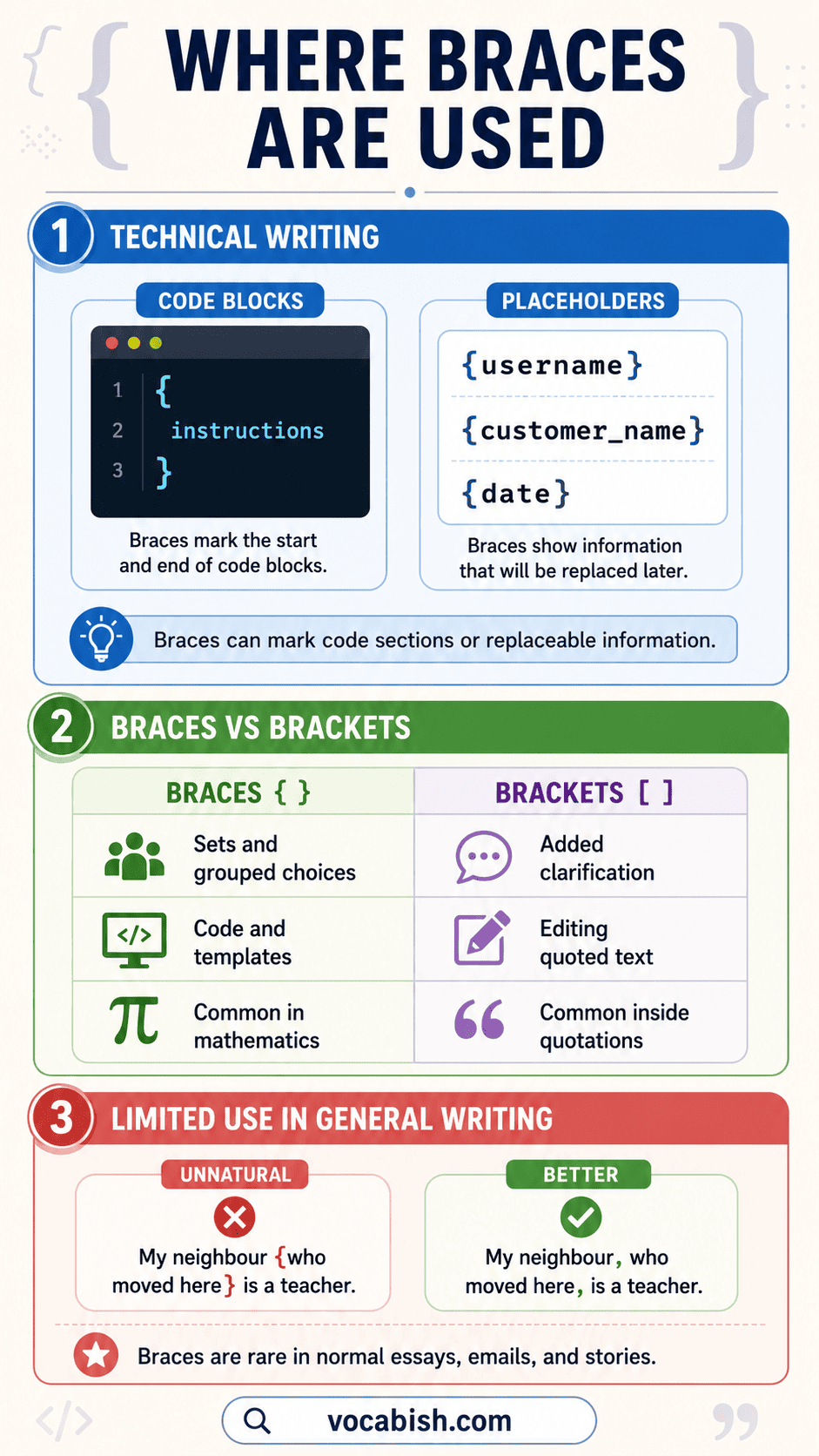
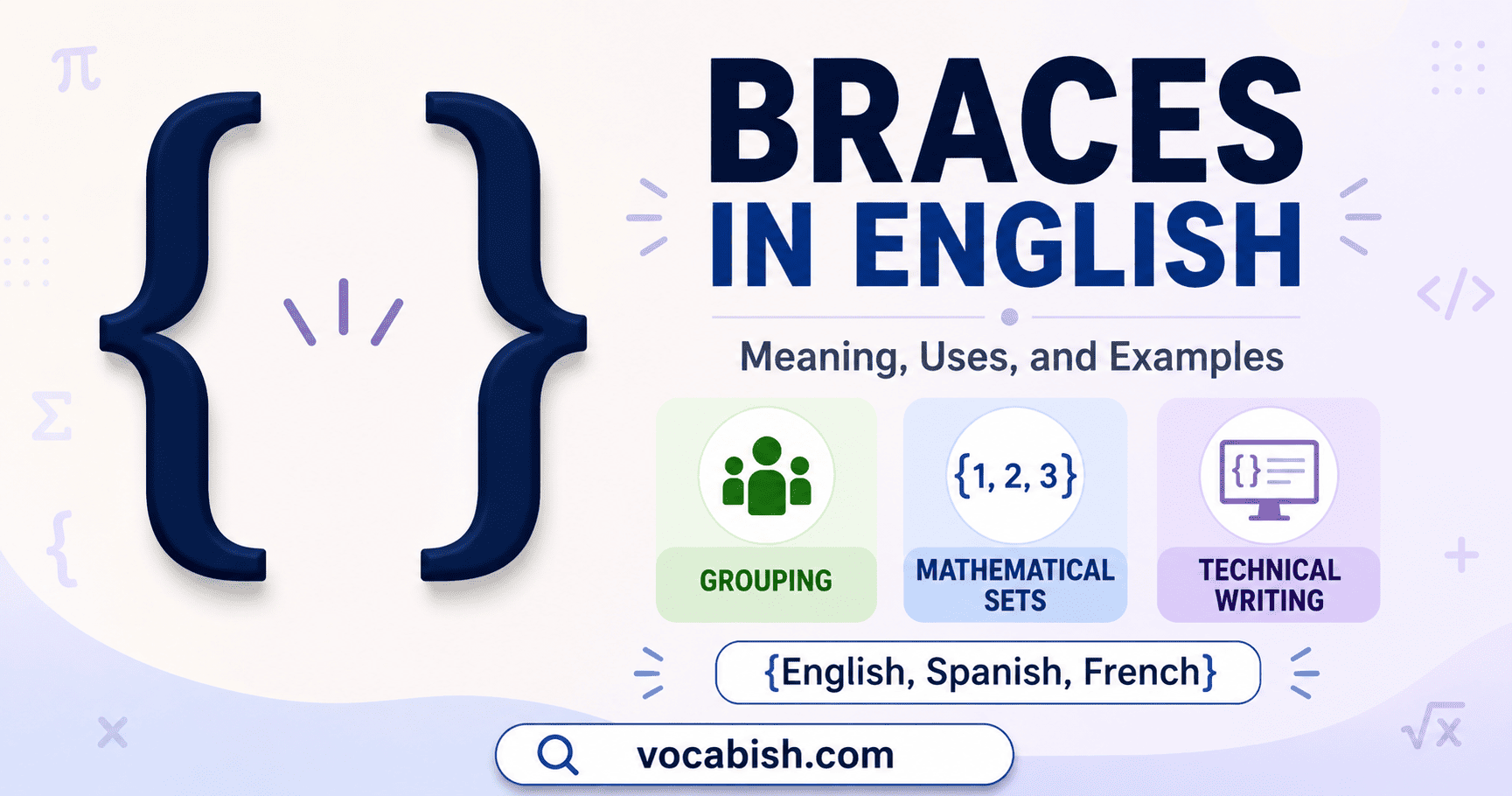

Braces punctuation marks look like this: { }. They are mainly used to group related items, represent mathematical sets, and organise information in technical writing.
Unlike commas, parentheses, and quotation marks, braces rarely appear in ordinary sentences. You are more likely to see them in mathematics, computer programming, scientific notation, forms, and specialised instructions.
What Are Braces?
Braces are a pair of curved symbols:
- Opening brace: {
- Closing brace: }
- Complete pair: { }
They are also commonly called curly brackets, especially in computing and everyday conversation.
Braces show that the information placed inside them belongs together. Their exact purpose depends on the subject or context.
Example:
Select one language: {English, Spanish, French}
The braces group the available choices as one related set.
Braces normally appear as a pair. An opening brace introduces the grouped information, while a closing brace marks its end.
Grouping Related Items
Braces can place connected words, values, or options into one visible group.
They may be used for:
- Listing available choices
- Grouping related values
- Presenting alternative forms
- Showing items belonging to the same category
- Combining several expressions under one condition
Examples:
- Available sizes: {small, medium, large}
- Select a response: {yes, no}
- Accepted formats: {PDF, DOCX, TXT}
- Choose a pronoun: {he, she, they}
In these examples, the braces indicate that every item inside them belongs to the same selection or category.
This style is useful in forms, worksheets, instructions, and technical documents. In normal prose, however, a bulleted list usually looks clearer.
Braces in Mathematics
Braces are widely used in mathematics. One of their main functions is showing a set, which is a collection of distinct numbers, objects, or values.
Examples:
- {1, 2, 3, 4}
- {red, blue, green}
- {x, y, z}
The first example represents a set containing four numbers. The second contains three colours, while the third contains three variables.
Braces may also show a set defined by a rule:
{x | x is an even number}
This means “the set of all values of x that are even numbers.”
Other mathematical uses include:
- Grouping equations in a system
- Showing possible solutions
- Defining functions
- Representing empty sets
- Organising nested calculations
Examples:
- Possible answers: {2, 4, 6}
- Empty set: { }
- Solution set: {x = 3, y = 5}
Braces should not be confused with parentheses in calculations. Parentheses often control the order of operations, while braces commonly represent sets or larger grouped systems.
Braces in Technical Writing
Braces are common in computer programming, coding instructions, templates, and technical notation.
In many programming languages, they mark the beginning and end of a block of code.
if (age >= 18) {
    displayMessage();
}
The opening brace begins the instructions connected to the condition. The closing brace ends that section.
Braces may be used in technical writing to show:
- Code blocks
- Functions and commands
- Objects and data structures
- Replaceable information
- Variables in templates
- Alternative values
- Configuration settings
Template example:
Dear {customer_name}, your order has been dispatched.
Here, {customer_name} is a placeholder. It will later be replaced with the customer’s actual name.
Instruction example:
Enter the date in this format: {day}/{month}/{year}
The braces identify information that the user must provide.
The meaning of braces can change between programming languages and technical systems. Writers should therefore follow the rules of the specific software, language, or style guide they are using.
Braces vs Brackets
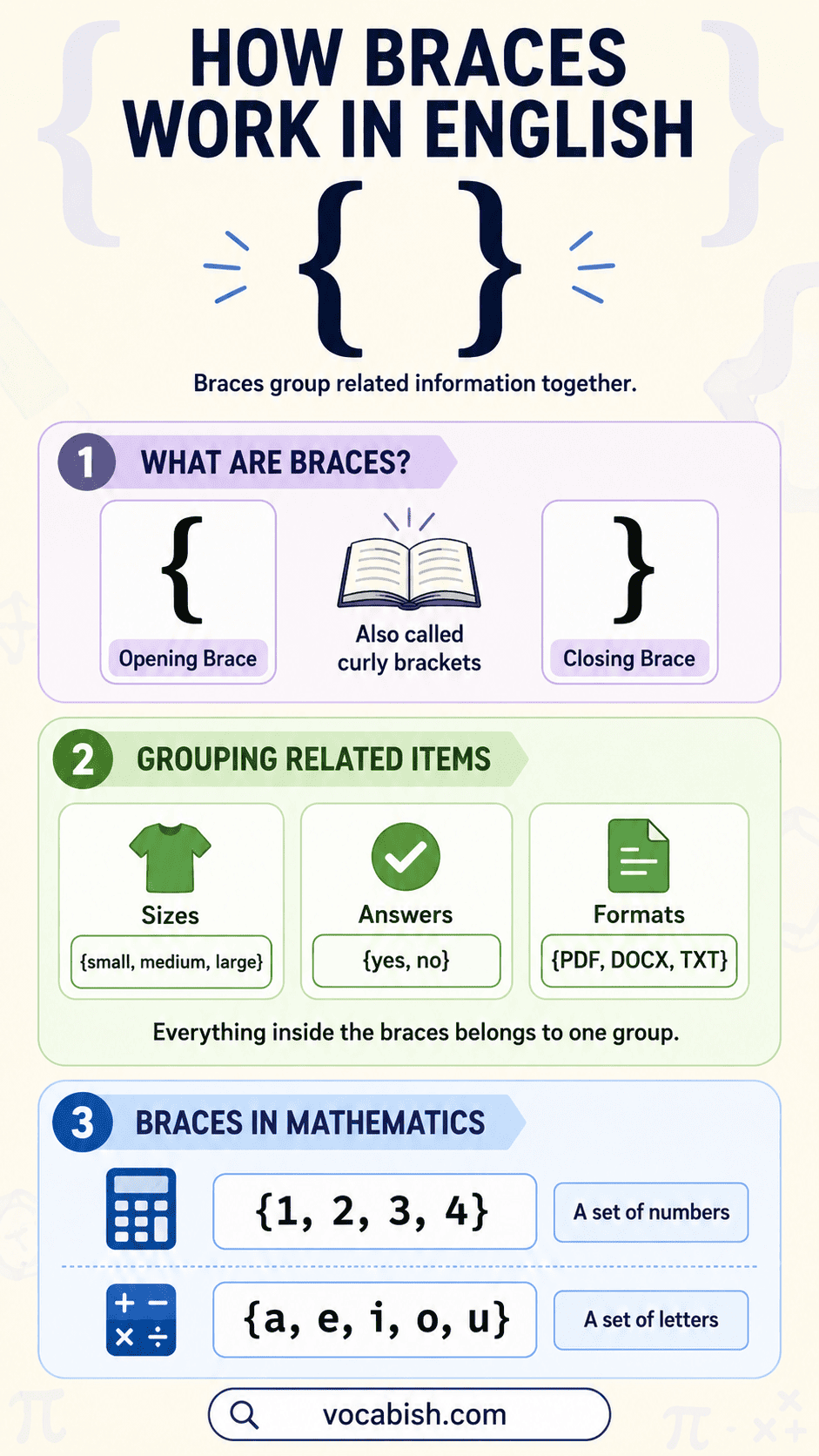
Brackets and braces are different punctuation marks. Their names are sometimes confused because braces are also called curly brackets.
Feature | Braces | Square Brackets |
|---|---|---|
Symbol | { } | [ ] |
Common name | Curly brackets | Square brackets |
Main use | Sets, code blocks, grouped choices | Added information, corrections, editorial comments |
Common in ordinary prose | Rarely | Occasionally |
Common in mathematics | Yes | Yes |
Common in programming | Very common | Very common |
Example | {1, 2, 3} | She said, “[The meeting] begins at nine.” |
Square brackets often add information inside quoted material:
“They arrived [in Lahore] before sunset.”
Braces would not be correct in this sentence because the added words are an editorial explanation, not a mathematical or technical group.
Limited Use of Braces Punctuation in General Writing
Braces have a very limited role in essays, emails, stories, and everyday sentences.
Avoid using braces for:
- Additional comments
- Side explanations
- Non-essential information
- References and citations
- Ordinary examples
- Parenthetical remarks
Unnatural:
My neighbour {who recently moved here} is a teacher.
Better:
My neighbour, who recently moved here, is a teacher.
Also correct:
My neighbour (who recently moved here) is a teacher.
Use braces in general writing only when you need to show a clear set of choices or follow a required technical format.
Acceptable in a form:
Preferred contact method: {email, phone, text message}
Less natural in a paragraph:
You can contact us by {email, phone, text message}.
A normal sentence would sound smoother:
You can contact us by email, phone, or text message.