
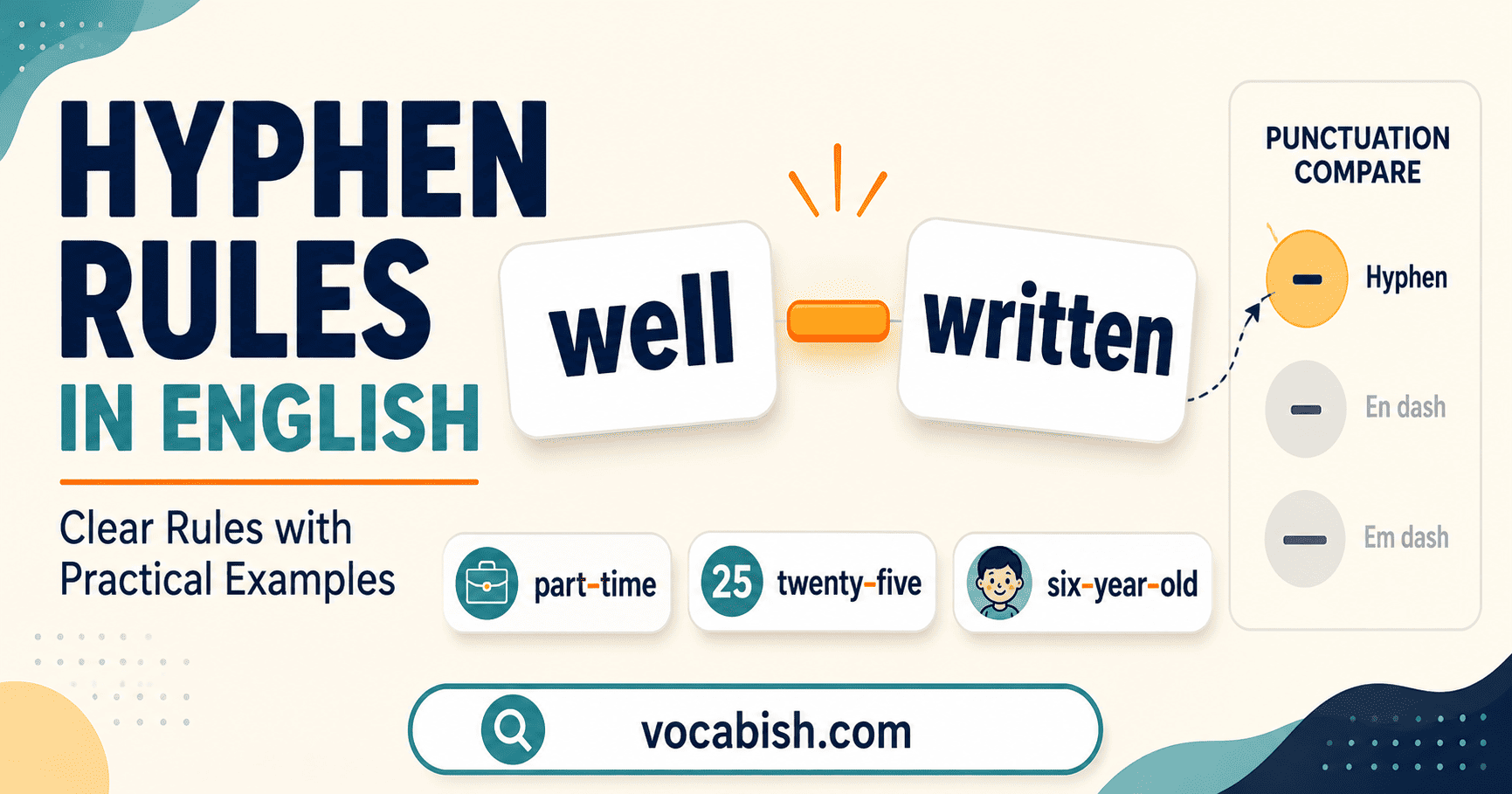

A hyphen (-) is a short punctuation mark that joins words or parts of words. It helps readers see that separate words are connected and should be understood as one unit.
Compare:
- a man-eating shark — a shark that eats people
- a man eating shark — a man who is eating shark meat
The small mark changes the relationship between the words. However, not every compound needs one. Some compounds are written as one word, some remain open, and others are hyphenated.
Hyphens in Compound Words
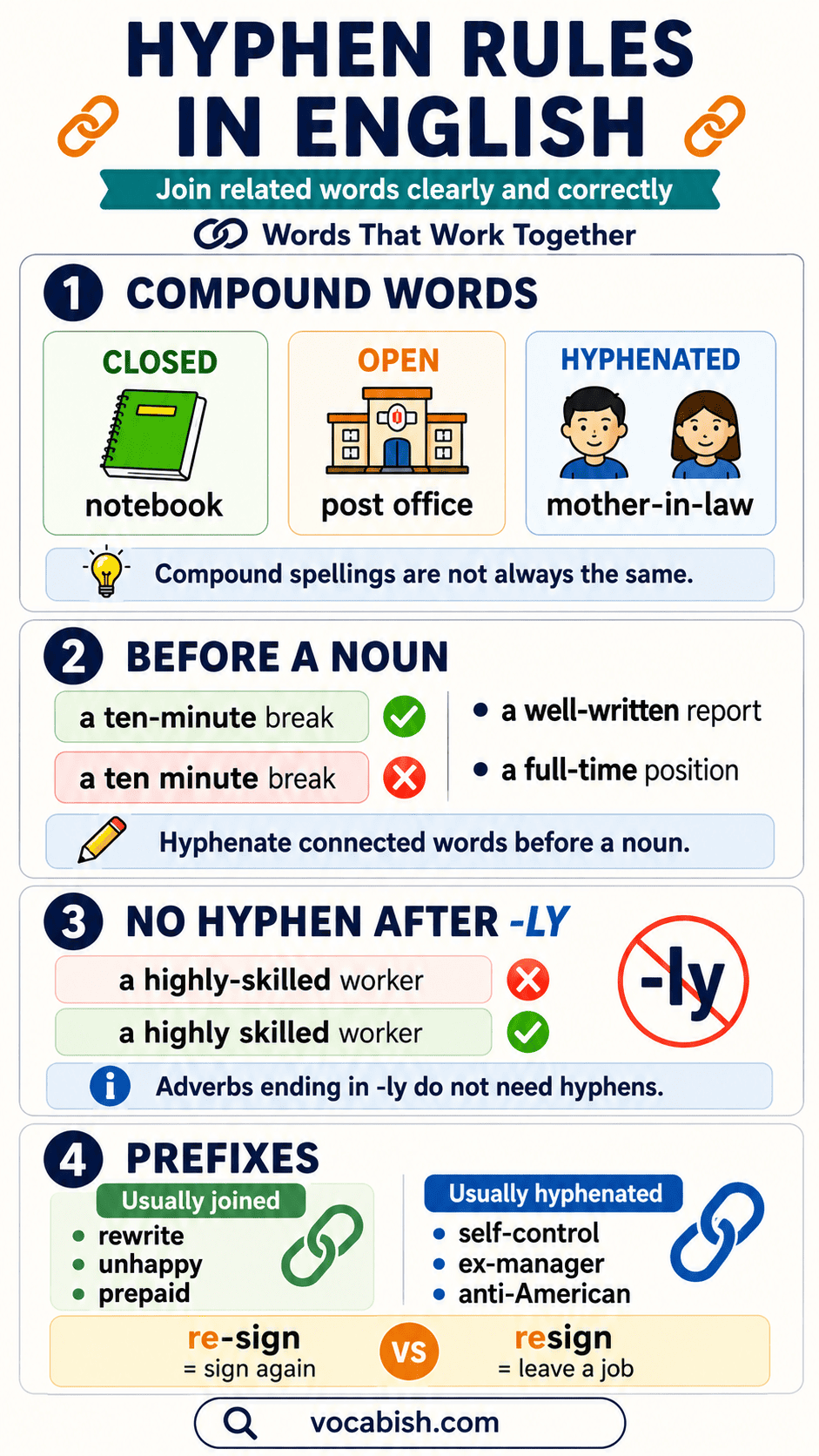
A compound word combines two or more words to express one idea. Compound words have three common forms:
Form | Description | Examples |
|---|---|---|
Closed compound | Written as one word | bedroom, notebook, sunlight |
Open compound | Written as separate words | post office, high school, living room |
Hyphenated compound | Joined with a hyphen | mother-in-law, check-in, runner-up |
There is no single rule that predicts the form of every compound. The accepted spelling often develops through common usage.
For example:
- email was once commonly written as e-mail
- online was previously seen as on-line
- website was once frequently written as web site
Use a current dictionary when you are uncertain about an established compound.
Some compounds change form according to their grammatical function:
Noun | Verb |
|---|---|
Please complete the check-in. | Please check in at reception. |
The company announced a takeover. | Another company may take over the business. |
We ordered takeout. | We decided to take out some food. |
She attended the follow-up. | The doctor will follow up tomorrow. |
The hyphenated or closed form is often a noun, while the open form is usually a verb.
Compound Adjectives before Nouns
A compound adjective contains two or more words that work together to describe a noun. When it appears before the noun, it is usually hyphenated.
- a ten-minute conversation
- a full-time position
- a well-written report
- a high-speed train
- a last-minute decision
- an easy-to-follow guide
- a four-bedroom house
- a world-famous athlete
The hyphen shows that the words belong together:
- a small-business owner
The person owns a small business.
Without the hyphen, the reader may initially think that small describes the owner.
Before the noun and after the noun
Many compound adjectives lose their hyphens when they come after the noun.
Before the noun | After the noun |
|---|---|
She is a well-known singer. | The singer is well known. |
We booked a five-star hotel. | The hotel has five stars. |
He has a full-time job. | He works full time. |
It was a last-minute change. | The change was made at the last minute. |
They live in a two-storey house. | Their house has two storeys. |
Some established compound adjectives remain hyphenated after the noun. Check a dictionary when the expression has a recognised spelling.
Do not hyphenate an adverb ending in -ly
An adverb ending in -ly clearly modifies the adjective that follows it, so a hyphen is unnecessary.
Correct:
- a highly skilled worker
- a carefully planned event
- a recently published article
- a beautifully decorated room
- a widely recognised problem
Incorrect:
- a highly-skilled worker
- a carefully-planned event
- a recently-published article
An adverb that does not end in -ly may need a hyphen:
- a well-prepared student
- a fast-moving vehicle
- a much-needed break
- a best-selling novel
Do not hyphenate proper-name modifiers unnecessarily
A proper name already forms a recognisable unit.
- a New York restaurant
- a Shakespeare play
- a United Nations meeting
A hyphen may still appear when the proper name becomes part of a longer compound:
- a New York-based company
- a Shakespeare-inspired drama
- a United Nations-supported programme
Hyphens with Prefixes
A prefix is added to the beginning of a word, such as un-, re-, pre-, non-, or anti-.
Most prefixes join directly to the base word:
- unhappy
- rewrite
- prepaid
- inactive
- misunderstand
- international
- semicircle
- overcrowded
Use a hyphen in the following situations.
With self-, ex-, and all-
These prefixes commonly take hyphens:
- self-control
- self-employed
- self-confidence
- ex-manager
- ex-wife
- ex-president
- all-inclusive
- all-knowing
- all-purpose
Do not confuse ex-, meaning “former,” with words that naturally begin with ex:
- ex-teacher — a former teacher
- extend — not a prefixed form
- explain — not a prefixed form
Before a capital letter or proper noun
Use a hyphen when a prefix is attached to a proper noun, capitalised word, or abbreviation.
- anti-American
- non-European
- pre-Roman
- post-Victorian
- pro-democracy
- non-English-speaking
- mid-July
- non-EU countries
To prevent confusion
A hyphen can separate forms that would otherwise look confusing or create another word.
With a hyphen | Meaning | Without a hyphen | Meaning |
|---|---|---|---|
re-sign | sign again | resign | leave a position |
re-cover | cover again | recover | return to health |
re-creation | creating again | recreation | leisure activity |
co-owner | joint owner | — | — |
re-enter | enter again | — | — |
Modern dictionaries sometimes accept closed forms such as reenter or cooperate. British and American spelling preferences may also differ, so consistency matters.
When the prefix ends and the base begins with the same vowel
A hyphen may improve readability:
- anti-inflammatory
- semi-independent
- pre-existing
- re-elect
- co-operate
Some of these words also have accepted closed spellings, such as preexisting or cooperate. Follow the spelling used by your dictionary or publication.
Hyphens in Numbers and Ages
Compound numbers from twenty-one to ninety-nine
Hyphenate written compound numbers between twenty-one and ninety-nine.
- twenty-one
- thirty-six
- forty-five
- seventy-eight
- ninety-nine
The rule also applies when the number forms part of a larger number:
- one hundred and twenty-five
- three hundred and sixty-two
- one thousand nine hundred and forty-seven
Only the compound number below one hundred is hyphenated.
Fractions written in words
Written fractions are commonly hyphenated when they function as nouns or modifiers.
- two-thirds of the class
- a one-half share
- a three-quarter majority
- four-fifths of the building
- a two-thirds reduction
Do not add a hyphen when the fraction is introduced by a and used as a simple noun phrase:
- half an hour
- a quarter of the cake
Ages used before nouns
Hyphenate an age when it describes a noun.
- a five-year-old child
- a twelve-year-old student
- a two-month-old puppy
- an eighty-year-old building
Notice that year and month remain singular inside the compound adjective.
Incorrect:
- a five-years-old child
- a two-months-old puppy
Correct:
- a five-year-old child
- a two-month-old puppy
Ages used as nouns
A hyphenated age expression can also identify a person or animal.
- The competition is open to six-year-olds.
- A twenty-year-old answered the door.
- The class includes several fourteen-year-olds.
The plural ending is added to old, not to year.
Ages after nouns
Do not use hyphens when the age comes after the noun.
Before a noun | After a noun |
|---|---|
a seven-year-old girl | The girl is seven years old. |
a three-week-old baby | The baby is three weeks old. |
a fifty-year-old bridge | The bridge is fifty years old. |
a six-month-old kitten | The kitten is six months old. |
Hyphenated Nouns
Some compound nouns have established hyphenated spellings.
Common examples include:
- mother-in-law
- father-in-law
- sister-in-law
- brother-in-law
- passer-by
- runner-up
- editor-in-chief
- merry-go-round
- self-esteem
- check-in
- dry-cleaning
- X-ray
Forming plurals
In many multiword compounds, the main noun becomes plural.
Singular | Plural |
|---|---|
mother-in-law | mothers-in-law |
father-in-law | fathers-in-law |
passer-by | passers-by |
runner-up | runners-up |
editor-in-chief | editors-in-chief |
Other hyphenated nouns take the plural ending at the end:
- check-ins
- X-rays
- drive-throughs
- grown-ups
Use a dictionary if the main word is not obvious.
Noun and verb differences
Some expressions are hyphenated as nouns but written separately as verbs.
- We had a short get-together.
- Let us get together on Friday.
- The system requires a log-in.
- You must log in first.
- The police began a follow-up.
- They will follow up on the report.
Usage varies for newer terms. For example, many dictionaries now prefer login as one word when it is a noun or adjective.